
The reload bonus offer aimed at Australians — and the licence it never carries
A reload bonus is the second pitch, not the first. The welcome offer is calibrated to convert a new account; the reload is calibrated to keep a returning one depositing. Australian readers searching the term are already past the sign-up screen, weighing the offer against the deposit they have already made or the next one they are considering. None of the offshore operators marketing a reload to them hold an Australian licence for the product they are selling, because online casino games and online pokies cannot be licensed anywhere in Australia under any state or territory regime. What follows is what those offers actually demand from a player, what the Australian legal frame around them looks like, and which operators the ACMA has already had to formally address.

Data current as of 30 October 2026; licence status and blocking figures cross-checked against the Australian Communications and Media Authority’s published formal-warnings register and its blocking-action reports.
Table of Contents
- Inducement mechanics: how a reload offer is assembled
- The landscape of operators pitching to Australians
- Fundamenta: what every reload offer conceals
- Prohibition: the Australian legal frame
- When the offer stops: responsible play and the offshore gap
- Money in: the payment routes available — and blocked
- Operator-by-operator read
- The blocking rate
- Frequently asked questions
Inducement mechanics: how a reload offer is assembled
The word “reload” is the marketing tell. It borrows from the language of account top-ups: the moment a player tops up a balance, the casino credits a percentage of that top-up as bonus funds, usually with a multiplier and a free-spin bundle stapled on. The structure looks identical to a welcome bonus in every labelled part — percentage match, maximum cap, wagering requirement, eligible-games list, maximum cashout — and the difference is the audience. A welcome bonus is sold on acquisition; a reload is sold on retention, to a customer the operator already has a card on file for, or a cryptocurrency deposit history with, or at least a confirmed email and a working password.
That distinction matters for two reasons. The first is that the marketing budget behind a reload is recovered differently. A welcome bonus is a customer-acquisition cost: if the player does not return, the casino has written off the spend. A reload is a customer-retention cost, paid out only after the player has deposited again, which is itself a signal of intent. Operators will, in practice, run heavier match percentages on welcome offers than on reloads, because the welcome has to do more work to convert. The reload is a smaller carrot — fifty per cent rather than one hundred, capped lower — designed to maintain the rhythm rather than start one.
The second reason is that the same game contributions and the same maximum-bet rule usually reappear in the reload’s terms, because they are property of the casino’s bonus engine rather than of any single offer. A player who learned that slots contribute one hundred per cent to wagering on the welcome offer will find the same weighting on the reload. A player who learned that table games contribute ten per cent will find the same. This is the part the marketing copy leaves out: the structure of the offer is not new, only the timing.
How often a reload runs is the second marketing tell. A weekly reload is the standard cadence, often pegged to a specific day — “Wednesday reload”, “Friday free spins” — so the offer becomes a habit trigger. Some operators run a tiered monthly structure: a deposit match in week one, free spins in week two, a cashback in week three, a tournament entry in week four. Others offer the reload only on request, through a VIP manager, with the percentage negotiated by loyalty tier. The cadence is almost never published in the headline terms; it lives in the operator’s promotional email stream, which a player can opt out of only after the account is open.
The “bitcoin casino” or “BTC casino” branding is a third tell, sitting on top of the reload structure rather than replacing it. A bitcoin-branded reload pays the same bonus — denominated in the casino’s account currency, not in bitcoin — but takes the deposit in cryptocurrency. The marketing pitch sells anonymity, speed and the absence of a chargeback route. The actual difference for a player is that the deposit does not pass through a bank, which removes the bank’s own gambling-block option as a backstop. That point resurfaces in the section on payment routes.
Free-spin bundles are the most common companion to a reload match. The casino credits a fixed number of free spins on a named pokie — often a single title, sometimes a small list — at a fixed stake per spin. Winnings from those spins typically land as bonus funds rather than as cash, and are subject to the reload’s wagering requirement. A “100% up to A$500 plus 200 free spins on the selected pokie” reload is, mechanically, two coupled offers: a deposit-match bonus and a free-spin bundle, with the wagering flow shared. The “200 free spins” is the visible number; the wagering attached to the winnings is the invisible one.
The cashback reload is the third variant, most commonly pitched at higher-tier players. Instead of matching a deposit, the casino returns a percentage of net losses over a defined period — typically a week, sometimes a day — as bonus funds. The percentage is small (five to fifteen per cent is typical), and the wagering requirement is usually lower than on a deposit match, because the casino is pricing in the expected loss it is already giving back. A cashback reload is a retention tool more than a value offer; it is the operator pricing in churn.
In every case the operator holds the edge. The wagering requirement is set above the expected loss, so a player who clears it converts bonus funds to cash at a small fraction of their face value. The reload is not a discount; it is a deferred discount, with the deferral priced in. That is what “reload” actually means on the operator’s side of the ledger. The player reloads the deposit; the casino reloads its margin.
The landscape of operators pitching to Australians
The table below sets out the eleven offshore operators whose reload-style inducements have been formally addressed by the ACMA, alongside the operator-of-record the regulator named and the listing presence (or absence) research surfaced on third-party sites that reference the brand. It is not a ranking. It is a map of who the regulator has had to address by name for offering prohibited services to Australians.
| Brand | ACMA action and date | Operator named by the ACMA | Listing presence |
|---|---|---|---|
| RocketPlay | Formal warning, March 2026 (Pulsup Ltd); earlier Dama N.V., May 2022 | Pulsup Ltd (RocketPlay) | Listings noted (GamblingInsider) |
| Level Up Casino | Formal warning, May 2022 | Dama N.V. | Listings noted (Westpac) |
| Woo Casino | Formal warning, March 2025 | Dama N.V. | — |
| Spirit Casino | Formal warning, May 2025 | Dama N.V. | — |
| National Casino | Formal warning, July 2025 | Consolutetish S.R.L. | Listings noted (ACMA, AUSTRAC, BetStop) |
| Bizzo Casino | Formal warning, July 2025 (Consolutetish); earlier TechSolutions, 2022 | Consolutetish S.R.L. | Listings noted (GamblingInsider) |
| Ignition Casino | Formal warning, July 2025 | Bamboo Media | — |
| Instant Casino | Formal warning, February 2025 | EOD Code SRL | Listings noted (EcoPayz, PayID) |
| Jackbit | Formal warning, April 2026 | Ryker B.V. | — |
| Casino Intense | Formal warning, April 2025 | Sterplay Holding Ltd | Listings noted (AUSTRAC, BetStop, GamblingInsider) |
| Sky Crown | Formal warning, September 2022 | Hollycorn N.V. | — |
A few patterns fall out of that table. The first is concentration: Dama N.V. and Consolutetish S.R.L. each account for three of the eleven warnings, which is what the regulator’s published enforcement reads like when a single operator-of-record runs several front brands and changes the front when one is named. The second is recency: seven of the eleven warnings are dated 2025 or 2026, in the period after the credit-card ban took effect in June 2024. That ban is correlated with offshore operators chasing different deposit routes, including cryptocurrency, which is what brings the bitcoin-branded reload offer into the picture in the first place. The third is the absent column: five of the eleven brands do not surface in the third-party listings research checked, which is information about the marketing footprint, not about the operator’s actual customer base. Some operators acquire customers through affiliate networks that do not leave listing traces.
The per-brand entries further down this page go through each row. The point of the table is that the choice set for an Australian reader weighing reload offers is not a market. It is a list of operators the regulator has already had to formally address.
Fundamenta: what every reload offer conceals
Underneath the per-operator marketing, a reload offer has three structural components and three structural frictions. The components are the deposit match, the bonus cap and the wagering requirement. The frictions are the game weighting, the maximum-bet rule and the maximum-cashout rule. A reader who understands those six items can read any reload offer in any market without needing to be told what “100% up to A$500” means.

The deposit match is the headline. “100% match” means the casino credits bonus funds equal to the deposit, capped at a stated maximum. “50% match up to A$200” means the casino credits half the deposit as bonus funds, up to A$200. The match percentage and the cap are the two numbers that matter; the headline is the percentage, the cap is the ceiling.
The wagering requirement is the multiplier applied to the bonus before it converts to withdrawable cash. “40x wagering on the bonus” means the player must place bets totalling forty times the bonus amount before the bonus funds are released. A 50% match up to A$200 with 40x wagering means a player depositing A$400 receives A$200 in bonus funds and must place A$8,000 in qualifying bets before that A$200 becomes withdrawable. The qualifying bets are not separate from normal play; they are the play, with the bonus funds paying for it.
The frictions tighten the offer. Game weighting says which games count fully toward the wagering requirement and which count partially. Slots commonly count one hundred per cent; table games commonly count ten per cent or less; live dealer often counts zero. A player who tries to clear A$8,000 of wagering on a blackjack variant that counts ten per cent has to place A$80,000 of bets to do it. The maximum-bet rule says the player cannot place a single bet above a stated amount — commonly A$5 or A$10 — while the bonus is active. A bet over that ceiling typically voids the bonus and any winnings from it. The maximum-cashout rule caps how much of the converted bonus a player can withdraw — sometimes a flat cap, sometimes a multiple of the bonus.
A bonus’s “real cost” is the product of the wagering requirement and the house edge on the games played to clear it. A player who clears A$8,000 of wagering on a slot with a 96% return-to-player has lost, on average, A$320 of the playthrough — and of that A$320, A$200 was bonus money the casino gave them, leaving roughly A$120 lost from the player’s own deposit. The bonus was not free. It was a smaller loss than the deposit would have been on its own, paid out as an inducement to deposit again. That is the mechanics of every reload offer on the market, branded or not.
What makes a “bitcoin casino” reload structurally different is the deposit and withdrawal route, not the bonus. The player deposits in cryptocurrency, plays in the casino’s account currency, and withdraws in cryptocurrency. The bonus mechanics — match, cap, wagering, game weighting, max bet, max cashout — are the same. The branding is different because the operator wants the player to associate the offer with anonymity and speed rather than with the bank rails the player might otherwise be using. The Australian layer on top is that a bitcoin-branded reload, pitched to an Australian, removes the bank’s gambling-block backstop from the transaction entirely — the protection mechanism that follows from the credit-card and digital-wallet restrictions discussed in the section on payment routes.
The reload offer is a marketing artefact in three layers: a structural layer (deposit match, cap, wagering), a friction layer (game weighting, max bet, max cashout), and a brand layer (bitcoin, weekly, VIP, cashback). All three layers appear on the same page of terms; only the first is legible at a glance. The reader’s task is to make the second legible before depositing, because the friction layer is where the offer’s real cost sits.
Prohibition: the Australian legal frame
The Interactive Gambling Act 2001, tightened by the Interactive Gambling Amendment Act 2017, makes it an offence to provide online casino games, online pokies and in-play betting to a person physically in Australia. The offence sits with the provider, not the player. No state or territory licenses online casino games or online pokies. What is licensable in Australia is wagering on races and sport placed before the event, lotteries and keno — in practice licensed by the Northern Territory Racing and Wagering Commission, which regulates 52 online bookmakers including the household names, runs on no full-time staff and meets once a month in Darwin. The Australian-licensed online wagering market is real, but it does not sell reload bonuses on pokies because it does not sell pokies.
The credit-card ban that took effect on 11 June 2024 is the second layer. Australian-licensed online wagering services cannot accept payment by credit card or any other credit-related product; the penalty for an operator that breaches the rule is up to A$247,500 per case. Digital wallets linked to a credit card inherit the ban. Cryptocurrency is not licensed as a payment route at all for licensed wagering. The deposit routes that remain for a licensed Australian wagering service are debit card, bank transfer, PayID/Osko and BPAY — all four of which run through Australian banking infrastructure that can apply its own gambling block.
The enforcement layer sits with the ACMA. The regulator investigates complaints, issues formal warnings to offshore operators it identifies as offering prohibited services to Australians, and can direct Australian internet service providers to block illegal sites. By the snapshot reported in June 2026, the ACMA had directed the blocking of 1,751 illegal gambling and affiliate websites since the first blocking request in November 2019, and more than 230 unlicensed gambling services had left the Australian market since enforcement was strengthened in 2017. The blocking request is administrative rather than judicial: the regulator asks, the ISPs comply, and the site goes dark to Australian traffic. That mechanism is what makes a single ACMA round — twelve sites in the round reported on 26 June 2026, including 7Signs, ChromaBet, Donbet, Duospin, Freshbet, Slots Gem, Jacks Club, Lucky Start, Pointsbetz, Spinrise, Vinyl Casino and Wildsino — a material event for every offshore operator still serving Australians.
H2 Gambling Capital’s 2025 estimates put Australian losses to illegal gambling sites at around A$3.9 billion a year, with the share of gambling going through legal channels falling from 74 per cent in 2021 to 64 per cent in 2025. The trend runs against the regulator’s stated objective. The 2026 reform bill — the Interactive Gambling Amendment (Gambling Reform) Bill 2026, which passed Parliament on 19 August 2026 — is the legislative response, and its advertising and inducement measures commence on 1 January 2027. That is law passed but not yet in force; the enforcement picture on a page read before that date is the ACMA’s blocking cadence of 2024 through 2026.
The individual Australian who deposits at an offshore casino is not prosecuted. The IGA targets the provider, not the player. What the player does lose on deposit is recourse. There is no Australian complaints body for an offshore operator; the regulator that issued the warning cannot compel a withdrawal; the bank that processed the deposit has already handed it off. If the offshore operator refuses a withdrawal, the player is left with the operator’s internal dispute process and whatever alternative-dispute-resolution service the operator’s stated licence — typically Curaçao or Anjouan — provides. The Australian Consumer Law does not extend to an offshore operator serving Australians from outside the country. That is the trade the reload offer is selling against.
The blocking rounds between November 2019 and June 2026 are cumulative. The ACMA adds to the blocked-sites list in each round, the round sizes vary, and the total of 1,751 includes affiliate marketing sites as well as casino brands. The blocking-rate is calculated further down this page. The policy reading is that an offshore operator can be told once, twice, three times — the Dama N.V. portfolio alone has been named in 2022, 2025 and 2025, with Woo and Spirit Casino as the same operator under different fronts — and continue to operate under a new name while the IGA waits to be strengthened.
When the offer stops: responsible play and the offshore gap
The Australian responsible-gambling infrastructure is built around Australian-licensed operators. BetStop, the National Self-Exclusion Register, has been live since August 2023. A player who registers with BetStop is excluded from every Australian-licensed online and phone wagering service, and the exclusion period runs from a minimum of three months to a permanent bar. The mechanism works because licensed operators are connected to the register and must check against it on signup and on a recurring basis. The mechanism does not extend to an offshore casino, because an offshore casino is not connected to BetStop.
That gap is the central practical consequence of choosing an offshore operator over a licensed one. A player who self-excludes at BetStop is not protected from depositing at an offshore casino on the same afternoon. The self-exclusion is enforced where the law reaches; offshore is outside that reach. The offshore operator’s own responsible-gambling tools — deposit limits, session timers, self-exclusion at the operator level — are exactly as good as the operator’s compliance team chooses to make them, with no Australian regulator checking that they exist or work.
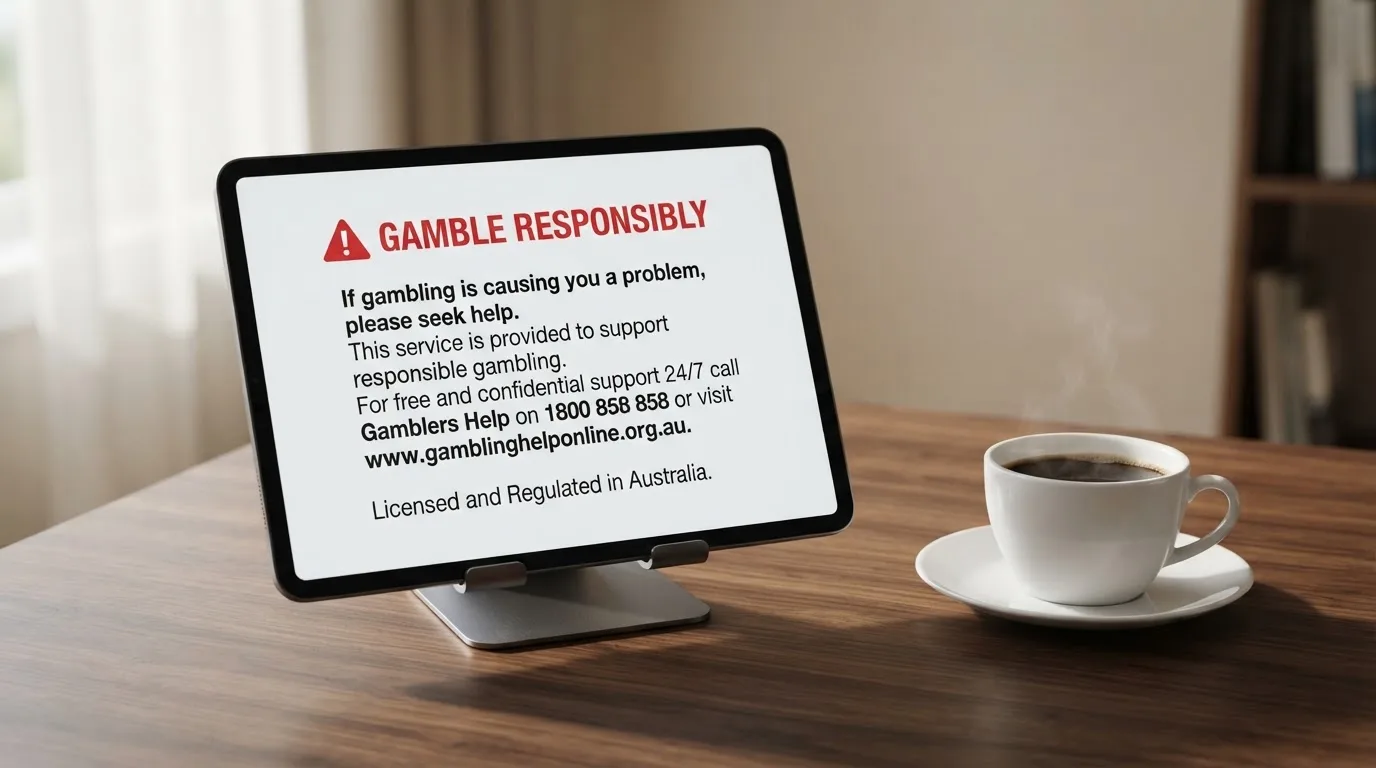
The National Gambling Helpline is 1800 858 858, free, available 24 hours a day, with web chat through Gambling Help Online. The helpline is the right number to call regardless of where a person has been playing. State-based services — the Victorian Responsible Gambling Foundation, Gambling Help NSW, and the equivalent bodies in each state and territory — provide counselling, financial counselling and self-exclusion support. None of these are gated on the player having been playing at an Australian-licensed operator. They are available to anyone in Australia whose gambling has become a problem, whatever the operator.
The offshore operator’s marketing is part of the responsible-gambling picture. Reload offers are, by construction, a retention tool — timed to deposit activity, sent to customers who have already deposited, calibrated to keep the rhythm going. The structure is not inherently harmful; the same mechanism is what a licensed operator uses to keep a player who is spending within their means. The difference is that the licensed operator sits inside the BetStop and helpline architecture, and the offshore operator does not.
The minimum age for any Australian gambling product is 18. Offshore operators that allow minors are in breach of every licence they claim to hold, but the only meaningful enforcement is the operator’s own. Australian-licensed operators verify age at signup; offshore operators vary. The reload offer, by definition, is being marketed to an account that has already passed signup, so the age question is settled. The self-control question is the one the offshore operator is not set up to address.
A reader weighing a reload offer is not, by that act, in difficulty. Most readers of this term are casual players deciding whether a particular bonus is worth a particular deposit. The responsible-gambling section is here because the offer they are weighing exists in a market where the backstops the licensed market provides — BetStop, the helpline, the regulator — are not connected to the operator making the offer. The offers the reader can claim from an offshore operator are the same offers they could claim from a licensed one, with more consumer protection on the back end. That is the responsible-gambling point the reader most needs to weigh against the marketing.
Money in: the payment routes available — and blocked
The Australian payment stack is the second line of defence behind the IGA, and the one most offshore operators now have to navigate around. Four mechanisms do most of the work: the credit-card and credit-product prohibition, the bank-level gambling blocks, the merchant-category-code filter that the banks apply, and the digital-wallet rules that inherit the credit-card ban.
The credit-card prohibition is the simplest layer. Since 11 June 2024, Australian-licensed online wagering services cannot accept payment by credit card or any other credit-related product. The prohibition is in the Interactive Gambling Act itself, with penalties of up to A$247,500 per case for an operator that breaches it. The ban extends to credit-linked digital wallets — a wallet funded from a credit card inherits the ban. A wallet funded from a debit card does not, but the wallet provider and the bank both retain discretion to block the transaction on their own terms.
Bank-level gambling blocks are the second mechanism, and the one most readers will encounter first. Westpac’s gambling block operates at card level: it refuses authorisation of transactions registered under the merchant category code for betting and casino gambling on eligible personal credit and debit cards. Commonwealth Bank’s gambling lock works the same way — applied through the CommBank app, it blocks most gambling transactions, with the bank’s own caveat that it cannot guarantee every gambling-related purchase will be stopped. ANZ’s gambling block, activated in the ANZ app, extends to digital-wallet transactions on eligible cards rather than only the physical card, and carries a 48-hour cool-off before the block can be removed — deliberate friction the bank has built in to slow impulse changes. Each of the four majors offers the same kind of block, with the same kind of caveat.
The merchant-category-code filter is the layer the banks use to apply those blocks. Every card transaction is tagged with a four-digit MCC; the betting-and-gambling MCC is the trigger. That code is what an offshore casino’s payment processor needs to present for the transaction to clear. Some offshore processors route transactions through different MCCs — food, retail, digital goods — to slip past the filter. The filter still catches most of them, because the merchant name and the transaction pattern are themselves signals. The reader sees this as a transaction that declines at the checkout; the bank sees it as a pattern worth flagging.
American Express is the awkward case in this picture. Amex operates as a three-party scheme, not the four-party model Visa and Mastercard use — it issues cards and processes transactions itself rather than relying on a separate issuing bank. The Reserve Bank of Australia’s July 2025 review proposes removing surcharges only on eftpos, Mastercard and Visa transactions, leaving Amex explicitly outside the proposed ban. For gambling-transaction purposes, Amex inherits the credit-card prohibition through the IGA, but the surcharge and processing economics are different — which is why an offshore operator that has trouble clearing a Visa transaction may have less trouble with an Amex one.
Apple Pay and Google Pay are the wallet layer. Apple does not charge consumer fees for using Apple Pay; any surcharge comes from the merchant’s card-processing fees rather than from Apple. Transaction limits and PIN requirements are set by the card issuer and the merchant, not by Apple. Where the underlying card is a credit card, the IGA ban applies through the wallet — the wallet inherits the card’s status. By the end of 2025, Apple Pay, Google Pay and Samsung Pay together accounted for around 45 per cent of all card payments in Australia by number, which is the share of transactions an offshore casino needs to clear through a different MCC if it wants to take them at all.
PayID and Osko are the instant-transfer layer. With Osko, a bank transfer between participating Australian banks arrives in under a minute, 24 hours a day including weekends, whether the transfer is addressed to a BSB and account number or to a PayID. PayID-based instant transfers are available at over 100 Australian financial institutions. The transaction limit on a single Osko transfer is set by the sending bank; the receiving end shows the account holder’s name before the transfer is sent. Australia Payments Plus, which runs both PayID and Osko, warns that being asked to transfer money to a PayID associated with an illegal gambling site almost certainly means a scam site.
BPAY is the bill-payment layer, distinct from PayID. BPAY has run since 1997, is available in the online banking of over 140 Australian banks and financial institutions, and is run by Australian Payments Plus. A BPAY payment is entered by Biller Code and Customer Reference Number; it is the payment method a licensed Australian wagering service uses for some deposits, and it is not the payment method an offshore casino can practically use, because BPAY requires an Australian biller agreement. The offshore operator’s deposit page either does not list BPAY or lists it as a token option that fails at checkout.
The New Payments Platform is the underlying rail. Australia’s NPP went live on 13 February 2018; more than 25 million PayID identifiers were registered on it by April 2025; participants must keep monthly platform outages to no more than two minutes. The platform is the reason Osko and PayID work; it is not a payment method a consumer uses directly.
| Payment method | Type | Availability |
|---|---|---|
| Debit card | Card | Licensed & offshore |
| Bank transfer | Bank | Licensed & offshore |
| PayID / Osko | Instant transfer | Licensed |
| BPAY | Bill payment | Licensed |
That is the picture the reload offer sits inside. The offer is the carrot. The payment infrastructure is what the carrot is dangled from. The Australian regulatory and banking frame is what the carrot is dangled against.
Operator-by-operator read
The eleven operators below are the subjects of the ACMA’s formal warnings over the past four years. The write-ups do not describe their offers — the ACMA’s enforcement record is the only verifiable signal research carries for these brands — and they do not recommend any one of them. The verdicts at the foot of each entry are the page’s own read of what the warning record, and the listing presence, says about the brand.
RocketPlay
The ACMA issued a formal warning to Pulsup Ltd over Rocketplay.com.au in March 2026, on top of the May 2022 warning to Dama N.V. covering the same brand. Two warnings on one brand, four years apart, is the regulator’s pattern for an operator that has changed ownership and continued under a fresh licence. The listing presence research surfaces is a single third-party page on Gamblinginsider.com — a thin footprint for a brand that markets itself across multiple jurisdictions.
The RocketPlay record is two warnings on one brand, four years apart, under two operators of record — the rotation the offshore model is built to absorb, and the regulator’s pattern for a brand that has changed hands but kept the name.
Level Up Casino
The ACMA’s May 2022 warning to Dama N.V. named six casino brands, of which Level Up was one. The other five were Bambet, Dazard, Rocketplay, Wild Tornado and Cobra Casinos. The third-party listing research surfaces for Level Up is a reference on Westpac’s gambling-block documentation, which is what a bank’s MCC reference looks like when it is naming the brand to clarify which transactions the block catches. Level Up is, on the warning record, one of six sister brands under the same Dama N.V. umbrella.
Level Up sits inside the Dama N.V. portfolio, and the ACMA’s 2022 warning was the first formal address to that operator — one warning, six brands, and a pattern the regulator has had to repeat under different brand names since.
Woo Casino
The ACMA issued a formal warning to Dama N.V. over Woo Casino in March 2025. Woo is, on the warning record, the second of the Dama N.V. warnings after Level Up in 2022, and the brand sits under the same operator-of-record as Spirit Casino. Research surfaces no third-party listing presence for the brand — the listing column in the table is empty. That absence is information rather than a clean record: the brand has a regulator action against it and no listing-traceable presence in the sources research checked.
Woo Casino is one warning deep and unlisted; the public footprint is the regulator’s. The reader weighing a reload offer from Woo is choosing on a brand whose only verifiable record is the ACMA’s formal address.
Spirit Casino
The ACMA issued a formal warning to Dama N.V. over Spirit Casino in May 2025, two months after the Woo Casino warning and three years after the Level Up warning. Spirit and Woo sit under the same operator-of-record; the brand rotation is the visible mechanism. Like Woo, Spirit surfaces no listing presence in the third-party directories research checked.
Spirit and Woo share an operator-of-record; the regulator’s address to Dama N.V. has moved from one warning in 2022 to two in 2025. That is what steady-cadence enforcement against a single offshore operator-of-record looks like over four years.
National Casino
The ACMA issued a formal warning to Consolutetish S.R.L. over National Casino in July 2025. National is the brand with the broadest listing presence in the table — referenced on the ACMA’s own page, on AUSTRAC’s threshold-transaction reporting materials, and on BetStop’s National Self-Exclusion Register. Three regulators’ surfaces, plus the warning itself, is a denser public footprint than any other brand in the table.
National Casino is the brand the Australian regulatory infrastructure has the most documented handle on. A reload offer from National is an offer from a brand the regulator already has on a list, sitting on a payment rail the regulator’s own register can see.
Bizzo Casino
The ACMA issued a formal warning to Consolutetish S.R.L. over Bizzo Casino in July 2025 — the same warning that named National Casino. Bizzo’s record also carries an earlier formal warning, in 2022, to TechSolutions (CY) Group Limited and TechSolutions Group N.V. Two warnings on the same brand, four years apart, is the same pattern as RocketPlay: the operator-of-record has changed, and the regulator has had to address the new operator under the same brand name. Research surfaces a single third-party listing on Gamblinginsider.com.
Bizzo’s record is two warnings, four years apart, under two different operators of record. The brand name has outlasted the licence-of-record in the warning register — which is what the offshore model is designed to do, and what the regulator’s two-step enforcement is responding to.
Ignition Casino
The ACMA issued a formal warning to Bamboo Media over Ignition Casino in July 2025. Ignition surfaces no third-party listing presence in the directories research checked. The single-signal record — one warning, no listing footprint — matches the shape of Woo Casino and Spirit Casino.
Ignition is one warning, no listings, no further trace. The reader weighing an Ignition reload offer is choosing on a regulator address and nothing else research surfaced — the narrowest verifiable record in the table.
Instant Casino
The ACMA issued a formal warning to EOD Code SRL over Instant Casino in February 2025. Research surfaces two third-party listings — on Ecopayz.com and Payid.com.au — both payment-method directories that reference the brand in passing. The listing presence is in payment infrastructure rather than in affiliate marketing directories, which is the smaller and more transactional footprint.
Instant Casino’s third-party trace is in the deposit route rather than in the affiliate network. The reload offer sits on a payment rail the player can reach; the marketing footprint is thinner than National’s or Casino Intense’s.
Jackbit
The ACMA issued a formal warning to Ryker B.V. over Jackbit in April 2026. Jackbit is the bitcoin-branded brand in the table — the one whose reload offer is most often pitched as a “BTC casino reload” in the marketing research carries as background. Research surfaces no third-party listing presence for the brand.
Jackbit is the bitcoin-branded brand in the table, and the recent warning places the brand in the same enforcement stream as every other operator here. The deposit route removes the bank’s gambling-block backstop — that is the bitcoin reload offer’s selling point, and the same reason the bank-level block does not catch it.
Casino Intense
The ACMA issued a formal warning to Sterplay Holding Ltd over Casino Intense in April 2025. Research surfaces three third-party listings — on austrac.gov.au, on betstop.gov.au, and on Gamblinginsider.com. That is the second-broadest footprint in the table, after National Casino. AUSTRAC’s reference is on the threshold-transaction reporting materials; BetStop’s is on the self-exclusion register; Gamblinginsider.com is an affiliate directory.
Casino Intense has the second-broadest verifiable trace in the table. The brand has been on the regulator’s list and on the affiliate network’s list at the same time — which is the closest an offshore brand can come to a public footprint without holding an Australian licence.
Sky Crown
The ACMA issued a formal warning to Hollycorn N.V. over its Sky Crown and Blue Leo casino services, in a publication dated September 2022. Sky Crown is the oldest warning in the table — older than Level Up, older than Bizzo’s first warning, older than RocketPlay’s first. Research surfaces no third-party listing presence for Sky Crown.
Sky Crown is the oldest warning in the table, and the listing footprint has not survived the four years since. A reload offer from Sky Crown is an offer from a brand whose public record begins and ends with the regulator’s 2022 address.
The blocking rate
The arithmetic the page owes the reader is the rate at which the ACMA has been adding to the blocked-sites list since the first blocking request in November 2019. The input from research: 1,751 illegal gambling and affiliate websites blocked by the snapshot reported in June 2026, and the date of the first blocking request. The condition attached to the figure is that this is the cumulative total over the period between those two dates, averaged, rather than the rate at which any single round operates.
The arithmetic: 1,751 sites over the 79 months between November 2019 and June 2026 works out to an average of roughly twenty-two sites a month — about five a week, or close to two hundred and seventy a year across the full period. The band the result lives in is roughly twenty to twenty-five a month, or four to six a week, depending on how the early low-volume years are weighted against the recent higher-volume years. The June 2026 round alone added twelve sites, which is a single round close to the monthly average for the period as a whole.
The reading the rate supports: the ACMA’s enforcement cadence has been steady-to-rising since 2019, and a single round in 2026 is delivering what an average month across the full period would have delivered. The blocking mechanism — administrative request to ISPs, ISP compliance — is not slowing down. The offshore offer the reload bonus is part of is being closed off at the Australian-network edge at a rate that the regulator can sustain and the operator has to absorb.
Frequently asked questions
What is a reload bonus, and how does it differ from a first sign-up bonus?
A reload bonus is a repeat-deposit offer: the casino credits a percentage of a returning player’s deposit as bonus funds, usually with a wagering requirement and often with a free-spin bundle stapled on. A first sign-up bonus is the same structure applied to the first deposit, with a higher match percentage and a higher cap because the offer has to convert a new account rather than retain an existing one. The mechanics are identical; the audience and the cadence are different.
Why does a bitcoin casino brand its repeat-deposit offer as a ‘reload bonus’?
The “reload bonus” label is what tells a returning customer they qualify; the “bitcoin” label is what tells them how to deposit. A bitcoin-branded reload takes the deposit in cryptocurrency and credits the bonus in the casino’s account currency. The marketing pitch sells anonymity and the absence of a chargeback route. For an Australian reader, the practical effect is that the bank-level gambling block is removed from the transaction, because no bank is involved.
Is accepting a reload bonus from an offshore casino any different, legally, to accepting its welcome bonus?
No. The Interactive Gambling Act 2001 prohibits the provision of online casino games and online pokies to a person in Australia, and the prohibition applies to every offer the operator makes — welcome, reload, cashback, free-spin bundle, VIP tier. The provider is the party the regulator addresses, not the player, but a player who deposits at an offshore casino has no Australian complaints body and no Australian recourse if the operator refuses a withdrawal.
How often do sites typically run a reload bonus for existing players — weekly, or only occasionally?
Weekly is the standard cadence, often pegged to a specific day — Wednesday, Friday — so the offer becomes a deposit-day trigger. Some operators run a tiered monthly structure: a deposit match in week one, free spins in week two, cashback in week three, a tournament entry in week four. VIP-tier reloads are negotiated by loyalty tier and run on request rather than on a calendar. The cadence is rarely in the headline terms; it sits in the operator’s promotional email stream.
What happens to an unused reload bonus offer if the player doesn’t deposit again in time?
The reload offer expires. Most operators set the reload bonus on a window — twenty-four hours, seventy-two hours, or a week — from the moment the offer is sent or accepted. A player who does not deposit within the window forfeits the bonus. There is no carry-over, no extension on request, and no negotiation after the window closes. The cadence exists precisely because the offer has to be acted on inside a specific time.