
Online pokies no-deposit bonuses in Australia: the offer, the law, the arithmetic
A no-deposit pokies bonus is the most marketed offer in offshore casino advertising aimed at Australians. The pitch is simple: sign up, take the bonus, spin the reels, withdraw what survives. The fine print is less simple, and so is the legal ground underneath it. Every brand that markets such an offer to a person in Australia sits outside Australian law, and the Australian Communications and Media Authority has spent the last decade issuing formal warnings and ordering the sites blocked. The page below walks through what the offer actually is, what the law actually says, and what an ACMA record on a brand actually looks like — eleven brands, eleven warnings, one prohibition.

Data current as of 30 October 2026 and checked against the ACMA register of formal warnings and the published blocking round.
Table of Contents
- What a “no-deposit pokies bonus” actually is, and where it sits
- The legal ground: what the IGA actually says
- Player protection, and what an offshore site does not give
- Settlement times and the PayID claim
- The eleven brands on the ACMA’s published warning list
- How fast the ACMA has been blocking sites, in one arithmetic
- The eleven brands, one by one
- How to read the warning list as a whole
- What the pokies themselves look like, for context
- The bookmaker side, briefly, because it comes up
- What an Australian player can actually do
- Frequently asked questions
What a “no-deposit pokies bonus” actually is, and where it sits
A no-deposit bonus is a small credit the site credits to a new account on sign-up, before the player has paid anything in. For pokies specifically, the credit usually arrives as a fixed bundle of free spins on one named slot, sometimes as a small cash credit (A$5 to A$25 in the affiliate pages that promote these offers) on the same condition — wager it through eligible games before it can be withdrawn. There is no purchase. That is the whole appeal, and it is also the whole catch.

The catch sits in three places. First, the playthrough condition. Almost every no-deposit offer carries a wagering requirement — a multiple of the bonus, often 40× to 60×, that has to be turned over on eligible games before any winnings become withdrawable. A$10 in bonus credit with a 50× requirement is A$500 of bets before a cent can come out, and most of those bets will be placed at minimum stake to grind the requirement down. Second, the maximum cashout cap. Even after the playthrough is met, the bonus terms almost always cap the amount that can be withdrawn from bonus-derived winnings — A$50, A$100, occasionally more. The rest is forfeit. Third, the eligible games. Pokies almost always count 100% toward the requirement; table games count less, sometimes nothing at all. The bonus is engineered to be played on the games with the worst return to the player, not the games where the player has the best chance of clearing it.
None of this is hidden, exactly. Every offshore site carries terms and conditions, and the better ones state the playthrough, the cap and the eligible games in plain prose. They are not, however, framed as the marketing pages frame them. The marketing says “free spins, no deposit needed.” The terms say “free spins on this slot, 50× playthrough, A$100 max cashout, bonus funds forfeited on early withdrawal.” Both are true. The reader who reads only the first sentence walks into the second one.
It is worth being precise about what the offer is and is not. It is not a free path to real money. It is a free path to a small cashout, conditional on grinding through a turnover requirement that the slot’s house edge will eat into on every spin. The expected value of the bonus to the player is the bonus amount times the slot’s return-to-player, minus the playthrough the player has to perform to clear it — and the playthrough is the part the marketing pages do not mention. For a player who treats the offer as a five-minute try, the expected value is close to zero. For a player who grinds it out to the cap, the expected value is small but non-zero, with most of the upside consumed by the cap itself.
The broader context matters too. Australians lose roughly A$3.9 billion a year to illegal gambling sites according to H2 Gambling Capital’s 2025 estimate, and the share of gambling going through legal Australian channels fell from 74% in 2021 to 64%. No-deposit bonuses are not the whole of that A$3.9 billion, but they are the front door — the offer that gets a player through the sign-up screen and into the rest of the offshore catalogue. The arithmetic above is what the player does once they are through the door.
The legal ground: what the IGA actually says
The Interactive Gambling Act 2001, as tightened by the Interactive Gambling Amendment Act 2017, makes it an offence for a provider to offer online casino games, online pokies or in-play betting to a person in Australia. No state or territory licenses an online casino. None of the eleven brands reviewed later on this page holds an Australian licence for the product it is offering. The licences some of them display — Curaçao, Anjouan, Kahnawake — are licences to operate in other jurisdictions; they are not licences to take Australian customers, and the Australian regulator treats them as immaterial to the question.
What the law does, in practice, is target the provider. An individual Australian who signs up to an offshore site is not prosecuted. The IGA’s enforcement teeth point at the company offering the service, not the punter using it. That asymmetry matters for how a reader should read the rest of this page. It does not make the site legal; it makes the player unlikely to face a courtroom. The two facts are different things.
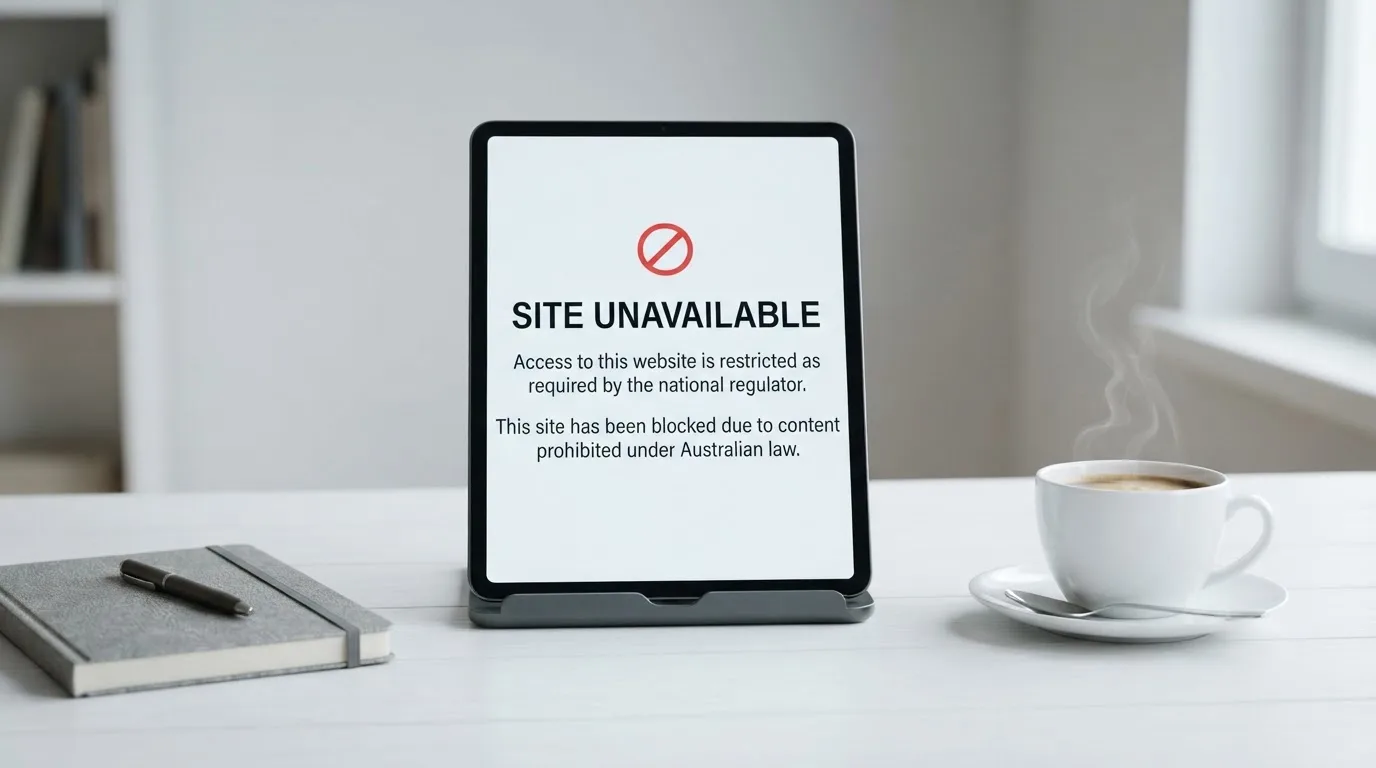
The Australian Communications and Media Authority is the body that investigates, issues formal warnings and asks Australian internet service providers to block sites. A formal warning is a published notice that names the operator behind the brand and the section of the IGA the operator is alleged to have breached. A blocking request is a step further: the ACMA writes to ISPs and asks them to take the site offline at the Australian edge of the network. Both steps are public, and both leave a record.
The ACMA reported in June 2026 that 1,751 illegal gambling and affiliate marketing websites had been blocked since the first blocking request in November 2019, and that more than 230 unlicensed gambling services had left the Australian market since enforcement was strengthened in 2017. The 26 June 2026 round alone asked ISPs to block 12 more sites: 7Signs, ChromaBet, Donbet, Duospin, Freshbet, Slots Gem, Jacks Club, Lucky Start, Pointsbetz, Spinrise, Vinyl Casino and Wildsino. None of those twelve sits on the list reviewed here, and several of them are first-time entries. The blocking round is a moving target, not a registry.
A formal warning does not automatically trigger a blocking request. The ACMA’s published process moves from investigation to warning to further action, and the timing varies. A brand can sit on the warning list for years before the ACMA asks ISPs to block it; another brand can be blocked after a single warning. The reader who treats a warning as “the site is about to disappear” is reading ahead of the evidence; the reader who treats it as “the regulator has publicly named this operator for offering a prohibited service to Australians” is reading what the warning actually says.
There is one piece of 2026 reform the reader should know about. The Interactive Gambling Amendment (Gambling Reform) Bill 2026 passed Parliament on 19 August 2026, and its advertising and inducement measures commence on 1 January 2027. It is a law with a start date, not a law in force on this page. The penalties and the new offences become enforceable at the start of 2027. What is enforceable today is the existing IGA, and the existing IGA is what the warnings on this page rest on.
Player protection, and what an offshore site does not give
A licensed Australian wagering provider is part of a protection system that an offshore site is not. The most concrete piece of that system is BetStop, the National Self-Exclusion Register, live since August 2023. A player who registers with BetStop is excluded from every Australian-licensed online and phone wagering service. The exclusion holds across operators, because the operators are required to check the register. An offshore casino is not connected to BetStop. Registering with BetStop does not stop an offshore site from accepting the same player’s deposits; it only stops the licensed half of the market. A player who has registered with BetStop and is looking for a no-deposit pokies bonus is looking in the wrong half.
The National Gambling Helpline is 1800 858 858, free, 24 hours a day, with chat at Gambling Help Online. It is a service for people who gamble on licensed Australian products and for people who gamble on offshore ones — the helpline does not draw the distinction. It is the right number to call if a reader recognises themselves sliding toward a stake they cannot afford, on either side of the legal line.
A separate protection sits in the payment system. Credit cards, credit-related products and digital currency are banned as payment for licensed online wagering in Australia since 11 June 2024, with penalties of up to A$247,500 for an operator that takes one. The legal deposit routes for licensed wagering are debit card, bank transfer, PayID and Osko, and BPAY. A site that asks an Australian player for a credit card number or a crypto wallet address is operating outside the Australian payment rules; it is a small marker, but a reliable one. It does not make the offer more or less valuable on its own terms, but it is a clear signal that the site is not built for Australian consumer protection.
The consumer protections an offshore site cannot give an Australian player are the obvious ones. There is no Australian complaints body. There is no Australian recourse if the site refuses a withdrawal, caps a payout below the advertised amount or simply stops answering email. There is no Australian insolvency regime that returns a player’s balance if the operator goes under. There is no BetStop. There is no credit-card ban. There is no requirement that the slot’s return-to-player match the figure the marketing page claims, and no Australian auditor checking it.
A balance on an offshore site can be lost to a blocking request. The ACMA does not ask ISPs to refund balances; it asks them to make the site unreachable from an Australian IP address. A player with a real-money balance on a site the ACMA has just had blocked has no automatic path to getting it back. The site may still be reachable through a VPN or a non-Australian connection, but that is the player’s own problem to solve, and the funds are at the offshore operator’s discretion.
Settlement times and the PayID claim
The “PayID no deposit pokies” framing is one of the more durable marketing shapes in offshore advertising aimed at Australians. PayID is the real-time bank-to-bank transfer layer that sits on the New Payments Platform in Australia, and it is fast. A PayID transfer between two Australian bank accounts usually settles in under a minute during business hours, often in seconds. Offshore casinos that accept PayID use it for the deposit side, and they market the withdrawal side the same way: deposit in, win, withdraw back to the same PayID, almost immediately.
What PayID does not change is the playthrough condition. A PayID no-deposit bonus still carries the same 40× to 60× wagering requirement a regular no-deposit bonus carries. The transfer rail is faster; the requirement to grind it through the eligible games is identical. A PayID no-deposit bonus differs from a standard no-deposit bonus in the deposit method mentioned and in nothing else the player should care about. The speed at which the eventual withdrawal arrives — assuming it survives the playthrough, the max cashout and the site still being reachable — is a function of the site, not the rail.
The settlement time the marketing page claims is, in practice, the time between the player pressing withdraw and the funds appearing in the Australian bank account. For an Australian-licensed wagering provider using PayID, that is genuinely close to instant. For an offshore casino, it is whatever the site chooses to advertise, and the gap between the advertised settlement time and the actual one is the gap where balances sit in the offshore operator’s account while the player waits. The reader who treats “instant withdrawal” as a guarantee is reading the marketing page; the reader who treats it as a published estimate is reading more carefully.
The handful of terms that recur across PayID no-deposit pokies pages — fast withdrawals, Australian-friendly, no deposit needed, real money wins — are the marketing vocabulary of the affiliate sites that promote these offers. The repetition is structural, not coincidental: a small set of affiliate networks writes most of the pages, and the affiliate networks reuse the same hooks. The reader who notices the same sentence on five different review sites is not looking at five independent reviews. They are looking at the same source rewritten five times. That is why the terms recur: the underlying offer has a small set of features, the marketing reduces those features to a small set of phrases, and the phrases repeat across the network.
The eleven brands on the ACMA’s published warning list
The table below lists the eleven brands reviewed on this page. Every one of them has been the subject of a formal warning published by the ACMA under the Interactive Gambling Act 2001. None of them holds an Australian licence for online casino games. The “no-deposit bonus support” column reflects only what independent listings report about whether the brand has carried a no-deposit style offer; it is not the brand’s own claim, and it does not apply to Australian players as a right. Where no listing exists, the column stays empty.
| Brand | ACMA action and date | Operator named by the ACMA | No-deposit support on independent listings |
|---|---|---|---|
| RocketPlay | Formal warning, March 2026 | Pulsup Ltd (RocketPlay); earlier Dama N.V., May 2022 | — |
| Level Up Casino | Formal warning, May 2022 | Dama N.V. | Listed on third-party game-provider indexes |
| Woo Casino | Formal warning, March 2025 | Dama N.V. | — |
| Spirit Casino | Formal warning, May 2025 | Dama N.V. | — |
| National Casino | Formal warning, July 2025 | Consolutetish S.R.L. | Listed on third-party game-provider indexes |
| Bizzo Casino | Formal warning, July 2025; earlier 2022 | Consolutetish S.R.L.; earlier TechSolutions (CY) Group and TechSolutions Group N.V. | — |
| Ignition Casino | Formal warning, July 2025 | Bamboo Media | — |
| Instant Casino | Formal warning, February 2025 | EOD Code SRL | — |
| Jackbit | Formal warning, April 2026 | Ryker B.V. | — |
| Casino Intense | Formal warning, April 2025 | Sterplay Holding Ltd | Listed on third-party game-provider indexes |
| Sky Crown | Formal warning, September 2022 | Hollycorn N.V. | — |
The dates span 2022 to April 2026. Some operators appear more than once because they sit behind more than one brand: Dama N.V. alone is named for RocketPlay, Level Up, Woo and Spirit; Consolutetish S.R.L. for National Casino and Bizzo. The repeated appearance is not a duplicate entry; it is the regulator naming the corporate vehicle behind the marketing skin. A reader looking at the table sees eleven brands; the regulator is looking at a smaller set of operators running several brands each. Both readings are correct.
The “no-deposit support” column carries an em dash for eight of the eleven brands. The em dash is not a claim about the brand, and it is not a denial. It is the honest answer to the question the column is asking: independent listings have not been confirmed for that brand on the relevant subject, and the brand itself is not a source the page draws on. Three brands — Level Up Casino, National Casino and Casino Intense — appear on third-party game-provider indexes, which is what the listings say: the brand has a presence on the indexes, not that the brand holds an Australian licence or that it offers an Australian player a no-deposit bonus it will pay out.
Every row in the table also carries a condition the page has already stated in the section on the IGA: the product on offer is prohibited for Australian players, and the licence the site displays elsewhere does not change that. The table repeats the condition not as a fresh fact but as a reminder; the reader who scans the table and skips the prose above it should still see the same warning in the table itself.
How fast the ACMA has been blocking sites, in one arithmetic
The regulator’s blocking record is the one number on this page that is genuinely worth computing. As of June 2026, the ACMA reported 1,751 illegal gambling and affiliate marketing websites blocked since the first blocking request in November 2019. That is just over six and a half years of blocking activity.
The blocking rate is therefore roughly 1,751 ÷ 79 months — somewhere between 22 and 23 blocked sites per month across the full period, or about 270 blocked sites per year on average. The early years were quieter; the most recent rounds have been larger, with the 26 June 2026 round alone covering twelve sites in one go. As a band rather than a single figure, the practical takeaway is: between 20 and 30 sites per month on average, with individual rounds sometimes covering more than that in a single week. The ACMA’s June 2026 total — 1,751 sites blocked since November 2019 — is the count to use; the per-month rate is derived from it. Both belong to the same calculation.
What the rate does not say is which site is next. A formal warning can sit on the books for years before the site is blocked; some sites are blocked after a single round; some sites change name, IP address or corporate vehicle after a warning and start the cycle again under a new brand. The reader who treats the rate as a forecast — “this site will be blocked by X” — is reading ahead of the evidence. The reader who treats it as a measure of how steadily the regulator is acting — and how steadily the offshore side is having to replace blocked sites — is reading what the rate actually measures.
The arithmetic does not invent a forecast. It draws the per-month band from the published total and the published start date, both of which come from the ACMA’s own June 2026 communication. Where the rate will be a year from now is not knowable from the page; the rate so far is.
The eleven brands, one by one
Each brand below carries the same fields the table carries, in prose: the ACMA action and date, the operator the regulator named, and an honest answer to whether any independent listing associates the brand with a no-deposit offer. The verdict at the end of each block is the page’s own judgement of what the brand is, judged against what the rest of the page has already established — not a recommendation to play, and not a reassurance that the brand will pay out. The reader who reads the verdicts as buying advice is reading the wrong thing.
RocketPlay
The ACMA issued a formal warning to Pulsup Ltd over RocketPlay in March 2026. The same brand sits under an earlier warning to Dama N.V. from May 2022. Two warnings, four years apart, on the same brand, from two different corporate vehicles — the regulator is naming the marketing skin and the operator behind it, and the operator behind it has changed at least once. No independent listing has been confirmed for RocketPlay on the relevant subject. The site displays an offshore licence that is not an Australian one. The brand is a textbook example of the warning cycle the ACMA’s June 2026 figures describe: a site warned, a blocking request eventually issued, the operator reappearing under a new corporate name, the cycle starting again.
Level Up Casino
Level Up was named in the May 2022 warning to Dama N.V., the same warning that covered five other Dama brands. Independent game-provider indexes list Level Up, which is what those indexes say — the brand is on the indexes. It is not an Australian licence and it is not a guarantee that the site will pay out a no-deposit bonus to an Australian player. Level Up is the same operator, the same prohibition and the same consumer-protection gap as the rest of the Dama roster, viewed through a different marketing skin.
Woo Casino
The ACMA issued a formal warning to Dama N.V. over Woo Casino in March 2025. Woo is the second Dama brand to be warned after the May 2022 batch — the cycle restarted on the same operator under a new skin. No independent listing has been confirmed for Woo on the relevant subject. The brand’s presence on the regulator’s warning list is the page’s whole case for treating it like the rest of the Dama roster: same operator, same prohibition, same absence of Australian consumer protection.
Spirit Casino
Spirit sits under the May 2025 warning to Dama N.V., the third Dama brand to be added to the warning list since the original 2022 batch. No independent listing has been confirmed for Spirit on the relevant subject. The brand is two months newer than Woo on the warning list, and that is the only material difference between them — the date the regulator named the operator, not anything the brand itself has done differently.
National Casino
The ACMA issued a formal warning to Consolutetish S.R.L. over National Casino in July 2025. The same warning covered Bizzo Casino. National Casino appears on third-party game-provider indexes, which is what those indexes say — the brand has a presence on them. The brand is newer on the warning list than the Dama brands and operates under a different corporate vehicle. What it shares with the rest of the table is the prohibition and the absence of Australian consumer protection, distinct from the operator behind it.
Bizzo Casino
Bizzo was named in the July 2025 warning to Consolutetish S.R.L. The same brand was the subject of an earlier 2022 warning to TechSolutions (CY) Group Limited and TechSolutions Group N.V., so Bizzo carries two warnings, three years apart, on the same brand, from two different operators. The regulator is naming the brand as a continuing presence on the offshore side, and the brand has cycled through at least two corporate vehicles to keep that presence. No independent listing has been confirmed for Bizzo on the relevant subject.
Ignition Casino
The ACMA issued a formal warning to Bamboo Media over Ignition Casino in July 2025. Ignition is the second brand named in the same warning round that covered National Casino and Bizzo, but under a different operator. No independent listing has been confirmed for Ignition on the relevant subject. The brand is the only one on the table tied to Bamboo Media; the rest of the operator’s footprint, if any, is not on the warning list as of the regulator’s June 2026 publication.
Instant Casino
The ACMA issued a formal warning to EOD Code SRL over Instant Casino in February 2025. Instant is the earliest warning on the 2025 half of the table — a year before the July 2025 round that covered Ignition, National and Bizzo. No independent listing has been confirmed for Instant on the relevant subject. The brand is a single operator, a single warning, and the same prohibition as the others, regardless of the year it was named.
Jackbit
The ACMA issued a formal warning to Ryker B.V. over Jackbit and CasinOK in April 2026. Jackbit shares the warning with another brand — CasinOK — under the same operator, the same way Dama N.V. sits behind four brands on the table. No independent listing has been confirmed for Jackbit on the relevant subject. The brand is the most recent Dama-style multi-brand warning on the table; the warning date is the same month as the ACMA’s June 2026 blocking-round communication.
Casino Intense
The ACMA issued a formal warning to Sterplay Holding Ltd over Casino Intense in April 2025. Casino Intense appears on third-party game-provider indexes — the third brand on the table, alongside Level Up and National Casino, to have a confirmed listing on those indexes. The listing is not an Australian licence and is not a guarantee. Casino Intense is a brand on the regulator’s warning list, operating under an offshore licence, with no Australian consumer protection to offer.
Sky Crown
The ACMA issued a formal warning to Hollycorn N.V. over Sky Crown and Blue Leo casino services in September 2022. Sky Crown is the earliest warning on the table — three and a half years before the most recent entries. The brand shares its warning with Blue Leo, the same way Jackbit shares with CasinOK and Dama N.V. sits behind four brands. No independent listing has been confirmed for Sky Crown on the relevant subject. The age of the warning is the brand’s distinguishing feature: it has sat on the regulator’s published list the longest, and it has not been removed.
How to read the warning list as a whole
The eleven brands above are not a ranking and not a recommendation. They are the brands the ACMA has chosen to publish formal warnings on, drawn from the regulator’s own register. The reader who treats the table as a “best of” list is misreading it; the regulator is not endorsing any of them, and neither is this page.
What the list does show, taken as a whole, is the shape of the offshore side as the regulator sees it. Eleven brands. Seven distinct operators behind them. Warnings spanning September 2022 to April 2026. One operator (Dama N.V.) appearing four times under four brand names. Another (Consolutetish S.R.L.) appearing twice. Two operators (Hollycorn N.V., Ryker B.V.) each appearing once but tied to two brands on the warning. The regulator is naming marketing skins and the corporate vehicles behind them, and the ratio of brands to operators — eleven brands, seven operators — is the ratio the reader should remember when reading an offshore site’s “about” page.
A reader who lands on this page because an affiliate review of one of these brands mentioned a no-deposit pokies bonus has landed here for a reason. The reason is the offer, not the operator. The offer is real as a marketing construct: the affiliate page is describing what the site would credit on sign-up. The offer is not real as a right: no Australian player has a right to be paid it, no Australian regulator can compel it, and the brand sits on the warning list above for offering exactly this kind of product. Both things are true at the same time, and the reader should hold both.
What the pokies themselves look like, for context
Pokies — electronic gaming machines — operate in every Australian state and territory, and each jurisdiction separately regulates their design and operation. The legal minimum return-to-player for poker machines varies by jurisdiction: 85% in New South Wales, the Northern Territory, Queensland and generally Victoria (87% at Crown Melbourne), 87% in the Australian Capital Territory and Tasmania, 87.5% in South Australia and 90% in Western Australia. The 85% floor is the lowest in the world for legal machines, and the gap between 85% and 90% across states is the gap the regulator has set on what an Australian player loses back to the machine on average. A licensed pub or club poker machine in New South Wales returns 85 cents in the long run for every dollar wagered; a Western Australia casino machine returns 90 cents. Both numbers are below 100%. The house always has an edge.
The land-based market is large. In 2020-21 Australians bet almost A$150 billion through gaming machines and lost A$12.18 billion on them. New South Wales alone had 87,298 gaming machines outside casinos across 2,195 venues as of June 2023, with player losses of A$8.18 billion in 2022-23. Queensland had 21,122 gaming machines in 351 venues in October 2023, and Victoria had 26,380 outside Crown Casino in 488 venues under a 30,000 statewide limit. Australia has about 3% of the world’s pub and club poker machines with 0.3% of the global population. The machines are concentrated, heavily used, and regulated state by state.
Online pokies — the online version of these machines — are prohibited for people in Australia. The land-based machines are licensed and regulated. The online versions are not licensed in any state or territory, and the ACMA’s published position is that the offshore sites offering them are breaking the Interactive Gambling Act. The reader who plays a land-based pokie in a licensed Australian pub or club is in a regulated environment; the reader who plays an online pokie on an offshore site is not.
The bookmaker side, briefly, because it comes up
The Northern Territory Racing and Wagering Commission regulates 52 of Australia’s online bookmakers, including Sportsbet, Bet365 and Ladbrokes. These are licensed in the Territory for tax reasons, and the commission has no full-time staff and meets once a month in Darwin. The Northern Territory licence covers wagering on races and sport — what is licensable under the Interactive Gambling Act — and not online casino games or online pokies. A reader who sees a Northern Territory licence on a casino site is looking at a confusion: the licence does not cover the product on offer.
The wagering side is also where BetStop and the credit-card ban apply. A licensed Australian bookmaker checks BetStop on sign-up, refuses credit cards and credit-related products, and refuses crypto. An offshore casino does none of these things. The two product categories look similar from the marketing page; they are different products under different regulatory regimes, with different protections on each side.
What an Australian player can actually do
The page has covered what the offer is, what the law says, what the regulator has done about it and what the eleven brands on the warning list look like. The reader’s options, drawn from the material above, are straightforward.
The reader can recognise that no-deposit pokies bonuses are marketed heavily because they work as a sign-up mechanic, not because they are unusually generous. The playthrough condition is the cost; the max cashout cap is the ceiling on what the player can take out; the slot’s house edge is what eats the requirement on every spin. The arithmetic above — A$10 bonus, 50× playthrough, A$500 of bets, A$100 max cashout — is what the offer looks like when the marketing is taken off.
The reader can recognise that every brand on the table above sits outside Australian law. The product on offer is prohibited. The licences some of those brands display elsewhere do not authorise Australian customers. The operator behind the brand is, in several cases, the same operator that the regulator named for an earlier warning under a different marketing skin. The reader who picks a brand from this list because it “looks safer” is reading the marketing, not the warning.
The reader who recognises themselves sliding toward a stake they cannot afford has a clear next step. BetStop is the right registration for an Australian who wants to be excluded from licensed wagering, and the National Gambling Helpline — 1800 858 858, free, 24/7, with chat at Gambling Help Online — is the right number to call. The helpline is for offshore gambling too. The two protections are not the same; they are the two protections Australia actually has, and both are reachable.
The reader who wants to play pokies without crossing into the offshore half of the market has a regulated option already: the licensed pub and club machines in their state or territory, which carry state-set minimum returns, state-level complaints processes and state-level self-exclusion arrangements. The machine is still a negative-expectation proposition — 85 cents returned for every dollar wagered in the lowest-return state, 90 cents in the highest — but the protection around it is real, and the player who loses is not also losing to an unregulated offshore operator. The two choices are different products, under different rules, with different consumer outcomes. They are not the same thing.
Frequently asked questions
How much is a typical online pokies no-deposit bonus actually worth, in real terms?
In affiliate marketing it is usually framed as a fixed bundle of free spins or a small cash credit — A$5 to A$25 is the common range on the pages that promote these offers. The realisable value to the player is what survives a playthrough requirement of 40× to 60× and a maximum cashout cap, often A$50 to A$100. For most players the realised value is small; for a player who grinds out the cap it can be a modest payout, with most of the upside consumed by the cap itself.
Does a PayID no-deposit pokies bonus differ from a standard no-deposit one apart from the deposit method mentioned?
No. The PayID rail is fast for deposits and withdrawals, but the bonus terms — the playthrough requirement, the eligible games and the maximum cashout cap — are the same on a PayID no-deposit offer as on a non-PayID one. PayID changes the rail; it does not change the bonus. The marketing of an “instant PayID” offer emphasises the rail because the rail is fast; the bonus is the same.
Is claiming a no-deposit pokies bonus from an offshore operator something Australians can lawfully do?
No. The Interactive Gambling Act 2001, as amended in 2017, prohibits the provision of online casino games and online pokies to a person in Australia, and no state or territory licenses them. An individual Australian is not prosecuted for signing up, but the site is breaking Australian law by offering the product, and the player has no Australian consumer protection on the other side. The product is prohibited; the player is not the target of enforcement, but neither is the product legal.
What playthrough condition usually applies before winnings from a no-deposit pokies bonus can be withdrawn?
A 40× to 60× wagering requirement on the bonus amount is the typical range on the affiliate pages that publish no-deposit pokies terms, with eligible games restricted to slots and a maximum cashout cap of A$50 to A$100 on bonus-derived winnings. The exact figure varies by brand and by promotion, and the terms page of the specific site is the only authoritative source — which is itself part of the consumer-protection gap, because the site is the only party whose terms the player can read.
Why do ‘instant PayID pokies no deposit’ pages so often repeat the same handful of terms?
The repetition is structural. A small set of affiliate networks writes most of the pages that promote these offers, and the affiliate networks reuse the same hooks — fast withdrawals, Australian-friendly, no deposit needed, real money wins — across the brands they cover. The reader who notices the same sentence on five different review pages is not looking at five independent reviews; they are looking at the same underlying material rewritten with different brand names. That is why the terms recur.
What’s the practical cap on how much can be withdrawn from a no-deposit pokies win?
The cap is set by the bonus terms, not by the slot. A A$50 to A$100 maximum cashout on bonus-derived winnings is the typical range on the affiliate pages that publish no-deposit pokies terms. Anything won above the cap is forfeit when the player requests withdrawal, regardless of how the playthrough was completed. The cap is the ceiling on what the offer can pay out, and the offer is engineered to make the cap the binding constraint.