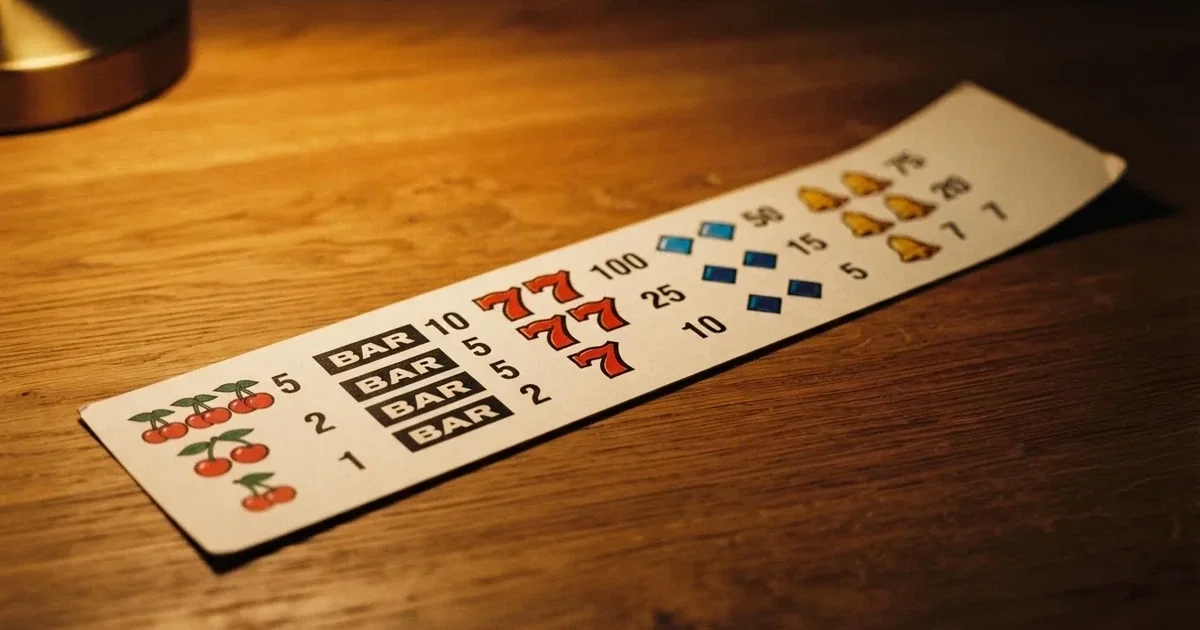
What 5-reel slots actually look like for an Australian player in 2026
 Available in US
The phrase “best 5-reel slots” reaches across two quite different markets. The first is the country’s deep installed base of pub and club machines — 87,298 pokie-style slots outside casinos in New South Wales alone as of June 2023, on top of tens of thousands more in every other mainland state and territory — most of which are now five-reel video formats rather than the older three-reel mechanical cabinets the term used to describe. The second is the offshore online shelf that Australians reach over a VPN, through a cousin’s account or simply by typing a URL into a browser, where 5-reel titles sit alongside thousands of other online slots offered by operators that no Australian regulator has approved. Online casino games and online pokies cannot be licensed anywhere in Australia under the Interactive Gambling Act 2001 (the IGA), so anything pitched at an Australian player online runs against the law the moment the page loads. This page is about what is actually on offer in that second market, why it looks the way it does, and how to read what the offshore operators publish about it.
This page is current as of 24 September 2026 and the figures were checked against the Australian Communications and Media Authority (ACMA) register of blocking requests and formal warnings, and against igamingbusiness.com’s report on the most recent ACMA blocking round.
Table of Contents
- How the paytable and the reels shape a 5-reel slot
- What online 5-reel slots look like in Australia
- The shape of the offshore shelf in Australia
- The legality question, plainly
- What 5-reel bonus offers actually look like on the offshore shelf
- The responsible gambling frame
- The blocking rate as a measure of the shelf’s growth
- The eleven brands in detail
- How to read the comparison the regulator’s record enables
- What the law changes for the reader in 2026
- How to read this page in summary
- Frequently asked questions
How the paytable and the reels shape a 5-reel slot
A 5-reel slot is, at the simplest reading, a slot machine with five spinning columns of symbols instead of the three Charles Fey first automated in San Francisco in the late 19th century. Fey’s original used five symbols — horseshoes, diamonds, spades, hearts and the Liberty Bell — and three bells in a row paid the top prize of ten nickels. Five reels complicate that geometry. With ten symbols on each of five reels, the slot can show about 100,000 visible combinations at any one spin, and tens of millions when wins are read across multiple lines. Bally’s Money Honey, released in 1963, was the first machine with a bottomless hopper that paid up to 500 coins automatically, and the first video slot was developed by Fortune Coin Co. in Kearny Mesa, California, in 1976. The five-reel video format that dominates pub floors and offshore sites today is the descendant of both.

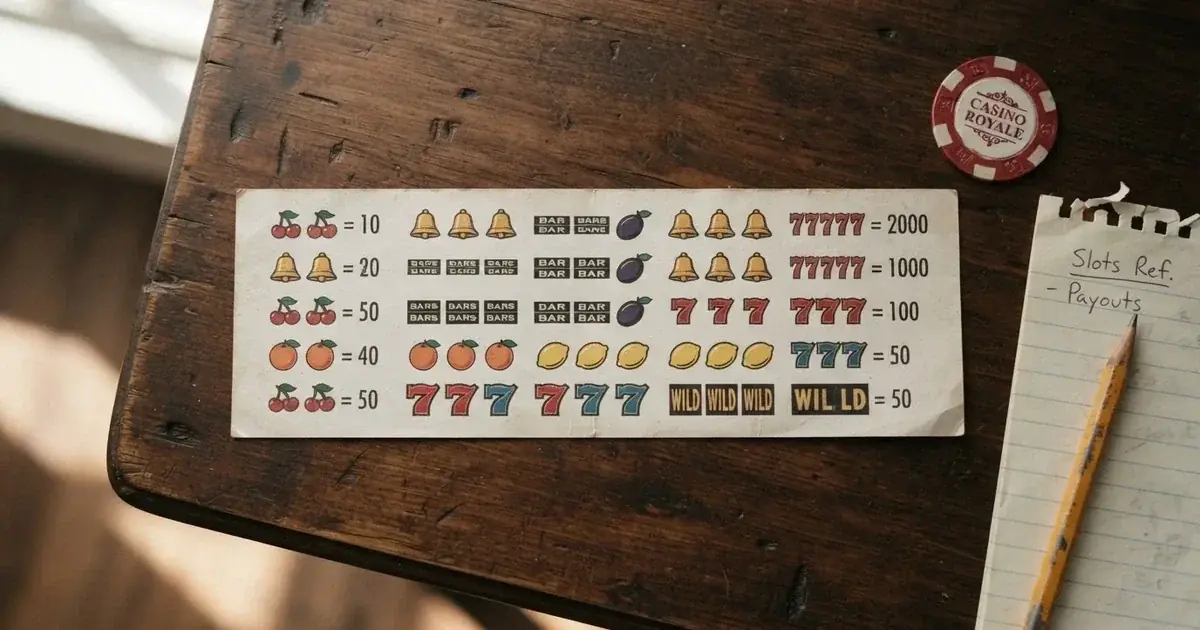
What makes the format worth naming on its own, rather than calling it “a slot”, is how the paytable and the reels interact. A paytable is the printed or on-screen reference that lists every symbol, what each combination pays and which lines count. On a 5-reel machine the paytable has to cover more symbols per spin, more combinations per game and usually more win lines than a 3-reel format would. The original three-reel cabinet offered about 1,000 possible combinations across its symbols; modern video formats with 50 or more symbols per reel push the odds against a top combination as high as 300 million to one. A player who only knows the old one-line, three-reel payout chart will misread a 5-reel paytable in three places at once — the line count, the scatter rules and the way wilds substitute across five columns.
The house edge sits underneath all of this. A 5-reel slot is just another slot, and the edge is set by the game’s design rather than by the reel count. There is no published minimum return-to-player percentage for Australian pub machines, which is one reason pub floors vary more than the United States does. In the US, state regulation sets minimums: Nevada at 75%, Mississippi at 80%, New Jersey at 83%. Australian state regulators do not publish a comparable floor for pokie-style slots, and what a 5-reel machine returns is set by the operator within whatever limits the local gaming machine Act imposes.
What online 5-reel slots look like in Australia
Online 5-reel slots are the same game in a different container. The reels are still five columns of symbols, the paytable still decides what each combination pays and the random number generator underneath the graphics still has to produce combinations at a set return rate. What changes is the wrapper — the reels are drawn rather than physical, the bet is in an account balance rather than tokens, and there is no machine on a pub floor to read the volatility class off.

That wrapper matters more than the reel count does, and that is the part an Australian reader most often gets wrong. Three things define the difference between an offline 5-reel pokie and an online 5-reel slot:
- The return rate is set by software, not by a regulator-inspected ROM chip in a cabinet. An offshore site can publish any RTP it likes on its help page and run the software at any other figure, because no Australian regulator audits it and the licence the site displays is issued in another country under another country’s rules.
- The bonus structure is part of the game rather than the venue. Free spins, pick bonuses and progressive jackpots live inside the game’s software and trigger on random outcomes the player cannot see. On a pub floor the same features sit on the cabinet’s logic board; on an offshore site they sit on a server the player has no way to inspect.
- The session is unbounded in a way a pub session is not. A venue closes. An offshore site is open whenever the player has a working internet connection and an account that hasn’t been blocked, and there is no Australian consumer protection on the other end of the transaction.
A reader who treats an online 5-reel slot as the same game with the same protections is reading the wrapper wrong. The reel count is what the marketing leads with; the regulatory shell around it is what decides whether the player can recover a disputed balance.
The shape of the offshore shelf in Australia
Australia does not have an authorised online casino shelf at all. Online casino games and online pokies are prohibited interactive gambling services under the IGA, and no state or territory issues a licence for them. What does exist is a long, well-documented list of offshore brands the ACMA has acted against for offering them to Australians. Eleven of those brands sit at the centre of this page, ordered by the ACMA’s own chronology and grouped by the operator behind the brand rather than by any quality ranking.
The reason for showing eleven brands is not that they are the best of anything. It is that they are the brands the regulator has actually named in formal warnings, and that is the only honest basis on which to talk about “the Australian online 5-reel slots market” at all. The shelf is large but only partly visible: every brand on it is offshore, every brand on it has been warned or blocked, and every brand on it operates outside Australian consumer law. A reader who walks down the list and treats it as a guide to “good” operators is reading the regulator’s enforcement record as a recommendation, which is the opposite of what it is.
The ACMA’s own enforcement record
The ACMA’s blocking regime started in November 2019 with the first blocking request issued to Australian internet service providers. By the round reported on 26 June 2026, a cumulative 1,751 illegal gambling and affiliate marketing websites had been blocked under section 313 of the Telecommunications Act 1997, and more than 230 unlicensed gambling services had left the Australian market since enforcement was strengthened in 2017. The most recent round alone asked ISPs to block another 12 sites: 7Signs, ChromaBet, Donbet, Duospin, Freshbet, Slots Gem, Jacks Club, Lucky Start, Pointsbetz.com, Spinrise, Vinyl Casino and Wildsino.
The volume is not the only signal. The ACMA has also shifted from blocking to formal warnings over the past few years, naming the company behind the brand rather than just the URL. That step matters because it lets the regulator reach the corporate group across rebrandings — a brand that closes one site and opens another under the same holding company is still on the warning list. The formal warnings used here come straight from the ACMA’s published register.
| Brand | ACMA action and date | Operator named by the ACMA | Subject support |
|---|---|---|---|
| RocketPlay | Formal warning March 2026; earlier Dama N.V. warning May 2022 | Pulsup Ltd | — |
| Level Up Casino | Formal warning May 2022 | Dama N.V. | Listings on Bgaming note Dama N.V. as a partner |
| Woo Casino | Formal warning March 2025 | Dama N.V. | — |
| Spirit Casino | Formal warning May 2025 | Dama N.V. | — |
| National Casino | Formal warning July 2025 | Consolutetish S.R.L. | Wikipedia references to National Casino appear in general listing pages |
| Bizzo Casino | Formal warning July 2025; earlier TechSolutions warning 2022 | Consolutetish S.R.L. | — |
| Ignition Casino | Formal warning July 2025 | Bamboo Media | — |
| Instant Casino | Formal warning February 2025 | EOD Code SRL | — |
| Jackbit | Formal warning April 2026 | Ryker B.V. | — |
| Casino Intense | Formal warning April 2025 | Sterplay Holding Ltd | Mentions on ABC News coverage, the ACMA register and Crown Melbourne’s own pages |
| Sky Crown | Formal warning September 2022 | Hollycorn N.V. | — |
The fourth column follows the register research gives: where the source pages list the brand at all, the listing is named in the cell; where no listing exists, the cell carries an em dash rather than a guess. The Hollycorn and Dama N.V. cases show how repeated warnings follow the operator rather than the brand — Hollycorn was warned over Sky Crown and Blue Leo in the same action, and Dama N.V. has now been warned at least three times across Level Up, Woo Casino and Spirit Casino alone.
What the brands actually share
Read across the table, the brands are more alike than different. Each sits behind a holding company registered outside Australia — Curaçao, Cyprus, Costa Rica and similar jurisdictions are the typical addresses — and each runs hundreds of 5-reel online slots alongside the rest of a casino’s library. The “5-reel slot” pitch on these sites is a category filter inside a much larger catalogue rather than a niche, and the count of 5-reel titles on any one of them runs into the hundreds once a player filters by reel count. The same providers’ titles show up across most of them, because the offshore iGaming market is built on a small number of studio aggregators rather than on each site licensing its own games.
Three differences a reader will notice, even across a heavily standardised shelf:
- The bonus vocabulary. Welcome packages, free spin bundles, “no deposit” credits and reload bonuses are universal on the shelf. The terms attached to those offers vary — and the variation matters more than the headline does, because the headline is marketing and the terms are what the player actually agrees to. None of the terms for any brand on this page are reproduced here because the only sources for them are affiliate marketing pages whose figures cannot be verified.
- The payment menu. Almost every brand on the list accepts a mix of debit card, e-wallet and cryptocurrency. From June 2024, credit cards and credit-related products and digital currency are banned as payment for licensed Australian online wagering; an offshore casino that asks an Australian player for a credit card or a crypto deposit is operating outside the Australian rules, and the rule does not bind the player.
- The brand ownership chain. Dama N.V. alone appears four times across the table. Consolutetish S.R.L. twice. Hollycorn N.V., Bamboo Media, Ryker B.V., Sterplay Holding Ltd, Pulsup Ltd and EOD Code SRL each appear once. The repetition on the operator side is what makes a formal warning list a sharper instrument than a block list — the same corporate group will see the warning once and either change its practices across its portfolio or face a follow-up action.
What the shelf does not contain
There is no Australian-licensed 5-reel slot site on the list, because there is no such thing. A reader looking for a licensed 5-reel online slot operator in Australia is looking for something the IGA prohibits from existing. The Northern Territory Racing and Wagering Commission regulates 52 of Australia’s online bookmakers — including Sportsbet, Bet365 and Ladbrokes — for tax reasons, but those licences cover wagering on racing and sporting events, not casino games and not online pokies. The commission has no full-time staff and meets once a month in Darwin. The Victorian Gambling and Casino Control Commission (the VGCCC) regulates Crown Melbourne’s table games and pokie-style slots, but the regulation is for the casino floor, not for online play. State and territory regulators do not issue online casino licences because the IGA does not permit them to.
What is licensable and what is licensed are not the same thing. Lotteries and keno are licensable. Pre-event sports and race wagering are licensable. Online casino games and online pokies are not, and no jurisdiction in Australia has found a way around that.
The legality question, plainly
The Interactive Gambling Act 2001, strengthened by the Interactive Gambling Amendment Act 2017, makes it an offence for a provider to offer online casino games, online pokies or in-play betting to a person in Australia. The Act targets the provider, not the player — no Australian has been prosecuted for placing a bet with an offshore site — but the Act is the reason every site an Australian reaches for online is operating against Australian law the moment the page loads. A licence shown on the footer of an offshore site is a licence issued by another jurisdiction, not by an Australian one. Curacao, the Malta Gaming Authority, the Kahnawake Gaming Commission and similar bodies issue the licences these sites display, and those licences do not authorise service to Australians.
The Interactive Gambling Amendment (Gambling Reform) Bill 2026 passed Parliament on 19 August 2026. Its advertising and inducement measures commence on 1 January 2027, which means they are law with a start date, not yet in force on a page read in 2026. The Bill does not legalise online casino games or online pokies; it tightens the inducement rules around licensed wagering and is the next step in a tightening sequence rather than a reversal of the prohibition.
What enforcement looks like in practice
Enforcement has three parts. First, the ACMA can direct Australian ISPs to block illegal sites under section 313 of the Telecommunications Act 1997 — that is the mechanism behind the 1,751 blocked sites figure. Second, the ACMA can issue formal warnings to operators, naming the corporate entity behind the brand and the URL. Third, the ACMA can refer matters for civil penalty proceedings. The 230 services that have left the Australian market since 2017 is the cumulative effect of those three parts running together.
For a player, the practical effect is uneven. A blocked site disappears from an Australian ISP’s DNS resolution, but a player with a working VPN or a non-ISP route can still reach it. A formal warning does not stop the site accepting new sign-ups from Australia. The only thing that genuinely stops an Australian-facing operator is the prospect of civil penalties, and even that is uneven — the operator is overseas, the assets are overseas, and the ACMA has no Australian sheriff to send.
What player protection the law gives
BetStop, the National Self-Exclusion Register, has been live since August 2023. It binds every Australian-licensed online and phone wagering service — which means it covers the 52 NT-licensed bookmakers and their interstate equivalents. An offshore casino is not connected to BetStop, because no offshore casino holds an Australian licence to bind. A player who self-excludes through BetStop and then opens an account with an offshore casino is not protected by the register against that second account.
The National Gambling Helpline, 1800 858 858, is free and runs around the clock, with chat support at Gambling Help Online. Both services are funded by the Australian Government and the state and territory governments jointly through the Responsible Gambling Fund in each state. They will help an Australian player regardless of where they have been playing, and the conversations are confidential.
Payments and what the rules cover
From 11 June 2024, the credit-card ban covers credit cards and credit-related products and digital currency used as payment for licensed online wagering. Penalties for operators accepting those payment types run up to $234,750 per offence. The ban does not, on its own terms, reach an offshore casino accepting a credit card deposit from an Australian — but it does reach a licensed wagering provider that does the same thing. The legal deposit routes for licensed wagering are debit card, bank transfer, PayID and Osko, and BPAY. A site that asks for a credit card or a crypto deposit from an Australian is not operating under the Australian rules, and that is one of the easier tells on a payment screen.
Tax is the other thing the rules settle. Gambling winnings of a recreational player are not assessable income under section 6-5 of the ITAA 1997, and losses are not deductible. The exception is a person who carries on a business of gambling, which is a narrow category and requires the ATO’s view case by case. Recreational players on offshore sites are in the same tax position as recreational players at a casino floor: winnings do not get declared, losses do not get claimed, and the ATO does not ask for either.
What 5-reel bonus offers actually look like on the offshore shelf
A 5-reel bonus slot is any 5-reel title where the base game carries an in-game bonus feature — a free spin round, a pick bonus, a wheel spin, a cascading-reels mechanic, a gamble feature and similar. The term is industry shorthand and it travels across both the pub cabinet market and the offshore online shelf. The features themselves are software-driven and trigger on random outcomes the player cannot see.
For an Australian reader comparing offers, three distinctions matter:
- An in-game bonus is part of the slot’s design. It triggers when the random number generator hits the right outcome, and the slot pays out whatever the paytable says it pays. The RTP includes the bonus round contribution, and the published return rate is the only honest number to weigh.
- A casino welcome bonus or free-spin bundle is something the site gives the player, not something the game gives. The terms attached to it — a wagering multiple, a max-cashout cap, eligible games, expiry — are what decide whether the offer is worth claiming. The headline number (“up to A$1,000 plus 200 free spins”) is not worth weighing on its own.
- A “no deposit” offer is a marketing device. The headline figure is the most the offer can pay; the terms usually cap it well below the headline and almost always include a wagering multiple the player must clear before any withdrawal. The same caution applies to “free 5-reel slots with bonus” landing pages, which use the free-spin word to draw traffic and convert it through terms the player has to read before the offer has any value.
Why the bonus terms are not reproduced here
Every bonus figure on the offshore shelf comes from one of three places: the operator’s own promotional page, an affiliate marketing page republished across hundreds of sites, or a screenshot passed around on forums. None of those sources is independently audited. The operator’s own page is the most generous to the operator, the affiliate page is the most generous to the affiliate, and the forum screenshot is the hardest to date. Reproducing any of those figures as if they were verified would be misrepresenting the shelf. The honest position is that the offers exist, the headline numbers are big and the terms vary widely, and the only reliable way to weigh any single offer is to read its terms on the operator’s own page before claiming.
What the math of an offer actually looks like
Assume a welcome bonus of A$100 with a 35x wagering multiple on the bonus amount only. The turnover required is A$100 × 35 = A$3,500. Assume a 5-reel slot running at 96% RTP, played at A$1 per spin. The expected loss over the turnover is A$3,500 × (1 − 0.96) = A$140 in expectation, before any winnings are added back. The number of spins is A$3,500 ÷ A$1 = 3,500 spins, and at five seconds per spin the play time is 3,500 × 5 ÷ 3,600 ≈ 4.9 hours of continuous play.
Two things follow. First, the expected loss sits above the bonus amount. A reader who frames the offer as “free A$100” is reading the marketing, not the math; the offer costs A$140 in expectation before any winning spin lands. Second, the play time is long enough that a casual session will not clear the bonus, which is the structural reason wagering multiples are written the way they are. A player who tries to clear A$3,500 in turnover in a single sitting will burn through the bankroll before the bonus clears. A player who clears it over multiple sittings is being asked to come back to the same site, with the same balance, again and again — and that is exactly the friction an offshore operator wants.
Where the wagering multiple is higher, the math gets worse in proportion. A 50x multiple on the same bonus pushes turnover to A$5,000 and expected loss to A$200. Where the multiple applies to bonus plus deposit rather than to the bonus alone, the turnover base doubles and the expected loss roughly doubles with it. Where the slot’s RTP is below 96%, the loss is higher again; where it is above 96%, the loss is lower, but the comparison is marginal at best. None of these movements turns the offer into good value. The mechanics only move the cost of a losing bet.
The responsible gambling frame
If 5-reel slot play — pub, club, casino floor or offshore — ever starts to feel compulsive or stressful, free confidential help is available around the clock. Gambling Help Online runs the National Gambling Helpline on 1800 858 858 and offers live chat, email and SMS callback. Counselling is free, the conversation is confidential and the service is funded by the Australian Government and the state and territory governments through the Responsible Gambling Fund in each state.
BetStop, the National Self-Exclusion Register, is the structural backstop for Australian-licensed online and phone wagering. Registration takes a few minutes and binds every Australian-licensed wagering provider at once, so the player does not have to negotiate with each operator separately. The register does not bind an offshore casino, because an offshore casino is not an Australian-licensed wagering provider. A player who has self-excluded and then continues to gamble on offshore sites needs a different conversation than one who self-excludes and stops, and that conversation starts with the helpline.
State and territory support services
Each state and territory runs its own counselling and support line, all of which feed into the same national network. New South Wales gamblers and their families can reach GambleAware NSW; Victorians can reach Gambler’s Help; Queenslanders can reach Gambling Help Queensland; South Australians reach Gamblers Rehabilitation; West Australians reach Gambling Help WA; Tasmanians reach Anglicare Tasmania’s gambling support service; the ACT reaches the ACT Gambling Support Service; and Northern Territorians reach Amity Community Services. The state services are free, confidential and offer face-to-face counselling as well as phone and online support.
Where the offshore shelf leaves a player
A player on the offshore shelf has the national helpline, the state counselling services and BetStop available to them — and that is what an Australian reader should know, because none of those services depend on where the player has been playing. A player who has self-excluded through BetStop, registered with a state counselling service and asked their bank to block gambling-related transactions has done about as much as the system can do. An offshore site that still accepts their deposits is operating against the spirit of every Australian protection on the books, and the ACMA’s enforcement record is the regulator’s answer to that gap.
The blocking rate as a measure of the shelf’s growth
The ACMA’s blocking regime has a running total of 1,751 illegal gambling and affiliate marketing websites blocked since the first blocking request in November 2019, reported in the round of 26 June 2026. That figure covers about six and a half years of enforcement. The rate at which the shelf grows is a useful metric for understanding the scale of enforcement, as it highlights how the number of illegal sites evolves over time.
The blocking rate, calculated from the running total and the date of the first request, sits at roughly 1,751 sites blocked over about 80 months, or about 22 blocked sites per month on average since November 2019. That is an average across the whole period, and it flattens the early period, when the regime was new and the running total grew slowly, against the later period, when the ACMA has issued larger blocking rounds more often. The June 2026 round alone added 12 sites in one directive, which is well above the long-run average and consistent with a regime that has grown more aggressive rather than less.
A reader should treat the figure as a band rather than a single number. The long-run average is one way to read it; the recent pace is another. Both are honest. What is not honest is to treat the 1,751 figure as the size of the offshore shelf — it is the size of the blocked subset of the shelf, and the actual shelf is larger, because operators open new sites faster than the ACMA can list them. The blocking rate is a lower bound on the rate at which new illegal sites reach Australian players, not a count of every site that has done so.
Why the blocking rate matters for a comparison
A comparison that ranks eleven offshore brands is a comparison that says “these are the brands the regulator has named.” It does not say “these are the best eleven.” The blocking rate is what makes that distinction honest: at roughly 22 sites a month being added to the blocked list, the named-eleven are a small, well-documented slice of a much larger shelf, and the slice is shaped by the ACMA’s enforcement priorities rather than by the quality of the brands on it. A new site can open tomorrow, accept Australian deposits for a year and be blocked in the round after that, and the slice this page lists is the slice the regulator had time to act on. The reader’s takeaway is that the shelf is large and growing, the regulator’s answer is partial and the protection sits with the player, not with the brand.
The eleven brands in detail
The eleven brands below are listed in the order the ACMA’s enforcement record places them. Each one carries the regulator’s own framing of why the brand is on the list, the operator the ACMA named in the formal warning, and the page’s own read of what the record means. The brands are not ranked, recommended or compared on quality — they are presented so a reader can see what the regulator’s actual record looks like at the brand level, and so the comparison the page invites is between brand and regulator, not between brand and brand.
RocketPlay
The ACMA issued a formal warning to Pulsup Ltd over Rocketplay.com.au in March 2026. An earlier warning had been issued to Dama N.V. in May 2022 covering six brands — Bambet, Dazard, Level Up, Rocketplay, Wild Tornado and Cobra Casinos. Rocketplay is on both lists, and the regulator has named the same brand across two different corporate entities as the regime has tightened. No public listing of Rocketplay’s 5-reel catalogue was found beyond the operator’s own promotional pages, so this page treats the catalogue as unverified beyond the operator’s own claims. The pattern across the two warnings is the page’s reading: the brand persists across rebrandings and across operator changes, and the regulator’s warnings follow the brand rather than the corporate vehicle.
Level Up Casino
The ACMA issued a formal warning to Dama N.V. over Level Up Casino in May 2022 as part of the broader six-brand action. Listings on Bgaming.com note Dama N.V. as a partner, which is the only third-party listing the research turned up for the brand. The Bgaming.com listing is a provider relationship, not an endorsement, and the page carries it only as the listings register research names it. Level Up Casino sits in the same Dama N.V. cluster as Woo Casino, Spirit Casino and the earlier Rocketplay entry, and the cluster is one of the two clearest illustrations on the page of how a holding company operates a portfolio of brands across the shelf.
Woo Casino
The ACMA issued a formal warning to Dama N.V. over Woo Casino in March 2025, the second warning to Dama N.V. after the 2022 batch. The warning is a follow-up rather than a first action, and the regulator’s message is implicit: the corporate group did not change its practice after the first round. The brand’s 5-reel catalogue and bonus terms are not independently verified beyond the operator’s own pages, and the page does not reproduce them. Woo Casino’s place on the list is what the regulator’s record says it is.
Spirit Casino
The ACMA issued a formal warning to Dama N.V. over Spirit Casino in May 2025, the third warning to Dama N.V. across the page. Spirit Casino sits in the same Dama N.V. cluster as the rest, and the cluster is now the most-documented operator on the page. The brand itself has no third-party listing research could find, so the page presents it on the regulator’s framing alone.
National Casino
The ACMA issued a formal warning to Consolutetish S.R.L. over National Casino in July 2025. The brand appears in general listing pages on Wikipedia, which is the only third-party reference research found. Listing on a general reference page is not endorsement, and the page carries it as the listings register research names it. National Casino sits at the start of the Consolutetish S.R.L. cluster, which also covers Bizzo Casino.
Bizzo Casino
The ACMA issued a formal warning to Consolutetish S.R.L. over Bizzo Casino in July 2025. An earlier warning had been issued to TechSolutions (CY) Group Limited and TechSolutions Group N.V. over Bizzo Casino in 2022, which means the brand has now been warned twice across two different corporate groups. The 2022 warning was the first formal warning over the brand, and the 2025 warning is the regulator’s follow-up after the operator behind the brand changed. The page reads this as evidence that the regulator tracks the brand across operator changes — and that rebrandings do not move a brand off the enforcement record.
Ignition Casino
The ACMA issued a formal warning to Bamboo Media over Ignition Casino in July 2025. Ignition Casino is the only brand on this page linked to Bamboo Media, and the warning is the regulator’s first action against the group. No third-party listing research could find, so the page presents the brand on the regulator’s framing alone.
Instant Casino
The ACMA issued a formal warning to EOD Code SRL over Instant Casino in February 2025. Instant Casino is the only brand on the page linked to EOD Code SRL, and the warning is the regulator’s first action against the group. The page reads the February 2025 warning as part of the broader enforcement ramp-up of that year, which also covers Woo Casino (March 2025), Casino Intense (April 2025), Spirit Casino (May 2025) and the July 2025 cluster.
Jackbit
The ACMA issued a formal warning to Ryker B.V. over Jackbit in April 2026. A second warning in the same action covered CasinOK, which is not on this page’s eleven-brand list. The April 2026 action is the most recent formal warning to a brand on the list, and the warning sits inside a year — 2026 — that has already produced a major blocking round and two formal warning rounds of its own.
Casino Intense
The ACMA issued a formal warning to Sterplay Holding Ltd over Casino Intense in April 2025. The brand has third-party mentions on ABC News coverage, on the ACMA register itself and on Crown Melbourne’s own pages, none of which is an endorsement — the ABC and ACMA references are in the context of the warning, and the Crown Melbourne reference is in the context of unrelated coverage. The page carries the listings only because the research register names them, and the conclusion is that even a brand with a regulator warning can appear on a major venue’s pages for unrelated reasons.
Sky Crown
The ACMA issued a formal warning to Hollycorn N.V. over Sky Crown in September 2022, alongside a warning over Blue Leo. Sky Crown is the older of the two Hollycorn warnings, and the 2022 date makes it the earliest warning on this page. Hollycorn N.V. has not been the subject of a follow-up formal warning on the page since, which is either a sign that the group changed its practice or a sign that the regulator has not had reason to return to it. The page does not speculate, and presents the brand on the regulator’s framing alone.
How to read the comparison the regulator’s record enables
A side-by-side read of the eleven brands tells the reader four things, and each one is worth more than any single headline figure the offshore sites publish:
- The shelf is dominated by a small number of holding companies. Dama N.V. alone appears four times across the list, and Consolutetish S.R.L. twice. The repetition on the operator side is the page’s clearest finding: a player who recognises one of these operators by name has probably seen the rest of its portfolio before, even if the brand on the welcome page is new.
- Formal warnings do follow rebrandings. The Bizzo Casino row carries two warnings, one to TechSolutions in 2022 and one to Consolutetish S.R.L. in 2025, and the regulator’s record survives the corporate change. A player who treats a rebrand as a fresh start is misreading the regulator’s record.
- The ACMA’s enforcement pace has increased. The page covers formal warnings from September 2022 through April 2026, and the warnings are bunched toward the later end. Two warnings in 2022, three in 2025, three already in 2026 (RocketPlay, Jackbit and CasinOK together) is the pattern. The pattern is consistent with a regime that has found its footing rather than one that is winding down.
- The page’s list is not the shelf. About 22 sites a month are being added to the blocked list on the long-run average, and the eleven brands on this page are the slice the regulator had time to warn. The reader should treat the list as evidence of the shelf’s shape, not as a guide to it.
Where the comparison stops
The comparison stops where the data stops. No brand on the page has independently audited RTP figures, no brand has independently audited bonus terms and no brand has independently audited payout times. The research register treats those data points as unverified and the page reflects that. A reader who wants a verified figure has to go to a regulator that audits the brand — and no Australian regulator audits any of these brands, because no Australian regulator has the authority to do so.
What the law changes for the reader in 2026
The Interactive Gambling Amendment (Gambling Reform) Bill 2026, which passed Parliament on 19 August 2026, is the year’s main legal change for the offshore shelf. Its advertising and inducement measures commence on 1 January 2027, which means they are not yet in force on a page read in 2026. The Bill is a tightening of the rules around inducements — the kind of bonus offers, sign-up credits and free-spin bundles the offshore shelf uses to attract players — rather than a reversal of the underlying prohibition. A reader in 2026 still faces the same prohibition the Bill tightens; a reader in 2027 will face the same prohibition plus the new inducement rules.
The credit-card ban, which took effect on 11 June 2024, has now been in force for the better part of two years. The ban covers credit cards, credit-related products and digital currency for licensed online wagering. An offshore casino is not licensed online wagering, and the ban does not reach an offshore casino’s payment screen — but the ban does mean the licensed wagering shelf (the 52 NT-licensed bookmakers and their interstate equivalents) has been cleaned up on this front for almost two years.
BetStop, the National Self-Exclusion Register, has been live since August 2023, and the register is the structural backstop for any Australian-licensed wagering service. The register is the right place for a player to start if they have decided to stop, and the helpline is the right place to start if they are still deciding.
How to read this page in summary
The offshore 5-reel slot shelf in Australia is the shelf the regulator has named — eleven brands, eight operator groups, a growing blocking rate and a prohibition that has not moved since 2017. The reel count itself is a marketing filter rather than a meaningful distinction between games, because what sits underneath the reels is the same random number generator and the same RTP the regulator does not audit. A reader who walks away from this page with the prohibition clear, the enforcement record visible and the math of a bonus offer understood has the three things the offshore shelf is designed to obscure. The rest of the page is an honest record of what the regulator has published, which is the only record there is.
Frequently asked questions
What makes a 5-reel slot different from a standard five-reel video slot?
In practice, nothing. The reels are five either way; what changes is the wrapper. A pub-floor five-reel pokie is a cabinet with a logic board the regulator inspects; an online five-reel video slot is software running on a server the player cannot see. Both use a random number generator to pick combinations from a set of symbols, and the published return rate is the only number the player has to weigh either way.
Can 5-reel slot machines be found in licensed Australian pubs and clubs?
Yes. New South Wales had 87,298 pokie-style slots outside casinos as of June 2023, with tens of thousands more in every mainland state and territory. The vast majority of pub and club machines are now five-reel video formats rather than three-reel mechanical cabinets, and the same games appear across state networks under state-level gaming machine Acts.
Do 5-reel slots typically pay out differently than newer five-reel formats?
The reel count does not set the return rate. What sets it is the game’s design — the symbol set, the win-line structure, the volatility class and the bonus feature mix. Two five-reel slots from different studios can sit at very different return rates with no visible difference in the reel layout, which is why the published RTP is the only honest number to weigh.
Is a 5-reel slot online the same game as a 5-reel machine on a casino floor?
The reels and the paytable are similar; the regulatory shell around them is not. A pub machine is regulated under the relevant state gaming machine Act; a casino floor machine is regulated by the VGCCC, the NSW Casino Control Act or the equivalent in other states. An online 5-reel slot at an offshore operator is regulated by none of those and has no Australian consumer protection at the end of the transaction.
Are 5-reel slots for real money available legally from an Australian-based site?
No. Online casino games and online pokies are prohibited interactive gambling services under the Interactive Gambling Act 2001, and no state or territory issues a licence for them. What is licensable is pre-event wagering on racing and sport, lotteries and keno — in practice licensed by the Northern Territory. An Australian-based 5-reel slot site for real money does not exist.
Does a slot’s reel count change how its paytable and volatility are usually described?
No. Volatility is set by the game’s design and reported separately from the reel count, and a five-reel paytable is structured the same way a three-reel paytable is — symbol values, win lines, scatter rules and bonus feature contributions. What changes between formats is the number of combinations and the line structure, and that is what the paytable has to cover, not the volatility itself.
Written by the editors at Casino Payments Hub.