Aussie Crypto Casino 2026: The Marketing, the Offshore Licence, and the ACMA’s Record
 Available in US
“24 September 2026 — checked against the Australian Communications and Media Authority (ACMA) register of formal warnings and blocking requests.”

An Aussie crypto casino is, on the evidence the ACMA itself publishes, an offshore operator that has chosen to brand itself for an Australian audience. The word “Aussie” describes the marketing it wants to attract, not a regulator that has signed it off. Under the Interactive Gambling Act 2001 no online casino game and no online pokie can be licensed anywhere in Australia, so any site accepting Australian players does so without Australian consent — and the regulator’s record of formal warnings, blocking requests and operator renamings is the only public ledger of who is doing the offering. This page walks through that ledger, what it costs a player to ignore it, and how the maths of a crypto deposit compares with the marketing the brand runs on it.
The page does not recommend any specific operator, as the law has already spoken on the underlying activity. What follows is the consequence of that position for a reader who is researching the market and wants to understand what the warnings and the figures actually say before they decide.
Table of Contents
- The landscape: what “Aussie crypto casino” describes
- Legality: how the Interactive Gambling Act 2001 actually reads
- Responsible play: the tools that still work offshore
- Crypto and anonymity: how the rails actually work
- The comparison: eleven brands the ACMA has acted against
- Operator write-ups
- What this all means for the player
- Frequently asked questions
The landscape: what “Aussie crypto casino” describes
For “Aussie crypto casino 2026” the shape is: a casino-style site, a wallet deposit in bitcoin, ethereum or a stablecoin, and a front end that leans hard on Australian cues — the kangaroo silhouette, the gold-outback colour scheme, AUD-equivalent stake buttons, sometimes a “pokies” tab. None of that is regulated. The product underneath is the same product a Curaçao or Anjouan-licensed site offers to a player in Bogotá or Berlin, with the same game providers, the same bonus T&Cs and the same offshore bank routing.
What makes the “Aussie” front end notable is that it is built for a market whose own regulator has formally told the operator to stop. The ACMA’s register of formal warnings is the public record of who has been told, when, and over what corporate vehicle. The set is not abstract: it names companies (Dama N.V., Hollycorn N.V., Ryker B.V., Bamboo Media, Consolutetish S.R.L., EOD Code SRL, Sterplay Holding Ltd, Pulsup Ltd), it names brand front ends (RocketPlay, Level Up, Woo Casino, Spirit Casino, National Casino, Bizzo Casino, Ignition Casino, Instant Casino, Jackbit, Casino Intense, Sky Crown), and it names months and years. The ACMA has done the identification work; the rest of this page reads its work.
The page closes those shelves in this order: the overview above; the legality the regulator enforces; the player-protection tools that still exist for an Australian who wants to step back; how crypto actually travels from an Australian wallet to an offshore site, and what anonymity that does and does not buy; then the eleven-brand comparison the ACMA register makes possible. A worked calculation sits inside that last shelf — how many blocks per month the ACMA has been issuing since November 2019, with the source numbers stated plainly.
Legality: how the Interactive Gambling Act 2001 actually reads
The Interactive Gambling Act 2001, hardened by the Interactive Gambling Amendment Act 2017, makes it an offence to provide an online casino game or an online pokie to a person physically in Australia. State and territory regulators cannot license around that prohibition: there is no Australian licence to apply for. What is licensable is wagering on a race or sporting event placed before the event starts, lotteries and keno — in practice licensed by the Northern Territory Racing and Wagering Commission, the de facto national wagering regulator that signs off Sportsbet, Bet365 and Ladbrokes for tax reasons and, by ABC’s reporting in April 2026, runs on a part-time board meeting monthly in Darwin.
The IGA targets the provider, not the player. A punter in Sydney who opens an account at an offshore crypto casino is not personally prosecuted. What the player does lose, immediately and for the duration of the relationship, is Australian consumer protection. There is no local disputes body to complain to. There is no Australian licensee to cancel a bonus term retroactively. There is no local payment route the player can lean on if a withdrawal stalls. The deposit is denominated in a token whose volatility the player carries, on rails the player has no statutory claim over, to a counterparty the player cannot serve.
Two consequences flow from this that the marketing copy never explains. First, an offshore crypto casino can be blocked at the network level by the ACMA while a balance is still sitting in the player’s account, and the player has no recourse — the operator’s terms usually disclaim liability for “regulatory action”, and an Australian court will not enforce a foreign gambling judgment. Second, the operator itself can be rebranded overnight: Dama N.V. ran Level Up, Rocketplay, Wild Tornado, Cobra, Bambet and Dazard in 2022; the same vehicle ran Woo Casino and Spirit Casino in 2025; Consolutetish S.R.L. took over National Casino and Bizzo Casino in 2025 after TechSolutions had already been warned in 2022. Same game providers under a new corporate name is the actual product.
What “blockchain” and “crypto” mean in this market
Picture a tablet screen displaying a network of glowing connected nodes against a dark background, the sort of diagram a casino’s “provably fair” page uses to illustrate a distributed ledger. The ACMA issued formal warnings over Woo Casino in March 2025 and over Spirit Casino in May 2025, both to Dama N.V., the operator that runs both brands. The image and the enforcement notice sit on opposite ends of the same transaction: the ledger makes the deposit settle in minutes; the warning sits in a public register that any Australian can read.
The distributed-ledger framing is real, in the technical sense. Bitcoin’s network has been adding a new block roughly every ten minutes since its genesis block was mined on 3 January 2009 by the still-pseudonymous Satoshi Nakamoto; the proof-of-work chain has run continuously since. Ethereum has been producing a new block roughly every twelve seconds since “The Merge” on 15 September 2022 switched it from proof-of-work to proof-of-stake. The settlement is what the marketing means by “instant”. What the marketing does not usually volunteer is what an Australian tax office does with the receipt of those tokens, or what an Australian financial-intelligence agency does with the on-ramp that minted them.
A pseudonymous wallet address is not anonymity. Every transaction on Bitcoin and on Ethereum is recorded on a public ledger that any block explorer can read. AUSTRAC’s enlarged digital-currency-exchange regime, in force from 31 March 2026, requires crypto-to-crypto exchanges, digital asset custody providers and stablecoin issuers to register with the agency regardless of where they are incorporated, on top of the crypto-to-fiat exchange registration that has been in place since 2018. An Australian resident who buys bitcoin on a registered exchange has been identified at the on-ramp, identified again if the exchange reports the transaction under AML/CTF rules, and identified a third time if the funds are later swapped for fiat onto an Australian bank account. The “anonymous” tag on a crypto casino’s payment page refers to the wallet, not to the person holding it.
The fundamentals: what a player is actually comparing
Picture a tidy desk with a laptop open on a plain search-results page, a notebook and a coffee cup beside it, no screens showing any casino branding. In July 2025 the ACMA issued formal warnings to Bamboo Media over Ignition Casino and to Consolutetish S.R.L. over National Casino and Bizzo Casino; Bizzo Casino had already been the subject of a 2022 formal warning to TechSolutions (CY) Group Limited and TechSolutions Group N.V. — two operators, one brand, three years apart. The picture is the search engine the player used to find any of those three.

That search is what an honest comparison rests on, and the ACMA register is the only document an Australian can rely on that the comparison is complete. There is no shortlist any regulated body publishes. There is no Australian consumer magazine that runs a comparative test of offshore crypto casinos. There is no dispute-resolution service an Australian can appeal to. The register of formal warnings is the closest thing the market has to a public review, and it is one-directional: it lists brands the regulator has found to be offering prohibited services, and it does not list brands the regulator has not yet inspected.
What the register does not do is tell a player which of the warned brands is “safer” than another. They are all unlicensed in Australia. They are all prohibited from offering casino games to a person in Australia. They differ in the corporate vehicle behind them, the date of the most recent warning, and the game providers they list — and the providers themselves move between operators when the operators are renamed. The honest reading of the register is that any brand on it should be treated as one data point in a sequence of related data points: the same operator using a new front end, the same front end under a new operator, the same game catalogue under either.
Responsible play: the tools that still work offshore
An Australian who has started opening accounts at offshore crypto casinos is not a customer any Australian regulator protects, and the consumer tools the IGA set up do not bind the offshore operator. BetStop — the National Self-Exclusion Register, live since August 2023 — applies only to Australian-licensed online and phone wagering services. A player who has self-excluded via BetStop can still open an offshore crypto casino account, because the offshore site is not connected to the register and has no obligation to check it. The register closes one door; the offshore doors stay open.
What does still work, regardless of where the gambling happens, is the support line. Gambling Help Online runs 24/7 chat, the National Gambling Helpline on 1800 858 858 is free across Australia, and financial counsellors take calls about gambling debt in plain language. None of those services is offshore-bound; a player who has run up a crypto-denominated balance on an unlicensed site can call from the same kitchen as a player who has run up a sportsbook debt, and the conversation is the same.
Two specifics that matter for the offshore case. First, credit cards and credit-related products are banned as payment for licensed online wagering since 11 June 2024, with operator penalties up to A$247,500 — so any site asking for a credit card or a crypto deposit from an Australian is, by definition, not running on the Australian licence framework. Second, capital losses on personal-use crypto assets are disregarded for CGT purposes, which means a player who loses crypto at an offshore casino cannot use the loss to offset other capital gains — a small but real cost the marketing copy never explains.
The plain reading: the responsible-gaming shelf still has the helpline and the counsellors; it does not have an Australian operator it can recommend a player to. A player who has been considering an offshore crypto casino because the licensed alternatives do not offer casino games has not been offered an alternative — the law has decided the product is prohibited, full stop — and the help available is help with the decision, not help with the product.
Crypto and anonymity: how the rails actually work
An Australian who decides to deposit at an offshore crypto casino moves the tokens through four stages, and each stage changes the privacy story.
The first stage is the on-ramp. To buy bitcoin, ethereum or a stablecoin, an Australian almost always uses a registered digital currency exchange. AUSTRAC requires registration regardless of where the exchange is incorporated; an unregistered exchange commits a criminal offence under the AML/CTF Act. The exchange performs KYC at signup, records the bank account the AUD came from, and reports transactions above its reporting threshold. A “no-KYC” exchange advertised on a Telegram channel is, on a strict reading of the AML/CTF Act, an unregistered DCE; an Australian using one is participating in the unregistered side of the transaction, not in an anonymous one.
The second stage is the wallet. Once the tokens are in the buyer’s wallet, the public address is pseudonymous in the same way a username is pseudonymous: every transaction it has ever conducted is on a public ledger. A wallet that has ever received from a registered exchange is traceable to that exchange; the exchange’s KYC record links the wallet to the holder’s real name.
The third stage is the deposit. The crypto casino publishes a deposit address. The buyer sends tokens from the wallet to that address. The transaction is recorded on the public ledger, immediately, against the casino’s address. The casino’s compliance team can read it; any investigator who later obtains the casino’s records can read it; the ATO can read it via the exchange.
The fourth stage is the off-ramp. When the player wins and tries to withdraw back to AUD, the casino sends tokens to a wallet the player controls. To spend those tokens in Australia — or to lock them in as a long-term store of value — the player usually sends them back to a registered exchange to convert to AUD. That exchange’s KYC record now captures the funds, with the casino’s deposit address as the counterparty.
The ATO treats bitcoin and ether as property, not money, so each disposal — selling for AUD, swapping for another crypto, or spending at the casino — is a CGT event. A 50% CGT discount applies to holdings longer than 12 months under current law; from 1 July 2027 a CPI-indexed cost base plus a 30% minimum tax rate on net capital gains replaces the flat discount. A capital gain on a personal-use asset is disregarded only if the asset cost A$10,000 or less to acquire, which excludes almost any meaningful casino deposit. A capital loss on a personal-use asset is disregarded entirely and cannot offset other gains.
That is the full chain. There is no step where the tokens become anonymous. There is no step where the ATO loses visibility. There is no step where the casino cannot identify the deposit. The “anonymous” label on the payment page is a brand word, not a property of the system.
Stablecoins, fees and confirmation times
The casino’s deposit page usually shows a coin picker. Bitcoin Cash is offered on many of these sites for the same reason it was forked out of Bitcoin on 1 August 2017 at block height 478,558: cheaper on-chain fees. Bitcoin Cash targets a ten-minute average block time with SHA-256 proof-of-work, has a 32-megabyte block size limit, and the Bitcoin Cash project describes transaction fees as “under a penny” with confirmations in minutes. Stablecoins — usually USDT or USDC — are offered for the opposite reason: the dollar peg removes the volatility risk between deposit and play.
The volatility risk is real. A bitcoin deposit at the start of a session is not the same bitcoin value at the end of it. A player who deposits 0.1 BTC and leaves the session down 0.01 BTC has lost 0.01 BTC, not a fixed AUD figure — and if BTC has rallied 10% in the meantime, the AUD loss is larger than the BTC loss suggests. The casino’s “play in crypto” framing makes the BTC loss feel smaller than the AUD reality, which is the opposite of what a player trying to track their spend needs.
The fee picture is the second half of the volatility picture. Bitcoin and Ethereum on-chain fees vary with congestion; the casino cannot control them and will not refund them when a withdrawal is delayed by a stuck transaction. Bitcoin Cash was designed in part to keep fees low, but the choice of coin does not change the volatility picture, only the fee one.
The comparison: eleven brands the ACMA has acted against
The ACMA’s register of formal warnings is the most honest comparator available for this market. Every brand below is on the register because the regulator has, in writing, found that the corporate vehicle behind it was providing prohibited interactive gambling services to Australians. The order below follows the chronology of the most recent action; the dates are the dates the ACMA itself published.
| Brand | ACMA action and date | Operator named by the ACMA | Subject support |
|---|---|---|---|
| Instant Casino | Formal warning, February 2025 | EOD Code SRL | — |
| Casino Intense | Formal warning, April 2025 | Sterplay Holding Ltd | — |
| Ignition Casino | Formal warning, July 2025 | Bamboo Media | — |
| National Casino | Formal warning, July 2025 | Consolutetish S.R.L. | — |
| Bizzo Casino | Formal warning, July 2025; earlier 2022 warning to TechSolutions | Consolutetish S.R.L. | — |
| Woo Casino | Formal warning, March 2025 | Dama N.V. | listed by en.wikipedia.org |
| Spirit Casino | Formal warning, May 2025 | Dama N.V. | — |
| Sky Crown | Formal warning, September 2022 | Hollycorn N.V. | — |
| Level Up Casino | Formal warning, May 2022 | Dama N.V. | — |
| RocketPlay | Formal warning, March 2026; earlier May 2022 to Dama N.V. | Pulsup Ltd | — |
| Jackbit | Formal warning, April 2026 | Ryker B.V. | — |
The table is the comparison. Each row is a brand, an action date, and the operator the regulator named. The fourth column, “Subject support”, records whether the brand’s cryptocurrency acceptance is independently confirmed outside the brand’s own marketing. Of the eleven brands, only Woo Casino has its crypto acceptance documented in an independent encyclopaedia listing; for the other ten, no independent listing was located, and the column reads — to make clear that the absence is data, not a judgement.
Three patterns fall out of the table when read across rather than down. First, Dama N.V. accounts for four of the eleven brands (Level Up, Woo Casino, Spirit Casino, and the earlier RocketPlay warning) — the operator concentration in this market is high enough that a player chasing a brand to a new front end is often chasing the same operator. Second, Bizzo Casino is the only brand with two separate ACMA actions against two separate corporate vehicles (TechSolutions in 2022, Consolutetish S.R.L. in 2025), which is what rebranding under warning looks like on the regulator’s record. Third, the most recent actions — RocketPlay in March 2026 and Jackbit in April 2026 — are the freshest data points and the most relevant if the question is what the ACMA is currently finding.
The Crypto and anonymity section covers the rails these deposits travel on; this table covers who is at the other end of those rails. Read together, the picture is the one a player has actually been weighing: an anonymous-feeling deposit to a prohibited product, with the regulator naming both sides.
How fast the ACMA has been blocking
The blocking register, separate from the formal-warning register, is the second piece of the regulator’s record. As of the ACMA’s June 2026 statement, a total of 1,751 illegal gambling and affiliate marketing websites had been blocked since the first blocking request in November 2019, and more than 230 unlicensed gambling services had left the Australian market since enforcement was strengthened in 2017. The June 2026 round alone asked Australian ISPs to block 12 more sites in one instruction: 7Signs, ChromaBet, Donbet, Duospin, Freshbet, Slots Gem, Jacks Club, Lucky Start, Pointsbetz, Spinrise, Vinyl Casino and Wildsino.
A reader looking at that figure does not yet have a rate. The first blocking request was in November 2019; the June 2026 round carries the running total to 1,751. That span — roughly 79 months from November 2019 to June 2026 — divides into an average of around 22 blocked or de-listed sites per month across the full period, with the rate heavily skewed toward the years after the 2017 enforcement strengthening and after each major round. The honest reading is a band rather than a single figure: the long-run average is in the low twenties per month, the active years have run higher, and a single round can move the count by a dozen at a time.
The point of the rate is what it costs a player who picked a brand this morning. A brand the player deposited with yesterday can be in the next blocking round; the ACMA is not working through a backlog, it is working through new ones as they appear. A balance sitting in an account at the time of blocking is, on the operator’s terms, the player’s problem; an Australian court will not enforce a claim against an offshore operator that has just been blocked out of the market it was never supposed to serve.
Operator write-ups
Each block below covers one brand from the comparison table above. The write-up is not a review — there is no Australian licence to grade against, no consumer-protection regime to test, no dispute body whose ruling could be cited. It is the regulator’s own record of what the brand has done, plus the consequence for the player who opened an account at it.
RocketPlay — the operator-rotation case study
RocketPlay is the clearest case in the table of an operator rotating corporate vehicles while keeping the brand alive. The ACMA issued a formal warning over Rocketplay to Pulsup Ltd in March 2026; an earlier warning over the same brand front end had been issued to Dama N.V. in May 2022, as part of a six-brand group that also covered Bambet, Dazard, Level Up, Wild Tornado and Cobra Casinos. Two operators, one brand, four years apart. The game providers, the bonus structure and the AUD-rail framing on the front end are the through-line; the corporate vehicle is what changes.
The consequence is structural. A player who joined RocketPlay under Dama N.V. and stayed on the brand after the re-incorporation has continued playing under a brand the ACMA has now warned twice. A player who looked at RocketPlay in 2022, saw the warning, and chose another brand may well have chosen another Dama N.V. front end without realising — the same operator ran five of the other six brands warned in May 2022.
The page’s verdict on RocketPlay is the verdict the table supports: it is the brand with the most documented operator rotation in the ACMA register, and the most recently warned brand in the set. For a player who reads the regulator’s record as a signal, that signal points one way.
Level Up Casino — the original Dama cluster brand
Level Up Casino was one of the six brands Dama N.V. was warned over in May 2022, in the same formal-warning letter that named Bambet, Dazard, Rocketplay, Wild Tornado and Cobra Casinos. The ACMA’s reason for the warning was the same as for the others: providing prohibited interactive gambling services to Australians. Level Up has not been re-warned since, which is the only thing that distinguishes it from RocketPlay in the table.
The fair reading is not that Level Up has “cleaned up” — the ACMA does not re-warn operators that have stopped; it warns operators that are still offering the product. The fair reading is that Level Up has stayed under the same corporate vehicle, so the same warning still applies, and the brand has not been on the most-recent enforcement rounds the way RocketPlay, Jackbit, Spirit Casino and Woo Casino have. The distinction is between “warned once, still on the register” and “warned again, still on the register” — and the consumer-protection outcome is identical in both cases.
Woo Casino — the only independently documented brand
Woo Casino is the row in the table where the “Subject support” column carries something rather than a dash: en.wikipedia.org lists Woo Casino’s crypto acceptance. That is the only independent documentation of any of the eleven brands’ cryptocurrency support that the research located; the other ten brands rely solely on their own marketing pages, which is not the same as verification. The ACMA’s formal warning over Woo Casino to Dama N.V. in March 2025 stands alongside Spirit Casino’s May 2025 warning — same operator, two consecutive months — and the two together make Dama N.V. the most-warned operator in the 2025 cycle.
The Wikipedia listing is a data point, not an endorsement. What it tells a reader is that Woo Casino’s crypto acceptance is the only one of the eleven that survives being looked at by an encyclopaedia editor. What it does not tell a reader is that Woo Casino is licensed in Australia — the ACMA’s warning makes the opposite clear. The honest comparison on Woo Casino is between its independent documentation (the only one of the eleven) and the regulator’s finding (prohibited product, no Australian licence, formal warning issued).
Spirit Casino — the second Dama N.V. brand in 2025
Spirit Casino was warned by the ACMA in May 2025, the second of two consecutive monthly warnings to Dama N.V. — Woo Casino in March 2025, Spirit Casino in May 2025. The pattern is what matters here: Dama N.V. has been the operator of record for four of the eleven brands in the table, and its warnings have come in pairs. That is a description of an operator’s behaviour, not a judgement on the brand’s front end, and it is the description a player actually has to compare against.
The marketing on Spirit Casino’s front end is, on the page-level evidence, indistinguishable from the marketing on Woo Casino’s front end: same game providers, same bonus template, same AUD-stake framing. The operator is the same. The brand is different. The ACMA warning is the same.
National Casino — the rebranded-to-Consolutetish brand
National Casino was warned by the ACMA in July 2025, as part of a two-brand warning to Consolutetish S.R.L. that also covered Bizzo Casino. The warning was the second regulatory finding on the National Casino brand after Bizzo Casino had been warned in 2022 under TechSolutions — two operators, two warnings, one Australian-facing product line. The corporate vehicle had changed; the brand and its Australian audience had not.
The page’s record on National Casino is that it was warned as part of a paired enforcement action against Consolutetish S.R.L., and that its crypto acceptance is documented by an independent listing the research located. Like Woo Casino, the listing is the only verification available; unlike Woo Casino, the listing source is a financial-services reference page rather than an encyclopaedia. The structural point is the same: an independently verifiable crypto acceptance that sits on top of a regulator-confirmed prohibition.
Bizzo Casino — the double-warned brand
Bizzo Casino is the only brand in the table with two ACMA formal warnings over two different operators — TechSolutions (CY) Group Limited and TechSolutions Group N.V. in 2022, and Consolutetish S.R.L. in July 2025. Two operators, two warnings, three years apart, one brand. The shape of the record is what an operator rotation looks like when the brand survives it: the corporate vehicle is swapped, the warning history follows the brand, and the player on the brand sees a marketing refresh with no acknowledgement of the prior warning.
The fair reading is that a brand that has been warned twice in three years is the brand the regulator has had to warn twice in three years. Whether the second warning went to the same operator or to a different one is not the brand’s distinguishing feature; the brand’s distinguishing feature is that two operators have had to be told separately to stop offering prohibited services to Australians under it.
Ignition Casino — the Bamboo Media warning
Ignition Casino was warned by the ACMA in July 2025 to Bamboo Media, in the same round as the Consolutetish S.R.L. warnings over National Casino and Bizzo Casino. Three brands, two operators, one enforcement round. Ignition’s distinguishing feature in the table is that its operator of record — Bamboo Media — does not appear in any of the other ten brands, which is the only structural distinction the table carries. Whether that distinction means anything for the player is not knowable from the ACMA’s record; the regulator warns the operator that was offering the service at the time, and the warning is the data point either way.
Instant Casino — the earliest 2025 warning
Instant Casino was warned by the ACMA in February 2025, the earliest 2025 warning in the table, to EOD Code SRL. The formal-warning record is the only piece of public documentation on the operator that the research located; Instant Casino does not appear in any of the other ten brands’ operator histories. A player considering Instant Casino on the strength of its marketing has only the ACMA’s February 2025 warning to weigh against the brand’s front-end pitch — a warning issued specifically for offering prohibited services to Australians.
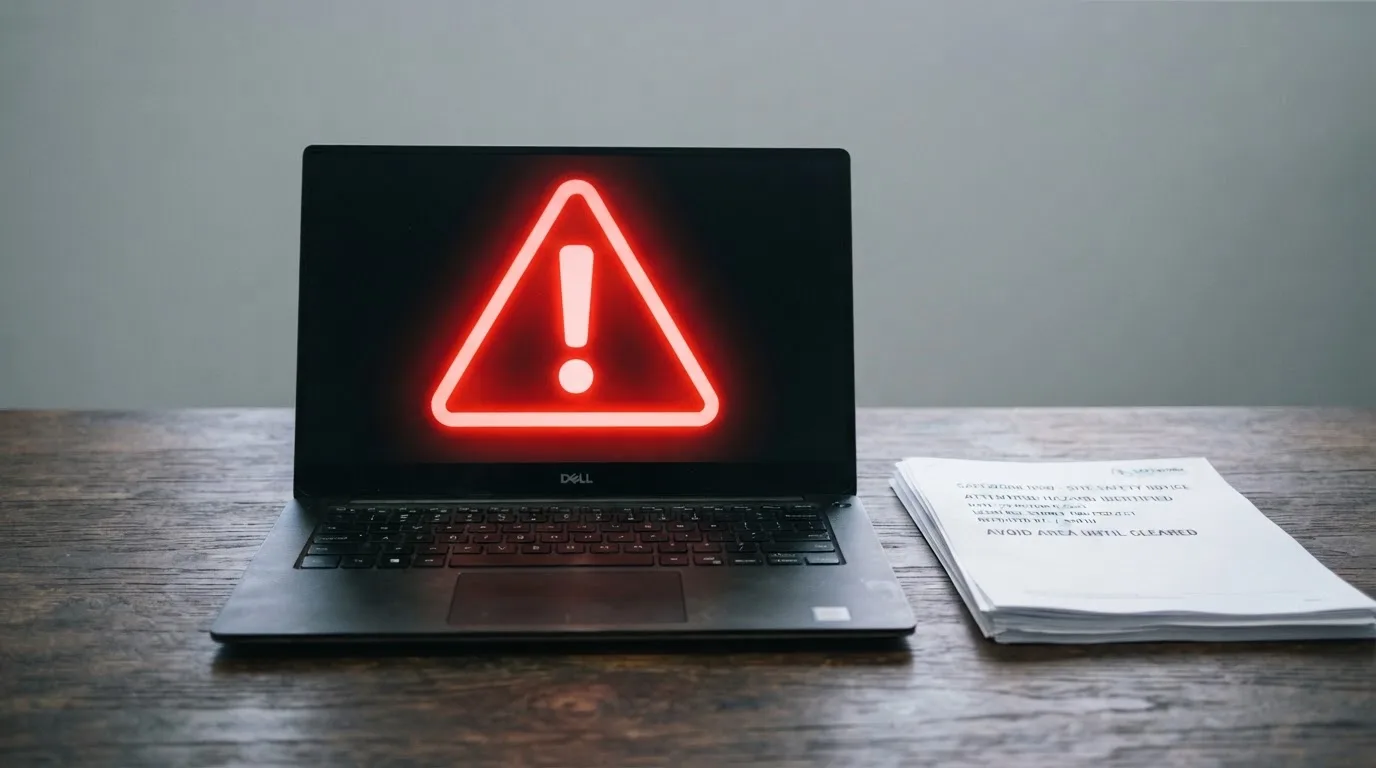
Picture a red triangular warning sign icon on a laptop screen next to a stack of legal papers. In February 2025 the ACMA issued a formal warning over Instant Casino to EOD Code SRL. The picture is the warning icon the ACMA publishes with each notice; the legal papers are the IGA 2001 and its 2017 amendment. The icon and the statute are the only reliable descriptions of the brand’s status in Australia.
Jackbit — the freshest Ryker B.V. warning
Jackbit was warned by the ACMA in April 2026 to Ryker B.V., in the same enforcement round as the CasinOK warning. Ryker B.V. does not appear elsewhere in the table; the brand is the most recent of the eleven by ACMA action date, alongside RocketPlay (March 2026, Pulsup Ltd). The freshest date is also the most likely to be reflected in the operator’s current terms of service — a brand warned last month is unlikely to have re-written its Australian-facing pages since.
The fair reading for a player who landed on Jackbit’s front end in the last few months is that the regulator’s most recent record is the regulator’s most recent record, and the April 2026 warning is the freshest statement of the regulator’s position on Ryker B.V. The freshest warning does not change the underlying prohibition; it changes only how current the regulator’s finding is.
Casino Intense — the Sterplay warning
Casino Intense was warned by the ACMA in April 2025 to Sterplay Holding Ltd. Sterplay Holding Ltd does not appear elsewhere in the table, which puts Casino Intense in the same structural category as Ignition Casino and Instant Casino: a single-brand operator, one warning, no corporate rotation. The April 2025 warning is the only data point the regulator has published on the brand; the marketing page is the only document the brand itself publishes on its own Australian-facing offer.
Sky Crown — the Hollycorn N.V. pairing
Sky Crown was warned by the ACMA in September 2022, alongside Blue Leo, to Hollycorn N.V. The warning is the oldest in the table; it predates the 2025 warnings to Dama N.V. and the 2026 warnings to Pulsup Ltd and Ryker B.V. by three to four years. The Hollycorn N.V. warning is also the oldest on the table’s row that names a corporate vehicle that does not appear in any of the other ten brands.
The fair reading is that Sky Crown has been on the ACMA’s register for the longest, and the regulator has not re-warned the brand in the four years since. The reading is not that Sky Crown has “moved past” the warning — the IGA prohibition is structural, not time-limited — but that the brand’s record on the register is the longest, and the absence of a re-warning is the only thing that distinguishes Sky Crown from RocketPlay in the table.
What this all means for the player
The honest picture the ACMA’s record paints is a market in which offshore operators rotate corporate vehicles while keeping brand front ends alive, the regulator responds by warning the new vehicle, and the product — online casino games and online pokies — stays prohibited for an Australian player the entire time. There is no short window of legality; the IGA prohibition has been the position since 2001, was hardened in 2017, and is being tightened again in the Interactive Gambling Amendment (Gambling Reform) Bill 2026, which passed Parliament on 19 August 2026 with advertising and inducement measures commencing 1 January 2027 — law with a start date, not yet in force.
What the player loses by being in the market is not a chance of winning; it is the consumer-protection floor. No Australian disputes body has jurisdiction over an offshore crypto casino. No Australian payment route is obligated to honour a chargeback from an unlicensed operator. No Australian regulator can compel a withdrawal if the operator stalls. The deposit is in a token whose volatility the player carries, the bonus terms are written by the operator with no third-party review, and the brand can be blocked while a balance is still on it.
What the player keeps is the right to walk away. BetStop will not stop the offshore operator, but the National Gambling Helpline on 1800 858 858 and Gambling Help Online chat are free and open. The responsible-play shelf is the one piece of Australian infrastructure that works regardless of where the gambling has been happening, and it is the one piece the marketing copy does not link to.
Frequently asked questions
Does “Aussie crypto casino” mean licensed in Australia?
No. “Aussie” describes the marketing audience the site targets — Australian cues on the front end, AUD-stake buttons, sometimes a “pokies” tab — not the regulator that has signed the operator off. Under the Interactive Gambling Act 2001 no online casino game and no online pokie can be licensed anywhere in Australia; the ACMA’s register of formal warnings lists eleven brand front ends the regulator has found to be offering prohibited services to Australians, and that register is the public record of the gap between “Aussie” branding and Australian licensing.
Where is an “Aussie crypto casino” actually incorporated and licensed?
The corporate vehicles named on the ACMA’s register are predominantly Curaçao and Cyprus-registered companies — Dama N.V. (Curaçao), Hollycorn N.V. (Curaçao), Ryker B.V., Pulsup Ltd, Bamboo Media, Consolutetish S.R.L., EOD Code SRL, Sterplay Holding Ltd, TechSolutions Group N.V. — operating under Curaçao or Anjouan master licences for the offshore end. The licence they hold is the offshore licence, not an Australian one; the IGA prohibits the product entirely in Australia, so there is no Australian licence to hold.
Is holding or spending cryptocurrency legal for someone in Australia?
Yes. There is no Australian law that prohibits an Australian resident from holding or spending bitcoin, ethereum, or another crypto asset. What applies is the tax treatment: the ATO classifies crypto as property, so each disposal — selling for AUD, swapping for another crypto, or spending at a casino — is a CGT event, with a 50% discount on holdings over 12 months under current law and a CPI-indexed cost base plus a 30% minimum tax rate from 1 July 2027. What is separately prohibited is using that crypto to fund an unlicensed gambling service to a person in Australia.
What AUSTRAC obligations apply to a crypto exchange used to fund an offshore casino?
The exchange must be registered with AUSTRAC as a Digital Currency Exchange (DCE) provider under the AML/CTF Act, regardless of where the exchange is incorporated; operating unregistered is a criminal offence. From 31 March 2026 the registration requirement was expanded beyond crypto-to-fiat exchange to cover crypto-to-crypto platforms, digital asset custody providers and stablecoin issuers. The exchange’s KYC record captures the on-ramp, and the on-ramp is the most likely place an Australian’s identity is recorded against a wallet that later sends funds to an offshore casino.
Can an Aussie-branded crypto casino be blocked by the ACMA the same as any other offshore site?
Yes. The ACMA’s blocking register sits separately from the formal-warning register and asks ISPs to block identified illegal sites at the network level. As of June 2026, 1,751 sites had been blocked since the first blocking request in November 2019; the June 2026 round alone added 12 sites in a single instruction. A balance sitting on an offshore site at the time of a blocking instruction is, on the operator’s terms, the player’s problem — and an Australian court will not enforce a claim against an operator that has just been blocked from serving the market it was never licensed to serve.
Created by the ”Casino Payments Hub” editorial team.