
Golden Pokies Casino Australia 2026: An Honest Read of an Offshore Path
A search for Golden Pokies casino Australia 2026 usually arrives with a specific question in mind — what does the site offer, does the app work, how does the sign-up bonus pay out. Those are real questions, and the rest of this page answers them. They are also the second question, not the first. The first is whether the offer sits on the right side of Australian law, because under the Interactive Gambling Act 2001 no offshore casino is licensed to provide online pokies or table games to a person physically in Australia. Golden Pokies was added to an Australian block list in March 2021, alongside Play Croco, Aussie Play and a handful of other offshore brands. Everything that follows treats that as the framing fact and reads the offers inside it.
Data current as of 8 November 2026 and cross-checked against the Australian Communications and Media Authority register of formal warnings and blocked services.
Table of Contents
- What Golden Pokies Is — and Is Not
- How Offshore Casino Payments Arrive and Leave
- The Sign-Up Bonus and What It Costs
- Games, Providers, and the Catalogue Question
- Landscape of Blocked Brands
- How Fast the Blocklist Is Growing
- The Law an Australian Player Is Sitting Under
- Choosing a Path — and What Each One Costs
- Responsible Gambling and What the Offshore Frame Removes
- Frequently Asked Questions
What Golden Pokies Is — and Is Not
Golden Pokies is an offshore online casino. The branding — gold coins, golden reels, the “pokies” naming convention — borrows directly from Australian gambling vocabulary, which is the point: the site is built to look at home on a local screen. None of that is the same as a local licence. The site is operated by an entity outside Australia, holds no Australian licence to offer online casino games, and has been on the ACMA’s blocking list since March 2021. The browser site and a downloadable mobile app draw from the same catalogue and the same terms. The app is not a separate product with separate rules; it is a thin wrapper around the same account, the same bonus balance, and the same withdrawal queue.
That single fact reshapes the comparison a player is actually making. The relevant alternatives are not “Golden Pokies versus another licensed Australian casino” — there is no Australian-licensed online casino to compare it with, because the IGA prohibits licensing them. The relevant alternatives are Golden Pokies versus other offshore sites in the same posture, or versus legal Australian wagering (sports and racing), or versus not playing at all. This page lays out each path with what it actually costs.
How Offshore Casino Payments Arrive and Leave
The Golden Pokies sign-up pitch leads with deposit and payout, because that is where the offer lives. Offshore casinos accept a wider payment menu than Australian-licensed wagering does, partly because they are not bound by the rules that govern licensed operators. That wider menu also carries wider friction. Two things matter up front.

The first is credit. Under amendments to the Interactive Gambling Act 2001 that took effect on 11 June 2024, Australian-licensed online wagering services cannot accept payment by credit card or other credit-related products, and the same restriction constrains linked digital wallets like Apple Pay when used for gambling. Offshore sites are not subject to that rule — a Visa or Mastercard credit deposit will often go through at Golden Pokies in a way it would not at Sportsbet. That is not a feature. It removes a guardrail that exists for a reason, and a player who has asked their bank to block gambling transactions on the card is not necessarily safer against a credit card that sits outside the bank’s merchant-category filter.
The second is digital wallets and instant transfers. PayID and Osko, run by Australian Payments Plus, settle between participating banks in under a minute around the clock; PayID is available at more than 100 Australian institutions and over 25 million PayID identifiers were registered on the New Payments Platform by April 2025. BPAY, owned jointly through Cardlink Services Limited by ANZ, Commonwealth Bank, NAB and Westpac, has been live since 18 November 1997 and reaches over 140 banks. These are the rails a player might use to fund a deposit from an Australian bank account. They are also the rails on which the most obvious safety check sits: PayID shows the registered name of the account holder before the transfer is sent, and AP+ warns that being asked to send money to a PayID at an illegal gambling site is almost certainly a scam. A site that is already on the ACMA block list is precisely the kind of destination that warning was written for.
Bank-side gambling blocks exist precisely because players have asked for them. Westpac’s gambling block refuses authorisation on transactions registered under the merchant category code “Betting/Casino Gambling” on eligible personal credit and debit cards. ANZ’s block, set in the ANZ app, also blocks gambling transactions made through a digital wallet such as Apple Pay on an eligible card — not just the physical card — and once turned on takes 48 hours to turn off, with the bank warning that not all gambling transactions will be blocked and that some non-gambling transactions may be blocked in error. Apple Pay itself imposes no consumer fee; any surcharge on a card transaction comes from the merchant’s processing fees, and Apple does not set the transaction limits or PIN requirements — those sit with the card issuer or the merchant. The relevant point for a player weighing an offshore casino is that turning a bank block on does not promise to stop every offshore transaction, only those the bank’s filter recognises as gambling. A site the filter does not see as gambling will pass.
Legal Payment Methods
| Payment Method | Legal Status / Note |
|---|---|
| Debit Card | Legal for licensed wagering |
| Bank Transfer | Legal for licensed wagering |
| PayID/Osko | Legal for licensed wagering |
| BPAY | Legal for licensed wagering |
Apple Pay, Google Pay and Samsung Pay together accounted for around 45% of all card payments in Australia by number at the end of 2025, which is the volume an offshore site has to thread its way through. The Reserve Bank’s July 2025 review proposes removing surcharges on eftpos, Mastercard and Visa transactions and explicitly leaves American Express outside that proposed ban — a reminder that surcharging rules and the cost of any given card deposit depend on the network, not on the casino.
The Sign-Up Bonus and What It Costs
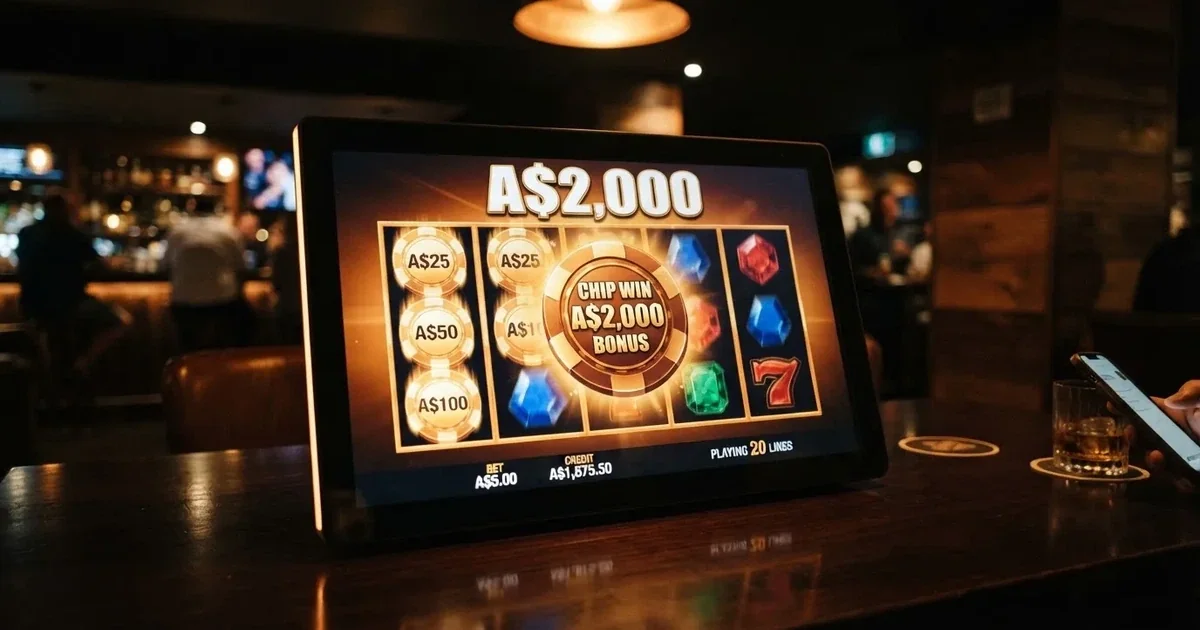
The Golden Pokies sign-up bonus follows the same shape as most offshore casino welcome offers: a headline number, sometimes paired with a bundle of free spins, attached to a wagering requirement and a maximum-cashout ceiling. The “no deposit” variant — a small chip or a handful of free spins credited without a deposit — is the loudest pitch. It is also the one most worth reading slowly.
A no-deposit bonus code still requires playthrough before any winnings convert to withdrawable cash. The typical structure runs a high wagering multiple on the bonus amount, a maximum cashout cap well below the headline value, a restricted list of eligible games, and an internal review step before a first withdrawal. That review is the friction point: the operator checks identity documents, sometimes the source of funds, and the bonus terms explicitly. A player who skipped the fine print at sign-up finds the rules they agreed to applied at exactly the moment they want to leave. None of this is hidden in the marketing, but the marketing does not lead with it either.
Free-spin offers sit in the same envelope. The spins are credited on a named slot title with a fixed coin value, the winnings land as bonus money, and that bonus money then runs through its own playthrough. The headline “50 free spins” reads as a free play; the actual cost is the time at the slot clearing the winnings, with a cap on how much of those winnings can ever come out.
Where the deposit-gated welcome package differs is in scale, not in structure. A larger bonus carries a larger required turnover, and the time to clear it scales linearly with that turnover. The arithmetic is the same: required turnover = bonus × wagering multiple, the number of spins that translates into depends on the stake per spin, and the elapsed time on those spins depends on a typical five-second interval between spins. A player with a small bankroll on a 35× bonus is not playing against the house in the usual sense — they are running a clearance clock against their own balance, with a maximum cashout waiting at the end of it.
The block-and-clear cycle is the part the marketing does not draw. A no-deposit chip that converts to A$40 of withdrawable cash after a 50× playthrough takes 2,000 unit-stakes of slot play to clear — at five seconds a spin that is roughly 2.8 hours of continuous play, on a single game, with no choice but to keep going. A larger welcome bonus takes proportionally longer. The house edge runs through every one of those spins, and the expected loss across the clearance is turnover × (1 − RTP) on the chosen game. The bonus has not given the player anything; it has bought their time at the slot.
Games, Providers, and the Catalogue Question
Golden Pokies lists a catalogue of slot titles under its own branding, the way most offshore casinos do. The paytables and feature sets come from the underlying game software, which is licensed from a handful of studios and reused across many offshore sites under different skins. The same five-reel video slot with the same RTP can sit on Golden Pokies, on a sister brand under the same operator, and on a competitor with no shared ownership. What changes between sites is the wrapper — the welcome offer, the loyalty scheme, the deposit bonus on a Tuesday, the name on the cashier — not the mathematics of the games underneath.
For an Australian player that has been blocked from licensed online casinos, the practical consequence is that the experience is closer to a foreign site than to anything local. The providers whose work shows up in these catalogues are studios licensed in Malta, Curaçao, Gibraltar and similar jurisdictions. None of those licences carries weight in Australia, because Australian regulators do not licence online casino games at all. The game library is real, the spins are real, the math is real — the legal frame around them is the offshore operator’s house rules.
Live dealer tables follow the same pattern. The studio may be in Europe or Latin America, the stream comes through the same account, the table limits are set by the operator, and any complaint about a hand goes to the operator’s own dispute process. There is no Australian regulator to escalate to, no ADR body, no local court with clear jurisdiction over an offshore operator. That gap is not theoretical: it is the reason the ACMA’s blocking regime exists in the first place.
Landscape of Blocked Brands
The brands below sit on the same page of the Australian market. Each one is named here because the ACMA itself issued a formal warning to its operator for offering prohibited services to Australians, and the date of that action is part of the public record. None of them is licensed to provide online casino games in Australia; the law is the same for all of them. The point of listing them together is not to rank them. It is to show how the ACMA’s enforcement has spread across a long list of operators, in some cases repeatedly.
| Brand | ACMA action and date | Operator named by the ACMA |
|---|---|---|
| RocketPlay | Formal warning March 2026; earlier Dama N.V. action May 2022 | Pulsup Ltd |
| Level Up Casino | Formal warning May 2022 | Dama N.V. |
| Woo Casino | Formal warning March 2025 | Dama N.V. |
| Spirit Casino | Formal warning May 2025 | Dama N.V. |
| National Casino | Formal warning July 2025 | Consolutetish S.R.L. |
| Bizzo Casino | Formal warning July 2025; earlier 2022 action over TechSolutions | Consolutetish S.R.L. |
| Ignition Casino | Formal warning July 2025 | Bamboo Media |
| Instant Casino | Formal warning February 2025 | EOD Code SRL |
| Jackbit | Formal warning April 2026 | Ryker B.V. |
| Casino Intense | Formal warning April 2025 | Sterplay Holding Ltd |
| Sky Crown | Formal warning (September 2022) | Hollycorn N.V. |
The pattern that falls out of the dates is not subtle. Dama N.V. alone has received formal warnings in May 2022, March 2025 and May 2025, covering at least eight brands over three years. A formal warning is the lightest formal step the ACMA takes before asking ISPs to block a site; the warning is published, the operator is given a chance to cease, and if it does not, the next step is a blocking request to Australian internet providers. Golden Pokies itself reached that step in March 2021. The list is also not the full set: the ACMA’s June 2026 blocking round alone added twelve more domains — 7Signs, ChromaBet, Donbet, Duospin, Freshbet, Slots Gem, Jacks Club, Lucky Start, Pointsbetz, Spinrise, Vinyl Casino and Wildsino — on top of the warnings the table records.
For a player comparing offers across this set, the legal exposure is identical. The marketing varies; the catalogue overlaps; the wagering terms look alike at a glance. The only reliable difference between two brands on the same offshore platform is the specific bonus on the day, and that bonus changes weekly. Choosing among them on the strength of the welcome offer is choosing among identical propositions with different wrappers.
RocketPlay
Pulsup Ltd received a formal warning over RocketPlay in March 2026, layered on top of an earlier May 2022 warning to Dama N.V. covering Rocketplay and five other brands. The same operator group, the same warning category, the same prohibition. Rocketplay is listed in affiliate marketing material in much the same terms as Golden Pokies, with a sign-up bonus and a free-spin bundle. The relevant comparison is not whether Rocketplay’s bonus is bigger or smaller this week; it is whether a player should be on either site at all, given that both are operating outside the Australian licence frame and both have been formally named by the regulator.
Level Up Casino
Dama N.V., May 2022. Level Up sits in the first batch of Dama brands the ACMA named in a single warning, and Dama has been back in front of the regulator twice since — over Woo Casino in March 2025 and Spirit Casino in May 2025. A player landing on Level Up today is landing on an operator with a three-year paper trail of ACMA contact. The site’s listing in Westpac’s gambling-block documentation is consistent with that record: the bank has identified the merchant category for what it is.
Woo Casino
Dama N.V., March 2025. Woo Casino sits in the second batch of Dama brands the ACMA has formally named, after the May 2022 group and before Spirit Casino. Nothing in the public record suggests Woo has complied with the warning in the sense of withdrawing from the Australian market; the site is still listed in affiliate directories.
Spirit Casino
Dama N.V., May 2025. The most recent of the three Dama N.V. warnings covered here. Spirit Casino is the freshest name in a familiar pattern — same operator group, same prohibition, same regulator response.
National Casino
Consolutetish S.R.L., July 2025. National Casino is named alongside Bizzo Casino in a single July 2025 warning, and the ACMA’s own enforcement pages, along with AUSTRAC’s threshold-reporting guidance and BetStop’s exclusion register, list it in the same frame. National Casino is the kind of brand an Australian player reaches through a search for “no deposit bonus” or “free spins welcome package,” and the ACMA has now formally recorded it as operating in breach of the Interactive Gambling Act 2001.
Bizzo Casino
Consolutetish S.R.L., July 2025, on top of a 2022 formal warning to TechSolutions (CY) Group Limited and TechSolutions Group N.V. Bizzo is the clearest case in this set of a brand the ACMA has had to name twice. The 2022 warning went to a TechSolutions entity; the 2025 warning went to a Consolutetish entity; the underlying brand is the same. A player who picked Bizzo up in 2023 because the offshore licence looked reassuring is looking at a brand whose operating entity has changed name at least once since, with the regulator still chasing.
Ignition Casino
Bamboo Media, July 2025. Ignition Casino is one of two brands in the July 2025 round — the other being the Consolutetish pair — and the only one tied to Bamboo Media rather than Dama N.V. or Consolutetish. The pattern is the same regardless of operator.
Instant Casino
EOD Code SRL, February 2025. The formal warning was published in early 2025, and Instant Casino appears in payment-rail documentation alongside PayID and ecoPayz listings — a reminder that the payment methods an offshore site advertises at its cashier are not endorsements by the payment networks.
Jackbit
Ryker B.V., April 2026. The most recent formal warning in this set, with the ACMA naming both Jackbit and CasinOK in the same action. There is no public record of compliance; the operator has been on notice for months.
Casino Intense
Sterplay Holding Ltd, April 2025. Casino Intense appears in AUSTRAC’s guidance, BetStop’s register and gamblinginsider listings — a small footprint, the same offshore posture, the same warning from the ACMA.
Sky Crown
Hollycorn N.V., formal warning published September 2022. The earliest warning in this set. Sky Crown also shares its operator with Blue Leo Casino, named in the same ACMA action. The two-and-a-half-year gap between Sky Crown’s warning and the more recent names is not a sign the matter is closed; the ACMA’s enforcement regime runs on blocking requests rather than on-going compliance monitoring.
How Fast the Blocklist Is Growing
The ACMA asked Australian ISPs to block Golden Pokies in March 2021. By June 2026, the cumulative total of illegal gambling and affiliate marketing websites blocked since the first request in November 2019 had reached 1,751, and more than 230 unlicensed gambling services had left the Australian market since enforcement was strengthened in 2017. The arithmetic tells its own story.
The first blocking request went out in November 2019 and the running total stood at 1,751 by June 2026. That is 1,751 blocked services across roughly 80 months, an average of about 22 blocked domains per month across the life of the regime — though the monthly rate has accelerated as the ACMA has moved from one-off actions to monthly rounds. The June 2026 round alone added twelve domains. A blocking regime that started as a novel use of the IGA’s section 313 powers has become a routine part of the regulator’s quarterly reporting. The trajectory is the story: the ACMA’s enforcement is not a one-off crackdown, and the brands it names in any given warning are a sample, not a closed list.
H2 Gambling Capital’s 2025 report estimates that Australians lose about A$3.9 billion a year to illegal offshore gambling sites, and that the share of gambling going through legal channels fell from 74% in 2021 to 64%. The blocklist’s growth and the migration of spend away from licensed channels are two views of the same shift. A player looking at Golden Pokies in 2026 is looking at one site in a population that grew by an average of more than twenty sites a month across the regime’s life.
The Law an Australian Player Is Sitting Under
The Interactive Gambling Act 2001, strengthened by the Interactive Gambling Amendment Act 2017, makes it an offence to provide online casino games, online pokies or in-play betting to a person in Australia. No state or territory licences those products. What is licensable is wagering on races and sport placed before the event, lotteries and keno — in practice licensed by the Northern Territory Racing and Wagering Commission, which regulates 52 of Australia’s online bookmakers, including Sportsbet, Bet365 and Ladbrokes. The commission has no full-time staff and meets once a month in Darwin.
Enforcement sits with the ACMA. It investigates, issues formal warnings, and directs ISPs to block illegal sites. The individual player is not prosecuted — the IGA targets the provider — but an offshore site gives no Australian consumer protection, no complaints body, and no recourse if a withdrawal is refused. A site that gets blocked with a balance still on it is a site that has stopped paying out at all. The Interactive Gambling Amendment (Gambling Reform) Bill 2026 passed Parliament on 19 August 2026; its advertising and inducement measures commence on 1 January 2027, which means they are law with a start date, not yet in force on a 2026 page.
Player protection in Australia runs through BetStop, the National Self-Exclusion Register, which has been live since August 2023 and binds Australian-licensed online and phone wagering services. An offshore casino is not connected to it — a self-excluded player is not self-excluded from Golden Pokies. The National Gambling Helpline at 1800 858 858 is free and runs 24/7, with chat available through Gambling Help Online. These are the resources a player reaches when something has gone wrong, and they reach further when the underlying site is licensed than when it is not.
Payments sharpen the picture. Australian-licensed online wagering has not been able to accept credit cards or credit-related products since 11 June 2024, with penalties of up to A$247,500 for operators. Legal deposit routes for licensed wagering are debit card, bank transfer, PayID/Osko and BPAY. A site that asks an Australian player for a credit card or a crypto deposit is a site operating outside the Australian rules, and the choice to use those routes is the choice to leave the consumer-protection frame.
Recreational gambling winnings are not assessable income in Australia and losses are not deductible, unless the person is carrying on a business of gambling. For a casual player that is the end of the tax story. Anyone with a serious edge case is best advised to check with the ATO.
Choosing a Path — and What Each One Costs
Three paths sit in front of an Australian player who has searched for Golden Pokies. Each is a real choice with a real cost, and the costs are not all in dollars.
The first path is the offshore site itself. The cost is the price of an unregulated product: no Australian licence, no local complaints body, no guarantee the site will still be reachable or paying out next month, and a balance that can be stranded by an ACMA blocking request. The marketing offers a bonus; the bonus buys time at a slot, with the house edge running throughout. This is the path the rest of this page has been describing.
The second path is Australian-licensed wagering. Sportsbet, Bet365, Ladbrokes and the rest of the NTRWC’s 52-licensee set are licensed for racing and sports betting placed before the event. They cannot offer online pokies, online casino games or in-play betting — those products are not licensable. A player whose interest is a slot machine is not on this path at all; a player whose interest is a bet on the Melbourne Cup or the AFL is on a path with full Australian consumer protection, BetStop coverage, no credit-card acceptance, and a regulator in the same country.
The third path is not playing. The bonus on the marketing page is a constructed incentive, not a free lunch; the wagering requirement, the maximum cashout, and the restricted games are the actual offer. A player who looks at the time-to-clear arithmetic and the expected loss over that time and decides the offer is not worth the spend is making a calculation the marketing would rather they did not make.
The Australian market’s data backs that calculation. H2 Gambling Capital’s 2025 estimate of A$3.9 billion a year in losses to illegal offshore sites is the cost the regulator is trying to reduce, the cost the banks are trying to limit with merchant-category blocks, and the cost the player is paying on the other side of the “golden” branding.
Responsible Gambling and What the Offshore Frame Removes
The responsible-gambling frame in Australia assumes a licensed product. BetStop’s exclusion register binds Australian-licensed wagering services, not offshore casinos. Deposit limits, cooling-off periods, time-out tools, and activity statements are operators’ own implementations — useful where they exist, and not present where they don’t. An offshore casino is not required to offer any of them, and the marketing built around no-deposit offers is designed to draw a player in quickly, which is exactly when a personal budget matters most.
The bank-side tools are partial. Westpac’s gambling block works at card level on the merchant category code for “Betting/Casino Gambling”; ANZ’s block, once turned on, also blocks gambling transactions through a digital wallet on an eligible card and takes 48 hours to turn off, with the bank’s own warning that the block is not perfect. A player who has turned these on has done what the bank’s product allows; they have not eliminated the offshore transaction, only reduced the surface. The transaction that comes through on a card the bank did not flag is the one that still happens.
A personal budget is the only tool that lives entirely with the player. A written cap on the session, a hard stop at the cap, and a refusal to chase losses through a new deposit are behaviours that work the same way on a licensed site, an offshore site, and a venue. They are also the behaviours the offshore marketing works hardest to undermine, with bonus reloads and “we miss you” emails timed to the moment a player has stopped playing. The 1800 858 858 helpline and Gambling Help Online chat are free, 24/7, and operate outside the offshore frame entirely.
Frequently Asked Questions
Is Golden Pokies legal for someone in Australia to use for real-money play?
No. Online casino games and online pokies are prohibited under the Interactive Gambling Act 2001, and the ACMA added Golden Pokies to its ISP block list in March 2021. The site is not licensed to provide real-money play to a person in Australia, and using it does not give an Australian player the protections that come with a domestic licence.
What does a Golden Pokies no-deposit bonus code actually unlock?
A small chip or a handful of free spins credited without a deposit, attached to a wagering multiple, a maximum cashout cap, and an internal review before any winnings can be withdrawn. The headline value of the offer is the value at the cashier; the value the player can actually withdraw is the value after the playthrough, the cap, and the operator’s review.
Is the Golden Pokies app a separate product from its browser-based site?
No. The mobile app and the browser site draw from the same account, the same bonus balance, the same game catalogue, and the same terms. The app is a wrapper around the same product, not a parallel product with its own rules.
What kind of slot titles are listed under the Golden Pokies catalogue?
Mainly video slots from the same handful of offshore-licensed studios that supply most offshore casinos — five-reel video slots with paytables drawn from the same underlying game software, used under different skins across many sites. Live dealer tables, where offered, run from studios outside Australia with the operator setting the table limits.
What conditions usually apply before a Golden Pokies sign-up bonus can be withdrawn?
A wagering multiple (commonly 35× to 50× the bonus), a maximum cashout ceiling well below the headline value, a list of eligible games that may exclude high-RTP titles, an expiry window on the bonus, and an identity-and-source-of-funds review at the first withdrawal. The specific numbers vary by promotion; the structure does not.
How does Golden Pokies compare with other offshore sites offering similar sign-up bonuses?
The marketing, the catalogue, and the bonus structure are similar across the offshore set — the same game providers, the same wagering multiples, the same internal review at cashout. The differences are in the specific bonus terms at any given moment. Choosing between them on the strength of the welcome offer is choosing between similar products with different wrappers, and all of them sit outside the Australian licence frame.