
Best pokie machine to play in Australia: a reader’s guide for 2026
There is no such thing as the best pokie machine to play in Australia. There is the kind of machine that suits a particular bankroll, the kind of maths that lets a player compare two machines without being misled, and the legal question of where any of those machines can actually be played. This guide covers all three.
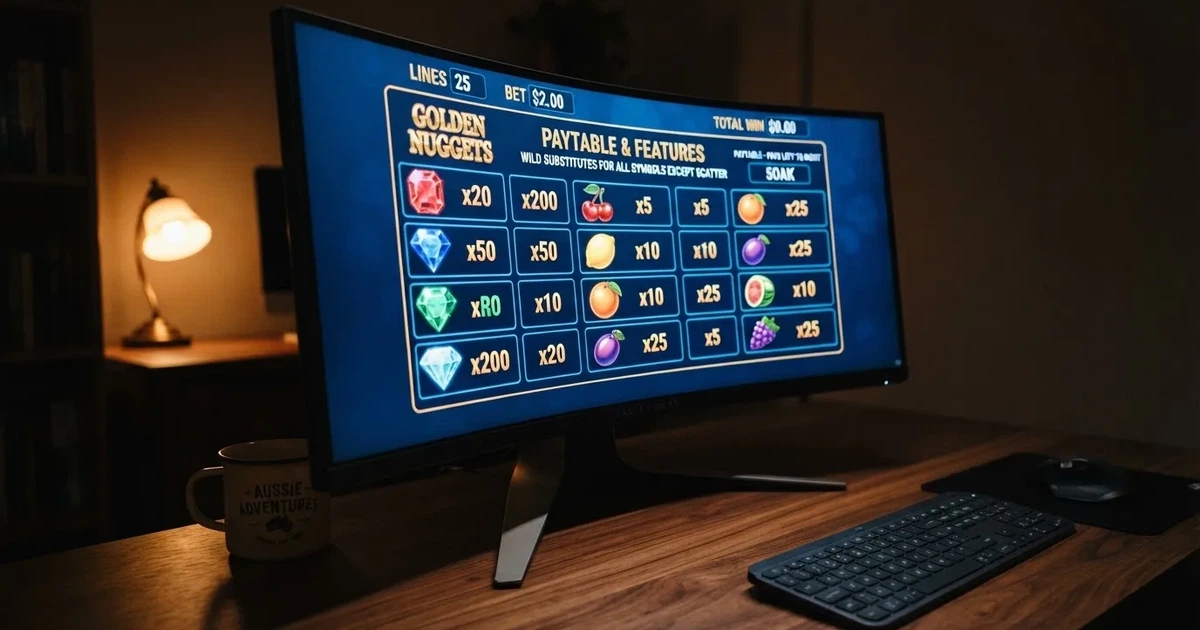
The data below is current as of 3 November 2026 and was checked against the Australian Communications and Media Authority’s register of formal warnings and blocking actions.
Table of Contents
- What “best” actually means at a pokie machine
- The machines themselves: what’s licensed, what isn’t
- Bet size, lines, and the maths that does not change
- How payout percentage is actually reported
- Volatility in practice
- Mobile apps and the licensed-machine question
- What the ACMA has actually done
- Operator warnings: who the ACMA has named
- The legal frame, in full
- What an Australian player is actually buying
- Responsible gambling, in the Australian frame
- Comparing two machines honestly
- A practical checklist at the venue
- Frequently asked questions
What “best” actually means at a pokie machine
A pokie machine is a game with a known mathematical profile. Two numbers carry most of the decision: the return-to-player, the slice of every dollar wagered that the machine is programmed to return over the long run, and the volatility, which describes how that return lands across individual sessions. Bet size changes neither, and a “hot” machine is a marketing word, not an engineering one.

The legal minimum return-to-player varies by state. It sits at 85% in New South Wales, the Northern Territory, Queensland and most of Victoria, at 87% in the ACT and Tasmania, at 87.5% in South Australia, and at 90% in Western Australia — and Crown Melbourne’s table is set 2 points higher than the rest of Victoria at 87%. Every licensed pokie in Australia displays its return-to-player on the machine itself or in the venue’s printed material. If the figure is not visible, ask staff before you sit down.
Volatility is the harder of the two. A low-volatility machine returns most of its payout in small, frequent hits; a high-volatility machine holds the return back and pays it out in occasional, larger hits. The long-run return is the same across the two styles when RTP is identical — what changes is the shape of the session. A player with a small bankroll who needs a long evening will likely prefer low volatility. A player who can absorb a dry hour in exchange for a shot at a larger payout will likely prefer high.
The phrase “best pokie machine” is doing a lot of work when someone says it. It sometimes means the highest RTP. It sometimes means the most generous-feeling session, which is a volatility question. And it sometimes means a jackpot title with a top prize large enough to make the rest of the maths feel incidental. Those three goals point at three different machines, and the right answer depends on which one the player is actually asking about.
The machines themselves: what’s licensed, what isn’t
Australia has about 3% of the world’s pub and club poker machines, on a population of roughly 0.3% of the globe. In 2020–21, players fed almost A$150 billion through gaming machines and lost A$12.18 billion on them. The machines themselves are regulated state by state, and the design rules differ across every border.
New South Wales, the largest concentration by a wide margin, had 87,298 gaming machines outside casinos across 2,195 venues in June 2023, with player losses of A$8.18 billion in 2022–23. Queensland had 21,122 machines in 351 venues as of October 2023. Victoria had 26,380 machines outside Crown Casino across 488 venues in 2021–22, all held under a statewide cap of 30,000. Western Australia took the opposite path: poker machines in pubs and clubs were banned when Crown Perth opened in 1985, and Crown Perth’s own count has since grown from about 200 in 1985 to roughly 2,500, all approved by the state’s Gaming and Wagering Commission.
The legal floor on what a licensed pokie machine returns is set by the same regulators. New South Wales, the Northern Territory, Queensland and most of Victoria sit at 85%, the ACT and Tasmania at 87%, South Australia at 87.5%, and Western Australia at 90%. Crown Melbourne’s table is set 2 points above the rest of Victoria at 87%. These are minimums: a venue may set its machines higher, but it cannot set them lower, and the figure is required to be visible to the player.
Tasmania’s machines carry an additional layer. The Federal Group held a monopoly licence over every poker machine in the state from 1968; legislation passed in November 2021 ended that monopoly and moved oversight to the Tasmanian Liquor and Gaming Commission. Tasmania also planned mandatory pre-commitment cards — a system that forces a player to set a loss limit before sitting down — with implementation delayed until late 2025. The cards were a nation-first reform, and the delay is itself part of the story: the policy exists, the rollout does not yet.
Online pokies are a different category. The Interactive Gambling Act 2001, as strengthened in 2017, makes it an offence to provide online casino games or online pokies to a person in Australia. No state or territory licenses them. What is licensable is wagering on races and sport placed before the event, lotteries and keno — in practice licensed by the Northern Territory through the Northern Territory Racing and Wagering Commission, which regulates 52 online bookmakers including Sportsbet, Bet365 and Ladbrokes. The commission has no full-time staff and meets once a month in Darwin, which is itself a structural detail worth knowing.
The practical result: a player asking about an online pokie machine in Australia is asking about an unregulated product. The remainder of this page covers both halves of that reality.
Bet size, lines, and the maths that does not change
Bet size does not change the odds on a pokie machine. A 1-cent credit played across 50 lines and a 5-cent credit played across 10 lines are two ways of staking the same amount per spin; the return-to-player is set against total money wagered, not against the size of any individual credit. This is the single most consistently misunderstood thing about pokies, and it is the one a floor staffer hears most often.
Multi-line machines are not more likely to pay out than single-line ones. The total return over time is the same; what multi-line play does is fragment the wager into more outcomes per spin, which produces more small hits and fewer quiet spins. From the player’s seat that reads as “more action”, but from the machine’s maths the line count is a way of changing the texture of a session, not its expected return. A 50-line machine at 1 cent per line is roughly equivalent in expected loss to a single-line machine at 50 cents. The session’s shape changes; the session’s expected cost does not.
Progressive jackpots are the honest exception. A machine with a progressive jackpot is taking a slice of every wager to fund a prize that grows until it is won. The base game’s RTP is therefore lower than the equivalent non-progressive machine, by the slice feeding the pool. The trade is straightforward: a player accepts a lower expected return in exchange for a chance at the headline prize. Whether that trade is worth it depends entirely on what the player came for.
How payout percentage is actually reported
Every licensed pokie machine in Australia has a published return-to-player figure, and the venue is required to make it available. The format varies: some machines display it on the help screen, others carry a sticker on the cabinet, others rely on printed leaflets. If the figure is not in front of you, staff can produce it.
The figure is a long-run average across many millions of spins, not a session forecast. A machine programmed to return 90% will return very close to 90% across, say, ten million spins, but any one session of a hundred spins can sit anywhere on a wide range around that average. The 90% is what to compare two machines by; it is not what either machine is going to do this evening.
State-level minimums set a floor. A machine in a NSW pub cannot return less than 85%; a machine at Crown Perth cannot return less than 90%. Within those bands, the actual figure on a given machine is the venue’s and the operator’s choice, and that choice is what a player is comparing when they compare machines. Two machines in the same venue, on the same night, can carry different RTPs. A player who wants the highest available return should read the figures, not the cabinet art.
Volatility in practice
Volatility describes how a machine’s long-run return is distributed across individual sessions. Two machines with identical 90% returns can feel like very different games, and the difference is volatility.
A low-volatility machine returns most of its payout through small, frequent hits. The session feels busy. The bankroll moves in small steps. A player with A$50 looking to play for two hours will, on average, finish with a small loss and a sense that the machine “did things” the whole evening. The cost per minute of play is fairly predictable.
A high-volatility machine holds the return back and pays it out through occasional, larger hits. The session feels quieter, sometimes for an hour or more, and then lands something substantial if it lands at all. The bankroll swings wider. A player with A$200 who can absorb a quiet stretch will sometimes finish well ahead; more often they will finish behind, and the average loss per minute of play is higher because long quiet stretches are still costing them the same per spin.
Neither volatility is “better”. Each suits a different bankroll and a different mood. A player who wants the longest possible evening on a given budget should generally look at lower-volatility titles. A player who wants a chance at a larger payout and accepts a shorter evening should look at higher-volatility titles. The return-to-player is the same; what changes is the path.
Mobile apps and the licensed-machine question
There is a difference between a mobile pokie-machine app and the licensed pokie machines in an Australian pub or club, and the difference is structural rather than cosmetic.
The licensed machines in Australian venues are state-regulated. Each cabinet carries a regulator-approved return-to-player figure, an approved game ruleset, and a physical audit trail. The venue is licensed, the operator is licensed, and the machine itself is approved for play in that jurisdiction. New South Wales’ 87,298 machines outside casinos, Queensland’s 21,122 and Victoria’s 26,380 all sit inside that regime.
A mobile pokie app offered to a person in Australia is, by definition, an unregulated product. The Interactive Gambling Act 2001 prohibits the supply of online casino games and online pokies to people in Australia; no state or territory issues a licence for that supply. An app that offers pokie-style games to an Australian customer is offering a product that has not been approved by any Australian regulator, and the figures it advertises — RTP, volatility, jackpot size — are not audited by any Australian body.
That is not a stylistic distinction. A licensed machine in a NSW club has a regulator behind every figure on its cabinet. An app offering pokie-style games to an Australian has, in the legal sense, no regulator behind any of its figures. The mathematics may be honest; the audit framework is not.
In practice, an Australian looking for a pokie experience on a phone has two honest options. One is to play the licensed machines physically, in pubs and clubs, where the regulation is real. The other is to play the offshore apps and accept that the regulatory frame around the product is the one that applies to the operator’s home jurisdiction, not the one that applies in Australia. Neither is a trick question, but the two are not interchangeable, and a player who treats them as such is reading past the most important line in the comparison.
What the ACMA has actually done
The Australian Communications and Media Authority does three things that matter to this guide. It investigates complaints about prohibited services. It issues formal warnings to operators, published on its website with the operator’s name and the date. And it directs Australian internet service providers to block illegal sites, which is the action that takes a brand off the Australian internet altogether.
As of June 2026, the ACMA had asked ISPs to block 1,751 illegal gambling and affiliate marketing websites since the first blocking request in November 2019, and more than 230 unlicensed gambling services had left the Australian market since enforcement was strengthened in 2017. The most recent round reported on 26 June 2026 added 12 more: 7Signs, ChromaBet, Donbet, Duospin, Freshbet, Slots Gem, Jacks Club, Lucky Start, Pointsbetz, Spinrise, Vinyl Casino and Wildsino. The blocking rate since November 2019, on the figures the ACMA itself has published, sits at roughly 27 sites per month across the seven years since the first request — though the rate is not constant, with newer rounds landing in bursts rather than on a steady schedule.
The blocking action matters because it is the only lever the ACMA has that physically stops an Australian customer from reaching an offshore site. A formal warning is a published step in the enforcement chain; a blocking request is the step after it, and it is the one that costs the operator its Australian traffic. The cumulative total is the figure that gives a sense of scale: a thousand-plus sites blocked over seven years, with the rate holding rather than fading.
The formal warnings tell a parallel story. In March 2026 the ACMA issued a formal warning to Pulsup Ltd over RocketPlay. In May 2022 it issued a formal warning to Dama N.V. covering six casino brands: Bambet, Dazard, Level Up, Rocketplay, Wild Tornado and Cobra Casinos. The same Dama N.V. was warned again over Woo Casino in March 2025 and over Spirit Casino in May 2025. In July 2025 the ACMA warned Bamboo Media over Ignition Casino, and Consolutetish S.R.L. over National Casino and Bizzo Casino; Bizzo Casino had already been the subject of a 2022 formal warning to TechSolutions (CY) Group Limited and TechSolutions Group N.V. In February 2025 the ACMA warned EOD Code SRL over Instant Casino. In April 2026 it warned Ryker B.V. over Jackbit and CasinOK. In April 2025 it warned Sterplay Holding Ltd over Casino Intense. Hollycorn N.V. was warned over its Sky Crown and Blue Leo services in September 2022.
A formal warning is not a blocking action. It is the ACMA’s published record that the operator has been told the service is prohibited. Repeated warnings are a pattern rather than a punishment — the punishment is the next round, which is the blocking request. Operators warned twice or more across consecutive years are the operators the ACMA has had to tell repeatedly, and that pattern is itself a signal.
Operator warnings: who the ACMA has named
The list below is the ACMA’s own list, in the order research carries them. Each entry is an operator the ACMA has warned for offering prohibited online casino services to Australians. None of these is a recommended place to play; the prohibition is the headline, the warning is the ACMA’s record of it, and the brand is included here because the ACMA’s register is the most useful single piece of information a reader can check.
| Brand | ACMA action and date | Operator named by the ACMA | Subject support |
|---|---|---|---|
| RocketPlay | Formal warning, March 2026; earlier warning under Dama N.V., May 2022 | Pulsup Ltd (RocketPlay), March 2026; Dama N.V. (May 2022) | — |
| Level Up Casino | Formal warning, May 2022 | Dama N.V. | listings reference: BGaming |
| Woo Casino | Formal warning, March 2025 | Dama N.V. | — |
| Spirit Casino | Formal warning, May 2025 | Dama N.V. | — |
| National Casino | Formal warning, July 2025 | Consolutetish S.R.L. | listings reference: en.wikipedia.org |
| Bizzo Casino | Formal warning, July 2025; earlier warning, 2022 | Consolutetish S.R.L. (July 2025); TechSolutions (CY) Group Limited and TechSolutions Group N.V. (2022) | — |
| Ignition Casino | Formal warning, July 2025 | Bamboo Media | — |
| Instant Casino | Formal warning, February 2025 | EOD Code SRL | — |
| Jackbit | Formal warning, April 2026 | Ryker B.V. | — |
| Casino Intense | Formal warning, April 2025 | Sterplay Holding Ltd | listings reference: Abc.net.au, acma.gov.au, Crownmelbourne.com.au |
| Sky Crown | Formal warning, September 2022 | Hollycorn N.V. | — |
The same operator name appearing across more than one row is the ACMA’s own pattern. Dama N.V. has been warned in May 2022, March 2025 and May 2025 — three rounds across four years covering eight distinct brand names. Consolutetish S.R.L. was warned in July 2025 over two of its brands. Ryker B.V. was warned in April 2026 over two more. The pattern is the news: when the ACMA names an operator once, it is a warning; when it names the same operator again under a different brand, it is a structural pattern the regulator has had to address more than once.
The table’s “Subject support” column reflects what is publicly available for each brand outside the ACMA’s own register. For most of the brands, no independent listing or verification is on the public record — that absence is itself the information. For a handful, third-party listings reference the brand, and that reference is recorded here in the language research carries.
RocketPlay
RocketPlay is the brand the ACMA has named most recently: a formal warning was issued to Pulsup Ltd over RocketPlay in March 2026, on top of an earlier warning to Dama N.V. in May 2022 that covered six casino brands including RocketPlay. The product is prohibited under the Interactive Gambling Act 2001, and the ACMA’s published action is the formal record of that prohibition being enforced against this brand. There is no public source for the brand’s RTP, volatility or payout profile beyond what its own marketing pages have carried. For a reader comparing options, the relevant fact is the ACMA action, not the marketing.
Level Up Casino
Level Up Casino was named in the same May 2022 warning to Dama N.V. that covered five other brands. The brand appears in third-party listings indexed on BGaming, which is the only public source for the brand outside the ACMA’s own register. The product on offer is the prohibited category of online casino game, and the warning is the ACMA’s published record.
Woo Casino
Dama N.V. was warned again over Woo Casino in March 2025, three years after the May 2022 warning that also named this brand. The repetition is the ACMA’s pattern with Dama N.V. — the same operator warned multiple times across multiple brand names. The product remains prohibited, and the warning remains the published record.
Spirit Casino
Spirit Casino was the second Dama N.V. brand named in 2025, with a formal warning issued in May 2025. The pattern is the same: a brand name, an operator parent, a date, and a prohibition on the product category. No independent listing or verification sits outside the ACMA’s register.
National Casino
National Casino was named in the July 2025 warning to Consolutetish S.R.L., alongside Bizzo Casino. The brand appears in third-party listings on en.wikipedia.org. The product is prohibited under the Interactive Gambling Act 2001, and the ACMA’s action is the relevant published fact.
Bizzo Casino
Bizzo Casino was named in the same July 2025 warning to Consolutetish S.R.L., and was already the subject of a 2022 formal warning to TechSolutions (CY) Group Limited and TechSolutions Group N.V. — a brand that changed hands or rebranded under a new operator and landed back on the ACMA’s register. The repeated appearance under different operator names is itself the news.
Ignition Casino
Ignition Casino was named in the July 2025 warning to Bamboo Media. The brand has no independent listing or third-party verification outside the ACMA’s register. The product is prohibited, the warning is the published record, and the absence of any other public reference is itself a data point.
Instant Casino
Instant Casino was the subject of a formal warning to EOD Code SRL in February 2025. The product is prohibited, and the ACMA’s action is the relevant published fact.
Jackbit
Jackbit was named in the April 2026 warning to Ryker B.V., alongside CasinOK. The same operator warning covering two brands is the pattern the ACMA’s recent enforcement has taken. The product is prohibited, and the warning is the published record.
Casino Intense
Casino Intense was the subject of a formal warning to Sterplay Holding Ltd in April 2025. The brand appears in third-party listings across Abc.net.au, acma.gov.au and Crownmelbourne.com.au — references that situate the brand in the broader Australian gambling coverage landscape rather than endorse it. The product remains prohibited.
Sky Crown
Sky Crown was named in the September 2022 warning to Hollycorn N.V., alongside Blue Leo. The Hollycorn warning is among the earlier entries in the ACMA’s recent enforcement record. The product is prohibited, and the warning is the published record.
The legal frame, in full
The Interactive Gambling Act 2001, as amended in 2017, makes it an offence to provide online casino games, online pokies or in-play betting to a person in Australia. No Australian state or territory issues a licence for the supply of online casino games. The Act targets the provider, not the individual player; an Australian customer of an offshore site is not personally at risk of prosecution. The customer is, however, outside the protection of every Australian consumer-protection body that would otherwise apply to a gambling dispute.
The ACMA is the regulator that enforces the Act. Its three tools are investigation, formal warning and blocking request. The blocking request is the one that physically prevents Australian traffic from reaching an offshore site: Australian ISPs are directed to block the domain, and the site becomes inaccessible from inside Australia without a workaround. The June 2026 cumulative figure — 1,751 sites blocked since November 2019, more than 230 services having left the Australian market since 2017 — is the scale of that enforcement.
The Interactive Gambling Amendment (Gambling Reform) Bill 2026 passed Parliament on 19 August 2026; its advertising and inducement measures commence 1 January 2027. It is law with a start date, not yet in force on a page published in 2026. The measures touch advertising rather than the underlying prohibition on supply, which has been in force since 2017.
The Northern Territory Racing and Wagering Commission regulates 52 of Australia’s online bookmakers — including Sportsbet, Bet365 and Ladbrokes — licensed in the Territory for tax reasons. The commission has no full-time staff and meets once a month in Darwin. The bookmakers it licenses offer wagering on sport and racing, not casino games; the licensing frame for online wagering and the prohibition on online casino are two different regulatory decisions.
What an Australian player is actually buying
An Australian playing a licensed pokie in a NSW pub is buying a product with a regulator behind every figure on the cabinet, an audited return-to-player at or above the state minimum, and a venue that can be complained to if the machine fails. The minimum age is 18. Gambling Help Online and the National Gambling Helpline at 1800 858 858 are free, 24/7 and run as chat or voice. BetStop, the National Self-Exclusion Register, has been live since August 2023 and binds Australian-licensed online and phone wagering services.
An Australian playing an offshore pokie app is buying a product with no Australian regulator behind any of its figures. The RTP on the app’s help screen is not audited by any Australian body. The app’s complaint procedure is whatever the operator’s home jurisdiction requires, which is not an Australian jurisdiction. If a withdrawal is refused, the recourse is whatever the operator’s terms allow, which is not an Australian consumer law. The site can be blocked by the ACMA with a balance still on it. The site’s payment rails may include credit cards or crypto, which are banned for licensed Australian wagering since 11 June 2024 — a signal that the operator is running outside the Australian rules.
The two products are not the same product at a different price. They are different products under different regulatory frames, and the price comparison is the smaller of the differences.
Responsible gambling, in the Australian frame
The responsible-gambling supports in Australia sit alongside the licensed product. The National Gambling Helpline at 1800 858 858 is free, 24/7, with chat at Gambling Help Online. BetStop, the National Self-Exclusion Register, has been live since August 2023 and binds Australian-licensed online and phone wagering services — meaning it does not bind an offshore casino, which is one of the reasons an offshore casino is not a substitute for the licensed product.
Each state also runs its own self-exclusion and support framework. New South Wales, Victoria, Queensland, South Australia, Western Australia, Tasmania, the ACT and the Northern Territory each maintain a register or programme that applies to gaming machines in their jurisdiction. Tasmania’s planned mandatory pre-commitment cards, intended as a nation-first reform, were scheduled for late 2025 — a delay that is itself part of the state’s current responsible-gambling architecture.
A player who is reading this guide because they want to manage their own play has clear next steps: set a pre-commitment limit at the venue, use BetStop if they want a state-wide exclusion from licensed wagering, and call the Helpline if they want to talk to someone. None of these tools covers an offshore casino. That gap is the structural reason the prohibition matters.
Comparing two machines honestly
To compare two licensed pokie machines honestly, a player needs three figures from each: the return-to-player, the volatility profile and the bet size. With those three, the comparison is mechanical.
The return-to-player is the long-run slice of every dollar wagered that the machine returns. Higher is better, but the difference between 90% and 92% is small per spin and accumulates only across many spins. The volatility describes the shape of the session. Two machines at 90% RTP can sit at very different volatility profiles, and the one with higher volatility will produce more sessions that finish either well ahead or well behind, with fewer sessions near the average. The bet size sets the cost per spin. A 1-cent credit across 50 lines and a 50-cent credit across 1 line stake the same amount per spin, and the comparison between two machines is the comparison at the same total stake per spin, not at the same credit size.
A player who wants the longest evening on a fixed budget generally picks the highest RTP available at the lowest volatility they can find, at the smallest total stake per spin they are comfortable with. A player who wants a chance at a larger payout accepts a lower base RTP in exchange for the volatility that produces the larger hits, and stakes a bit higher per spin to make those hits worth having. The arithmetic is the same; the trade-off is in what the player came for.
A practical checklist at the venue
A player walking into a pub or club and looking at the pokie floor has a short checklist. Confirm the return-to-player is on display, on the help screen or on printed material, and that it sits at or above the state minimum. Choose a volatility profile that matches the bankroll and the evening: low for long sessions, high for a shot at a larger payout. Set a pre-commitment limit before sitting down, and stick to it. If the venue offers BetStop enrolment, that is the next step up from a single-venue limit. If a session is not going as planned, the National Gambling Helpline at 1800 858 858 is free, 24/7, with chat at Gambling Help Online.
The same checklist does not apply offshore. The figure on an offshore app’s help screen is not audited by any Australian regulator; the pre-commitment limit is a setting on the app, not a state-registered instrument; the helpline is still free and Australian, but BetStop does not bind the offshore operator. A player who wants the protection of the Australian frame needs to stay inside it.
Frequently asked questions
What’s the difference between a low-volatility and a high-volatility pokie machine?
A low-volatility machine returns most of its payout through small, frequent hits; the session feels busy and the bankroll moves in small steps. A high-volatility machine holds the return back and pays it out through occasional larger hits; the session feels quieter and the bankroll swings wider. The long-run return is the same when RTP is identical; what changes is the shape of the session. A small bankroll suited to a long evening generally points toward low volatility; a bankroll that can absorb a quiet stretch points toward high.
Does bet size change the odds on a pokie machine?
Bet size does not change the odds. The return-to-player is set against total money wagered, not against the size of any individual credit. A 1-cent credit across 50 lines and a 50-cent credit across a single line stake the same amount per spin and carry the same expected return over time. What changes with bet size is the dollar cost of each spin, not the machine’s mathematics.
Are mobile pokie-machine apps the same as the licensed machines in a pub or club?
No. Licensed pokie machines in Australian pubs and clubs are state-regulated: every figure on the cabinet is approved by the relevant state regulator, the return-to-player is set at or above the state minimum, and the venue is licensed. A mobile pokie app offered to a person in Australia is, by definition, an unregulated product: the Interactive Gambling Act 2001 prohibits the supply of online casino games and online pokies to Australians, and no state or territory issues a licence for that supply. The mathematics on the app may be honest; the audit framework behind it is not an Australian one.
How can someone find the payout percentage of a specific pokie machine before playing?
Every licensed pokie machine in Australia displays its return-to-player, either on the help screen, on a sticker on the cabinet, or on printed material at the venue. If the figure is not visible, venue staff can produce it. The figure is a long-run average across many millions of spins, not a forecast for the session about to be played. State-level minimums set the floor: 85% in NSW, the NT, Queensland and most of Victoria, 87% in the ACT and Tasmania, 87.5% in South Australia, and 90% in Western Australia, with Crown Melbourne set 2 points higher than the rest of Victoria.
Are multi-line pokie machines more likely to pay out than single-line ones?
Multi-line and single-line machines have the same expected return over time at the same total stake per spin. Multi-line play fragments the wager into more outcomes per spin, which produces more small hits and fewer quiet spins; single-line play concentrates the wager into fewer outcomes per spin, which produces fewer small hits and more quiet spins. The session’s shape changes; the session’s expected cost does not, and the comparison between the two is the comparison at the same total stake per spin.
Who audits pokie machines in licensed Australian venues?
Pokie machines in Australian venues are audited state by state, with each state and territory running its own regulator: Liquor & Gaming NSW, the Victorian Gambling and Casino Control Commission, the Office of Liquor and Gaming Regulation in Queensland, the Tasmanian Liquor and Gaming Commission, the South Australian Liquor and Gambling Commissioner, the Department of Local Government, Sport and Cultural Industries in Western Australia, the ACT Gambling and Racing Commission, and the Northern Territory’s Racing and Wagering Commission for wagering. Each regulator approves the machines, the games, the return-to-player figures and the venue operations in its jurisdiction.