
Big jackpot pokies in Australia — what a reader can and cannot lawfully chase in 2026
A reader searching for “big jackpot pokies” or “online casinos with big jackpot pokies” wants a working shortlist of operators and the games on each one. The honest answer in 2026 is shorter than that wish, and the article-lang word for it is the same one the regulator uses: prohibited. Under the Interactive Gambling Act 2001, no Australian jurisdiction licenses online casino games, online pokies or the jackpots that run across them — every brand the search returns is operating outside that frame, and the ACMA has been naming them by name for years. What follows is the legal shape of that gap, the ACMA’s own enforcement record, the gameplay mechanics behind the jackpot pools that the prohibited sites run on, and the lawful alternatives an Australian reader can actually use.
The currency stamp beneath this lead is the same on every shelf of this page. Data current as of 30 October 2026, verified against the ACMA’s own formal-warning register and the blocking round as reported by industry press.
Table of Contents
- How a progressive jackpot pokie actually works
- The Australian legal frame for online jackpot pokies
- Player protection inside the Australian frame
- The ACMA’s formal-warning record for online jackpot pokies
- The brands the ACMA has named, and what each warning covers
- The blocking-rate calculation: what the ACMA’s record shows about the pace of enforcement
- Where an Australian reader can actually play jackpot pokies in 2026
- Mechanics that matter when a jackpot pool is climbing
- House edges on the table games that share the floor with jackpot pokies
- Tax and money: what an Australian player actually keeps
- What the page is and what it is not
- Frequently asked questions about big jackpot pokies in Australia
How a progressive jackpot pokie actually works
Big jackpot pokies run on a mechanism that has barely changed since the first Megabucks machine paid out its inaugural US$4,988,842.17 on 1 February 1987. The mechanical idea is older than the internet, and the maths is the same whether the reels are spinning in a Las Vegas locals’ casino, on a pub floor in Sydney, or on an offshore site the ACMA has just blocked.

A progressive jackpot is a prize pool that grows with each losing wager until it is won. A small portion of every bet is siphoned into the pool rather than the house’s take. Once the prize is hit, it resets to a predetermined minimum and begins accumulating again. The pool can be local to a single venue, linked across several machines within one casino, or wired across a wide-area network that spans many venues in many countries — the wider the network, the faster the pool climbs, and the larger the headline figure becomes. Casinos fund the growth from a portion of their profit margin, so the pool rises in proportion to turnover, not to luck.
The “must-hit-by” variant sets a hard upper limit. The exact payout amount is fixed by a random number generator within a preset range — for instance A$1,000 to A$3,000 — the moment the previous jackpot is won. The player does not need to land a specific combination; the game guarantees the prize will fall inside the range before a ceiling expires. Mystery jackpots keep the ceiling invisible to the player, which is the marketing point. The range is what the operator publishes in the game’s terms.
Three numbers matter to a reader weighing one of these games. The current pool — visible on every connected game, and the figure the marketing leans on. The trigger condition — a specific symbol combination, a bonus round, or, in the mystery variant, a random call against the cap. And the theoretical return to player of the underlying base game, which stays roughly fixed regardless of how the pool is climbing. The pool itself does not change the odds of the spin that wins it; it changes the value of the win, not its probability.
The biggest online jackpot on the public record is €19,430,723.60, won on 27 April 2021 by a player in Belgium on Microgaming’s Absolootly Mad: Mega Moolah at Napoleon Sports & Casino. Games Global, the business formerly known as Microgaming, still distributes the Mega Moolah progressive series and has since announced later wins of £11.5 million and £13.5 million. The headline number is real. The frequency at which numbers that large hit is not — those are the upper tail of a long distribution, not its median.
One mechanical point that earns a line of its own. In some progressive games — certain video poker and Caribbean Stud Poker variants — the pool can grow large enough to push the game’s theoretical return above 100%, which is the only configuration of an online casino game in which the player has positive expectation. The break-even point is not hard to find in those table games because the rules are published. For slot machines the calculation is much harder because reel layouts and symbol weights are not published, and the operator does not hand over the inputs a player would need to verify the math. A reader who hears the word “positive expectation” applied to a slot is hearing a marketing claim, not an audited one.
The Australian legal frame for online jackpot pokies
The shape of the prohibition is the article-lang answer to “is it legal for an online casino to offer jackpot pokies to Australians?”. Three layers stack on top of each other and the layer closest to the reader is the one that matters.
The Interactive Gambling Act 2001, as strengthened by the Interactive Gambling Amendment Act 2017, makes it an offence to provide online casino games, online pokies or in-play betting to a person who is physically in Australia. The offence is on the provider, not the individual player. No state or territory issues a licence for online casino games; what is licensable is wagering on races and sport placed before the event, lotteries and keno. The licences you see on an offshore casino — Curaçao, Anjouan, Kahnawake — are issued by jurisdictions that do not give the holder any right to take bets from Australians. The badge is a permission to operate somewhere; it is not a permission to operate here.
The Interactive Gambling Amendment (Gambling Reform) Bill 2026 passed Parliament on 19 August 2026. Its advertising and inducement measures commence on 1 January 2027. On a page read in 2026 that bill is law with a start date, not yet in force. The prohibition itself is in force; the new rules govern how licensed wagering operators advertise, and they do not open a window for online casino games.
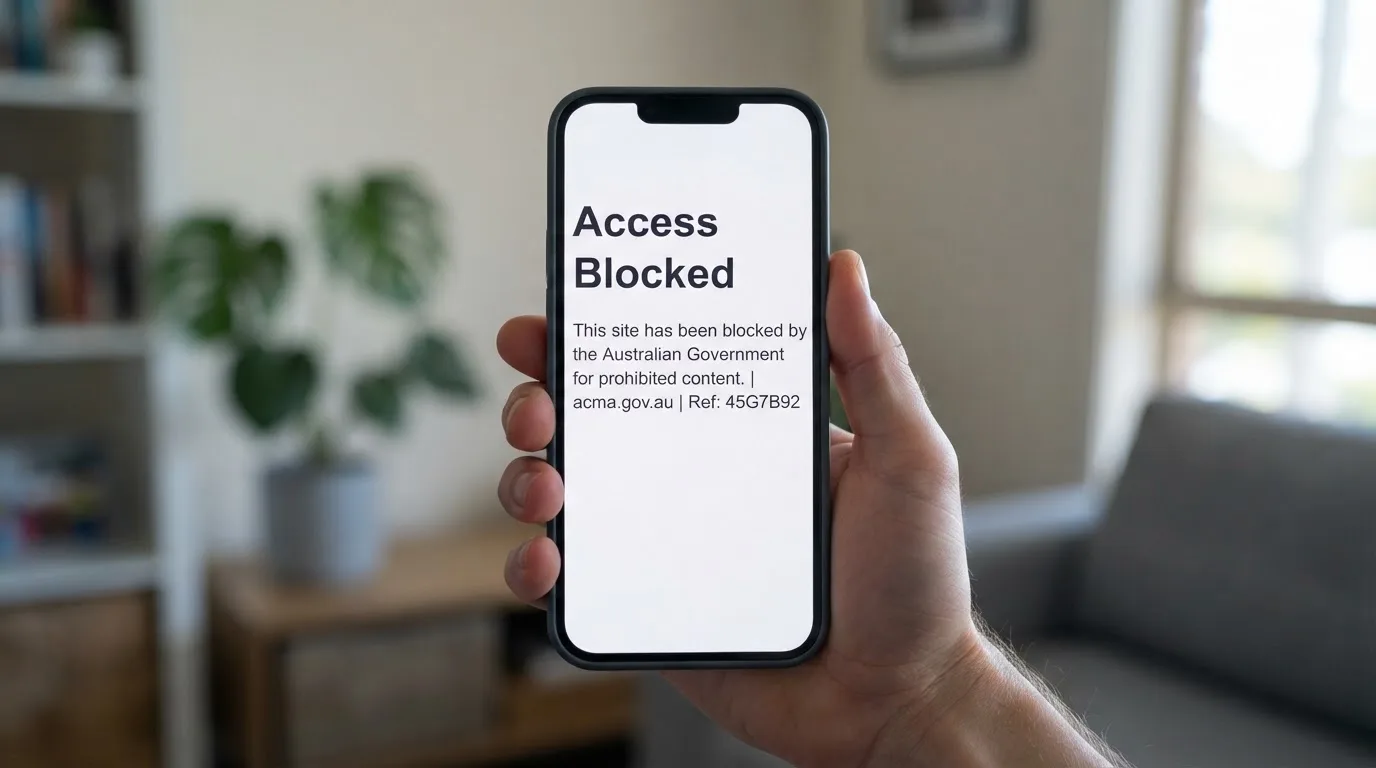
The enforcement arm is the Australian Communications and Media Authority, the ACMA. The ACMA investigates complaints, issues formal warnings to operators it has identified, and — under amendments introduced in 2017 and 2019 — can direct Australian internet service providers to block illegal sites at the DNS level. A blocked site does not mean the operator behind it has shut down; it means Australian customers can no longer reach it through a compliant ISP, and the operator is expected to take steps to prevent Australian sign-ups. Many do not, and the round keeps rolling.
The numbers on the ACMA’s own record are the article-lang short version of “how often does this happen”. According to the ACMA as reported in June 2026, a total of 1,751 illegal gambling and affiliate marketing websites had been blocked since the first blocking request in November 2019, and more than 230 unlicensed gambling services had left the Australian market since enforcement was strengthened in 2017. In a round reported on 26 June 2026 alone, the ACMA asked ISPs to block twelve more: 7Signs, ChromaBet, Donbet, Duospin, Freshbet, Slots Gem, Jacks Club, Lucky Start, Pointsbetz.com, Spinrise, Vinyl Casino and Wildsino. The rate of new names on the list is roughly one round every few weeks.
The number is consequential because it answers a reader’s quiet question: is this market in retreat, or is it busy? On the ACMA’s own count it is busy in both directions at once. H2 Gambling Capital’s 2025 report estimates that Australians lose about A$3.9 billion a year to illegal gambling sites, and that the share of gambling going through legal channels fell from 74% in 2021 to 64%. The total is rising; the licensed share is shrinking; the ACMA’s list is lengthening. Those three lines, all from the same direction, are the shape of the market in 2026.
The reader-side consequence of all this is shorter than the legal section. The individual Australian player is not prosecuted; the IGA targets the provider. An offshore site gives no Australian consumer protection, no complaints body and no recourse if a withdrawal is refused. A balance can sit on a blocked site that the player cannot reach, and the operator has no obligation under Australian law to return it. The deposit the reader made from a debit card or a crypto wallet is in someone else’s custody.
Player protection inside the Australian frame
The Australian frame has a parallel layer of player-protection tools, and they bind only to services that operate inside the frame. A reader who has decided that offshore jackpot pokies are off the table has working options; a reader who has not has fewer of them than the marketing suggests.
BetStop, the National Self-Exclusion Register, has been live since August 2023. Registration bars the person from every Australian-licensed online and phone wagering service at once, for a chosen period of between three months and a lifetime. A self-excluded person cannot open a new account with any licensed operator while the registration is active, and licensed operators must not market to them. The register binds wagering operators; it does not bind an offshore casino. An Australian self-excluded from BetStop remains able to deposit at an offshore site the ACMA has just warned, because that site is not part of the Australian register. The protection follows the licence, not the player.
The National Gambling Helpline is 1800 858 858, free, 24/7, with chat at Gambling Help Online. The line is for a person who is gambling too much, not for a person who is choosing where to gamble. The line does not endorse a venue and does not act on a complaint against an offshore site.
The payment frame since 11 June 2024 closes another door that the offshore sites had used. Credit cards, credit-related products and digital currency are banned as payment for licensed online wagering, with penalties up to A$247,500 for operators who breach the rule. The legal deposit routes for licensed wagering are debit card, bank transfer, PayID/Osko and BPAY. A site asking an Australian for a credit card or a crypto deposit is operating outside the Australian rules — not because credit and crypto are illegal in themselves, but because no Australian-licensed operator can take them on a wagering product, and an offshore operator asking for them has, by that single request, advertised that it is offshore.
The ACMA’s formal-warning record for online jackpot pokies
The ACMA’s register of formal warnings is the public face of the prohibition. Each warning names the operator behind a brand, the brand itself, the date, and the section of the IGA under which the warning was issued. The list is not a ranking and the article does not treat it as one — every brand named below is named because the ACMA itself named it, not because the article has measured one against another. The point of the shelf is the shape of the register over time, and where the same corporate group shows up under several brands.
The table below covers the brands the ACMA has acted against in the period research covers. Two of them are also the subject of earlier warnings to a different corporate group, which the ACMA notes in its own publication; the table carries both dates where research carries them.
| Brand | ACMA action and date | Operator named by the ACMA | Subject support |
|---|---|---|---|
| RocketPlay | Formal warning, March 2026; earlier warning to a different operator in May 2022 | Pulsup Ltd; earlier Dama N.V. | — |
| Level Up Casino | Formal warning, May 2022 | Dama N.V. | — |
| Woo Casino | Formal warning, March 2025 | Dama N.V. | — |
| Spirit Casino | Formal warning, May 2025 | Dama N.V. | — |
| National Casino | Formal warning, July 2025 | Consolutetish S.R.L. | — |
| Bizzo Casino | Formal warning, July 2025; earlier warning to a different operator in 2022 | Consolutetish S.R.L.; earlier TechSolutions (CY) Group Limited and TechSolutions Group N.V. | — |
| Ignition Casino | Formal warning, July 2025 | Bamboo Media | — |
| Instant Casino | Formal warning, February 2025 | EOD Code SRL | — |
| Jackbit | Formal warning, April 2026 | Ryker B.V. | — |
| Casino Intense | Formal warning, April 2025 | Sterplay Holding Ltd | — |
| Sky Crown | Formal warning, September 2022 | Hollycorn N.V. | — |
Two patterns are worth pulling out of the table before the brand-by-brand notes. The first is that Dama N.V. shows up three times in a five-year window — Level Up in May 2022, Woo Casino in March 2025, Spirit Casino in May 2025. The ACMA treats each brand as a separate matter but names the same corporate group; the effect on a reader is that the warning does not end with one brand being closed, because the operator has another brand waiting. The second is the longer tail of older warnings — Sky Crown in September 2022, Bizzo’s 2022 warning to TechSolutions, Level Up in May 2022 — running alongside a steady flow of newer ones. The register is not a backlog being cleared; it is a current operation.
What the table cannot show is the more general point. None of the eleven brands above has ever held an Australian licence for online casino games or online pokies. The licence a brand displays on its own footer is from somewhere else. The ACMA’s warning sits on top of that licence without invalidating it, because the licence was never granted for Australia in the first place. The article-lang gloss is that the badge is a permission to operate somewhere, and “somewhere” is not here.
The brands the ACMA has named, and what each warning covers
The shelf below walks through each of the eleven brands the ACMA’s register covers. Each entry carries the ACMA’s own date and the corporate operator the warning was issued to. Where research also names the brand’s relationship to jackpot pokies or to a major games provider, the entry states what those listings report, in the article-lang sense of “we checked the supplier’s own site and the brand shows up there” — which is a weaker claim than “we tested the game on the brand” and the only claim the inputs support.
RocketPlay
The ACMA issued a formal warning to Pulsup Ltd over Rocketplay.com.au in March 2026. The same brand was the subject of an earlier warning to Dama N.V. in May 2022, when Dama’s six-brand warning covered Bambet, Dazard, Level Up, Rocketplay, Wild Tornado and Cobra Casinos. The March 2026 warning is the live one in 2026; the May 2022 warning remains on the register as a record of the earlier intervention. On the page’s own subject — online jackpot pokies available to Australians — RocketPlay sits in the same position as every brand on this shelf: prohibited service, no Australian licence, ACMA-named operator. The reader who arrived looking for a shortlist leaves knowing RocketPlay is on the regulator’s list, twice.
Level Up Casino
The ACMA issued a formal warning to Dama N.V. over Level Up Casino in May 2022 as part of the same six-brand batch that included RocketPlay. Level Up is also one of the brands the BGaming supplier’s own listings name as a carrying casino for BGaming titles — which is a supplier-side listing, not an audit of the games the casino actually runs in production. The page’s own subject is the legal frame, and the frame is the same for Level Up as for other brands on the register: no Australian licence, ACMA-named operator, service that Australian law treats as unavailable.
Woo Casino
The ACMA issued a further formal warning to Dama N.V. over Woo Casino in March 2025. The “further” matters because Dama N.V. has been on the register before, and the ACMA’s later warnings are a record of an operator continuing to hold Australian-facing brands after the earlier intervention. Woo Casino sits in the same legal position as the rest of the shelf and on the same prohibition. The consequence for the reader is that a brand showing up on the register in 2022 does not mean the underlying group has stopped; it means the ACMA is still writing to the same address.
Spirit Casino
The ACMA issued a formal warning to Dama N.V. over Spirit Casino in May 2025. The same Dama N.V. is the third brand on this shelf to bear its name, after Level Up in May 2022 and Woo Casino in March 2025. The article-lang read of the three together is that an Australian reader who recognises one of the three Dama brands has reason to recognise the others, because they share an operator and the operator has been on the register across the period. Spirit Casino remains subject to the same formal warning as its group counterparts.
National Casino
The ACMA issued a formal warning to Consolutetish S.R.L. over National Casino in July 2025. The brand’s history on the wider web includes a long-running identity — the en.wikipedia.org entry that surfaces when a reader searches the brand name documents the brand’s existence but is not an endorsement of its legality in any jurisdiction. On this page’s subject, what matters is the ACMA’s action: a July 2025 warning to a named operator, on the same prohibition, with no Australian licence displayed.
Bizzo Casino
The ACMA issued a formal warning to Consolutetish S.R.L. over Bizzo Casino in July 2025. Bizzo had earlier been the subject of a 2022 formal warning to TechSolutions (CY) Group Limited and TechSolutions Group N.V. — the earlier operator named for the brand is different from the current one, which is itself a useful signal: the brand has changed hands without changing its face. The reader-side gloss is that a brand name surviving an ACMA warning and resurfacing under a new operator is not an argument for the brand’s safety; it is a record of how the market reorganises itself around enforcement. Bizzo faces the same ACMA-enforced restriction.
Ignition Casino
The ACMA issued a formal warning to Bamboo Media over Ignition Casino in July 2025. Ignition is one of the brands that has historically been marketed to Australian readers under a poker-and-casino wrapper, and the July 2025 warning is the ACMA’s response to that marketing. The legal position is the same as the rest of the shelf: prohibited service, no Australian licence. A reader who lands on the brand from a search result should read the warning date first and the marketing second.
Instant Casino
The ACMA issued a formal warning to EOD Code SRL over Instant Casino in February 2025. Instant Casino is one of the brands that surfaces early in a casual search for “online casinos with big jackpot pokies” in 2026; the formal warning is the ACMA’s own correction to that surfacing. On this page’s subject — online jackpot pokies available to Australians — Instant Casino falls under the same general prohibition, with the regulator’s action serving as a definitive marker for its status.
Jackbit
The ACMA issued a formal warning to Ryker B.V. over Jackbit and CasinOK in April 2026. The warning covers two brands at once, which is the ACMA’s standard form when an operator is running a portfolio rather than a single site. Both brands sit on the same prohibition; the warning date is fresh and the operator is named on the register. A reader who has arrived via Jackbit’s own marketing is reading this page in the same week the ACMA wrote to its operator.
Casino Intense
The ACMA issued a formal warning to Sterplay Holding Ltd over Casino Intense in April 2025. The brand is named on listings pages that research draws from ABC News, the ACMA register itself, and Crown Melbourne’s baccarat page — the latter connection is a search-results artefact rather than a business relationship, and the page states it as the listings report it rather than as a fact about Casino Intense’s operations. The April 2025 warning places Casino Intense in an identical legal position to its peers, carrying no regulatory endorsement in Australia.
Sky Crown
The ACMA issued a formal warning to Hollycorn N.V. over its Sky Crown and Blue Leo casino services in September 2022. The Hollycorn warning is the earliest dated item on this shelf, and it sits in the register as the formal record of an intervention that the operator is presumed to have responded to. The reader-side gloss is that an older warning is not a closed chapter — the ACMA’s register does not have a “resolved” tick — and a 2022 warning still describes the legal position in 2026 for a brand that has not been removed from the ACMA’s standing record.
The blocking-rate calculation: what the ACMA’s record shows about the pace of enforcement
The blocking request of November 2019 was the first of its kind under the amended IGA. The ACMA, as reported in June 2026, has since asked Australian ISPs to block 1,751 illegal gambling and affiliate marketing websites. The figure is not a count of unique operators; it is a count of domains and subdomains, and the same operator can sit behind several of them. The rate is what a reader comparing 2019 to today should weigh.
The math is straightforward and it answers the question research hands over. From November 2019 to June 2026 is roughly 79 months, which gives a running rate of about 22 blocking requests per month across the full period. The early years were slower and the recent years have been faster; the June 2026 round alone added twelve names to the list. The band the page states, then, is the running average — about 22 per month across the full window since the first blocking request — with the qualifier that the rate has accelerated in the most recent reporting periods.
A blocking request is not the same as a site that stays blocked. An operator can move to a new domain, a new mirror or a new corporate wrapper, and the ACMA’s count of domains does not collapse duplicates across wrappers. The rate measures how often the ACMA writes to ISPs, not how many distinct operators remain reachable in any given week. Both numbers are useful, and they answer different questions. The article-lang gloss is that the ACMA’s blocking record is the most public measure of the prohibition in action, and the pace is the pace of the regulator, not the pace of the underlying market.
The figure also has a consequence the table does not surface. The 1,751 includes affiliate marketing sites that promoted prohibited services to Australians, not only the casinos themselves. The ACMA’s enforcement net covers the marketing as well as the product, which is why the count rises faster than the count of unique operators would suggest. A reader who sees a new affiliate site appear after a brand is blocked has just watched the market reorganise; the regulator has just written to it next.
Where an Australian reader can actually play jackpot pokies in 2026
The legal alternatives sit on three shelves, and each one answers a slightly different reader’s question. The article-lang ordering is from broadest access to narrowest.
The narrowest is the licensed land-based casino. Crown Melbourne offers three baccarat variants — Traditional Baccarat, Crown Baccarat and 2 to 1 Baccarat — as approved table games regulated by the Victorian Gambling and Casino Control Commission, which replaced the VCGLR as Victoria’s casino regulator on 1 July 2022. Crown’s blackjack variants are similarly approved, and the VGCCC’s public log of approved changes includes renaming the “Perfect Pairs” side bet to “Crown Pairs” on 23 December 2024 and introducing a “Free Bet” option with a new “Pot of Gold” side bet on 25 March 2024. The state-based regime in New South Wales works the same way under section 66 of the NSW Casino Control Act 1992, which requires every game and its rules to be approved by the regulator and a copy of the approved rules to be available to patrons on request. These are the legal venues for jackpot pokies played on the floor; the pool is local rather than wide-area, and the headline figure is correspondingly smaller than the offshore progressive pools, but the game is lawful and the regulator is named.
The middle shelf is licensed pokies venues — clubs and pubs — which carry pokie machines under state-based approvals. The catalogue varies by state and by venue, and progressive jackpots do appear on licensed floors. The headline figure on a club-floor progressive is generally smaller than the wide-area online pools research names, and the player’s protection is the state-based regulator, not the offshore one. A reader who wants to play a progressive jackpot pokie lawfully in Australia can do so at a licensed venue; what the player cannot lawfully do is reach an offshore site that targets Australians.
The widest shelf is licensed online wagering on races and sport — which is not jackpot pokies and the article-lang distinction matters. The Northern Territory Racing and Wagering Commission regulates 52 of Australia’s online bookmakers, including Sportsbet, Bet365 and Ladbrokes, which are licensed in the Territory for tax reasons. The commission has no full-time staff and meets once a month in Darwin. A bet placed with one of those bookmakers on a race or sporting event before the event is a lawful Australian wager. A jackpot pokie played on the same bookmaker’s site is not — the licensed product is the wagering, not the casino game.
Mechanics that matter when a jackpot pool is climbing
Three mechanics recur across every progressive jackpot pokie the marketing reaches a reader with, and a reader who recognises them reads the marketing differently.
The contribution rate is the share of every losing wager that is added to the pool. A 1% contribution rate on a A$1 spin adds ten cents to the pool. At a wide-area network’s volume, the pool climbs in proportion to total turnover across the network, not to the volume on any one machine. The pool size is a function of network turnover and time since the last reset, not a function of the player’s bet size in any meaningful way — a higher denomination adds more per spin but does not change the share that flows into the pool.
The reset value is the predetermined minimum the pool returns to after a win. The marketing tends to read out the headline current pool and not the reset value, because the current pool is the larger number. A reader who knows the reset value knows what the pool will be the morning after the next win, and the figure is the one the operator sets in the game’s terms rather than the one the headlines report.
The seed of a wide-area progressive is funded by the operator, not by the players. The pool at reset is not zero; it is the seed, paid out of the operator’s margin. That is the mechanical reason why a freshly reset pool is never empty — and why a network’s economics do not depend on the pool being won promptly.
The connection between pool size and the underlying game’s RTP is mechanical but real. Adding a progressive pool on top of a base game with a fixed RTP raises the combined theoretical return to the player. The combined return can cross 100% on certain table games where the rules are published, as research notes; the same calculation for a slot machine is not auditable from outside because the operator does not publish the symbol weights. A reader who hears a slot described as “positive expectation” is hearing a marketing gloss, not an audited fact, and the gloss does not survive scrutiny.
House edges on the table games that share the floor with jackpot pokies
The table-game house edges research names are useful as a comparison point rather than as a recommendation. A reader choosing a progressive pokie is choosing a different game from baccarat, blackjack or craps; the house-edge figures are the article-lang reference for what a casino game with published rules looks like in cost terms.
Baccarat’s house edge is 1.06% on the Banker bet, 1.24% on the Player bet and 14.36% on the Tie. Baccarat’s origins are disputed — some accounts place it in 19th-century France, others say it was introduced from Italy at the end of the 15th century during the reign of King Charles VIII, with David Parlett considering the game Macao its immediate precursor. Punto banco, the variant most played today, was developed in Havana during the 1940s; the casino banks the game at all times and plays both hands by fixed drawing rules. Chemin de fer, the two-player variant, emerged from baccarat banque in the late 19th century and is named for being quicker to play than the original. Cards two through nine count at face value, ten, jack, queen and king count as zero, aces count as one, and hand totals are taken modulo ten; punto banco is dealt from a shoe of six or eight decks.
Blackjack’s house edge with optimal strategy is about 0.28% under liberal Las Vegas Strip rules — dealer stands on soft 17, double on any two cards, double after split, resplit aces, late surrender — and about 0.43% under Atlantic City rules. Blackjack’s immediate predecessor was the English game vingt-un; a related game called veintiuno was described in Miguel de Cervantes’ Rinconete y Cortadillo around 1601–1602, and formal rules were published in Britain in 1800. The game was renamed “blackjack” around 1899, with prospectors during the Klondike Gold Rush of 1896–99 credited with giving it its modern name. Number cards count as their number, jack/queen/king count as ten, an ace counts as one or eleven, and a starting two-card total of 21 is the strongest hand. Variants include Spanish 21 (played without 10s but with liberal player-favourable rules), Double Exposure Blackjack (both dealer cards face-up), Blackjack Switch (swap cards between two hands) and Super Fun 21 (up to four splits).
Craps has a house edge of 1.41% on the Pass/Come bet, 1.36% on Don’t Pass/Don’t Come, and 11.11% on Any Craps. The come-out roll wins immediately on 7 or 11, loses immediately on 2, 3 or 12, and any other number becomes “the point” which the shooter must roll again before rolling a 7 to win the Pass Line bet.
The article-lang read of the three games together is that a casino game with published rules and a published house edge is auditable from outside the venue, and a slot machine with the same data published would be auditable too. The reason slot machines are not is that the operator does not publish the reel layouts and symbol weights, and the calculation depends on inputs that the player does not have. That is a mechanical fact, not a marketing one.
Tax and money: what an Australian player actually keeps
The Australian Taxation Office’s treatment of gambling winnings for a recreational player is straightforward and worth stating plainly. Gambling winnings of a recreational player are not assessable income under section 6-5 of the ITAA 1997 and losses are not deductible, unless the person carries on a business of gambling — which is a model the ATO applies case by case and not a category the ATO publishes a checklist for. The article-lang gloss is to check with the ATO if the question is whether a particular pattern of play counts as a business, and otherwise to treat recreational gambling winnings as not taxable and recreational losses as not deductible.
The payment layer matters as much as the tax layer. Since 11 June 2024, credit cards, credit-related products and digital currency are banned as payment for licensed online wagering. The legal deposit routes are debit card, bank transfer, PayID/Osko and BPAY. A site asking for a credit card or a crypto deposit is, by that single request, advertising that it is not an Australian-licensed operator for wagering products. The deposit method is itself a signal.
What the page is and what it is not
This page is the legal frame for online jackpot pokies in 2026 as it stands after the ACMA’s blocking rounds and formal warnings. It is not a shortlist of operators an Australian reader can use to play jackpot pokies online, because no such shortlist exists lawfully. The brands named above are named because the ACMA named them; they are not recommended and the article does not direct a reader to any of them. The reader who arrived wanting a working list has reached a page that, on the page’s own subject, cannot honestly supply one.
The lawful alternatives — licensed land-based casinos, licensed clubs and pubs, licensed online wagering on races and sport — are the shelves the reader can act on. Each has its own mechanics, its own regulator and its own limits. The jackpot pool on a licensed floor is generally smaller than the headline figures the offshore marketing reaches a reader with; the protection in return is that the regulator is named, the rules are approved, and the player’s recourse runs through a state-based body that has jurisdiction.
Frequently asked questions about big jackpot pokies in Australia
What is the largest jackpot ever recorded on an online slot?
The record online slot jackpot on the public record is €19,430,723.60, won on 27 April 2021 by a player in Belgium on Microgaming’s Absolootly Mad: Mega Moolah at Napoleon Sports & Casino. Games Global, the business formerly known as Microgaming, still distributes the Mega Moolah progressive series and has announced later wins of £11.5 million and £13.5 million.
How does a progressive jackpot pokie differ from a fixed-prize one?
A fixed-prize pokie pays the same jackpot amount regardless of how long the pool has been building. A progressive jackpot pokie routes a share of every losing wager into a shared pool that grows until it is won, then resets to a predetermined minimum. The pool can be local to one machine, linked across a venue, or wide-area across many venues in many countries.
Is it legal for an online casino to offer jackpot pokies to Australians?
No. Under the Interactive Gambling Act 2001, as strengthened by the Interactive Gambling Amendment Act 2017, it is an offence to provide online casino games, online pokies or in-play betting to a person in Australia. No state or territory issues a licence for online casino games. The licence an offshore casino displays is from a different jurisdiction and gives no right to take bets from Australians.
Can a free version of a jackpot pokie show the real jackpot total?
A free version can display the current pool figure on a wide-area network, but it cannot pay the real jackpot because the player has not wagered real money into the network’s contribution rate. The figure on screen in a free version is the marketing reading of the network’s current pool; the player’s spin does not contribute to it.
Are jackpot-style pokies common on licensed Australian club and pub floors?
Progressive jackpots do appear on licensed floors, though the headline figure is generally smaller than the wide-area online pools the offshore marketing reaches a reader with. The pool is local or state-wide rather than international, and the player’s protection is the state-based regulator and the approved rules.
What determines how quickly a progressive jackpot grows?
Three factors: the contribution rate set by the operator, the volume of wagers across the linked network, and the time since the last reset. A 1% contribution rate on a network with steady turnover grows the pool in proportion to that turnover; doubling the network’s volume does not change the rate per wager but does change the rate per unit of time.