
Best Aussie Pokies Online Australia: The Real Shape of the Market in 2026
The search for “best aussie pokies online australia 2026” promises a ranked list of trustworthy sites. Australia does not have one, and a page that pretends otherwise is selling something that does not exist. Online pokies — the internet version of the pub machine — are prohibited under the Interactive Gambling Act 2001 for anyone physically in Australia, and no state or territory issues a licence for them. What does exist is a legal product in licensed pubs, clubs and casinos, a steadily growing list of offshore sites that operate outside Australian law, and a regulator — the ACMA — that has spent eight years naming names, issuing formal warnings and asking internet providers to block illegal services. This page is built around the gap between what a typical search result suggests and what the country actually permits.
Current as of 30 October 2026; licence and enforcement claims cross-checked against the ACMA register and the Interactive Gambling Act 2001.
Table of Contents
- Payment Methods at AU-Facing Offshore Pokies Sites
- Bonuses, Free Spins and the “Aussie Welcome Package”
- Pokies Catalogues: How They Are Built and What a Paytable Says
- What a Fair Ranking for Aussie Online Pokies Would Weigh
- Overview of Online Pokies in Australia
- The Legal Frame: What the IGA Actually Says
- Responsible Gambling: What Works and What Does Not Reach the Punter
- A Note on Tax and on the Money Side
- How This Page Was Built and What It Does Not Cover
- Frequently Asked Questions
Payment Methods at AU-Facing Offshore Pokies Sites
The first shelf to close is payments, because that is the shelf a punter hits before anything else. No Australian bank, no PayID participant and no Australian-licensed wagering service processes a deposit for an online pokie: the IGA makes the service illegal to provide, and the payment side of a transaction follows from that. What follows is therefore not a guide to depositing. It is a description of the methods the offshore sites typically advertise, framed in Australian banking vocabulary, so a reader knows what each one means and what the law already says about it.
What “PayID” Actually Means at an Offshore Site
PayID is an Australian real-time payments layer that sits on top of the New Payments Platform. A PayID resolves an email, phone number or ABN to a bank account at a participating institution, and an Osko payment settles in under a minute. A licensed Australian wagering service uses it; an offshore online pokie site cannot route PayID through a regulated Australian deposit product, because the receiving end is not a wagering provider licensed in Australia. When an “Aussie pokies PayID” listing tells you a deposit is instant, the marketing is borrowing the speed of a rail the site has no contractual right to use. The time the deposit takes is the time it takes the offshore operator to credit the balance — often quickly, sometimes not — not the time Osko takes to move the money.

What Changes When a Site Asks for a Credit Card or Crypto
The IGA does not ban a player from paying. It bans the operator from offering a prohibited service to someone in Australia. The credit-card and crypto ban sits one level down: from 11 June 2024, licensed Australian wagering providers cannot accept a credit card, a credit-related product or digital currency for a bet.
An offshore pokie site is not bound by that rule. A request for a credit card number or a Bitcoin wallet address is therefore not just a red flag for a punter — it is a red flag about the operator’s own status, because a licensed wagering service in Australia would not be asking. The same is true in reverse: a debit card or a bank transfer the offshore site accepts is being processed as a normal commercial payment, not as a regulated wagering deposit.
Settlement Timing at Offshore Sites
Where the data exists, the pattern is: deposits credit fast (the operator wants the punter playing), withdrawals are slow and conditional. Identity checks typically re-run on the first cashout, not on the deposit, which is why a withdrawal that should take one business day takes five. Some sites cap the weekly withdrawal amount. None of this is enforced by an Australian complaints body — the IGA’s enforcement arm targets the provider, not the punter, and a blocked site can leave a balance behind. The slot the page is closing here is payments; the slot the reader is closing is the realisation that no payment method turns an illegal service into a legal one.
Bonuses, Free Spins and the “Aussie Welcome Package”
The bonus shelf is where offshore marketing is loudest and where the IGA’s advertising rules bite. This shelf describes what an offer on these sites typically looks like and what the inducement rules do and do not catch — and it does so without printing any single offer’s wagering multiple, because the sources for those numbers are affiliate marketing pages, not the regulator.
What an Offshore Welcome Package Usually Contains
A “best aussie pokies online australia” result typically offers a matched deposit bonus — the site matches a first deposit at a stated percentage up to a cap — bundled with a batch of free spins on one or more named slot titles. The structure varies but the bones do not: a headline number, a wagering requirement stated as a multiple of the bonus or the bonus-plus-deposit, a list of games that contribute less than 100% to clearing that requirement, a maximum-cashout clause on the free-spin winnings and an expiry window measured in days. None of those terms is set by Australian law; all of them are set by the operator, in an environment where the operator is already breaking Australian law by offering the game in the first place.
Why “Aussie-Facing” Bonus Terms Are Not Australian Terms
A punter reading a welcome package assumes the terms come from somewhere accountable. They do not. The licence a site displays — Curaçao, Anjouan, Kahnawake — is a real business licence but it is not an Australian consumer protection regime. There is no Australian complaints body the punter can lodge with, no BetStop equivalent that the offshore site reads, and no statutory cooling-off period. A bonus term that the punter finds unfair is a bonus term the punter has already accepted by depositing. That is the difference between a deposit match on Sportsbet, where the regulator can pull the licence, and a deposit match on an offshore pokie site, where the regulator can only block the site.
Free Spins and the Credit-Bonus Loop
Free spins in this market usually convert to a small bonus credit on completion, and that credit carries its own wagering requirement before withdrawal. The loop — deposit, spin, convert, wager, withdraw — is the marketing engine that holds a player on the site. Where the IGA’s advertising reform bites is upstream: from 1 January 2027 the Interactive Gambling Amendment (Gambling Reform) Bill 2026 restricts inducements, but the bill commenced as law on 19 August 2026 with the inducement measures starting on that later date. Until then, the inducement rules are policed in the limited way the ACMA already polices them — through warnings, through blocking, and through the fact that a licensed wagering provider cannot run the same offer.
What a Punter Can Read Before Clicking
A bonus block on this page, even described qualitatively, has a use: it tells the punter which lines of small print cost the most. Wagering multiples sit in the 35–50× range on the bonus or the bonus-plus-deposit. Free-spin winnings are usually capped. The maximum stake while a bonus is active is usually capped too. A punter who reads those three clauses before depositing keeps the same offer but loses less of it. A punter who does not read them has, in effect, bought a marketing headline.
Pokies Catalogues: How They Are Built and What a Paytable Says
This shelf is the closest the page gets to the games themselves, and it does so without pointing to a real machine or site. A pokie is the local name for an electronic gaming machine; an “online pokie” is the internet version. The mechanics on screen are the same mechanics a pub player has known for decades — reels, paylines, a return-to-player percentage the regulator sets — but the catalogue around them is built differently online.
How an Offshore Catalogue Is Organised
An offshore pokie catalogue runs to the high hundreds or low thousands of titles, sorted by provider rather than by theme. A single aggregator may list the same game under different studio names if the studio has been through a corporate change. Categories like “Hot”, “New” and “Jackpot” are marketing categories, not regulatory ones. None of the titles on these sites are tested by an Australian state regulator; the testing bodies named on the page are typically GLI, eCOGRA or BMM Testlabs, which test against the rules of whichever jurisdiction the operator claims.
What a Paytable Shows and What It Hides
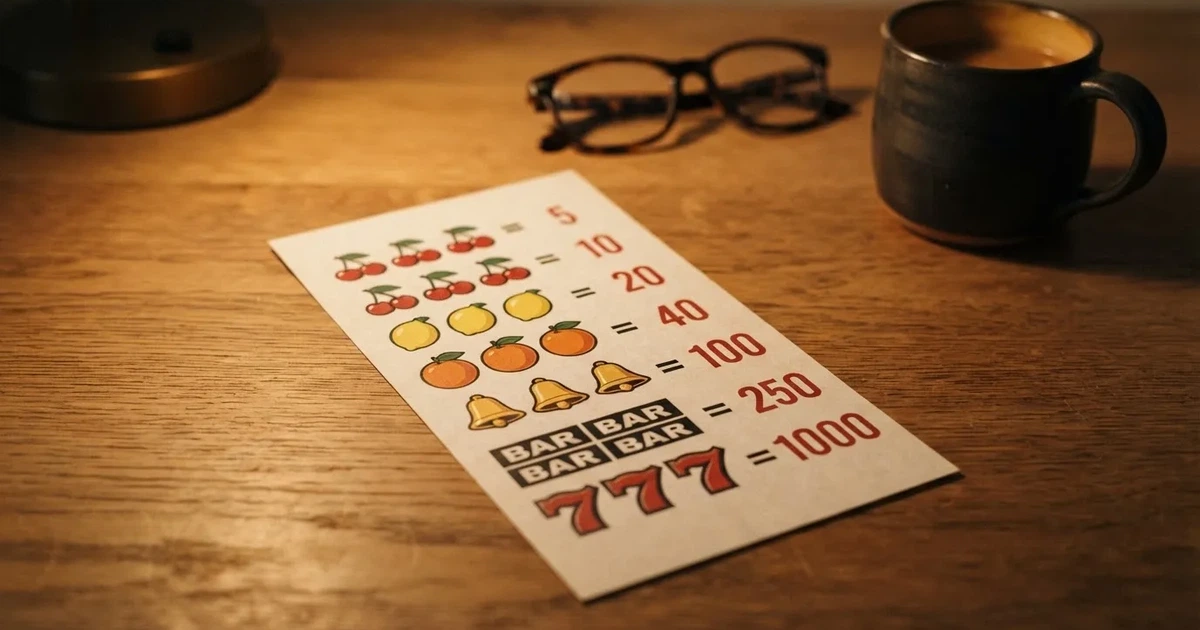
A paytable is the screen that lists each symbol’s payout, the rules for bonus features, the number of paylines, and — usually in small print near the bottom — the return-to-player percentage and the volatility rating. The RTP is a long-run average; it is not a guarantee for the next session. The volatility rating tells the punter how the payouts are distributed: a high-volatility title pays rarely and in bigger chunks, a low-volatility title pays often and in smaller chunks. Neither number is on the screen during play. Both are in the paytable. A punter who reads them has more information than a punter who does not, and the gap between the two is what the marketing relies on.
Why the RTP Bands Look the Way They Do
Australian state regulators set a minimum RTP for the land-based machines they license: 85% in New South Wales, the Northern Territory and Queensland, 87% in the Australian Capital Territory, Tasmania and (generally) Victoria, 87.5% in South Australia, and 90% in Western Australia. Those are floors, not averages. The online pokie on an offshore site typically tests at 94–96% RTP, because the offshore jurisdiction does not impose an Australian floor — but neither does it impose an Australian ceiling, and a 94% RTP and a 96% RTP are different products. The difference is the house edge: 6% versus 4%, or roughly A$6 versus A$4 per A$100 turned over in the long run. The page does not need to print a house edge to make that point; the catalogue description is enough.
Providers and Studios — Why the Names Repeat
A punter comparing catalogues will see the same studio names recur: Pragmatic Play, BGaming, Hacksaw Gaming, Nolimit City, Playson, Wazdan, Endorphina, Betsoft. The repetition is because most offshore operators license a small number of aggregator feeds rather than contracting directly with each studio. The studio is not Australian, the licence is not Australian, and the testing is not Australian. The punter who treats a “provider” as a brand endorsement is treating it as something the offshore catalogue does not promise.
What a Fair Ranking for Aussie Online Pokies Would Weigh
This is the section a punter looks for first, because it is the hurdle encountered before anything else. There is no licensed shortlist of online pokies sites in Australia, because online pokies are not licensed here. What can be done honestly is to set out the criteria a fair ranking would weigh, and then to show the brands those criteria run against when applied to the offshore market.
What a Real Ranking Would Need to Compare
A fair comparison of online pokie sites would weigh, at minimum: licence status under Australian law (which is to say, the absence of one for online pokies), enforcement history under the IGA, payment routes available to an Australian punter, withdrawal terms, identity-check timing, the operator behind the licence the site displays, and the duration and condition of any welcome offer.

Add the practical: a complaints path a punter can actually use, the time the site has operated under its current name, and whether the site has ever appeared on an ACMA blocking list. A ranking that omits any of those is a ranking that ranks marketing, not products.
Comparison of Offshore Operators
Eleven brands have been the subject of formal ACMA warnings over offering prohibited online casino services to Australians. The table below lists each brand as the ACMA named it, the operator behind it, the date of the warning and the subject support research found for that brand. Where research could not place a brand on a particular axis, the cell carries an em dash rather than a guess.
| Brand | ACMA action and date | Operator named by the ACMA | Subject support |
|---|---|---|---|
| RocketPlay | Formal warning, March 2026; earlier warning to same operator family, May 2022 | Pulsup Ltd | — |
| Level Up Casino | Formal warning, May 2022 | Dama N.V. | Listed by BGaming (listings-only) |
| Woo Casino | Formal warning, March 2025 | Dama N.V. | — |
| Spirit Casino | Formal warning, May 2025 | Dama N.V. | — |
| National Casino | Formal warning, July 2025 | Consolutetish S.R.L. | Listed on Wikipedia (listings-only) |
| Bizzo Casino | Formal warning, July 2025; earlier warning, 2022 | Consolutetish S.R.L. (July 2025); TechSolutions (CY) Group Limited and TechSolutions Group N.V. (2022) | — |
| Ignition Casino | Formal warning, July 2025 | Bamboo Media | — |
| Instant Casino | Formal warning, February 2025 | EOD Code SRL | — |
| Jackbit | Formal warning, April 2026 | Ryker B.V. | — |
| Casino Intense | Formal warning, April 2025 | Sterplay Holding Ltd | Listed by ABC, ACMA and Crown Melbourne references (listings-only) |
| Sky Crown | Formal warning, September 2022 | Hollycorn N.V. | — |
The table does not rank. It records what the ACMA has put on the public record. A reader who treats the absence of a brand from this table as a recommendation is reading the wrong way: the IGA prohibits the provision, not the naming, and the ACMA acts where it has cause to act.
How Many Sites the ACMA Has Blocked Since 2019
The arithmetic the page is owed — and the place where research gives enough to make a number worth printing — is the rate at which the ACMA’s blocking programme has run. As of the round reported on 26 June 2026, a total of 1,751 illegal gambling and affiliate marketing websites had been blocked since the first blocking request in November 2019. That is a span of roughly six and a half years. The annual average sits in the high two hundreds; the year-on-year pace has held steady rather than accelerated. The band this gives the reader is about 240 to 290 blocked sites per year across the period enforcement has run. The condition: this is what the ACMA has asked ISPs to block, not the universe of illegal sites that exist. The blocking programme is one enforcement tool among several — formal warnings, civil penalties and the IGA’s criminal offences — and a site can be illegal without ever appearing on a block list.
The Brands in Detail
What follows is each brand’s write-up. None of them is recommended. Each is described as the ACMA described it, and each is closed on what its block on the page actually is.
RocketPlay
The ACMA issued a formal warning to Pulsup Ltd over Rocketplay.com.au in March 2026. An earlier warning covered the same operator family under Dama N.V. in May 2022. The site is one of the more persistent brands in the Dama stable: it has cycled through operators, and the ACMA has cycled through warnings. A punter who arrives at the site today is arriving at a service the regulator has already named twice.
Level Up Casino
The ACMA warned Dama N.V. in May 2022 over a six-brand batch that included Level Up Casino. The brand surfaces in BGaming’s public listings as a distributor partner — research places that on the page as a listings-only fact, not an endorsement. A punter comparing Level Up to another Dama brand is comparing one warning to another; the difference is the brand name on the warning, not the legal posture.
Woo Casino
The ACMA issued a formal warning over Woo Casino in March 2025, again to Dama N.V. Woo has carried bonus terms and a PayID-adjacent payment pitch in its marketing at various points. None of that changes the underlying fact: a warning under the IGA is a warning that the service is prohibited for Australians, whatever the deposit rail.
Spirit Casino
The ACMA warned Dama N.V. over Spirit Casino in May 2025. Spirit is one of the newer brands in the same operator family and has been the subject of a single formal action to date. A single warning is not a clean record — it is the regulator saying it has already acted once.
National Casino
The ACMA warned Consolutetish S.R.L. over National Casino in July 2025. The brand appears on Wikipedia’s coverage of Australian-facing operators, which research records as listings-only rather than as a regulatory endorsement. National Casino is therefore a brand the encyclopedia has heard of and the regulator has warned.
Bizzo Casino
The ACMA warned Consolutetish S.R.L. over Bizzo Casino in July 2025. Bizzo had already been the subject of a 2022 warning to TechSolutions (CY) Group Limited and TechSolutions Group N.V. Two warnings across two operator groups means the brand has outlived its first corporate wrapper and the regulator has noticed it twice.
Ignition Casino
The ACMA warned Bamboo Media over Ignition Casino in July 2025. Ignition is one of the offshore brands marketed heavily to Australian-facing traffic through affiliate pages that also carry U.S. sportsbook positioning. The Australian-facing version of an American-facing brand is still Australian-facing for IGA purposes.
Instant Casino
The ACMA warned EOD Code SRL over Instant Casino in February 2025. The brand’s name suggests speed and frictionless onboarding, which is the marketing shape of a market the regulator is actively policing. The shape is not the substance.
Jackbit
The ACMA warned Ryker B.V. over Jackbit in April 2026. Jackbit has been marketed around crypto deposits, which sits inside the payment methods the IGA does not restrict for offshore sites and the credit-card ban does not reach.
Casino Intense
The ACMA warned Sterplay Holding Ltd over Casino Intense in April 2025. The brand surfaces in the same sources that mention Crown Melbourne and baccarat on Crown’s table-game page — research carries that as listings-only, not as a regulatory comparison.
Sky Crown
The ACMA warned Hollycorn N.V. over Sky Crown in September 2022 (with Blue Leo in the same action). Hollycorn operates a stable of brands under one corporate umbrella; a warning over one is a warning that names the operator, not just the brand.
What This Section Closes On
A ranking cannot be produced honestly because the underlying product is prohibited. What the section does is replace the ranking with a comparison the regulator has already done the work on.with a comparison the regulator has already done the work on: each brand is named, the operator behind it is named, and the date of the warning is on the page. A punter who reads this section is reading a list of services the ACMA has already told them are illegal, not a list of services an affiliate has dressed up.
Overview of Online Pokies in Australia
This overview sketches the wider landscape. The market’s promise — a comparison of the best online pokies sites in Australia — runs into three facts that organise everything else on the page. First, online pokies are prohibited for people in Australia under the IGA. Second, the legal product is the land-based machine in licensed pubs, clubs and casinos, and the rules vary by state. Third, the offshore market a punter actually seeks is the market the ACMA has spent eight years disrupting.
What “Aussie Pokies” Means in Marketing and What It Means in Law
In marketing, “Aussie pokies” is a brand handle — a way for an offshore site to dress itself in Australian iconography without any Australian licence behind it. In law, the only “Aussie pokies” that exist are the electronic gaming machines in licensed Australian venues, and each state and territory regulates them separately. The two are not the same product, and a page that conflates them is a page that has skipped the part of the question that matters.
The Land-Based Machine, in One Paragraph
Electronic gaming machines were first legally operated in New South Wales in 1956, by registered clubs. Today, machines operate in every Australian state and territory, and each jurisdiction sets its own minimum return-to-player, its own venue count, its own bet limits and its own harm-minimisation measures. In 2020–21 Australians bet almost A$150 billion through gaming machines and lost A$12.18 billion on them; Australia has about 3% of the world’s pub and club poker machines with 0.3% of the global population. New South Wales alone had 87,298 machines outside casinos across 2,195 venues in June 2023, with player losses of A$8.18 billion in 2022–23. Queensland had 21,122 machines in 351 venues in October 2023, and Victoria had 26,380 outside Crown Casino in 488 venues under a 30,000-machine statewide limit. Western Australia banned poker machines in pubs and clubs entirely when Crown Perth opened in 1985; Crown Perth’s own machine count has since grown from about 200 in 1985 to roughly 2,500, all approved by the state’s Gaming and Wagering Commission.
The Offshore Market in One Paragraph
The offshore market is the market players often seek. It is large, profitable and illegal to provide to anyone in Australia. H2 Gambling Capital’s 2025 report estimates that Australians lose about A$3.9 billion a year to illegal gambling sites, and that the share of gambling going through legal channels fell from 74% in 2021 to 64%. The illegal share is being eaten by the offshore market the ACMA is trying to disrupt, and the disruption is working at the edges (blocking, warnings, civil penalties) without yet turning the corner on the underlying figure.
Why a Page on This Topic Cannot Recommend a Site
This page is not a recommendation engine. It is a description of a market the regulator has named, with each named operator carrying the warning that puts it on the page. The recommendation a reader might want — “where should I play?” — is a recommendation the law does not permit the operator to fulfil, which means a page cannot honestly give it. The recommendation the page can give is to play the legal product, in the licensed venue, under the harm-minimisation measures the punter’s state has set, or not at all.
The Legal Frame: What the IGA Actually Says
The legality shelf is the one shelf the page cannot abbreviate. The IGA is the reason this page exists in its current shape: it is the statute that makes the offshore market illegal to provide, it is the statute the ACMA enforces, and it is the statute that determines what a punter in Australia can and cannot do.
The Interactive Gambling Act 2001, in Plain Terms
The Interactive Gambling Act 2001 (IGA), as strengthened by the Interactive Gambling Amendment Act 2017, makes it an offence to provide online casino games, online pokies or in-play betting to a person physically in Australia. No state or territory issues a licence for those services. What is licensable is wagering on races and sport placed before the event, lotteries and keno. The minimum age for any form of licensed gambling in Australia is 18. The criminal offence sits on the provider; the individual player is not prosecuted. That detail is not a get-out — it is a description of where the law chooses to put its weight.
What the ACMA Does
The ACMA (Australian Communications and Media Authority) investigates complaints, issues formal warnings, and directs Australian internet service providers to block illegal sites. The blocking programme began with the first blocking request in November 2019 and has run continuously since; as of the round reported on 26 June 2026, a total of 1,751 illegal gambling and affiliate marketing websites had been blocked. More than 230 unlicensed gambling services had left the Australian market since enforcement was strengthened in 2017. The most recent round reported on 26 June 2026 named twelve more sites: 7Signs, ChromaBet, Donbet, Duospin, Freshbet, Slots Gem, Jacks Club, Lucky Start, Pointsbetz.com, Spinrise, Vinyl Casino and Wildsino. The pace has held steady rather than accelerated; the underlying illegal market has not collapsed, and the ACMA has not claimed it has.
What a Formal Warning Actually Means
A formal warning under the IGA is the ACMA putting on the public record that a named operator is providing or has provided a prohibited service to Australians. It is not a criminal prosecution. It is not a civil penalty order. It is the regulator’s least invasive tool, and it is the one that produces the names this page carries. A warning can be followed by a civil penalty, an injunction, or a referral to the Commonwealth Director of Public Prosecutions; in practice, most of the action in this market has run through warnings and through blocking requests to ISPs.
Player Protection — and the Limits of It
The National Self-Exclusion Register, BetStop, has been live since August 2023. It binds Australian-licensed online and phone wagering services, which means it binds licensed bookmakers and licensed lottery operators and not much else. An offshore online pokie site is not connected to BetStop, and a punter who has self-excluded from Sportsbet has not self-excluded from a site the ACMA has blocked three times. The National Gambling Helpline is 1800 858 858 — free, confidential, twenty-four hours a day, with chat at Gambling Help Online. A punter who is reading this page because their own play has changed shape can call that number now.
Payments, Reform and What Comes Next
From 11 June 2024, credit cards, credit-related products and digital currency cannot be used as payment for licensed online wagering, with penalties up to A$247,500 for operators. The legal deposit routes for licensed wagering are debit card, bank transfer, PayID/Osko and BPAY. The Interactive Gambling Amendment (Gambling Reform) Bill 2026 passed Parliament on 19 August 2026, and its advertising and inducement measures commence on 1 January 2027. A page read before 1 January 2027 is read before the inducement rules are in force; a page read after is read under them. Either way, the inducement rules bind the licensed side of the market and do not bind the offshore side directly — the offshore side is bound by the underlying prohibition, which is unchanged.
Responsible Gambling: What Works and What Does Not Reach the Punter
The responsible-gambling section is one the page cannot leave thin. The product a reader searches for is the product that does the most harm to the people least equipped to handle it, and a page on this subject that does not say so is a page that has chosen its tone over its reader.
What the Legal Product Already Does
The licensed pub, club and casino machine sits inside a harm-minimisation regime that varies by state. Western Australia’s venue-level ban on poker machines is the most aggressive form of that regime; Crown Perth is the exception, with roughly 2,500 machines approved by the Gaming and Wagering Commission. Tasmania passed legislation in November 2021 ending the Federal Group’s monopoly on the state’s machines and moving oversight to the Tasmanian Liquor and Gaming Commission. Tasmania then planned nation-leading mandatory pre-commitment cards for its poker machines, but implementation of the reform was delayed until late 2025. New South Wales, Victoria, Queensland and the other jurisdictions each run their own version: pre-commitment tools, self-exclusion registers, advertising restrictions and venue-level rules on opening hours and bet sizes. None of this reaches a punter on an offshore site, because none of it binds an offshore site.
What the Offshore Site Does Not Do
The offshore site offers self-exclusion at its own discretion and not because the law requires it. It offers deposit limits in the same way. It offers “reality checks” — pop-ups telling a player how long they have been playing — because the testing laboratories the operator pays for grade them, not because an Australian regulator can enforce them. The punter who has set a deposit limit on Sportsbet has set a limit that BetStop and the regulator can see; the punter who has set a deposit limit on an offshore pokie site has set a limit the offshore site can move.
What the Numbers Say About the Market
Australians bet almost A$150 billion through gaming machines in 2020–21 and lost A$12.18 billion on them. The H2 Gambling Capital estimate for 2025 puts losses to illegal gambling sites at about A$3.9 billion a year. The illegal channel is roughly a quarter of the legal channel by spend; the harm profile of an unregulated product is not the same as the harm profile of a regulated one, and the page is not in a position to claim which is worse, only that they are different.
What to Do If Play Has Changed Shape
Free, confidential help is available any time through Gambling Help Online. The National Gambling Helpline is 1800 858 858. The punter reading this page because their own play or someone else’s play has become a problem has the same options the rest of the market has: the licensed product’s self-exclusion register (BetStop), the state-based help line, the general practitioner, and the people around them. A page that closes on anything other than that list has not closed on its reader.
A Note on Tax and on the Money Side
The money question — what a punter owes the ATO on a win — is one the page handles briefly, because the answer is brief. Gambling winnings of a recreational player are not assessable income under section 6-5 of the ITAA 1997, and losses are not deductible, unless the person carries on a business of gambling. The ATO’s guidance is the only authoritative version of that rule; this page does not substitute for it. A recreational punter at a pub, club or casino in Australia, or on an offshore site, is taxed the same way: not at all on the win, and not at all on the loss.
How This Page Was Built and What It Does Not Cover
The page was built from the ACMA’s own enforcement record, from the IGA’s text, from state-level data on the legal product, and from the H2 Gambling Capital 2025 estimate of losses to illegal sites. It does not carry affiliate marketing figures, it does not carry bonus terms from affiliate pages, and it does not carry any operator’s own description of its own welcome package. Where the data was missing — the volatility of a specific offshore title, the exact RTP of an offshore game’s catalogue — the page says so and moves on. Where the data was present — the date of an ACMA warning, the number of blocked sites, the state-by-state machine counts — the page carries the figure with its source. The reader who wants the offshore site’s marketing pitch can read the offshore site; the reader who wants the regulator’s record is reading it now.
Frequently Asked Questions
Does calling an online pokies site “Aussie” change where it is actually licensed?
No. The brand handle, the Australian iconography on the homepage, and the use of A$ in the cashier do not change the operator’s actual licence. The IGA’s prohibition on providing online pokies to people in Australia applies to the operator, not to the brand name on the site. A punter who wants the legal product plays the licensed pub, club or casino machine, not a site named after the country.
Are the bonus credits and free spins on an “Aussie pokies” site legal to advertise here?
No. A licensed Australian wagering service cannot offer inducements in the way an offshore site does. The Interactive Gambling Amendment (Gambling Reform) Bill 2026 tightens the inducement rules further from 1 January 2027, with the bill itself commencing as law on 19 August 2026. Until then and after, an inducement on an offshore site is not an inducement an Australian regulator has approved.
Is there a dedicated app for Aussie-branded online pokies that is legal to install locally?
No. The Apple App Store and Google Play restrict real-money gambling apps by jurisdiction, and apps that meet Australian requirements sit behind the licensed wagering providers — Sportsbet, Bet365, Ladbrokes and the rest — none of which offers online pokies. An “Aussie pokies” app offered through a sideload, an APK, or a third-party store is an app outside both the IGA and the store’s own rules.
Do state gaming regulators recognise any “Aussie online pokies” brand as licensed?
No. State and territory regulators license the land-based product — the pub, club and casino machine — and they do not license online pokies, because the IGA does not permit any state to do so. A brand that claims an Australian licence for an online pokie is either misreading or misrepresenting its own status; the ACMA’s enforcement record is the public version of that finding.
How does an Aussie-branded online pokies catalogue differ from a licensed pub’s machines?
The catalogue on an offshore site runs to the high hundreds or low thousands of titles, sourced from a small number of international aggregators. The licensed pub machine is a single machine, regulated state by state, with a state-set minimum RTP and a state-set bet limit. The two are not the same product: the offshore catalogue is unregulated in Australia and the pub machine is regulated by the state the venue sits in.
Can an Aussie-branded online pokies site accept a PayID deposit and still be unlicensed?
Yes. PayID and Osko are real-time payments rails on the New Payments Platform; they move money from the punter’s bank account to a recipient bank account. An offshore site accepting a PayID payment is receiving a bank transfer, not a regulated wagering deposit, and the IGA’s prohibition on providing online pokies is not affected by which rail the deposit runs on. The payment method does not make the service legal.