
Fast bank transfer deposits, slow legal ground — picking through “instant” casino banking in Australia
The transfer itself takes seconds. PayID and Osko push money between Australian bank accounts in under a minute, every hour of every week, and a transfer addressed to a casino cashier arrives before the player has closed the deposit screen. The site’s own review, the bonus reconciliation, the payment-processor’s batched settlement, and the eventual withdrawal back to an Australian account are all another story, and the whole arrangement sits on top of a prohibition that the Australian Communications and Media Authority enforces with quiet regularity. This guide walks through that gap between the speed of the rail and the status of the destination, naming every operator in the featured set, every ACMA action that put it there, and every Australian payment safeguard a player can lean on.
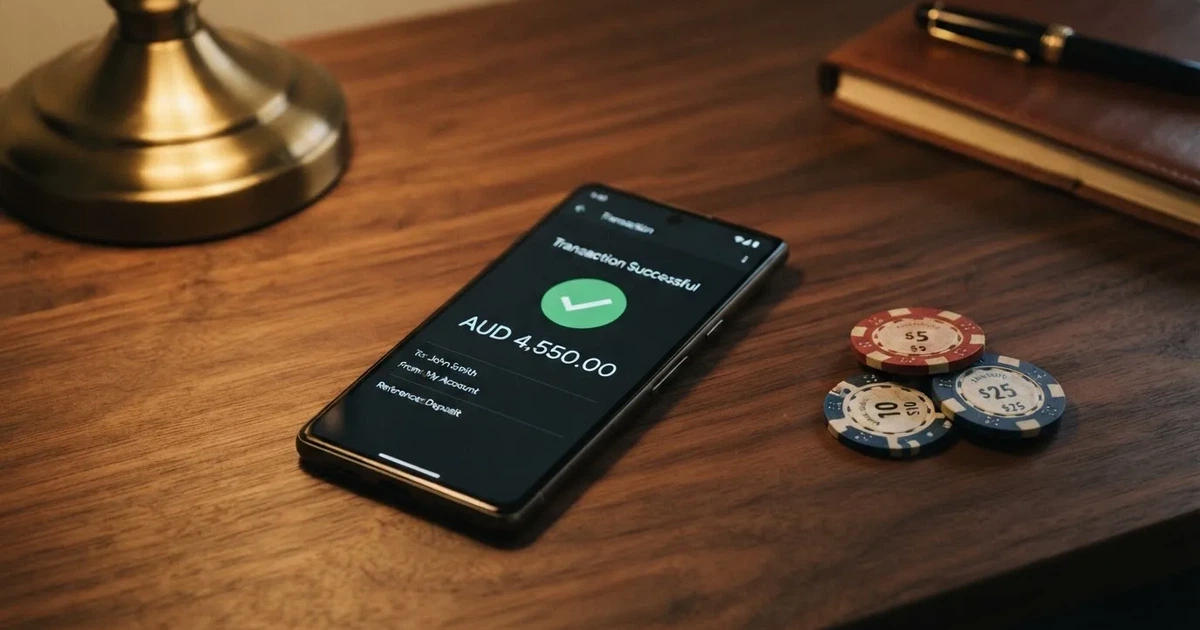
Currency note. Figures are current as of 29 October 2026 and have been checked against ACMA formal-warning publications and the public information pages of Australian Payments Plus, the Reserve Bank of Australia and the major Australian banks.
Table of Contents
- The Australian prohibition that runs through every brand on this page
- What the ACMA has actually done — the running total and the round behind it
- How PayID and Osko actually clear — the rail the marketing leans on
- The bank-side safeguards an Australian can already switch on
- What the deposit trail actually looks like — and the paper-trail point
- Why a fast deposit still ends in a slow withdrawal
- Payment methods the marketing also leans on — and where they fall
- Mechani: every brand the ACMA has warned
- What every operator on this page shares, and the one thing each does not
- What an Australian player can actually do — the practical kit
- The legality frame behind every action above
- The mark of an offshore casino cashier, in plain language
- Frequently asked questions
The Australian prohibition that runs through every brand on this page
Online casino games and online pokies cannot be licensed in Australia. The Interactive Gambling Act 2001, tightened by the Interactive Gambling Amendment Act 2017, makes it an offence to provide those products to a person physically in Australia; no state or territory issues a licence for them. What is licensable, and what BetStop binds, is wagering on racing and sport before the event, lotteries and keno. Online casinos, regardless of the Curaçao, Kahnawake or Costa Rica paperwork they display in a footer, have no Australian basis to take a deposit from an Australian resident.

The ACMA enforces this through formal warnings to the operator behind a brand, through directing Australian internet service providers to block illegal sites, and through referring repeat offenders for civil penalty proceedings. The individual player is not prosecuted — the Interactive Gambling Act targets the provider — but the player sits unprotected on the other side. An offshore site offers no Australian consumer protection, no Australian complaints body and no recourse if a withdrawal stalls or is refused. The site can be blocked while a balance is still on it, and the platform that runs it has no obligation under Australian law to pay it out.
The scale of the enforcement is the point of the numbers that follow. They are not abstract — they are the catalogue of names that an Australian punter will meet at a deposit screen.
What the ACMA has actually done — the running total and the round behind it
By June 2026 the ACMA had asked Australian internet service providers to block 1,751 illegal gambling and affiliate marketing websites since the first blocking request in November 2019. In the same statement the regulator reported that more than 230 unlicensed gambling services had left the Australian market since enforcement was strengthened in 2017. That is not a slow drip — it is the shape of a regime that has run for nearly seven years and is still finding new sites to add each round.
The round reported on 26 June 2026 asked ISPs to block twelve more names in one pass: 7Signs, ChromaBet, Donbet, Duospin, Freshbet, Slots Gem, Jacks Club, Lucky Start, Pointsbetz, Spinrise, Vinyl Casino and Wildsino. Several of those names had appeared in affiliate marketing only weeks earlier. The blocking regime is not a cleanup of a settled market — it is a moving target that catches the brands currently paying for Australian traffic.
The arithmetic that frames the whole enforcement story sits in those two figures together. From the first blocking request in November 2019 to the snapshot in June 2026 is roughly 80 months. 1,751 blocked sites over those 80 months works out at a band of roughly 21 to 22 sites blocked per month on average. The band rather than a single figure because some rounds bundle a dozen sites, others bundle one, and the cadence is set by the ACMA’s own scheduling, not by any rhythm in the offshore market. What the band captures is that the ACMA’s blocking pipeline has run continuously through years when Australian-facing casino marketing was meant to have been cleaned up — and it has not slowed.
H2 Gambling Capital’s 2025 estimate puts the Australian spend flowing to illegal sites at about A$3.9 billion a year, with the share of gambling going through legal channels falling from 74% in 2021 to 64%. The blocking regime is the surface; the dollar figure underneath is the reason it runs.
How PayID and Osko actually clear — the rail the marketing leans on
A PayID or Osko transfer between participating Australian banks arrives in under a minute, around the clock, including weekends, whether it is addressed to a BSB and account number or to a PayID. The same rail that moves a household bill in real time is what an “instant bank transfer casino” advertises — and it works exactly as advertised on the bank side. The cash is at the destination before the casino’s cashier page has refreshed.
Two rails sit underneath that speed, and both are Australian.
The New Payments Platform became accessible to the public on 13 February 2018 and is owned by New Payments Platform Australia Ltd, a non-profit company whose 13 shareholders include the Reserve Bank of Australia and the country’s major banks. More than 25 million PayID identifiers had been registered on the platform by April 2025. The platform’s reliability is written into its own rules — participants must keep monthly outages to no more than two minutes — and the ACCC authorised merging NPP Australia with BPAY and eftpos into a single company, Australian Payments Plus, in 2021.
PayID is the addressing layer on top of the New Payments Platform, available at over 100 Australian financial institutions. Paying to a PayID shows the account holder’s name before the transfer is sent, and Australian Payments Plus warns that being asked to send money to a PayID on an illegal gambling site almost certainly means a scam site. That warning is doing real work — a PayID on a legitimate Australian business names the business; a PayID on a Curaçao-registered casino cashier names an account that no Australian consumer law protects.
The rail is real and the rail is fast. The casino at the other end is the problem.
The bank-side safeguards an Australian can already switch on
| Bank | Scope | Coverage |
|---|---|---|
| Westpac | Card-level | Refuses transactions under ‘Betting/Casino Gambling’ |
| ANZ | Card and digital wallet | Blocks gambling via apps and Apple Pay; 48-hour wait to remove |
| Commonwealth Bank | Card-level | Automatically blocks most gambling transactions |
Three of the four major Australian banks publish a gambling-block feature that operates at card level, and one of them extends the block to the linked digital wallet. These are not the same as a self-exclusion register; they are an in-house switch a customer flips in the banking app.
Westpac refuses authorisation of transactions registered under the merchant category code “Betting/Casino Gambling” on eligible personal credit and debit cards. The block lives at the card, and a direct bank transfer that does not run through the card rails is unaffected by it.
ANZ runs a gambling transaction block that is activated in the ANZ app and extends to gambling transactions made through a digital wallet such as Apple Pay on an eligible card, not just the physical card itself. Removing the block carries a 48-hour waiting period, and the bank warns plainly that not all gambling transactions will be blocked and some non-gambling transactions might be blocked in error.
Commonwealth Bank lets customers apply a gambling lock to eligible cards via the CommBank app, which automatically blocks most gambling transactions, though the bank states it cannot guarantee all gambling-related purchases will be stopped.
These blocks are useful and they are honest about what they cover. A card block stops card payments and card-funded wallet payments; a direct Osko transfer from a bank account to a casino cashier sits outside the block because it never touches the card rails. The bank-side safeguard, for a player who wants a paper-trail deposit, is the bank statement itself — and the next section is about what that paper trail looks like when it lands.
What the deposit trail actually looks like — and the paper-trail point
A direct bank transfer deposit creates a record on the player’s bank statement that names the recipient account, the date, the amount and the reference. A card deposit or e-wallet deposit creates a record that names the card processor or the e-wallet operator, not the casino. The paper trail on a transfer is more direct, and that is the practical case the responsible-gaming guidance makes for using it: the player sees where the money went and when, without having to reconcile a wallet’s intermediate balance.
The same paper trail is what an AUSTRAC reporting rule looks at, with one important caveat. AUSTRAC’s threshold-transaction-report rule, which requires reporting of transfers of A$10,000 or more, applies only to physical cash; ordinary electronic bank transfers are not subject to that per-transaction reporting requirement, regardless of the amount sent. A punter using a transfer route is not, by virtue of the route alone, on a regulator’s radar. The paper trail is there for the punter, not for AUSTRAC.
The responsible-gaming logic for choosing a transfer is straightforward: the player can see the spend, can name the recipient, can flag the activity to themselves. It does not legalise the destination. It does not undo the prohibition. What it does is put the player in a position to track what is being lost, which is the precondition for any responsible-gaming decision the player might make next.
Why a fast deposit still ends in a slow withdrawal
The deposit rail is fast because the rail is Australian and the Australian banks own it. The withdrawal rail runs the other way — out of an offshore operator’s bank account, through its payment processor, into an Australian account — and none of those stages runs on PayID.
A withdrawal request sits in the casino’s own queue first. The casino’s transaction review checks the wagering requirements attached to any bonus, checks that no chargeback risk is open on the deposit, and confirms the receiving account matches the depositing account. Only then does the casino instruct its payment processor to send the funds. The payment processor is rarely an Australian bank; it is typically an intermediary in a jurisdiction that the casino’s own banking arrangements favour, and the transfer clears on whatever timeline that intermediary and the receiving Australian bank negotiate between them.
The marketing line of “instant” applies to the deposit leg only. On the withdrawal leg the same brand will quote a clearance window measured in business days, sometimes conditional on the player’s account being fully verified, sometimes conditional on a wagering multiple having been met, and almost always conditional on the receiving account being the same one that funded the deposit. A player who deposits by PayID and expects a PayID-speed withdrawal has read the deposit half of the page and missed the withdrawal half.
The Australian licensing that runs through the Northern Territory’s Racing and Wagering Commission illustrates the gap by contrast. The NTRWC regulates 52 of Australia’s online bookmakers — Sportsbet, Bet365 and Ladbrokes among them — and the commission itself runs with no full-time staff, meeting once a month in Darwin. Even on a regulator with the thinnest possible resourcing, a player dealing with a licensed Australian wagering service has the Australian consumer law behind them, has BetStop coverage, has a complaints route and has Australian deposit rules. An offshore casino cashier delivers none of those.
Payment methods the marketing also leans on — and where they fall
BPAY is a bill-payment service that runs inside a customer’s online banking: the payer enters the Biller Code and the Customer Reference Number printed on the bill. BPAY has operated in Australia since 1997, is available in the online banking of over 140 banks and financial institutions, is offered by over 95,000 businesses and is run by Australian Payments Plus. As with PayID, the rail is Australian and trusted; the destination it points at is the only question.
Apple Pay, Google Pay and Samsung Pay together accounted for around 45% of all card payments in Australia by number at the end of 2025. Apple does not charge consumer fees for Apple Pay in stores, online or in apps; any surcharge comes from the merchant’s own card-processing fees. Apple also states that transaction limits and PIN requirements for Apple Pay purchases are set by the card issuer or merchant, not by Apple. Under the Interactive Gambling Act as amended in 2023, Australian-licensed online wagering services cannot accept payment by credit card or credit-related products, and the same restriction bites Apple Pay when the underlying card is credit. ANZ’s gambling block specifically extends to gambling transactions made through Apple Pay on an eligible card.
American Express sits outside the Reserve Bank of Australia’s July 2025 proposal to remove surcharges on eftpos, Mastercard and Visa transactions, and Amex has its own three-party scheme rather than Visa or Mastercard’s four-party network. None of which changes the underlying issue: an Amex deposit at an offshore casino cashier is still a deposit at an offshore casino cashier.
Each method comes back to the same point. The rails are legitimate. The legal destination is the question.
Mechani: every brand the ACMA has warned
Eleven brands sit in the featured set, and every one of them is there because the ACMA itself issued a formal warning over it for offering prohibited services to Australians. This is not a ranking of which site is best — the prohibition applies to all of them equally — and it is not a recommendation. It is a list of the names a player is most likely to encounter, with the regulator’s own record of what it has done about each.
The table is the compact view. The prose that follows handles each brand in its own block.
ACMA action and operator by brand
| Brand | ACMA action and date | Operator named by the ACMA | Subject support |
|---|---|---|---|
| RocketPlay | Formal warning, March 2026; earlier Dama N.V., May 2022 | Pulsup Ltd | — |
| Level Up Casino | Formal warning, May 2022 | Dama N.V. | — |
| Woo Casino | Formal warning, March 2025 | Dama N.V. | — |
| Spirit Casino | Formal warning, May 2025 | Dama N.V. | — |
| National Casino | Formal warning, July 2025 | Consolutetish S.R.L. | — |
| Bizzo Casino | Formal warning, July 2025; earlier TechSolutions, 2022 | Consolutetish S.R.L. | — |
| Ignition Casino | Formal warning, July 2025 | Bamboo Media | — |
| Instant Casino | Formal warning, February 2025 | EOD Code SRL | — |
| Jackbit | Formal warning, April 2026 | Ryker B.V. | — |
| Casino Intense | Formal warning, April 2025 | Sterplay Holding Ltd | — |
| Sky Crown | Formal warning, September 2022 | Hollycorn N.V. | — |
Each row reads as it does for a reason. The ACMA formal warning is a public document naming the operator behind a brand, and the operator named is the corporate entity the regulator put on notice. A formal warning is one step in the ACMA’s enforcement ladder; it precedes civil penalty proceedings and ISP blocking orders, and it is also the step at which the regulator most clearly identifies which company is behind which Australian-facing brand.
The repeated operators tell their own story. Dama N.V. has been the subject of formal warnings in May 2022, March 2025 and May 2025, all under different brand names; Consolutetish S.R.L. was warned in July 2025 over both National Casino and Bizzo Casino, where Bizzo had already been the subject of a 2022 warning to TechSolutions. The pattern is the same operator rotating brand names and being warned again under the new name.
RocketPlay
The ACMA issued a formal warning to Pulsup Ltd over Rocketplay in March 2026, and Dama N.V. had already been warned over the same brand back in May 2022 when it sat inside a six-brand batch that also covered Bambet, Dazard, Level Up, Rocketplay, Wild Tornado and Cobra Casinos. The brand’s corporate address moved; the Australian-facing product did not. The Rocketplay domain is the ACMA’s own reference, not a marketing domain, and the speed of the PayID rail that takes a deposit into it is unrelated to whether the brand may lawfully take the deposit at all.
Level Up Casino
Level Up was named in the ACMA’s May 2022 warning to Dama N.V. alongside the five other brands in that batch. The brand is one entry in a six-brand set, all of which were flagged at the same time, and the case is the cleanest illustration on this page of an operator running a portfolio of casino brands under the same Australian-facing marketing. A player who moved from one of those brands to another because the first was blocked did not move out of Dama N.V.
Woo Casino
The ACMA formally warned Dama N.V. over Woo Casino in March 2025, twelve months after the May 2022 batch. Woo Casino is the second Dama N.V. brand on this page after Level Up and is also a more recent warning, which is what makes it useful here — it shows the ACMA still naming Dama N.V. in 2025, three years after the original warning, rather than the matter being closed.
Spirit Casino
The ACMA formally warned Dama N.V. over Spirit Casino in May 2025, two months after the Woo Casino warning. Spirit Casino is the third Dama N.V. brand on the page and the most recent in that operator’s run of formal warnings. The repetition is the point. Dama N.V. has now been warned in 2022, 2025 and 2025.
National Casino
The ACMA formally warned Consolutetish S.R.L. over National Casino in July 2025, alongside a warning to the same operator over Bizzo Casino. The pairing matters because it shows the ACMA naming an operator across two of its brands in one action, which is the same pattern Dama N.V. has been the subject of, and it makes the case that the enforcement has caught up with the operator rather than with the brand.
Bizzo Casino
The ACMA formally warned Consolutetish S.R.L. over Bizzo Casino in July 2025. Bizzo had already been the subject of a 2022 formal warning to TechSolutions (CY) Group Limited and TechSolutions Group N.V., which means a player who knew about the 2022 warning and switched away from Bizzo Casino in response was warned again in 2025 — under a new operator, on the same brand, doing the same thing. Two formal warnings over one brand is not a regulatory curiosity; it is the regulator telling the market that the brand has not changed.
Ignition Casino
The ACMA formally warned Bamboo Media over Ignition Casino in July 2025. Ignition Casino is the only Bamboo Media brand on the page and is the cleanest case of the ACMA naming an operator with no prior Australian-facing history on the page. What it shares with the others is the underlying issue: online casino games are not licensable in Australia, whatever the operator’s home jurisdiction says.
Instant Casino
The ACMA formally warned EOD Code SRL over Instant Casino in February 2025, and the brand name is the most direct on the page — “Instant” maps onto the same PayID-and-Osko language that the marketing elsewhere uses to sell a fast rail into a site that has no lawful basis to take the deposit. The naming overlap is not accidental; it is the brand leaning on the rail’s reputation.
Jackbit
The ACMA formally warned Ryker B.V. over Jackbit and CasinOK in April 2026, naming two brands from the same operator in one action. Jackbit is the more recently named brand on the page and the one that shows the ACMA still adding operators to its formal-warning list in 2026.
Casino Intense
The ACMA formally warned Sterplay Holding Ltd over Casino Intense in April 2025. The brand sits in the middle of the year-by-year cadence of ACMA action and is the single Sterplay brand on the page, which gives a clean read on the operator without the rotation pattern that runs through the Dama N.V. and Consolutetish S.R.L. entries.
Sky Crown
The ACMA issued a formal warning to Hollycorn N.V. over its Sky Crown and Blue Leo casino services in September 2022. Sky Crown is the oldest entry in the featured set and is the brand that anchors Hollycorn N.V.’s place in the catalogue. A formal warning issued in 2022 has not stopped the brand from continuing to accept Australian deposits, which is why the table carries the operator name rather than the brand name alone.
What every operator on this page shares, and the one thing each does not
The shared profile is straightforward. Each brand offers online casino games or online pokies to Australian residents. Each brand is the subject of at least one ACMA formal warning. Each brand displays a non-Australian licence in its footer — Curaçao, Kahnawake, Costa Rica — that does not authorise it to take an Australian deposit. Each brand runs a deposit cashier that includes direct bank transfer, PayID or Osko as headline options. Each brand is reached through affiliate marketing in Australia, which is itself one of the categories the ACMA’s blocking regime now targets.
What each brand does not share is the operator behind it. Eleven brands, eight distinct operators, and the operator names matter because the ACMA’s formal warning runs against the operator rather than the brand. A player blocked from a brand is one redirect away from a sibling brand under the same operator; a player who knew the brand was warned and not the operator has not reduced their exposure.
What an Australian player can actually do — the practical kit
Three actions sit within reach of any Australian who is looking at one of the brands above and thinking about a transfer.
Turn on a bank’s gambling block where one is available. Westpac blocks gambling at card level on eligible cards. ANZ extends that block to Apple Pay on an eligible card, with a 48-hour wait to remove it and a plain warning that the block is not total. Commonwealth Bank offers a gambling lock through the CommBank app, with the same caveat that it cannot guarantee every gambling-related purchase is stopped. None of these blocks touch a direct Osko transfer to an account that is not on the card rails, which is the point that brings the bank statement back into the picture.
Register with BetStop. BetStop is the National Self-Exclusion Register, live since August 2023, and it binds Australian-licensed online and phone wagering services. An offshore casino is not connected to it, so BetStop does not stop an offshore deposit, but it does stop the licensed Australian wagering channels — and a player who uses the registered exclusion as the line in the sand for themselves gets a single, hard rule rather than a set of small decisions per session. The National Gambling Helpline at 1800 858 858 is free, runs 24/7 and offers chat at Gambling Help Online.
Treat the bank statement as the responsible-gaming instrument. The paper trail on a transfer is direct, and a player who reviews their statement weekly knows exactly where the money went and when. The card block and the wallet block stop the routes that run through cards; the bank statement covers the route that does not.
The legality frame behind every action above
The legal architecture is short, and it sits behind every figure and every operator name in this guide.
The Interactive Gambling Act 2001, as amended in 2017 and again in 2023, prohibits the provision of online casino games and online pokies to a person in Australia. The 2023 amendment added credit cards and credit-related products to the banned payment methods for Australian-licensed online wagering, with the ban taking effect on 11 June 2024 and civil penalties up to A$247,500 for operators. The Interactive Gambling Amendment (Gambling Reform) Bill 2026 passed Parliament on 19 August 2026; its advertising and inducement measures commence on 1 January 2027, so the law is enacted but not yet in force on this page. Gambling winnings of a recreational player are not assessable income under section 6-5 of the ITAA 1997, and losses are not deductible, unless the person carries on a business of gambling.
What this architecture means for the brands on the page is that the prohibition is the prohibition: there is no Australian licence a casino-style brand can hold, no transition period that makes the current operations legal, and no wagering product an offshore casino can offer an Australian that the Interactive Gambling Act does not catch. The 2026 reform sits ahead of its start date and tightens the marketing side; the prohibition itself is already in force.
The mark of an offshore casino cashier, in plain language
A deposit screen that names PayID, Osko or a direct BSB-and-account transfer as an instant option is not, by that fact, legitimate. It is using a fast Australian rail. The mark of legitimacy is the licence the operator holds, the regulator behind it, and whether the product on offer is one the regulator actually permits. The Australian regulator does not permit online casino games. A site that offers them and runs an Australian-facing cashier is the site the ACMA’s blocking regime targets, and a formal warning over its name is sitting on the regulator’s own publications page.
The market the player meets is exactly this: an offshore operator, an Australian-facing brand, a fast rail into the cashier and a regulator that has named the brand by name. The transfer takes seconds. The legal position has not moved in the time it took the deposit to land.
Frequently asked questions
Is it legal for an online casino to accept a direct bank transfer from a player in Australia?
No. The Interactive Gambling Act 2001 prohibits the provision of online casino games and online pokies to a person in Australia, and no Australian state or territory licenses those products. An offshore operator accepting a direct bank transfer from an Australian resident is offering a prohibited service, regardless of how fast the transfer itself moves, and the ACMA’s formal-warning and blocking regimes target that operator rather than the player.
How does a bank transfer deposit at an offshore casino differ from a card deposit?
The transfer route bypasses the card rails and goes directly from the player’s Australian bank account to a nominated account, which is typically held by an intermediary rather than the casino itself. The card route runs through Visa, Mastercard or another card network and is subject to the card-issuer’s own gambling-block rules, which the transfer route is not. The transfer route leaves a more direct paper trail on the bank statement because it names the receiving account; the card route names the card processor.
Does a bank transfer leave a clearer paper trail than a card or e-wallet deposit?
Yes. A direct bank transfer records the recipient account, the date, the amount and any reference on the player’s bank statement, while a card or e-wallet deposit typically records only the card processor or the wallet operator. The transfer paper trail is what makes the route attractive from a responsible-gaming perspective — the player can see the spend directly — and it is the same paper trail that AUSTRAC’s threshold-transaction-report rule does not apply to, since that rule covers physical cash, not electronic transfers.
How long does an instant bank transfer usually take to actually clear at a casino site?
PayID and Osko transfers between participating Australian banks arrive in under a minute, twenty-four hours a day, seven days a week. The casino cashier usually credits the deposited funds to the player balance on receipt, so the deposit leg is genuinely fast. The withdrawal leg is not — the casino’s own review, the payment processor’s settlement and the receiving bank’s processing each add time, and the same brand that advertises an instant deposit will typically quote a withdrawal clearance measured in business days, conditional on account verification and the same-account rule.
Can a bank flag or block a transfer sent to an offshore casino site?
A bank can decline to process a transfer that fails its own screening, and Westpac, ANZ and Commonwealth Bank all publish gambling-block or gambling-lock features, though those features operate at card level and do not block direct bank transfers. The PayID layer adds a separate safeguard: the receiving account’s name is shown before the transfer is sent, and Australian Payments Plus warns that being asked to send money to a PayID associated with an illegal gambling site is itself a strong indicator of a scam site. A direct transfer is harder for a bank to block automatically than a card transaction, which is why the responsible-gaming case for the route leans on the paper trail rather than the rail.
What information does a casino site need to accept a direct bank transfer deposit?
A direct bank transfer deposit typically requires the player to supply a BSB and account number or a PayID, the deposit amount and a reference that the casino uses to match the incoming payment to the player’s account. Some casinos also require that the receiving account be nominated in advance, with the receiving details shown to the player only after the casino has set up the deposit instruction. The reference is the link between the player’s bank statement and the casino balance, and it is the field that, if mis-typed, leaves a deposit unreconciled.