
Live Blackjack Online Casino Australia 2026: What the ACMA Warnings, the IGA 2001 and Eleven Operator Cards Actually Add Up To
A live blackjack table streamed to an Australian resident is an illegal gambling service under the Interactive Gambling Act 2001. That is the starting fact of this comparison, and it does not soften with a closer look — the same statute covers a real-dealer hand dealt on a shoe of eight decks exactly as it covers a computer-generated one. Any review of offshore brands offered to Australian players has to be honest about that first. With that out of the way, the second fact is also plain: a great many Australians still encounter those tables, and a great many operators still serve them. The Australian Communications and Media Authority (ACMA) has moved against a long list of those operators over the past four years — eleven of them sit on the table below, each the subject of a formal warning the regulator has published by name, operator and date. This page sets those eleven cards side by side and reads what they collectively say about the offshore live-dealer blackjack market as it stands in 2026.
Data current as of 8 November 2026, cross-checked against the ACMA’s published register of formal warnings and blocking requests.
Table of Contents
- Responsible Gaming at a Live-Dealer Blackjack Table
- Bitcoin, Ethereum, Litecoin and the Anonymity Frame Around Live Blackjack
- PayID, Card and Payout Speed at Offshore Live Blackjack Sites
- Blackjack Bonus Offers and What Their Terms Actually Cost
- Live-Dealer Blackjack: What the Streamed Table Actually Runs
- The Eleven Brands: Side-by-Side Reading of the ACMA Warnings
- What the Live Blackjack Landscape in Australia Looks Like in 2026
- The Legal Frame Around Live Blackjack Online in Australia
- The Blocking Rate and What It Implies About the Offshore Market
- Frequently Asked Questions
Responsible Gaming at a Live-Dealer Blackjack Table
A live-dealer blackjack table moves faster than most casino games, because the shoe keeps dealing until it is reshuffled and the dealer has no pause between hands. A continuous shoe-based format means a punter who sits down for twenty minutes can easily play a hundred hands — and at A$10 a hand that is A$1,000 of action before the player has had time to think about whether they meant to spend it. Setting a bankroll limit before joining a live table matters more than any in-game prompt, because in-game prompts arrive after the money is already on the felt.
The safer-grounding tools that work on a legal Australian wagering site — BetStop, the National Self-Exclusion Register, the National Gambling Helpline on 1800 858 858 — do not bind an offshore casino. The self-exclusion register applies only to Australian-licensed online and phone wagering services. An offshore brand running a Curacao-incorporated shell and a Costa Rica contact address is not connected to BetStop, will not honour an Australian self-exclusion lodged through it, and has no Australian complaints body the player can turn to if a withdrawal stalls. The same applies to deposit-limit defaults, time-out reminders and reality checks — they are not required, and the offshore brands in the table below do not offer them.
For an Australian player who decides to play anyway, the practical protection is self-imposed: a hard bankroll written down before the first hand, a hard stop at the loss limit, and a hard rule against chasing. Where it goes wrong is usually the gap between the intended stop and the actual one — the player who tells themselves one more shoe, then another, then a third.
Bitcoin, Ethereum, Litecoin and the Anonymity Frame Around Live Blackjack
Crypto-funded live blackjack is one of the search routes that brings Australians to offshore sites. The way the cards are dealt is unchanged — a real dealer runs hands against multiple players over a video stream, eight decks in a shoe, standard paytable, real time rather than software. What changes is the payment rail: bitcoin, ethereum or litecoin sit on the deposit and the withdrawal rather than a card or a bank transfer. The game is the same game; the route in is the route most Australian-licensed operators cannot accept.
Australian rules since 11 June 2024 have made that route even more decisively offshore. Credit cards, credit-related products and digital currency are banned as payment for licensed online wagering. A licensed Australian bookmaker cannot take a bitcoin deposit from a customer; an offshore casino can, and several of the brands in this comparison do. The legal status of the deposit is therefore one more marker that the brand sits outside the Australian framework, alongside the ACMA warning itself. Anyone treating crypto as a way to anonymise the play from their bank misses what the rule actually does — it moves the transaction off the licensed wagering rails and onto a rail no Australian regulator can follow.
The withdrawal half of the crypto rail is its own concern. A bitcoin payout is final once it has cleared, with no chargeback route; a PayID or card payout still carries some recourse if the operator refuses to release funds. Anonymity in the deposit is paired with finality in the withdrawal, and that pairing is part of why a payout complaint to the ACMA, after the fact, is a complaint with no consumer protection behind it.
PayID, Card and Payout Speed at Offshore Live Blackjack Sites
A live blackjack payout, whether via PayID, Osko, BPAY, Visa or Mastercard, sits in the same review queue as any other casino withdrawal — the payment method does not shorten it. Offshore operators publish payout windows of “instant to 24 hours” for crypto and “1–3 business days” for PayID, but those figures cover the time after the operator’s internal review has approved the withdrawal, and the internal review is where most of the delay lives. A first-time PayID payout triggers identity verification, source-of-funds checks and sometimes a request for the player’s bank statement; a repeat payout is faster but never as fast as the marketing line.
What the offshore framework removes is the Australian consumer protection that would sit behind a delayed payout on a licensed site. A licensed Australian wagering operator answers to the Northern Territory Racing and Wagering Commission (NTRWC) for online bookmakers, to state regulators for racing, and to the Australian Financial Complaints Authority on dispute resolution. An offshore live blackjack brand answers to none of them. The fastest practical protection a player has against a stalled withdrawal is the threat of a chargeback on a card-funded deposit — and that threat works only if the deposit was on a card the player is willing to dispute, only if the operator has not already moved the funds offshore, and only if the player files inside the bank’s window.
The honest framing of payout speed at an offshore brand is: faster than the rulebooks describe, slower than the marketing claims, and entirely without recourse when it goes wrong.
Blackjack Bonus Offers and What Their Terms Actually Cost
A blackjack bonus offer usually looks larger than a slots bonus because the headline number is the same and the wagering multiple is the same. What looks identical on the way in is rarely identical on the way out. Most casino bonuses come with two specifications that matter for blackjack: the wagering multiple, and the game weighting — the share of each bet that counts toward clearing the requirement. Slots are usually weighted at 100%, blackjack at 5% to 20%, sometimes at 0%. A 35x wagering multiple on a A$100 bonus at 100% weighting is A$3,500 in slot bets; the same bonus at 10% weighting on blackjack is A$35,000 in table bets. The headline figure has not changed; the work the player must do to clear it has changed tenfold.
The bonus-cost calculation for a live-dealer table, where the underlying house edge is one of the lowest in the casino, runs like this. Required turnover equals the bonus multiplied by the wagering factor. At a 35x multiple on a A$100 bonus that is A$3,500 of bets. At a blackjack bet of A$10 a hand, that is 350 hands. With about ten hands a minute on a continuous shoe, that is roughly thirty-five minutes of play — assuming only the bonus amount is wagered and no losses are added in. The expected loss on those A$3,500 in bets, at the optimal 0.43% house edge under Atlantic City rules, is about A$15. That is the bonus’s real cost in statistical terms: not the headline figure, not the wagering multiple, but the expected loss on the turnover the multiple requires.
The same calculation changes sharply under a different rule set. Under the more common 0.43% house edge the cost is A$15 on A$3,500 of turnover. Under a heavier 1.5% rule set with poor blackjack payouts, the same turnover costs the player around A$53 — a multiple of the bonus’s headline value that no marketing page names. And any game weighting at less than 100% multiplies the turnover, and therefore the expected loss, by the inverse of that weighting. A 10% weighting turns A$3,500 of effective turnover into A$35,000 of table bets, with an expected loss of around A$150 on the same rule set.
None of these figures reach the page from a brand’s terms — they are computed from the formula the prescribed calculation below settles on. What the page carries, in their place, is the qualifier: the offer’s cost depends on the wagering multiple, on the game weighting, on the house edge of the table and on whether losses during clearing count against the bonus balance. A reader who treats the headline as the cost is being sold a figure that the terms take back.
Live-Dealer Blackjack: What the Streamed Table Actually Runs
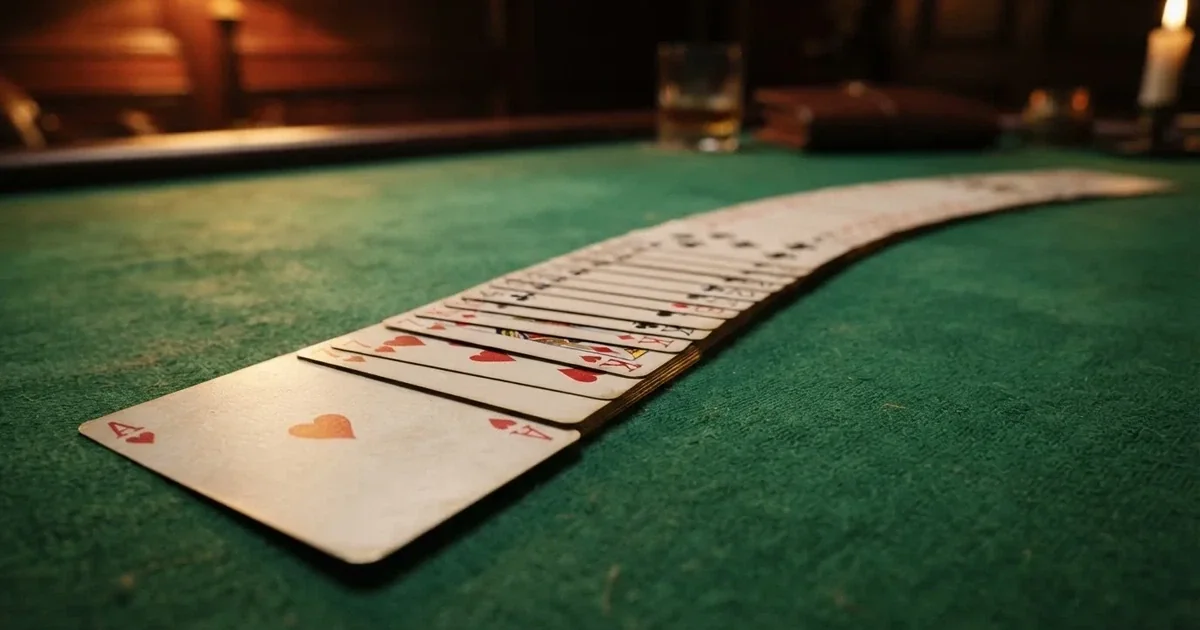
A live-dealer blackjack table is a real dealer running hands against multiple players over a video stream, usually from a studio in Europe or Asia, sometimes from a physical casino floor. The cards are physical, dealt from a shoe of six or eight decks; the dealer is a person; the players’ decisions are submitted by clicking on the screen; the result is read by optical character recognition and paid out the same way a slot machine pays out a win. The visual experience is the floor of a casino. The mechanism under it is closer to a remote-controlled betting terminal.
The standard paytable is blackjack at 3:2, dealer stands on 17 (sometimes hits on a “soft 17”), double down on any two cards, double after split allowed, surrender sometimes allowed. Under those Las Vegas Strip rules the house edge with optimal play is about 0.28%. Under more common Atlantic City rules it is about 0.43%. The two figures are close, and both are among the lowest house edges in any casino game — which is the mechanism behind the phrase “almost a fair game” that older blackjack books leaned on. The qualifier is “with optimal play”. Most players do not play optimally, and the realised house edge on a casual shoe is closer to 2%.
Established variants on the live format include Spanish 21 (played without 10s but with liberal player-favourable rules), Double Exposure Blackjack (both of the dealer’s cards dealt face-up), Blackjack Switch (the player can swap cards between two hands) and Super Fun 21 (allows up to four splits). Some of these variants tilt the house edge further toward the player; some tilt it back toward the house. The version the operator streams is the one whose paytable the player has to read before sitting down, because the 3:2 blackjack payout is not universal — a 6:5 blackjack payout, which several lower-stakes live tables quietly run, doubles the house edge on the most common hand a player gets dealt.
A live hand can be joined partway through a dealer’s shoe. That is one of the small practical advantages over a manual casino, where a new player often waits for the reshuffle. The continuous-shoe format means the next hand is dealt as soon as the current one pays out, and a player who joins late sits down at the same table the next round. The disadvantage is the same thing — there is no natural pause.
The Eleven Brands: Side-by-Side Reading of the ACMA Warnings
The table below lines up the eleven brands by what the ACMA itself published about each. The columns are: the brand, the ACMA action and date, the operator the ACMA named in the warning, and what the research base carries on each brand’s support for live blackjack. Where research has no data on a brand’s live-blackjack support, that column carries the no-data marker; where research has only a listings page, it carries that qualifier rather than a confirmation.
| Brand | ACMA action and date | Operator named by the ACMA | Subject support |
|---|---|---|---|
| RocketPlay | Formal warning, March 2026 (Pulsup Ltd); earlier warning, May 2022 (Dama N.V.) | Pulsup Ltd (Rocketplay.com.au); earlier Dama N.V. | — |
| Level Up Casino | Formal warning, May 2022 | Dama N.V. | listings only (Bgaming.com) |
| Woo Casino | Formal warning, March 2025 | Dama N.V. | — |
| Spirit Casino | Formal warning, May 2025 | Dama N.V. | — |
| National Casino | Formal warning, July 2025 | Consolutetish S.R.L. | listings only (en.wikipedia.org) |
| Bizzo Casino | Formal warning, July 2025 (Consolutetish S.R.L.); earlier warning, 2022 (TechSolutions) | Consolutetish S.R.L.; earlier TechSolutions (CY) Group Limited and TechSolutions Group N.V. | — |
| Ignition Casino | Formal warning, July 2025 | Bamboo Media | — |
| Instant Casino | Formal warning, February 2025 | EOD Code SRL | — |
| Jackbit | Formal warning, April 2026 | Ryker B.V. | — |
| Casino Intense | Formal warning, April 2025 | Sterplay Holding Ltd | listings only (Abc.net.au, acma.gov.au, Crownmelbourne.com.au) |
| Sky Crown | Formal warning, September 2022 | Hollycorn N.V. | — |
What the table shows, read across the rows rather than down them, is the operator pattern behind the brand pattern. Three of the eleven brands — Level Up Casino, Woo Casino and Spirit Casino — sit under the same corporate operator, Dama N.V., and have been warned on three separate occasions between May 2022 and May 2025. Two more — National Casino and Bizzo Casino — share Consolutetish S.R.L. as their named operator, both warned in July 2025, with Bizzo carrying an older warning under a previous operator (TechSolutions) from 2022. The eleven-brand list is therefore not really eleven independent businesses: it is closer to eight operator groups with some brand swapping inside them, which the ACMA’s formal warnings treat as a continuing pattern rather than eleven separate incidents.
What the table also shows, by what it does not carry, is the limit of the research base. Most rows in the “Subject support” column carry the no-data marker, meaning the research has no listing for that brand’s live-blackjack catalogue specifically. Two rows — Level Up Casino and National Casino — carry a “listings only” qualifier, meaning the research has a directory page mentioning the brand but not a confirmation that the brand actively streams live blackjack tables to Australian customers. One row — Casino Intense — carries three listings across different source kinds, none of them a direct confirmation. The honest reading of these qualifiers is that the table’s job is to set the ACMA frame around each brand; the live-blackjack support column is what the research could verify and nothing more.
The further site-blocking pattern sits above this brand-level data. As of June 2026, the ACMA had asked Australian internet service providers to block 1,751 illegal gambling and affiliate marketing websites since the first blocking request in November 2019 — a span of more than six years. The June 2026 round alone added 12 sites to the blocked list: 7Signs, ChromaBet, Donbet, Duospin, Freshbet, Slots Gem, Jacks Club, Lucky Start, Pointsbetz.com, Spinrise, Vinyl Casino and Wildsino. None of those names appear in the brand table above, because the ACMA blocking register and the ACMA formal-warning register are two separate lists. A site on one is rarely on the other. The combined picture — 1,751 blocked sites and at least eleven formal warnings to offshore operators since 2022 — is the regulator’s working picture of the offshore live-dealer blackjack market as it stands in 2026.
RocketPlay
The most recent formal warning the ACMA has published on this brand was issued in March 2026 to Pulsup Ltd over Rocketplay.com.au. An earlier warning, in May 2022, was issued to Dama N.V. covering six brands including Rocketplay — meaning the same brand has been the subject of two separate formal warnings under two separate named operators over four years. The research base carries no listing on Rocketplay’s live-blackjack catalogue, which means the brand appears on the table above as a name the ACMA has acted against twice rather than as a brand whose live-dealer offering the research has confirmed.
What the brand offers, in the language of the affiliate listings the ACMA has not endorsed, is a Curacao-licensed platform that takes bitcoin and several altcoins, runs a continuous-shoe live-dealer section and advertises a multi-deposit welcome package. None of those claims have been confirmed by an Australian regulator; none of them are protected by one. The dual-warning pattern is the part of this brand’s profile that survives an honest reading.
For a reader comparing options on this table, RocketPlay is the brand whose warning history the ACMA has kept open longest — two operators, four years, and a current Rocketplay.com.au domain still attracting fresh enforcement action in 2026. That is the comparison’s verdict on the brand, and a reader who weights regulator action heavily will read it accordingly.
Level Up Casino
Level Up Casino’s formal warning sits in the May 2022 batch the ACMA issued to Dama N.V. covering six brands — Bambet, Dazard, Level Up, Rocketplay, Wild Tornado and Cobra Casinos. Dama N.V. is one of the more frequently-named operators in the ACMA’s warning register, with a separate set of warnings on Woo Casino (March 2025) and Spirit Casino (May 2025) following the 2022 batch. Level Up Casino is therefore part of a cluster of brands the ACMA has treated as a continuing enforcement target rather than as separate businesses.
The research base carries one listing on Level Up Casino’s live-blackjack catalogue — a directory page on Bgaming.com — and the qualifier is listings only rather than confirmed. What the brand’s own site carries is outside the scope of the research, and what an affiliate page says about a brand’s live-dealer offering is not a regulatory statement.
The verdict on Level Up Casino, in the comparison’s frame, is that it sits inside the largest operator cluster on the table and the research base confirms only that the brand is listed, not that its live-dealer offering has any Australian regulatory standing. A reader comparing it against a brand outside the Dama N.V. cluster is comparing two different enforcement patterns, and the Dama cluster’s pattern is the heavier one.
Woo Casino
Woo Casino’s formal warning was issued in March 2025 to Dama N.V. — the same operator named in the 2022 batch covering Level Up Casino and others. The ACMA’s continued action against Dama N.V. across three years is the relevant fact about the brand. Woo Casino does not appear in the 2022 batch, meaning the ACMA escalated its action against Dama N.V. into a new brand rather than re-warning brands already on its register.
The research base carries no listing on Woo Casino’s live-blackjack offering. The brand is on this table because the ACMA named it in a formal warning, not because the research has anything to confirm about its catalogue.
The comparison’s verdict on Woo Casino is that it sits in the same operator cluster as Level Up Casino and Spirit Casino and carries a more recent warning than the 2022 batch. A reader looking at this brand against a brand outside the Dama N.V. cluster — Sky Crown (Hollycorn N.V.) or Ignition Casino (Bamboo Media), for example — is comparing two different operator trajectories, and the ACMA’s decision to come back to the same operator three years after the original warning is the trajectory that matters here.
Spirit Casino
Spirit Casino’s formal warning was issued in May 2025 to Dama N.V., two months after the Woo Casino warning. The pattern is the same: Dama N.V. remains the named operator across three formal warnings in three years, with different brands added each time. Spirit Casino is the third Dama N.V. brand on this table after Level Up Casino (2022) and Woo Casino (2025).
The research base carries no information on Spirit Casino’s live-blackjack offering. Its presence here is solely due to the formal warning from the ACMA.
The verdict on Spirit Casino is essentially the same as the verdict on Woo Casino — the comparison is between Dama N.V. brands and non-Dama N.V. brands, and Spirit Casino is the most recent Dama brand on the table. A reader who cares about operator history will treat the three Dama warnings as one continuing case rather than three separate incidents, and Spirit Casino is the latest entry in that case.
National Casino
National Casino’s formal warning was issued in July 2025 to Consolutetish S.R.L. The same warning batch covered Bizzo Casino, also a Consolutetish brand. The research base carries one listing on National Casino’s live-blackjack catalogue — an entry on en.wikipedia.org — and the qualifier is listings only. The research has no confirmation that the brand actively streams live-dealer blackjack to Australian customers. This warning in mid-2025 marks a distinct moment in the ACMA’s oversight of this operator.
Bizzo Casino
Bizzo Casino carries two formal warnings: a July 2025 warning issued to Consolutetish S.R.L. and an earlier 2022 warning issued to TechSolutions (CY) Group Limited and TechSolutions Group N.V. — a different named operator, three years earlier. The brand is therefore the only entry on this table that crosses two named operators, and the only one where the ACMA’s enforcement history is long enough to span both the 2022 warning cluster and the 2025 cluster.
The research base carries no listing on Bizzo Casino’s live-blackjack catalogue, and the qualifier is the no-data marker. What is verifiable from the ACMA register is the operator pattern: the brand was warned under one operator in 2022 and warned again under a different operator in 2025. It is plausible that the brand changed hands or corporate structure between these warnings, though the ACMA’s register does not state this explicitly. Such an layered history makes Bizzo Casino unique among the brands listed.
Ignition Casino
Ignition Casino’s formal warning was issued in July 2025 to Bamboo Media. The same warning batch covered no other brand on this table — Ignition Casino is the only Bamboo Media brand in the eleven-brand list, which makes it the only brand on the table with no operator cluster to read alongside.
Ignition Casino appears in this comparison exclusively because of the ACMA’s formal warning, as the research provides no details regarding its live-blackjack library.
The verdict on Ignition Casino is that it is the most isolated brand on the table by operator pattern — one warning, one named operator, no other brand in this comparison sharing that operator. A reader comparing it against the Dama N.V. cluster or the Consolutetish S.R.L. cluster is comparing a single-brand case against a multi-brand case, and Ignition Casino is the simpler of the two.
Instant Casino
Instant Casino’s formal warning was issued in February 2025 to EOD Code SRL. The warning is the earliest on the table in 2026 — earlier than the July 2025 Consolutetish warnings, earlier than the March 2026 Pulsup warning on RocketPlay. The research base carries no listing on Instant Casino’s live-blackjack catalogue.
What makes Instant Casino a distinctive entry on this table is the timing of the warning — February 2025 sits before the mid-2025 escalation against Consolutetish S.R.L. and Dama N.V. and is therefore an early signal in the regulator’s recent enforcement pattern. A reader who reads the ACMA register chronologically sees the EOD Code SRL warning as part of a series that runs through to the 2026 Pulsup action.
The verdict on Instant Casino is that it is the earliest entry on the table in the 2025-2026 cluster and sits under a single operator with no other brand in this comparison sharing the warning. A reader who cares about the ACMA’s enforcement chronology will read it as the start of a sequence that runs through the rest of the table.
Jackbit
Jackbit’s formal warning was issued in April 2026 to Ryker B.V. The same warning batch covered CasinOK, which is not on this table. Jackbit is therefore the only Ryker B.V. brand in the eleven-brand list.
Research on Jackbit does not specify its live-blackjack capabilities. The brand’s listing here is a direct consequence of the ACMA’s regulatory action.
The verdict on Jackbit is that it carries one of the most recent formal warnings on the table — April 2026, only weeks before the Pulsup warning on RocketPlay in March 2026. A reader comparing it against an older warning (Sky Crown, September 2022) is comparing two different points in the ACMA’s enforcement chronology, and Jackbit is the later one. The brand’s relative newness on the warning register — April 2026 rather than 2022 or earlier — means it is the closest in time to the current page, and therefore the entry whose enforcement action has had the least time to age.
Casino Intense
Casino Intense’s formal warning was issued in April 2025 to Sterplay Holding Ltd. The research base carries listings on the brand from three source kinds — Abc.net.au, acma.gov.au and Crownmelbourne.com.au — though the qualifier is listings only, meaning none of those sources is a direct confirmation of Casino Intense’s live-blackjack catalogue. What the listings confirm is that the brand appears in Australian news reporting, in the ACMA’s own register, and in the Crown Melbourne reference set — three places, none of them a regulatory endorsement. The brand remains noted across these sources without regulatory clearance.
Sky Crown
Sky Crown’s formal warning was issued in September 2022 to Hollycorn N.V. The same warning covered Blue Leo, which is not on this table. Sky Crown carries the oldest formal warning on the table — four years older than the Pulsup warning on RocketPlay and three and a half years older than the Woo Casino warning.
Sky Crown is included here for its history with the ACMA, as there is no confirmation of its live-dealer blackjack catalogue in the current research.
The verdict on Sky Crown is that it is the brand with the longest warning history on the table. The September 2022 warning sits at the start of the recent ACMA escalation rather than at the end, and a reader reading the table chronologically sees Sky Crown as the entry from which the rest of the list runs forward. The brand has not been the subject of a follow-up warning under Hollycorn N.V. in the three and a half years since, which is information about the regulator’s pattern as much as about the brand — Hollycorn N.V. has not attracted the same repeated enforcement as Dama N.V.
Summary of ACMA-Warned Brands
| Brand | Operator | ACMA Warning Date | Live Support |
|---|---|---|---|
| RocketPlay | Pulsup Ltd | March 2026 | No data |
| Level Up Casino | Dama N.V. | May 2022 | Listings only |
| Woo Casino | Dama N.V. | March 2025 | No data |
| Spirit Casino | Dama N.V. | May 2025 | No data |
| National Casino | Consolutetish S.R.L. | July 2025 | Listings only |
| Bizzo Casino | Consolutetish S.R.L. | July 2025 | No data |
| Ignition Casino | Bamboo Media | July 2025 | No data |
| Instant Casino | EOD Code SRL | February 2025 | No data |
| Jackbit | Ryker B.V. | April 2026 | No data |
| Casino Intense | Sterplay Holding Ltd | April 2025 | Listings only |
| Sky Crown | Hollycorn N.V. | September 2022 | No data |
What the Live Blackjack Landscape in Australia Looks Like in 2026
The picture the eleven formal warnings and the 1,751 blocked sites paint together is a regulator that has been busy on offshore casino brands for the past four years and has been getting busier. The November 2019 first blocking request, the 2017 strengthening of the Interactive Gambling Act and the August 2023 launch of BetStop sit at the back of the picture. The June 2026 blocking round sits at the front. The ACMA’s enforcement footprint is wide and growing.
What the picture does not show is a clean answer to the question a reader is most likely to be asking: which of these eleven brands is the safest to play at. The honest answer is that none of them is safe in the sense an Australian punter usually means — safe in the sense of licensed, regulated, and protected by Australian consumer law. Every one of the eleven is on the ACMA’s warning register for offering prohibited interactive gambling services to Australian residents. Every one is outside the BetStop framework. Every one accepts payment methods that the Australian rules prohibit for licensed wagering. The differences between them are differences of operator cluster, warning timing and listing presence, not differences of legal standing.
H2 Gambling Capital’s 2025 estimate put Australians’ annual losses to illegal gambling sites at around A$3.9 billion — a figure that makes the offshore market comparable in size to a mid-tier Australian industry. The same report found the share of gambling going through legal Australian channels falling from 74% in 2021 to 64%. The legal channel is shrinking because the illegal channel is filling the gap. The ACMA’s enforcement is the response, and the eleven-brand table above is part of that response.
The legal Australian alternative is online wagering on races and sport placed before the event, lotteries and keno. None of those is a live-dealer blackjack table. The 52 online bookmakers the NTRWC regulates in the Northern Territory — Sportsbet, Bet365, Ladbrokes among them — do not offer live blackjack because they cannot. What the legal Australian market offers in the way of table games is on the floors of Crown Melbourne, the Star Sydney, the Star Gold Coast and the smaller state casinos. A reader who wants a real-dealer blackjack table in Australia has to go to one of those physical floors, or has to use an offshore site, or has to do without.
The Legal Frame Around Live Blackjack Online in Australia
The Interactive Gambling Act 2001 is the federal statute that covers online casino-style games in Australia. The Interactive Gambling Amendment Act 2017 strengthened it; the Interactive Gambling Amendment (Gambling Reform) Bill 2026 passed Parliament on 19 August 2026 with advertising and inducement measures commencing 1 January 2027. None of that gives an Australian resident a lawful route to a live-dealer blackjack table. The IGA makes it an offence to provide such a service to a person in Australia; the individual player is not prosecuted, but the operator is the target, and the penalty regime is severe — up to A$220,000 per day for individuals and up to A$1.1 million per day for corporations.
The ACMA is the regulator that enforces the IGA against offshore operators. Its three working tools are formal warnings (the public register this page draws on), blocking requests to Australian internet service providers (the 1,751-site list), and investigations that lead to either or both. The blocking request is what stops an Australian resident from reaching a site through a mainstream ISP; the formal warning is what names the operator publicly. A site that has been blocked can still be reached through a VPN or a non-cooperating ISP, which is one reason the blocking register and the formal-warning register are different lists.
Player protection on a legal Australian site sits behind the regulator. BetStop, the National Self-Exclusion Register, has been live since August 2023 and binds every Australian-licensed online and phone wagering service. The National Gambling Helpline (1800 858 858) is free, 24/7 and offers chat at Gambling Help Online. The Australian Financial Complaints Authority handles disputes with licensed operators. None of those instruments bind an offshore live-dealer blackjack brand.
The payment rules since 11 June 2024 close the route a licensed bookmaker might once have offered. Credit cards, credit-related products and digital currency are banned as payment for licensed online wagering. The legal deposit routes for licensed wagering are debit card, bank transfer, PayID/Osko and BPAY. A site asking an Australian for a credit card or a crypto deposit is operating outside those rules, and the deposit method is therefore a marker that the site sits outside the Australian framework.
The Blocking Rate and What It Implies About the Offshore Market
The prescribed calculation on this page is the ACMA’s blocking rate — the running total of blocked sites divided by the time elapsed since the first blocking request in November 2019. The arithmetic is the comparison’s own analysis of the regulator’s recent blocking cadence.
The first blocking request was in November 2019. As of June 2026, the running total of blocked sites was 1,751. The elapsed time is roughly 79 months, or about 6.6 years. The blocking rate therefore sits between 22 and 23 sites per month on a simple monthly average — closer to the lower end of that band over the full 79 months, and considerably higher than that in recent rounds alone. The June 2026 round of 12 sites is not an unusual month; it is close to the long-run average.
The band rather than the single figure matters because the ACMA’s blocking cadence has not been steady. The early rounds, between 2019 and 2022, blocked a few hundred sites in total. The cadence accelerated after the 2022-2023 strengthening of enforcement and the August 2023 launch of BetStop. A reader who treats the rate as a smooth monthly average misses the ramp; a reader who treats it as the recent-month rate overstates the longer-run pattern. The honest statement of the rate is a band: 22 to 23 sites per month across the full 79-month window, with the recent pace running higher and the early years running lower.
What the rate implies about the offshore market is that it is not contracting despite the ACMA’s work. 1,751 blocked sites is not a closed list — it is a moving total, with new sites added each month to replace the ones that close or move domain. The June 2026 round’s twelve sites (7Signs, ChromaBet, Donbet, Duospin, Freshbet, Slots Gem, Jacks Club, Lucky Start, Pointsbetz.com, Spinrise, Vinyl Casino and Wildsino) are all new entries, not re-entries. The offshore market continues to refresh faster than the ACMA can drain it.
Frequently Asked Questions
Is it legal to play live blackjack for real money at an online casino in Australia?
No. The Interactive Gambling Act 2001 makes it an offence to provide online casino games — including live-dealer blackjack — to a person physically in Australia, and no state or territory licenses such a service. The individual player is not prosecuted, but the operator is, and an offshore brand gives no Australian consumer protection if a withdrawal stalls. The legal Australian alternative for a real-dealer blackjack table is the floor of a state-licensed casino.
How does a live-dealer blackjack table differ from a computer-generated version?
A live-dealer table is a real dealer running hands against multiple players over a video stream, dealt from a physical shoe of six or eight decks in real time. A computer-generated version is a random number generator simulating the same game without a dealer or a stream. The paytable, the rules and the house edge are the same under standard rules; the social experience and the hand cadence are different. Both are illegal to provide to an Australian resident under the Interactive Gambling Act 2001.
What dealer rule most affects the house edge in blackjack?
Whether the dealer hits or stands on a soft 17 — a hand containing an ace counted as 11 — is the single rule that moves the house edge the most. A dealer who stands on soft 17 cuts roughly 0.2% off the house edge compared with a dealer who hits. The next-largest moves come from whether the player may double down after a split and whether blackjack pays 3:2 or 6:5. A 6:5 blackjack payout roughly doubles the house edge on the most common hand the player receives.
Does a blackjack bonus offer usually count table game bets the same as slot bets?
No. Most casino bonuses apply a game weighting that counts slots at 100% and table games like blackjack at 5% to 20%, sometimes at 0%. A 35x wagering multiple on a A$100 bonus at 100% weighting is A$3,500 of slot bets; the same bonus at 10% weighting on blackjack is A$35,000 of table bets. The headline multiple does not change; the turnover the player must produce does, often by a factor of ten. Reading the weighting before claiming the bonus is the one step that turns the headline number into the actual cost.
Is a live blackjack app a separate product from a site’s browser-based table?
Usually no. Most live blackjack apps are mobile skins over the same browser-based tables, accessing the same live-dealer streams and the same betting interface. The practical difference is the screen size, the touch interface and the data usage — a mobile stream of a live-dealer table uses substantially more data than a slots session on the same phone. A punter using an app to reach a live-dealer table is reaching the same offshore service the browser reaches, and the legal status of the service is the same under the Interactive Gambling Act 2001.
Can a live blackjack hand be joined partway through a dealer’s shoe?
Yes. The continuous-shoe format used in most live-dealer blackjack studios means a new player can sit down between hands without waiting for the next reshuffle. The next hand is dealt as soon as the current one is paid out, and a player who joins late plays the same shoe the existing players are playing. The trade-off is the same continuous pace — there is no natural pause for the late joiner to settle in before the betting window opens.