
Quick withdrawal casino payout times in Australia: what actually happens when you cash out
The phrase “quick withdrawal casino” appears in Australian search results several thousand times a month. Offshore operators that cannot hold an Australian licence routinely advertise payouts in minutes, sometimes seconds. This page examines what those claims look like against the Australian regulatory frame, the real settlement times of domestic payment rails, and the eleven brands the ACMA has formally warned for offering prohibited services to Australians.

Current as of 30 October 2026. Cross-checked against the ACMA’s formal warning register and the Australian Communications and Media Authority’s published blocking requests.
Table of Contents
- The landscape of quick withdrawal claims in Australia
- Why the IGA makes every offshore casino an illegal offering
- The ACMA’s enforcement record against operators marketing quick payouts
- Responsible gambling and why offshore quick withdrawal casinos sit outside Australian support structures
- Payment rail speeds and what “quick withdrawal” actually means at the banking layer
- Eleven brands the ACMA has formally warned: what each represents
- How fast the ACMA is moving: blocking rate in context
- What this means for an Australian considering an offshore quick withdrawal casino
- A note on terminology
- Frequently asked questions
The landscape of quick withdrawal claims in Australia
A search for quick withdrawal casinos produces a familiar pattern. The top results are almost always offshore brands: Curaçao-licensed, Anjouan-licensed, or operating under a Costa Rica corporate wrapper. They advertise withdrawal times ranging from “instant” to “under one hour,” with the marketing copy built around speed as a competitive advantage over Australian-licensed alternatives.

The crucial distinction Australian readers need to understand from the outset: no online casino, offering table games, slots, or pokies to Australian players, holds an Australian licence. The Interactive Gambling Act 2001 makes it an offence to provide these services to anyone physically in Australia. What Australian regulators do license is pre-event sports and race wagering, lotteries, and keno, not casino games. So when a brand markets itself as a “quick withdrawal casino Australia” option, it is, by definition, operating outside the Australian regulatory perimeter.
This does not mean every offshore casino is a scam. Many process payouts promptly, hold legitimate licences in other jurisdictions, and run audited games. What it means is that an Australian player dealing with an offshore operator has no access to the protections available with a locally licensed provider: no Australian Complaints authority, no recourse through the ACMA if a withdrawal is refused, and no guarantee that the operator’s licence from a foreign regulator carries any practical weight if a dispute arises.
The H2 Gambling Capital 2025 estimate puts Australian losses to illegal gambling sites at around A$3.9 billion annually, with the share of gambling flowing through legal channels falling from 74% in 2021 to 64%. The volume of traffic is real, and so is the gap between marketing claims and regulatory reality.
Why the IGA makes every offshore casino an illegal offering
The Interactive Gambling Act 2001 (IGA), as strengthened by the Interactive Gambling Amendment Act 2017, targets the provider, not the player. Section 15A makes it an offence for a corporation to provide an online casino game, online pokies, or in-play betting to a person in Australia. The prohibition covers the act of offering, not the act of playing, which is why individual Australians are not prosecuted for using these sites.
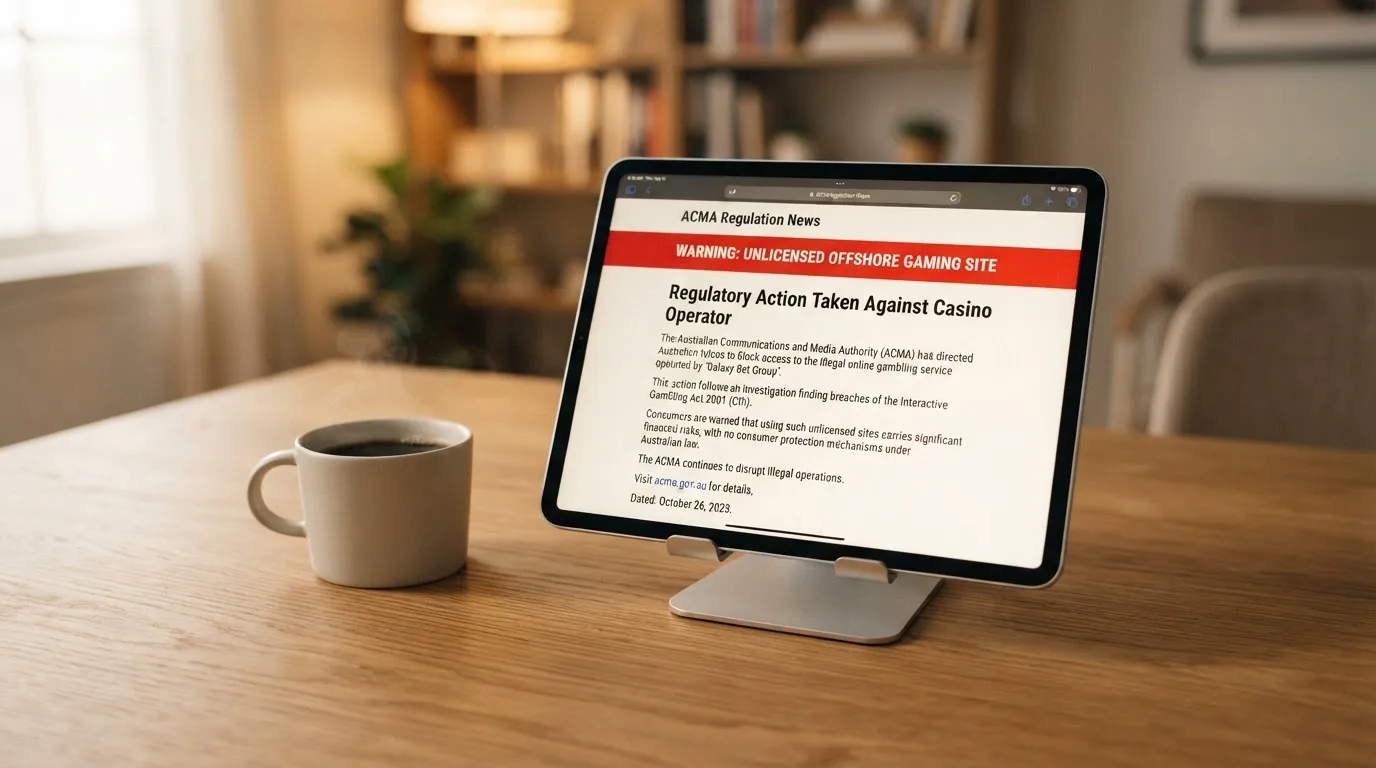
The ACMA, the regulator responsible for enforcing the IGA, has three principal tools: investigating complaints, issuing formal warnings, and directing Australian internet service providers to block illegal sites. As of mid-2026, the ACMA had requested the blocking of 1,751 illegal gambling and affiliate marketing websites since the first blocking request in November 2019. In the round reported on 26 June 2026, twelve more sites were added: 7Signs, ChromaBet, Donbet, Duospin, Freshbet, Slots Gem, Jacks Club, Lucky Start, Pointsbetz, Spinrise, Vinyl Casino, and Wildsino.
More than 230 unlicensed gambling services have left the Australian market since enforcement was strengthened in 2017, though this figure covers voluntary exits, not all of which followed formal action.
The practical consequence for Australian players is straightforward: if a casino offers table games, slots, or pokies to Australian customers, it is operating in breach of the IGA, regardless of what licence it displays in its footer. A Curaçao eGaming licence or an Anjouan licence permits the operator to run a business; it does not override Australian law for an Australian customer.
The Northern Territory exception, and why it does not cover casinos
Australia’s wagering sector is regulated primarily at the state and territory level. The Northern Territory Racing and Wethering Commission (NTRWC) licenses online bookmakers, 52 of them, including major brands like Sportsbet, Bet365, and Ladbrokes. The arrangement exists largely for tax reasons: the Territory’s point-of-consumption tax regime attracted operators who might otherwise have located elsewhere. The NTRWC itself has no full-time staff and meets once a month in Darwin.
Critically, the NTRWC licenses wagering services, meaning pre-event sports and race betting, not casino games or pokies. An online bookmaker licensed in Darwin cannot legally add a casino section to its product suite for Australian customers. The territorial licensing that supports Sportsbet or Bet365 does not extend to slot machines or live dealer tables.
The 2026 reform and what it changes
The Interactive Gambling Amendment (Gambling Reform) Bill 2026 passed Parliament on 19 August 2026. Its advertising and inducement measures commence on 1 January 2027. On a 2026 page, this is law passed but not yet in force: the substantive restrictions on marketing, bonus offers, and inducements directed at Australians take effect at the start of 2026 +1. The provisions already in force under the existing IGA, including the prohibition on providing prohibited interactive gambling services and the ban on credit card payments for licensed wagering, continue to apply.
The ACMA’s enforcement record against operators marketing quick payouts
The ACMA’s formal warnings register is the most concrete measure of enforcement activity. A formal warning is a public step taken after investigation: the regulator names the operator, the brand, and the breach, and warns that further action will follow if the conduct continues. The register is the closest Australia comes to a public list of which offshore casinos are actively targeting Australian customers.
Since 2022, the ACMA has issued formal warnings over dozens of brands. The pattern reveals how concentrated the enforcement effort has been on a relatively small number of corporate groups operating many sites.
Warnings by corporate group
Dama N.V., a Curaçao-registered operator, has received formal warnings on multiple occasions. In May 2022, the ACMA warned Dama N.V. over six brands: Bambet, Dazard, Level Up, Rocketplay, Wild Tornado, and Cobra Casinos. Further warnings followed in March 2025 (Woo Casino) and May 2025 (Spirit Casino). Rocketplay then surfaced under a new corporate wrapper: in March 2026, the ACMA warned Pulsup Ltd over Rocketplay. The brand migrated; the conduct did not.
TechSolutions Group N.V. and its Cypriot affiliate TechSolutions (CY) Group Limited received a formal warning over Bizzo Casino in 2022. By July 2025, Bizzo had resurfaced under Consolutetish S.R.L., which also drew a warning over National Casino in the same period.
Hollycorn N.V., another Curaçao group, received a formal warning over Sky Crown and Blue Leo Casino in September 2022.
Smaller operators have not escaped attention. In February 2025, the ACMA warned EOD Code SRL over Instant Casino. In April 2025, Sterplay Holding Ltd was warned over Casino Intense. In July 2025, Bamboo Media was warned over Ignition Casino. In April 2026, Ryker B.V. was warned over Jackbit and CasinOK.
What a formal warning actually means
A formal warning is not a fine and not a prosecution. It is a published statement that the ACMA has investigated, found the operator in breach, and is putting the operator on notice. Continued breach can trigger referral to the federal court for civil penalty orders or, more commonly, a request to Australian ISPs to block the site’s domains.
The blocking mechanism is the practical end of the chain. Once the ACMA requests blocking, Australian ISPs must comply under the relevant industry codes. For a player, this means that a site on the ACMA’s blocking list may become inaccessible, potentially with a balance still sitting in the cashier. The site does not need to disappear for the player to lose access; a blocked domain is enough.
Responsible gambling and why offshore quick withdrawal casinos sit outside Australian support structures
The Australian responsible gambling infrastructure, including the tools that actually work, binds only Australian-licensed operators. An offshore casino is not connected to it, and this gap is one of the strongest arguments against using offshore sites, beyond the legal question.
BetStop and what it does not cover
BetStop, the National Self-Exclusion Register, went live in August 2023. It allows a person to register once and be excluded from all Australian-licensed online and phone wagering services for a chosen period, ranging from three months to a permanent exclusion. The system is binding on every operator licensed under Australian law.
What BetStop does not do is reach offshore casinos. A self-exclusion registered with BetStop stops the registered person from opening new accounts with Australian-licensed bookmakers; it does not stop them from depositing at an offshore site with a Curaçao licence. The Australian exclusion register is a domestic tool.
Bank-level gambling blocks
Australian banks have responded to gambling harm with their own tools, all of which apply at the card or account level. These are the most effective practical barriers available to Australians, regardless of which casino they are considering.
Westpac’s gambling block works at the card level: it refuses authorisation of transactions registered under the merchant category code ‘Betting/Casino Gambling’ on eligible personal credit and debit cards. ANZ’s gambling transaction block, activated in the ANZ app, blocks gambling transactions made through a digital wallet such as Apple Pay on an eligible card, not just the physical card. Commonwealth Bank lets customers apply a gambling lock to eligible cards via the CommBank app, which automatically blocks most gambling transactions, though the bank states it cannot guarantee all gambling-related purchases will be stopped.
The coverage gap matters. A bank-level block stops the transaction at the payment network, so it works whether the casino is licensed in Darwin or Curaçao. A block registered with an Australian-licensed operator does not work if the player goes offshore. For anyone who has registered for self-exclusion and is considering an offshore site as a workaround, the bank-level tools are the stronger line of defence.
The 2024 credit card ban and what it covers
From 11 June 2024, Australian-licensed online wagering services cannot accept payment by credit card or other credit-related products, a restriction that also constrains gambling use of linked digital wallets like Apple Pay. Penalties for operators breach the prohibition reach up to A$247,500.
The ban does not, in practice, extend to offshore casinos. An offshore operator is not bound by the Australian prohibition and will accept credit card deposits from Australian customers without legal consequence in Australia. This is one of the clearer cases where the offshore route is materially worse for the player than the licensed alternative: the licensed route has guardrails the offshore route does not.
Help services that do work across borders
The National Gambling Helpline, 1800 858 858, is free, operates 24/7, and provides confidential counselling. The accompanying web chat at Gambling Help Online is available to Australians regardless of whether the gambling they are concerned about occurred at a licensed or offshore site. These services are the first point of contact for anyone whose gambling has become difficult to control.
Payment rail speeds and what “quick withdrawal” actually means at the banking layer
| Payment Method | Typical Processing Time | Characteristics |
|---|---|---|
| Osko / PayID | Under 1 minute | Instant settlement, 24/7, uses New Payments Platform |
| Bank Transfer | 1–3 business days | Standard rail, relies on banking cycle |
| Credit Cards | Instant / 1–3 days | Often blocked by bank-level gambling controls |
| Digital Wallet | Instant | Facilitates faster processing but depends on underlying card |
Osko and PayID: the genuine fast rails
Osko, run by Australian Payments Plus, enables bank transfers between participating Australian banks to arrive in under a minute, 24/7 including weekends, whether the transfer is addressed to a BSB and account number or to a PayID. Osko settles through the New Payments Platform, which became accessible to the public on 13 February 2018. The platform is owned by New Payments Platform Australia Ltd, a non-profit company whose thirteen shareholders include the Reserve Bank of Australia and the country’s major banks. More than 25 million PayID identifiers had been registered on the platform as of April 2025.
PayID-based instant transfers are available at over 100 Australian financial institutions. When a payer uses a PayID, the name of the account holder is displayed before the transfer is sent. AP+ warns that being asked to transfer money to a PayID on an illegal gambling site almost certainly means a scam site.
What this means for withdrawal times is straightforward: the bottleneck for an Australian receiving funds domestically is rarely the bank transfer itself. Osko can deliver funds in under a minute. The bottleneck sits on the sending side, with the casino’s own processing time, and with whatever internal review the operator runs before approving a withdrawal.
BPAY and its role
BPAY, launched on 18 November 1997, is a bill-payment service available in the online banking of over 140 banks and financial institutions and offered by over 95,000 businesses. It is owned equally, via parent company Cardlink Services Limited, by Australia’s four major banks: ANZ, Commonwealth Bank, National Australia Bank, and Westpac.
BPAY is not a fast rail for withdrawals. It is a bill-payment service: the payer enters the Biller Code and the Customer Reference Number printed on the bill. It is rarely used for inbound payments and does not have a role in the typical offshore casino withdrawal flow.
Credit cards, digital wallets, and the surcharge reform
American Express was established in 1850 as a freight-forwarding company and later became a card issuer, launching its first charge card on 1 October 1958. Unlike Visa or Mastercard’s four-party network, Amex traditionally issues cards and processes transactions itself as a three-party scheme.
The Reserve Bank of Australia’s July 2025 review proposes removing surcharges only on eftpos, Mastercard, and Visa card transactions, explicitly leaving American Express outside the scope of the proposed surcharge ban. For Australian players using Amex, this means surcharges may continue.
By the end of 2025, Apple Pay, Google Pay, and Samsung Pay transactions collectively accounted for around 45% of all card payments in Australia by number. Apple does not charge fees to consumers for using Apple Pay in stores, online, or in apps; any surcharge comes from the merchant’s own card-processing fees. Apple also notes that transaction limits and PIN requirements for Apple Pay purchases are set by the card issuer or merchant, not by Apple itself. ANZ’s gambling block, once activated, covers Gambling Transactions made through a digital wallet such as Apple Pay on an eligible card, not just the physical card. Once turned on, removing the block again requires a 48-hour waiting period.
AUSTRAC reporting and the A$10,000 threshold
AUSTRAC’s threshold-transaction-report rule requires reporting of transfers of A$10,000 or more, but only applies to physical cash. Ordinary electronic bank transfers are not subject to that per-transaction reporting requirement, regardless of the amount sent. For Australians moving money to or from offshore casinos, the A$10,000 threshold is not a triggering event for a report.
What realistic withdrawal times look like at offshore casinos
Most offshore casinos settle withdrawals in two phases. The first phase is the casino’s internal approval: identity verification, bonus wagering checks, anti-money-laundering review, and source-of-funds checks for larger amounts. The second phase is the payment itself, which depends on the rail.
For an offshore casino that has already verified the player’s identity and cleared any bonus terms, a withdrawal to an Australian bank account via Osko or PayID can in principle arrive within minutes of approval. The casino’s internal processing is the variable. Operators commonly publish target times of “instant,” “up to 24 hours,” or “1–3 business days.” The first figure is aspirational, the second typical for established accounts, and the third more honest about what a new account or a first withdrawal from a new casino tends to look like.
Winnings on slot games and table games do not process differently at the casino’s end, because the casino’s payment system does not care which game produced the balance. The game affects the player’s win rate and the balance size, not the withdrawal mechanism.
The marketing claim that a particular casino offers “quick withdrawal slots” is a category invention: the slot machine does not know or care how quickly the casino can pay out, and the casino’s payment processing is identical regardless of the game. A withdrawal from a slot balance, a live dealer table, or a sportsbook follows the same queue.
Eleven brands the ACMA has formally warned: what each represents
The brands below are not recommended. They are listed because the ACMA, the Australian regulator with primary responsibility for enforcing the IGA, has issued a formal warning over each one. The table is a record of enforcement, not a ranking.
| Brand | ACMA action and date | Operator named by the ACMA | Subject support |
|---|---|---|---|
| RocketPlay | Formal warning, March 2026; earlier warning May 2022 | Pulsup Ltd (March 2026); Dama N.V. (May 2022) | Listed in marketing listings |
| Level Up Casino | Formal warning, May 2022 | Dama N.V. | Listed in payment-provider terms |
| Woo Casino | Formal warning, March 2025 | Dama N.V. | No listing coverage found |
| Spirit Casino | Formal warning, May 2025 | Dama N.V. | No listing coverage found |
| National Casino | Formal warning, July 2025 | Consolutetish S.R.L. | Listed in regulator and self-exclusion references |
| Bizzo Casino | Formal warning, July 2025; earlier 2022 | Consolutetish S.R.L. (July 2025); TechSolutions (2022) | Listed in marketing listings |
| Ignition Casino | Formal warning, July 2025 | Bamboo Media | No listing coverage found |
| Instant Casino | Formal warning, February 2025 | EOD Code SRL | Listed in payment-provider terms |
| Jackbit | Formal warning, April 2026 | Ryker B.V. | No listing coverage found |
| Casino Intense | Formal warning, April 2025 | Sterplay Holding Ltd | Listed in regulator and self-exclusion references |
| Sky Crown | Formal warning, September 2022 | Hollycorn N.V. | No listing coverage found |
Every brand on this table was offering prohibited services, specifically online casino games, to Australian customers. Several have shifted corporate wrappers since their first warning, a pattern visible in the RocketPlay and Bizzo rows. The corporate name changes do not change the underlying conduct, and they do not change the legal status of the offering.
Reading the patterns
Dama N.V. accounts for four of the eleven brands (Level Up, Woo, Spirit, and originally RocketPlay), making it the most repeatedly warned corporate group in the ACMA’s recent enforcement record. The pattern of warning the same operator over multiple brands, then seeing new corporate wrappers take over some of those brands, is one of the clearest signs that formal warnings alone do not stop the activity. The Dama-Pulsup sequence around RocketPlay is the cleanest example.
The 2025 and 2026 warnings show enforcement continuing at pace. Six of the eleven brands were warned in 2025 or 2026, which suggests the ACMA’s enforcement tempo has not slowed.
The table is a record of action taken, not a prediction of future action. The ACMA’s next round could see any of these brands blocked, or new ones added. The blocking rate, the pace at which the regulator is moving sites off the Australian-accessible web, is the most useful number for a reader trying to gauge how long an offshore brand will remain reachable.
How fast the ACMA is moving: blocking rate in context
Between the first blocking request in November 2019 and the June 2026 round, the ACMA requested the blocking of 1,751 illegal gambling and affiliate marketing websites. That figure covers both gambling sites and affiliate marketing sites that promoted them.
Working from those inputs, the blocking rate since November 2019 sits in a band of roughly 260 to 280 sites per year on average. The rate is not uniform; early rounds covered larger numbers, and later rounds tend to focus on specific clusters. But the order of magnitude is useful: between 20 and 25 sites per month, on average, are added to the blocking list.
The condition behind that band matters. The figure depends on how the ACMA counts a “site” (one domain or one brand across multiple domains), whether affiliate marketing pages are included (they are in the 1,751 figure), and how many round each year contains. The band is wide because the rounds vary in size.
For an Australian player, the practical read is this: the ACMA is not catching every offshore casino, but it is removing sites at a steady clip. An offshore brand that has been warned once is likely to be warned again; an offshore brand that has been warned repeatedly is a candidate for blocking. The blocking rate is the regulator’s pace, and the pace is real.
What this means for an Australian considering an offshore quick withdrawal casino
The legal position is unambiguous: an Australian using an offshore casino is using a service the IGA prohibits the operator from providing. The ACMA’s enforcement record shows that the regulator is actively pursuing operators, not standing still.
The payment position is more nuanced. The Australian banking layer, including Osko, PayID, and the bank-level gambling blocks, is fast and effective. The bottleneck sits on the casino side. Realistic withdrawal times for established, verified accounts at established operators are measured in hours, not days. First withdrawals from new accounts, or withdrawals of larger amounts, take longer because of identity and source-of-funds checks.
The player-protection position is the strongest argument against the offshore route. BetStop does not reach offshore casinos. The credit card ban does not reach offshore casinos. The ACMA cannot compel an offshore operator to refund a disputed withdrawal. An Australian player who has a problem with an offshore casino has, in practical terms, nowhere to take it.
The marketing position is the weakest. “Quick withdrawal” claims made by offshore operators are aspirational. They are not impossible; some operators process payouts quickly. They are not enforceable by an Australian regulator; the ACMA cannot make an offshore operator pay. They are not a guarantee; they are a target time, set by the operator, for which the operator faces no Australian consequence if it is missed.
For Australians who choose to use offshore casinos despite the legal and consumer-protection risks, the practical advice is narrow: verify identity fully before the first deposit, because verification at withdrawal time is the commonest cause of delays; read the bonus terms, because wagering requirements and maximum cashout caps are where marketing claims collide with reality; use a payment method that can be recalled if needed, given that bank-level gambling blocks can stop transactions at the card level; and keep records, because the ACMA cannot help recover funds from an offshore operator, but a clear paper trail is the player’s only leverage.
For Australians who want to stop gambling, BetStop plus a bank-level gambling block is the most effective combination. For Australians who want help, 1800 858 858 is free and 24/7.
A note on terminology
This page uses Australian English throughout: licence as a noun, license as a verb, -ise endings on words like organise and recognise. Currency figures are presented in Australian dollars with the A$ prefix where ambiguity is possible. The term “pokies” refers to slot machines and is the standard Australian usage.
The brands named in the operator section are named because the ACMA named them. They are not named because they are recommended. No brand on this page is recommended as a place to play.
Frequently asked questions
What counts as a “quick withdrawal” at a real-money casino, in actual hours or days?
In Australian banking terms, the fast rail is Osko, which delivers bank transfers between participating Australian banks in under a minute, 24/7. So the lower bound for a domestic transfer is set by the rail, not by the casino. In practice, “quick” at an offshore casino means the casino’s internal processing time: identity verification, bonus checks, anti-money-laundering review. For an established account with completed verification, a few hours is typical. For a new account or a first withdrawal, 24 to 72 hours is common. Anything advertised as “instant” is a target, not a guarantee.
How does a quick withdrawal casino differ from an ordinary online casino in how it processes payouts?
It usually does not, in any structural way. The difference is in the published processing window, the internal queue position, and whether the operator runs payouts outside business hours. Some operators automate approvals for verified accounts below a threshold; others run manual reviews. The game the player was playing does not affect the payment process. A “quick withdrawal slots” claim is marketing, not a description of a different pipeline.
Do quick withdrawal casinos in Australia use faster local payment rails?
Offshore casinos do not access Australian payment rails directly. They typically pay out via international bank transfer, cryptocurrency, or an e-wallet that connects to Australian accounts. The casino’s payment is an international transaction. The speed at which the funds then reach the Australian player’s bank account depends on the receiving bank and the rail used for the final leg, which is where Osko and PayID matter if the casino supports local deposit and withdrawal rails. Most do not.
How long does a quick win at a casino typically take to reach a player’s withdrawal?
The “quick win” is a marketing framing. The win hits the casino balance immediately; whether it can be withdrawn depends on the casino’s bonus terms, withdrawal limits, and identity status. A win on a slot machine with no bonus attached and a verified account is withdrawable as soon as the casino approves the request, which, for an established account, is hours, not days.
Are quick withdrawal slots processed differently to quick withdrawal table game wins?
No. The payment queue does not know which game produced the balance. The casino’s withdrawal system treats all approved balances the same way. A player who has won A$500 on a slot machine and a player who has won A$500 on a live dealer blackjack table wait in the same queue, for the same processing time, and the funds arrive through the same payment rail.
Is a “quick withdrawal” claim from an offshore casino something Australians can actually rely on?
The claim itself is not enforceable. The ACMA does not regulate offshore operators and cannot compel a payout. Australian banks’ payment systems, including Osko and PayID, are reliable, but those systems serve the receiving end; the sending end is the offshore operator. If the operator delays, declines, or imposes an unexpected condition, the Australian player has no recourse through any Australian regulator. The reliable part is the rail; the unreliable part is the sender.