
The offshore pokies “instant withdrawal” claim: what Australian players need to know
Australian players who type “instant withdrawal” into a search bar are not browsing for entertainment. They have a balance and they want it now. The ads that answer them are run by offshore operators, and every one of those operators sits outside Australian law. This page works through that gap — what the word “instant” actually buys at an unlicensed site, why PayID has crept into the advertising alongside it, what the ACMA has done about it, and what the practical sequence looks like when a withdrawal request meets a regulator on one side and a Curacao-registered operator on the other.
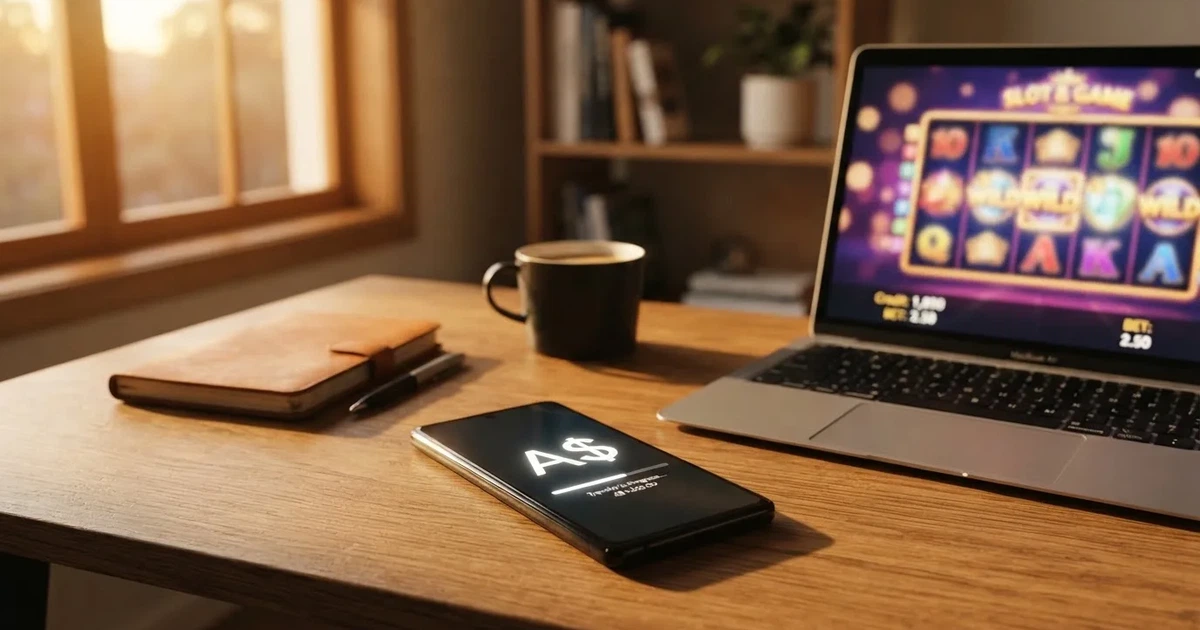
The data is current as of 30 October 2026 and has been checked against the Australian Communications and Media Authority’s published register of formal warnings and blocking requests.
Table of Contents
- The landscape Australian players are searching from
- Why “instant” and “PayID” travel together in the marketing
- The legal frame the ads do not show
- What the ACMA has done about the offshore pokies market
- What “instant” actually means at the operator’s end
- The eleven brands the ACMA has named
- The reading the table invites
- Responsible play, and the routes an Australian player can actually use
- What the page leaves the reader holding
- Frequently asked questions about instant withdrawal pokies in Australia
The landscape Australian players are searching from
Pokies — short for poker machines — are Australia’s name for electronic gaming machines. The land-based version is licensed and regulated state by territory, has been since New South Wales registered clubs first installed them in 1956, and now operates in clubs, pubs and casinos across every state. In 2020–21 Australians bet almost A$150 billion through these machines and lost A$12.18 billion on them, on a per-capita basis a stake roughly fifty times the world average.

Online pokies are a different product, and the law treats them differently. The Interactive Gambling Act 2001, tightened by the Interactive Gambling Amendment Act 2017, makes it an offence to provide online casino games, online pokies or in-play betting to a person physically in Australia. No state or territory licenses them. The thing Australians can place online with an Australian-licensed bookmaker is wagering on races and sport before the event, lotteries and keno — in practice licensed through the Northern Territory Racing and Wagering Commission, which regulates 52 of Australia’s online bookmakers including Sportsbet, Bet365 and Ladbrokes and does so with no full-time staff, meeting once a month in Darwin. The Commission licenses wagering, not casino games. It is not a doorway through which an online pokies operator can walk.
So the “instant withdrawal pokies” market a search engine surfaces for an Australian reader is, without exception, an offshore one. The site is reachable, the ads run, the affiliate pages rank — and none of that converts into an Australian licence. The minimum return-to-player that state regulators set for land-based machines — 85% in New South Wales, the Northern Territory, Queensland and most of Victoria, 87% in the ACT and Tasmania, 87.5% in South Australia, 90% in Western Australia — applies to machines inside Australian venues.
| Jurisdiction | Minimum RTP |
|---|---|
| New South Wales, Northern Territory, Queensland, Victoria | 85% |
| ACT, Tasmania | 87% |
| South Australia | 87.5% |
| Western Australia | 90% |
It does not bind an operator registered overseas and serving Australian customers through a website.
Why “instant” and “PayID” travel together in the marketing
The pair shows up together because PayID solves a real friction point that offshore casinos have wrestled with for years. PayID is Australia’s real-time payment overlay, attached to the Osko network operated by BPAY, and it uses a mobile number, email or ABN as a proxy for a BSB and account number. The transfer between banks clears within seconds; the recipient bank account is credited, and the funds are available, in roughly the same window. That is what makes the claim technically defensible. PayID moves the bank leg quickly.
What PayID does not do is compress the rest of the withdrawal. A pokies site does not simply pass the cash through. It has to approve the request against its own rules — wagering requirements, maximum-cashout caps, identity checks, anti-money-laundering holds, source-of-funds reviews for larger amounts — and the bank’s fast-settlement window sits at the back of that queue, not at the front. A PayID rail at the end of a slow internal queue is still a slow withdrawal. The marketing pairs the two because the rail is fast and the queue can be made to sound like part of it; what the player actually experiences is whatever the operator’s internal process takes to release the funds, with PayID then settling them in seconds once they leave.
The same observation explains why the word “instant” travels without a number beside it. A bank transfer through an Australian account does not need an offshore server to clear in seconds; it does it natively. The speed an “instant withdrawal pokies Australia” page is selling is, on the bank leg, a feature of Australian payments infrastructure, not of the operator running the site. What the operator contributes is the rest of the chain, and that is where the friction lives.
The legal frame the ads do not show
The Interactive Gambling Act 2001 prohibits the supply of online casino games to Australians. The 2017 amendments widened the offence, gave the ACMA the power to issue formal warnings, and authorised the regulator to ask Australian internet service providers to block illegal sites. The law targets the provider, not the individual player — an Australian punter is not prosecuted for placing a bet at an offshore casino — but that is the only piece of the legal frame that runs in the player’s favour.
What is missing is everything else. There is no Australian complaints body an aggrieved player can take an offshore operator to. There is no Australian regulator to escalate a refused withdrawal to. The licence the site displays — Curaçao, Anjouan, the Autonomous Island of Anjouan Gaming Authority, the Malta Gaming Authority for older sites — is real, and binds the operator to its home regulator, but that regulator’s interest in a complaint from a player several thousand kilometres away is not what the home regulator’s marketing copy implies. The balance the player cannot withdraw sits on the operator’s platform, governed by the operator’s terms, and the only Australian lever on it is the ACMA’s enforcement — which is structural, after the fact, and does not return funds.
The payment rules reinforce the frame. Since 11 June 2024 credit cards, credit-related products and digital currency are banned as a means of paying for licensed online wagering in Australia, with penalties up to $247,500 for an operator that breaches the rule. The legal deposit routes for a licensed Australian wagering service are debit card, bank transfer, PayID and BPAY. An offshore site that asks an Australian for a credit card or a crypto wallet is one layer further from the Australian regulatory perimeter, and the deposits the player makes there are not protected by the Australian ePayments Code or by the Australian Financial Complaints Authority.
The 2026 reform package passed Parliament on 19 August 2026 and adds advertising and inducement measures that commence on 1 January 2027. It is law with a start date. Until the commencement date the existing prohibitions still apply, and the new measures — once in force — will tighten the marketing that wraps the offshore offer rather than licence the offer itself.
What the ACMA has done about the offshore pokies market
The regulator’s enforcement has run in two parallel streams. The first is the formal warning — a published notice under section 5 of the Interactive Gambling Act 2001 that puts an operator on notice that its services are prohibited and that further action will follow. The second is the blocking request, under which the ACMA asks Australian internet service providers to make an illegal site unreachable from an Australian IP address, and which the ISPs implement by directing the relevant domain through a filter.
The blocking stream is the headline figure. According to the ACMA as reported in June 2026, a total of 1,751 illegal gambling and affiliate marketing websites had been blocked since the first blocking request in November 2019. In the same period more than 230 unlicensed gambling services had left the Australian market since enforcement was strengthened in 2017. In the round reported on 26 June 2026 the ACMA asked ISPs to block 12 more illegal gambling websites: 7Signs, ChromaBet, Donbet, Duospin, Freshbet, Slots Gem, Jacks Club, Lucky Start, Pointsbetz, Spinrise, Vinyl Casino and Wildsino.
Set against that running total, the arithmetic of the past roughly six and a half years is sobering. The first blocking request went out in November 2019 and the most recent figure published is 1,751 sites blocked by June 2026, which works out to an average of around 269 sites blocked per year over that window — closer to one site per working day than to the occasional sweep the older reporting suggested. The blocking stream is not a one-off clearing exercise; it is a rolling programme whose pace has settled into a steady, ongoing operation.
The formal-warning stream targets individual operators by name. Between 2022 and the first half of 2026 the ACMA published warnings over a long list of brands — Dama N.V. over six casino brands in May 2022, Hollycorn N.V. over Sky Crown and Blue Leo in September 2022, TechSolutions over Bizzo Casino in 2022, EOD Code SRL over Instant Casino in February 2025, Dama N.V. over Woo Casino in March 2025, Sterplay Holding Ltd over Casino Intense in April 2025, Dama N.V. over Spirit Casino in May 2025, Bamboo Media over Ignition Casino and Consolutetish S.R.L. over National Casino and Bizzo Casino in July 2025, Ryker B.V. over Jackbit and CasinOK in April 2026, and Pulsup Ltd over Rocketplay in March 2026. The names recur because operators re-incorporate under a new corporate entity and re-enter the Australian market under a new brand; the regulator responds by name each time, and the warnings accumulate on the same operator family in some cases and on fresh entities in others.
The ACMA’s own estimate, drawing on H2 Gambling Capital’s 2025 report, is that Australians lose about A$3.9 billion a year to illegal gambling sites, and that the share of gambling going through legal channels fell from 74% in 2021 to 64%. Enforcement is not closing the market. It is compressing it. The supply that survives the blocks and the warnings is the supply that has figured out how to reach an Australian customer through an unblocked front, and the marketing vocabulary that wraps it — instant, PayID, fast — has tightened with the compression rather than loosened.
What “instant” actually means at the operator’s end
“Instant withdrawal” is a marketing claim, and marketing claims about payouts have a well-attested history of being narrower than the word suggests. The fastest legitimate version is what the bank rail itself does: PayID settles between Australian bank accounts within seconds, and Osko on the New Payments Platform extends that to most retail accounts. That rail is what the operator can truthfully claim. What the operator cannot truthfully claim is that its own processing is the same thing, because the bank’s fast-settlement leg sits behind the operator’s approval queue.
The queue is not one step. A typical offshore pokies site’s withdrawal flow runs: the player requests a payout in the cashier, the request lands in the operator’s pending-withdrawals list, the operator checks wagering requirements against the bonus terms the player agreed to when claiming whatever promotion triggered the bonus balance, the operator checks that no chargeback risk has been flagged on the depositing card, the operator’s anti-money-laundering system screens the withdrawal amount and frequency against the player’s deposit history, and the operator’s payments team releases the funds to the nominated PayID. Only that last leg is PayID. The leg before it — the multi-step approval — runs on the operator’s own clock, and that clock is the variable the marketing copy elides.
For small wins the variable is short. Many sites auto-approve withdrawals below a threshold and release them within minutes, which is what the player means when they say “instant” and the operator means when it puts the word on the page. For larger wins, or for a player who has claimed a deposit bonus, or for a player whose deposit pattern triggers a source-of-funds review, the variable stretches. A request that would have been auto-approved at A$200 can sit pending for days at A$2,000, and at A$20,000 it can sit pending for the duration of an enhanced-due-diligence review that the operator’s compliance team has to perform under its home-jurisdiction obligations. The PayID leg is identical in both cases. What changes is everything before it.
Verification is the step players most often do not see coming. The first withdrawal typically requires a government ID, a proof of address, and sometimes a screenshot of the deposit method showing the cardholder’s name. The site is not doing this because the player asked; it is doing it because its home regulator’s anti-money-laundering rules require it, and the failure to do it is what gets the operator’s licence reviewed at home. From the player’s seat the verification looks like friction; from the operator’s seat it is compliance. The two readings are not contradictory, but the marketing does not distinguish them, and the player discovers the difference at the first withdrawal that triggers the document check.
The size-of-win asymmetry is the one the marketing most carefully avoids. A$500 cashed out from winnings on a no-deposit free-spin promotion is auto-approved at most sites within minutes, and the PayID rail settles it within the minute. A$25,000 won on the same session is reviewed by a human and paid out in days, if at all, after the player’s source of funds has been verified. The “instant” claim applies to the first case; the second case is the case the player would most want it to apply to.
The eleven brands the ACMA has named
The list that follows is not a ranking and not a recommendation. Each brand is on the page because the ACMA itself issued a formal warning over it for offering prohibited online casino services to Australians, and the only honest reason to include any of them in a comparison is to name the warning and the operator behind it. Where the research carries additional information about a brand’s history or its wider footprint, it is reported as the source reports it; where it does not, the field stays open.
| Brand | ACMA action and date | Operator named by the ACMA | Subject support |
|---|---|---|---|
| RocketPlay | Formal warning March 2026; earlier May 2022 (Dama N.V.) | Pulsup Ltd (March 2026); Dama N.V. (May 2022) | — |
| Level Up Casino | Formal warning May 2022 | Dama N.V. | Listed by BGaming among partner casinos (no Australian endorsement) |
| Woo Casino | Formal warning March 2025 | Dama N.V. | — |
| Spirit Casino | Formal warning May 2025 | Dama N.V. | — |
| National Casino | Formal warning July 2025 | Consolutetish S.R.L. | Wikipedia notes its presence in offshore casino listings |
| Bizzo Casino | Formal warning July 2025; earlier 2022 (TechSolutions) | Consolutetish S.R.L. (July 2025); TechSolutions Group (2022) | — |
| Ignition Casino | Formal warning July 2025 | Bamboo Media | — |
| Instant Casino | Formal warning February 2025 | EOD Code SRL | — |
| Jackbit | Formal warning April 2026 | Ryker B.V. | — |
| Casino Intense | Formal warning April 2025 | Sterplay Holding Ltd | Reported by ABC News and listed in ACMA and Crown Melbourne reporting on Australian enforcement context |
| Sky Crown | Formal warning September 2022 | Hollycorn N.V. | — |
The operator names are the ones the ACMA published in each warning, and the dates are the dates of those publications. Two of the brands — Bizzo Casino and RocketPlay — have appeared twice because the underlying corporate entity changed and the regulator responded to the new entity each time; the table records both. The subject-support column reports what the research carries about the brand outside the ACMA record: a presence in an industry listing, a press reference, a regulator’s own notice. No row asserts that the brand holds an Australian licence, because no row can.
RocketPlay
RocketPlay is the brand that has spent the longest under the ACMA’s gaze. The regulator published a formal warning over it in May 2022, addressed to Dama N.V., and returned to the brand four years later with a fresh warning addressed to Pulsup Ltd in March 2026. Two operators over the same brand is itself the point: when a licence is surrendered, the corporate wrapper is a low-cost thing to replace, and the brand on the front of the site can outlive the company behind it by years. The “instant withdrawal” claim on RocketPlay’s cashier page sits on top of that history.
Level Up Casino
The May 2022 warning to Dama N.V. covered six brands at once, and Level Up Casino was one of them. The brand remains in industry listings — BGaming, a studio whose games it carries, treats it as a partner casino — which is a useful reminder that “partner of” is a supply-chain relationship and not a regulatory endorsement. The ACMA action is what the Australian record shows.
Woo Casino
Woo Casino attracted a fresh warning to Dama N.V. in March 2025, three years after the original six-brand notice. The same operator family, the same regulator, a second round of correspondence: that is the cadence the ACMA has settled into with repeat offenders, and the second letter is the one that precedes a blocking request in the regulator’s stated enforcement sequence.
Spirit Casino
Spirit Casino was added to the Dama N.V. warning list in May 2025, two months after Woo Casino. Two warnings from the same regulator to the same operator in successive months is the pattern that ends with the next round of blocking requests, and Spirit Casino should be read alongside Woo Casino rather than as a standalone case.
National Casino
National Casino attracted a July 2025 warning addressed to Consolutetish S.R.L. — a different corporate wrapper from the TechSolutions entities that earlier carried other brands under the ACMA’s notice. The brand has an entry on Wikipedia among offshore casino listings, which is consistent with the corporate pattern: the same casino operation reappears under a new owner and a new regulator notice.
Bizzo Casino
Bizzo Casino is the cleanest illustration of the cycle. The brand was the subject of a 2022 formal warning to TechSolutions (CY) Group Limited and TechSolutions Group N.V., and it was the subject of a second warning to Consolutetish S.R.L. in July 2025. The brand carried through, the operator changed, the regulator responded both times.
Ignition Casino
Bamboo Media received a July 2025 formal warning over Ignition Casino. The brand is one of the better-known offshore poker rooms in the broader market, and its appearance in the Australian enforcement record is what brings it onto this list rather than any feature of its own product.
Instant Casino
The February 2025 warning to EOD Code SRL over Instant Casino is one of the earlier entries in the 2025 round, and the brand name is itself a small study in marketing: “Instant” is the word the player searches for, and the operator named after the word has the ACMA warning attached to it.
Jackbit
Ryker B.V. received an April 2026 formal warning over Jackbit, with CasinOK named alongside it. The warning is recent, the operator is fresh to the ACMA’s record, and there is no earlier action against the same brand because the brand itself is newer than the regulator’s recent history.
Casino Intense
Sterplay Holding Ltd received an April 2025 formal warning over Casino Intense. The brand has surfaced in Australian press reporting on offshore enforcement, alongside the regulator’s own notice and the wider context that Crown Melbourne’s reporting provides on the domestic casino market against which the offshore offer is competing for players.
Sky Crown
Hollycorn N.V. was the subject of a September 2022 formal warning covering Sky Crown and Blue Leo together. Hollycorn is one of the longer-running operator families on the ACMA’s list, and the Sky Crown entry is the one that names the specific brand carried on this page.
The reading the table invites
Read across the eleven rows and the picture is uniform. Every brand has been the subject of a formal warning. Three of the eleven have been the subject of two. The earliest entry is from May 2022; the most recent is from March 2026. The operator wrappers are a mix of Curaçao and Anjouan incorporations, with one Maltese-licence operator among them, and none of them is an Australian one. The brands differ in their product, their bonus mechanics and their game catalogue. They are identical in their relationship to Australian law, which is that there is none.
What the table does not show, and what an Australian player most needs to know, is what happens after the ACMA’s warning. A formal warning is not a block. The site remains reachable; the brand remains in the affiliate-feed the search results surface; the marketing pages continue to rank. The block — when it comes, and for some of these brands it has already come in earlier rounds — closes one front, and the operator opens another. The cumulative effect is the A$3.9 billion annual loss to illegal sites that the ACMA’s own commissioned estimate reports, and the falling share of gambling going through legal channels, from 74% in 2021 to 64% in 2024.
Responsible play, and the routes an Australian player can actually use
The Australian gambling-harm support network is real and is built around the land-based market rather than the offshore one. The National Gambling Helpline is 1800 858 858, free, available 24/7, with a chat option at Gambling Help Online. Each state runs its own counselling service — Gamblers Help in Victoria, GambleAware in New South Wales, Gambling Help Queensland and the equivalents in other jurisdictions — and the same phone number routes to the local service. The help is for anyone whose gambling has moved from entertainment to harm, including harm that begins at an offshore site.
BetStop, the National Self-Exclusion Register, has been live since August 2023. A person who registers is excluded from every Australian-licensed online and phone wagering service at once, for a period they choose between three months and a lifetime. The exclusion is binding on the licensed operator that receives it; the offshore operator is not connected to BetStop and is not bound by the registration. That is the structural limit of self-exclusion in this market, and it is worth naming plainly: the register protects a player from their own next session at a licensed bookmaker; it does not protect them from an offshore casino they can still reach through a search engine.
For an Australian player who wants to play pokies with the protections of Australian consumer law, the only option is the land-based machine. New South Wales had 87,298 gaming machines outside casinos across 2,195 venues as of June 2023, with player losses of A$8.18 billion in 2022–23. Queensland had 21,122 machines in 351 venues in October 2023. Victoria had 26,380 machines outside Crown Casino in 488 venues in 2021–22, under a statewide limit of 30,000. Western Australia banned poker machines in pubs and clubs when Crown Perth opened in 1985 and has held that line since; Crown Perth’s own machine count has grown from about 200 in 1985 to roughly 2,500, all approved by the state’s Gaming and Wagering Commission. The machines in these venues are the ones that pay out under Australian rules, are subject to Australian harm-minimisation requirements, and connect to the state-level self-exclusion and pre-commitment schemes that operate alongside them — Tasmania’s mandatory pre-commitment cards, delayed to late 2025 in implementation, are the most ambitious of these, and South Australia and the ACT run their own variants.
What the page leaves the reader holding
Three things travel together and are not separable.
The first is the bank rail. PayID is genuinely fast, and the settlement time the player experiences on the receiving end is genuinely short. The bank leg is not the slow part of an offshore withdrawal; the operator’s queue is.
The second is the regulatory perimeter. An Australian-licensed bookmaker is bound by the credit-card ban, the BetStop self-exclusion register, the A$247,500 penalty regime, and the Australian Financial Complaints Authority. An offshore casino is bound by none of these. The player who deposits at one is in the queue of the other.
The third is the ACMA’s enforcement cadence. The blocking total stood at 1,751 in June 2026 against a November 2019 baseline; the formal-warning register now covers more than thirty brand-operator pairings across two dozen brands; the H2 Gambling Capital estimate is A$3.9 billion in annual losses to illegal sites. The market the player is searching for is shrinking on paper and steady in practice, and the marketing vocabulary has tightened with the compression.
The arithmetic the regulator publishes is the closest thing to a settled number on the size of the market. The first blocking request went out in November 2019 and 1,751 sites had been blocked by June 2026, which works out to somewhere between 250 and 290 sites blocked per year over the period depending on the exact day count — a working pace, not a one-off sweep. The condition behind that band is straightforward: the ACMA’s enforcement runs through ISPs, and the figure reflects what the ISPs have actioned on the regulator’s request; the next blocking round will move it again.
Frequently asked questions about instant withdrawal pokies in Australia
What does “instant withdrawal” actually mean when a pokies site advertises it?
It means the bank leg of the transfer is fast — typically PayID settling within seconds — not that the operator’s own approval process takes no time at all. A small win that passes automated checks is usually released within minutes; a larger win, or one that triggers a document check or a source-of-funds review, can sit pending for days. The “instant” claim describes the rail, not the queue.
Does a PayID withdrawal claim from a pokies site move any faster than an ordinary bank transfer would?
The bank leg is the same — PayID on the New Payments Platform settles between Australian accounts in seconds, and that is what an ordinary real-time bank transfer does too. What the claim is selling is the speed of the rail, which an Australian player would have at any site that used it. The operator’s contribution is what happens before the funds leave the cashier, and that is where the variation lives.
Is an instant-withdrawal claim from an offshore pokies site something Australians can rely on legally?
No. The Interactive Gambling Act 2001 prohibits the supply of online casino games, including online pokies, to people in Australia; no state or territory licenses them. The ACMA enforces the prohibition by issuing formal warnings and asking ISPs to block illegal sites. The offshore operator is outside the Australian regulatory perimeter, and an Australian player who deposits at one has no Australian complaints body to escalate to.
Why do some sites specifically pair a PayID withdrawal claim with an “instant” claim in their ads?
Because the pair is what makes the claim technically defensible. PayID does move funds between Australian bank accounts in seconds. The marketing relies on that fact being true at the bank and elides the operator’s own processing time, which is where most of the delay actually occurs. Pairing the two words is a way of selling the rail as if it were the whole withdrawal.
What verification step, if any, typically happens before a withdrawal gets processed, instant or not?
The first withdrawal at an offshore pokies site almost always triggers a know-your-customer check — a government ID, a proof of address, and often a screenshot of the deposit method showing the cardholder’s name. The check is the operator’s anti-money-laundering obligation under its home-jurisdiction licence, not a discretionary friction. Once it has been completed, subsequent withdrawals usually pass the same check automatically, and that is when the “instant” claim most often holds.
How does an instant-withdrawal claim differ between a small win and a large one?
For a small win — typically a few hundred dollars — most operators auto-approve the request and the PayID rail settles it within minutes. For a large win — several thousand dollars and up — the request is reviewed by a human, often against a source-of-funds check, and the release can take days. The marketing claim does not change between the two cases; the operator’s internal process does.