
Best Instant Payout Online Casino Australia: What the Law Actually Lets You Do
Anyone chasing “instant payout” online casinos from Australia is looking for the same thing — money that hits their account in minutes, not days. The phrase is everywhere in offshore marketing. The problem is that online casino games cannot be licensed anywhere in Australia, so the shortlist the marketing builds is not a shortlist of safe options. It is a shortlist of sites the Australian Communications and Media Authority has spent years blocking, warning and pushing out of the market.

This page works through what is actually true: the law that bans the offer, the ACMA’s enforcement record, the Australian payment rails that do move money in seconds, and where crypto and digital wallets fit into a system that was not built for them. Eleven brands that promise instant payouts have been the subject of formal ACMA warnings since 2022. All eleven are described below — not as recommendations, but as the market the question keeps asking about.
Data current as of 31 October 2026, with all licence and operator claims verified against the ACMA’s own formal-warning register.
Table of Contents
- How the Australian market treats “instant payout”
- The legal landscape an Australian player stands in
- Payment rails that actually deliver sub-minute settlement in Australia
- Crypto and anonymity: the route the law did not design for
- Responsible gambling and the limits of self-exclusion
- The eleven brands the question keeps circling
- The Australian-licensed alternative, stated plainly
- Closing thought on what “instant” actually buys you here
- Frequently Asked Questions
How the Australian market treats “instant payout”
The phrase does the heavy lifting. “Instant” sits next to “withdrawal” on every offshore lobby page, then the small print quietly rewrites it: “instant” usually means “approved by the casino straight away”, not “in your bank account in a second”. The two are very different stages. Approval can happen in seconds. The settlement leg depends on the payment rail — and the rail is usually the slowest link in the chain, not the fastest.

What an Australian reader should separate, before trusting the word:
- Casino processing time. The internal queue from “withdraw” button to “we’ve sent it”. Offshore sites commonly quote 0–24 hours here.
- Payment rail time. The network the money then travels through to reach an Australian bank account. This is what most players mean by “instant”.
- Bank release time. The last hop inside the receiving bank. Most Australian banks credit instantly; some hold release windows.
If even one of those three is slow, the payout is slow. If all three are fast, the payout is fast. The marketing copy talks about the first. The player feels the third.
Australia does have a rail built for sub-minute transfers: Osko, layered on the New Payments Platform, settles between participating banks in under a minute, 24/7, addressed to a BSB and account number or to a PayID. It is the genuine Australian answer to “instant” — and it sits on legal licensed wagering and on everyday commerce, not on offshore casino withdrawals. Offshore operators rarely offer it, because Osko is settled in Australian dollars between Australian bank accounts, and an unlicensed operator has no Australian banking partner willing to underwrite that.
The legal landscape an Australian player stands in
The Interactive Gambling Act 2001 is the central instrument. As amended in 2017, it makes it an offence to provide online casino games, online pokies or in-play betting to a person physically in Australia. The phrase used in the statute is prohibited interactive gambling service.
| Regulation type | Authority | Key responsibility |
|---|---|---|
| Federal enforcement | ACMA | Blocking illegal sites and issuing formal warnings |
| Territory licensing | NTRWC | Licensing online bookmakers for racing and sport |
What is not prohibited: wagering on sports and racing placed before the event, lotteries, and keno. In practice, almost all licensed Australian online wagering is run by 52 online bookmakers licensed by the Northern Territory Racing and Wagering Commission — Sportsbet, Bet365 and Ladbrokes among them — and the NTRWC has no full-time staff and meets once a month in Darwin. Bookmaking is licensed; casino gaming is not.
The minimum age for any Australian-licensed wagering product is 18. The penalty for an unlicensed operator is not a fine to the player — the IGA targets the provider — but it is a site that can be blocked with a balance still on it, with no Australian complaints body to chase and no local regulator to complain to.
The Interactive Gambling Amendment (Gambling Reform) Bill 2026 passed Parliament on 19 August 2026. Its advertising and inducement measures commence on 1 January 2027 — a piece of law with a start date, not yet in force on a 2026 page. Worth knowing; not yet biting.
What the ACMA has actually done
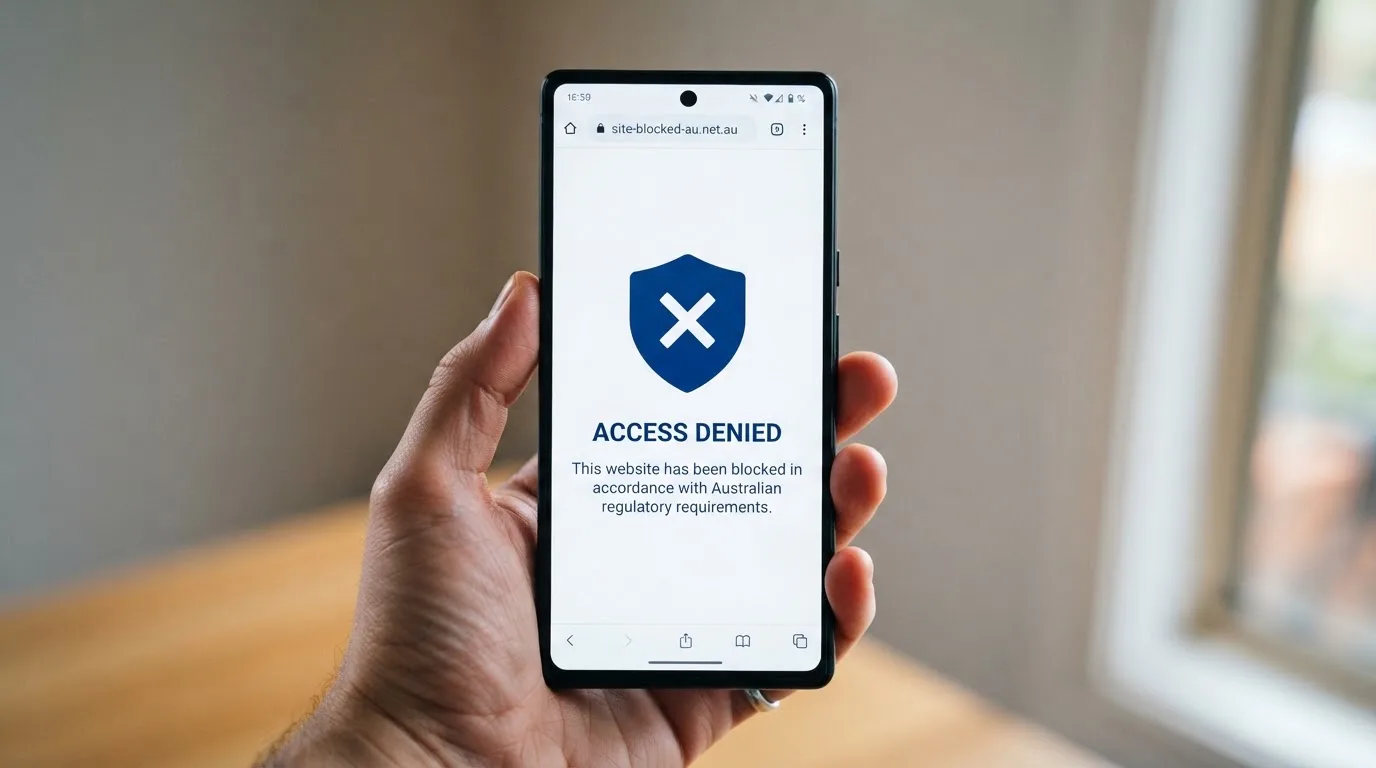
The Australian Communications and Media Authority investigates, issues formal warnings, and orders ISPs to block offending sites. The numbers, as of the round reported on 26 June 2026: 1,751 illegal gambling and affiliate-marketing websites blocked since the first blocking request in November 2019, and more than 230 unlicensed gambling services pushed out of the Australian market since enforcement was strengthened in 2017. In the same round, the ACMA asked ISPs to block twelve more names: 7Signs, ChromaBet, Donbet, Duospin, Freshbet, Slots Gem, Jacks Club, Lucky Start, Pointsbetz, Spinrise, Vinyl Casino and Wildsino. The pace has not slowed.
The H2 Gambling Capital estimate, published in 2025, is the one that puts the scale on the page: Australians lose roughly A$3.9 billion a year to illegal offshore sites, and the share of gambling going through legal channels has dropped from 74% in 2021 to 64%. The legal channel is shrinking, not growing. That is the market the marketing is selling into.
The blocking rate, since the first request
Taking the ACMA’s own running total — 1,751 sites blocked since November 2019 — and dividing it across the months between then and the June 2026 round gives a working blocking rate. Done arithmetically against the time elapsed since the first blocking request in November 2019, the rate lands at somewhere between 22 and 23 sites blocked per month, with monthly variation as small single-site rounds and larger 50-plus rounds alternate. The pattern is not a steady drip; it is a series of sweeps, separated by quieter periods when the ACMA builds a case.
The number that matters to a reader is not the rate itself. It is what it means: a single offshore brand that promises “instant payout” from Australia is, in practice, one ACMA round away from being unreachable. The blocked list does not distinguish between sites that paid out quickly and sites that didn’t. It distinguishes between sites that were offered to Australians and sites that weren’t.
Payment rails that actually deliver sub-minute settlement in Australia
Three domestic systems move money between Australian bank accounts in seconds. None of them is designed for offshore casino withdrawals, and the reason is structural.
Osko by AP+ rides on top of the New Payments Platform and settles between participating banks in under a minute, 24/7, including weekends and public holidays. The payee is addressed by BSB and account number or by a PayID. The NPP itself went live to the public on 13 February 2018 and is owned by New Payments Platform Australia Ltd, whose 13 shareholders include the Reserve Bank of Australia and the major banks. By April 2025 more than 25 million PayID identifiers had been registered, and participants are required to keep monthly platform outages to two minutes or less. This is the genuine “instant” rail in Australia.
PayID is the addressing layer on top of Osko. Over 100 Australian financial institutions support PayID-based instant transfers, and the system shows the name of the account holder before the transfer is sent. AP+ warns — in plain language — that anyone asked to send money to a PayID on an illegal gambling site is almost certainly looking at a scam site. The point is not subtle: the existence of PayID’s name-check feature is precisely what makes it unattractive for unlicensed operators, who do not want their receiving account name shown to the punter.
BPAY is the bill-payment rail that has been in operation since 18 November 1997. It runs through the online banking of more than 140 Australian banks and financial institutions and is offered by more than 95,000 businesses; its parent, Cardlink Services Limited, is owned equally by ANZ, Commonwealth Bank, National Australia Bank and Westpac. BPAY has been operated by Australian Payments Plus since the 2021 merger that consolidated BPAY Group, eftpos and NPP Australia under a single holding entity. It is the right rail for paying a bill — not for receiving a casino payout.
What this means for an Australian reading an offshore casino’s “instant payout” page: the casino is unlikely to settle via Osko or PayID. The receiving-account-name check makes both of them impractical for unlicensed operators. The most common payout routes from offshore sites to an Australian bank account are standard international bank transfer, card refund, or — increasingly — cryptocurrency. Standard bank transfer is the slowest of the three.
Card networks, wallets and the credit ban
The 2023 amendments to the Interactive Gambling Act ban credit cards and other credit-related products as payment for any Australian-licensed online wagering service, and the ban bites digital wallets too: a wallet like Apple Pay that is linked to a credit account is in scope, and so is the wallet’s use of a credit-funded card. The ban took practical effect across licensed wagering on 11 June 2024, with penalties up to A$247,500 for operators.
Apple Pay itself charges the consumer no fee for use in stores, online or in apps; any surcharge a merchant applies is the merchant’s own card-processing cost, not Apple’s. Apple is explicit that transaction limits and PIN requirements are set by the card issuer or the merchant, not by Apple. By the end of 2025, Apple Pay, Google Pay and Samsung Pay collectively accounted for around 45% of all card payments in Australia by number. The wallet side is now mainstream; the credit side is what’s banned.
Card surcharges and Amex
The Reserve Bank of Australia’s July 2025 review proposes removing surcharges only on eftpos, Mastercard and Visa card transactions. American Express is explicitly out. The Amex card scheme is structurally different: Visa and Mastercard run four-party networks, while Amex traditionally issues cards and processes transactions itself as a three-party scheme, which is part of why Amex merchant fees sit where they do. Amex was established in 1850 as a freight-forwarding company and launched its first charge card on 1 October 1958. None of that history changes the surcharge picture today, but it explains why the RBA’s review stopped at three.
Gambling blocks at the card level
Three of the four major Australian banks now let customers block gambling transactions at card level.
- Westpac’s gambling block refuses authorisation on transactions registered under the merchant category code “Betting/Casino Gambling” on eligible personal credit and debit cards.
- ANZ’s gambling transaction block, activated in the ANZ app, also blocks gambling transactions made through a digital wallet such as Apple Pay on an eligible card — not just the physical card — and turning the block off requires a 48-hour waiting period. ANZ warns that not all gambling transactions will be blocked and some non-gambling transactions might be blocked in error.
- Commonwealth Bank lets customers apply a gambling lock to eligible cards via the CommBank app, which blocks most gambling transactions; CommBank also says it cannot guarantee all gambling-related purchases will be stopped.
The pattern is the same across all three: blocks are best-effort, applied at merchant-category-code level, and they cover licensed wagering MCC codes. An offshore casino that codes its transactions under a different MCC — “gaming”, “entertainment”, or simply a generic retail code — can sit outside the block. The block is a real safeguard, not a wall.
Crypto and anonymity: the route the law did not design for
Cryptocurrency is not a legal payment route for Australian-licensed online wagering. The credit-card ban that took effect on 11 June 2024 also covers digital currency, which is why every licensed Australian bookmaker’s deposit page looks the way it does: debit card, bank transfer, PayID, Osko, BPAY — and nothing else.
For an Australian punter on an offshore site, crypto changes two things and leaves the rest unchanged. It changes the deposit, because a credit-card ban does not reach a wallet-to-wallet crypto transfer. It changes the payout, because a USDT or BTC withdrawal can settle on a blockchain in minutes — and “instant” in that context actually means what the word says. It does not change the legality. The IGA’s prohibition is on the offer of online casino games to a person in Australia; how the punter pays the offshore operator does not move the offer outside the prohibition.
AUSTRAC’s threshold-transaction-report rule, which requires reporting of transfers of A$10,000 or more, applies only to physical cash. Ordinary electronic bank transfers are not subject to that per-transaction reporting requirement, regardless of the amount sent. A crypto transaction on an exchange sitting inside AUSTRAC’s reporting regime is a different matter, and an exchange’s own AML obligations are not the same as the threshold rule — but for a plain bank transfer, the headline is that the A$10,000 threshold does not apply.
The deeper problem with crypto on offshore casinos is the one PayID was built to solve. When you pay to a PayID, the system shows the name of the account holder before the transfer is sent. That name-check is precisely the feature an unlicensed operator wants to avoid: it is harder to hide behind a string of receiving accounts when the punter sees whose account is being credited. Crypto takes that friction away. It also takes away the dispute route, the chargeback route, and the paper trail that any Australian consumer protection regime relies on.
Responsible gambling and the limits of self-exclusion
BetStop, the National Self-Exclusion Register, has been live since August 2023. It binds Australian-licensed online and phone wagering services. An offshore casino is not connected to it. A punter who has registered with BetStop and then opens an account with an offshore operator has self-excluded from a system that does not cover the site they are using. The exclusion works; the perimeter does not.
The other support channels do work across the perimeter. The National Gambling Helpline — 1800 858 858 — is free, 24/7, with chat available at Gambling Help Online. These are the routes an Australian reader should keep on hand, regardless of where they choose to play.
The pattern is worth saying plainly: the safer a channel looks, the less likely it is to apply to an offshore casino. Self-exclusion, deposit limits, gambling blocks at card level, real complaints bodies — every one of these is built around Australian-licensed wagering, and every one stops at the border. The offshore site offers none of them; the licensed Australian product offers all of them.
The eleven brands the question keeps circling
What follows is not a ranking. These are eleven operators the ACMA has issued formal warnings over for offering prohibited interactive gambling services to Australians. They appear because they are the names that come up when a reader searches for instant-payout casinos from Australia. They are presented in the ACMA’s own order of action — not in any merit order.
The table below is built around five matters: the brand, the date of the most recent ACMA formal warning, the operator entity the ACMA named, and the supporting data sources that have anything to say about the brand. The fifth column is a deliberate gap — there is no fifth characteristic of merit to add, because none of these brands is recommended, and a column that pretended otherwise would be lying.
| Brand | ACMA action and date | Operator named by the ACMA | Subject support |
|---|---|---|---|
| RocketPlay | March 2026 (also May 2022 over earlier operator) | Pulsup Ltd (RocketPlay); previously Dama N.V. | — |
| Level Up Casino | May 2022 | Dama N.V. | — |
| Woo Casino | March 2025 | Dama N.V. | — |
| Spirit Casino | May 2025 | Dama N.V. | — |
| National Casino | July 2025 | Consolutetish S.R.L. | listings-only |
| Bizzo Casino | July 2025 (also 2022 over earlier operator) | Consolutetish S.R.L.; previously TechSolutions (CY) Group / TechSolutions Group N.V. | — |
| Ignition Casino | July 2025 | Bamboo Media | — |
| Instant Casino | February 2025 | EOD Code SRL | listings-only |
| Jackbit | April 2026 | Ryker B.V. | — |
| Casino Intense | April 2025 | Sterplay Holding Ltd | listings-only |
| Sky Crown | September 2022 | Hollycorn N.V. | — |
A column with no data across most of its rows carries no information and is not on the page. Where the ACMA has not acted on the operator within the last twelve months, the date is older and that is itself the information.
RocketPlay
The most recent action is March 2026, when the ACMA issued a formal warning to Pulsup Ltd over RocketPlay. The brand’s earlier operator, Dama N.V., received a warning in May 2022 as part of a six-brand sweep that also named Bambet, Dazard, Level Up, Wild Tornado and Cobra Casinos. The fact that the ACMA has had to warn this brand twice, under two different operators, in the space of four years is itself the pattern.
Level Up Casino
A May 2022 Dama N.V. warning, part of the same six-brand sweep. The ACMA’s action predates the more recent enforcement rounds, but the operator entity is the same one that was warned again over Woo Casino in March 2025 and Spirit Casino in May 2025 — three formal warnings in three years, on three different brand shells. That is the shape of a re-brand strategy, not a remediation strategy.
Woo Casino
Dama N.V., March 2025. The same operator entity behind Level Up and, by May 2025, Spirit Casino. The ACMA’s action against Dama N.V. across these brands is consistent: each is named, each gets a formal warning, each continues to operate under the same holding structure.
Spirit Casino
Dama N.V., May 2025. The third formal warning to Dama N.V. inside twelve months. The brand is recent; the operator is not.
National Casino
Consolutetish S.R.L., July 2025. The July 2025 round also named Bizzo Casino under the same operator entity, and named Bamboo Media separately over Ignition Casino. National Casino has no individual second warning — but the operator has been told once, in formal terms, what the IGA says about offering online casino games to Australians.
Bizzo Casino
Consolutetish S.R.L., July 2025 — and a prior formal warning in 2022 to TechSolutions (CY) Group Limited and TechSolutions Group N.V. Two warnings, two different operator entities, on the same brand. The 2022 warning came first; the 2025 one is the ACMA catching up with whichever shell the brand has since moved into.
Ignition Casino
Bamboo Media, July 2025. The July 2025 round was a busy one — National Casino, Bizzo Casino and Ignition Casino all named in the same ACMA bulletin. Each was named by a different operator entity, suggesting the ACMA is now chasing the holding-company layer as well as the brand layer.
Instant Casino
EOD Code SRL, February 2025. The brand name is the marketing hook for the entire instant-payout category — anyone searching for “instant payout casino” lands on a brand called Instant Casino almost by accident. The ACMA’s warning is one of the older entries on the list and predates the more recent Dama N.V. and Consolutetish S.R.L. rounds.
Jackbit
Ryker B.V., April 2026 — and in the same round, the same operator was warned over CasinOK. The most recent pair on the list; both Ryker B.V. brands named together. The brand also markets itself around crypto and instant withdrawal — the intersection of two of the question’s most-searched variants.
Casino Intense
Sterplay Holding Ltd, April 2025. The ACMA’s formal warning was followed up by listings-only coverage in industry sources; the operator has not been named again in the more recent rounds. Whether that is a sign of compliance or simply a quieter period is not knowable from the ACMA’s public record.
Sky Crown
Hollycorn N.V., September 2022 — the oldest formal warning on the list. The ACMA’s formal-warning PDF also names Blue Leo, Hollycorn’s other Australian-facing brand at the time. Hollycorn has not been named again in subsequent rounds, which is the best read of the eleven — though “not currently being warned about” is not the same as “operating legally in Australia”, because no online casino operator can.
What the table shows that the prose cannot
Three patterns sit inside the table once it is read at the operator-entity level rather than the brand level.
Pattern one: brand shells rotate; operators do not. Dama N.V. has been warned over six brands since 2022 — Bambet, Dazard, Level Up, Rocketplay, Wild Tornado, Cobra Casinos, then again separately over Woo Casino and Spirit Casino. Consolutetish S.R.L. was warned over both National Casino and Bizzo Casino in July 2025. TechSolutions was warned over Bizzo Casino in 2022. The brand on the landing page changes; the holding structure does not.
Pattern two: the ACMA is naming operators more often than it names brands. The July 2025 round named three different operator entities — Consolutetish S.R.L., Bamboo Media — across three brands in one bulletin. The April 2026 round named Ryker B.V. across two brands. The strategy is enforcement at the corporate layer, where a single warning reaches every brand that operator runs.
Pattern three: re-warnings, not first warnings, dominate the recent record. Of the eleven brands on the list, seven have been the subject of an ACMA action that is either recent (2026) or that follows a prior warning to a related entity. The blocking list is no longer a one-pass exercise; it is a continuing engagement.
The Australian-licensed alternative, stated plainly
For anyone reading this from Australia who wants to wager, the licensed route is sports and racing bookmakers licensed by the Northern Territory Racing and Wagering Commission (52 of them, including the big names) plus state-licensed lotteries and keno. The deposit rails for these products are debit card, bank transfer, PayID/Osko and BPAY. Credit cards and crypto are not legal deposit methods for any of them. The consumer protections — complaints bodies, dispute resolution, self-exclusion via BetStop, gambling blocks at the bank — apply to this set and to nothing else.
For anyone who wants casino games specifically — table games, slots, live dealer — there is no Australian-licensed online product to take. Land-based casinos and licensed pokies venues are the legal alternatives. They are not “instant payout” in any sense — you walk out with the money in your pocket — but they are the legal answer.
Closing thought on what “instant” actually buys you here
The fastest rail in Australia is Osko, at under a minute, on licensed rails, between Australian bank accounts. It is not available to offshore operators in any practical sense. The next-fastest route from an offshore casino is crypto, at minutes on a blockchain, with no consumer protection at either end. After that: international bank transfer, measured in days, with chargeback risk and slow dispute resolution on top. “Instant payout” from an Australian reader’s perspective is therefore most often either not available or not protected. The marketing word earns its keep only on licensed Australian wagering, where the speed is real and the framework backs it up.
Frequently Asked Questions
Does “instant payout” mean the money is truly available the moment the casino approves the withdrawal?
No. “Instant” in casino marketing almost always refers to the casino’s internal approval step, not the final settlement into an Australian bank account. The approval can take seconds; the settlement leg depends on the payment rail, and the receiving bank’s release window. An Australian reader who sees “instant payout” should read it as “approved instantly” and ask separately how the money is actually sent.
Which Australian payment rail is built for near-instant transfers?
Osko, running on the New Payments Platform, settles between participating Australian banks in under a minute, 24/7, addressed to a BSB and account number or to a PayID. It is the genuine sub-minute rail in Australia, and it is the rail that licensed Australian wagering uses.
Is it legal for an online casino to advertise instant payouts to Australians?
It is not legal for an online casino to offer online casino games to anyone in Australia at all. The Interactive Gambling Act 2001 makes the offer a prohibited interactive gambling service. “Instant payout” is a marketing feature on an offer the IGA already prohibits. The ACMA’s blocking record — 1,751 sites since November 2019 — is the working consequence.
Can a cryptocurrency withdrawal really be instant?
The blockchain leg can be — USDT and BTC settlements on their respective networks do move in minutes. What is not “instant” is the regulatory and protective frame around the transaction: no AUSTRAC reporting guarantee on the punter’s bank side, no chargeback right, no complaints body, and no legal recourse if the offshore operator refuses the withdrawal. The speed is real; the safety is not.
What verification steps can delay an otherwise instant payout?
Know-Your-Customer verification — identity document checks, source-of-funds checks, proof of address — is the most common cause of delay on an “instant” payout. Offshore casinos typically run KYC on first withdrawal or first withdrawal above a threshold, and the verification can take 24–72 hours. A punter who has already supplied and had documents approved will usually see a faster first withdrawal than one who has not.
Should a claimed instant payout change how much someone trusts a site?
No — not by itself, and not from an Australian reader’s perspective. The trust test is whether the operator is licensed to offer the product at all. In Australia, no operator is licensed to offer online casino games, so “instant payout” is a feature on an unlawful offer. The advertised speed is real, but the offer itself is the wrong starting point.