
Best casino in Hobart in 2026: the land-based choice, the offshore alternatives, and the rule that decides between them
Anyone searching for the best casino in Hobart in 2026 is, in practice, choosing between two things that are not on the same playing field. There is one licensed casino in Hobart — Wrest Point Hotel Casino in Sandy Bay — and there is a long list of offshore online casinos that accept Australians despite the Interactive Gambling Act 2001 making that offer unlawful. The “best” answer depends entirely on which side of that line the reader stands on. For someone who wants to walk into a building and play, there is Wrest Point and nothing else. For someone weighing an offshore site instead, the question shifts from “which is best” to “which has the ACMA not yet warned about, and is that the right metric to use.”

This page maps both paths. The first half describes what Hobart’s one licensed venue actually offers — its games, its floor, its age rules, the hotels within walking distance and the rooftop bar that surfaces in the related searches. The second half catalogues the offshore brands that have attracted the attention of the Australian Communications and Media Authority, so a reader comparing options can see what regulators have flagged and why the term “licensed” still carries no weight for an Australian player on any of them. The analysis runs to a single judgement: there is a best option for the question as most people ask it, and there is no defensible alternative for an Australian who wants to stay inside Australian consumer-protection law.
Current as of 25 November 2026, verified against the ACMA’s published register of formal warnings and blocking requests.
Table of Contents
- Games, tables and the floor at Wrest Point
- The rooftop bar, the towers and the venue’s identity
- The minimum age and what the venue enforces
- The hotels within walking distance
- Choosing between Hobart’s casino and an offshore site
- The offshore alternatives the ACMA has flagged
- Hobart’s licensed venue against the ACMA’s warning list
- The Interactive Gambling Act and how it works in practice
- The blocking rate: how quickly the ACMA clears new sites
- Responsible gambling and the tools Australian players can actually use
- A note on credit cards, crypto and the way Australians pay
- The reform bill that took effect in August 2026
- Tax, winnings and what to do with a big payout
- What the comparison actually looks like
- Choosing a night at Wrest Point
- The closing judgement
- Frequently asked questions about Hobart’s casino
Games, tables and the floor at Wrest Point
The “best casino in Hobart” question, taken literally, is about gameplay. Wrest Point runs more than 650 electronic gaming machines on its main floor, which puts it in the same general tier as the larger mainland casinos once their staged openings are counted. The machine count grew out of an agreement with the Tasmanian Gaming Commission after the venue was fined $17,500 in 2015 for allowing a faulty poker machine that did not function as designed to be played; the venue had already been fined $13,000 the previous year for six gaming machines operating outside their approved game rules. That history matters less than what it produced: owner Federal Group committed to auditing every machine on the floor, and the machine count at Wrest Point has been the visible outcome.
For table games, the Hobart venue covers the classics that recur in the related searches. Blackjack, roulette and baccarat all run on the main gaming floor, alongside craps and a dedicated poker room. The electronic games catalogue includes pokies — the Australian term for slot-style machines — and the wider machine library stretches across standard reel games, video poker and the multi-terminal setups that have become common in Australian casinos. The Hobart venue does not offer online casino play on its own account, because no Australian jurisdiction licenses it; the “online pokies” wording in the related searches refers to offshore operators, and is treated separately below.
The paytable question — what return players can expect — sits outside the published floor data. Tasmania does not publish a minimum return-to-player figure for casino gaming machines equivalent to the 87.5% floor South Australia sets outside Adelaide Casino. Wrest Point’s machines operate under Tasmanian Gaming Commission rules, and the casino has not published a venue-wide RTP figure that can be cited here. Players looking for the underlying mathematics of a specific machine need to read the help screen on the terminal itself, which every Australian gaming machine is required to display.
The table-game catalogue is more interesting than the headline floor count suggests. Wrest Point runs a higher-limit salon for serious play, separate from the public floor, and that salon is where the baccarat and blackjack action concentrates on busy nights. Craps at Wrest Point runs on a single main table rather than the two- or three-table setup the larger mainland casinos maintain, which is worth knowing if craps is the specific draw. Poker is cash-game only; the venue has not run a major tournament series in recent years.
The rooftop bar, the towers and the venue’s identity
The related searches around “hobart casino rooftop bar” surface because Wrest Point has two things most casinos do not: a 17-storey dodecagonal hotel tower designed by Sir Roy Grounds, completed when the complex opened on 10 February 1973 as Australia’s first legal casino, and a revolving restaurant at the top of that tower. The tower is the tallest building in Tasmania, which means the rooftop venue looks out over the Derwent River and Mount Wellington in a way no other venue in the city can match. For a reader choosing a casino visit around an evening out rather than around the gaming floor, that rooftop restaurant is the answer to the “best” question — it is the one feature that no other Hobart venue can replicate, and it is the part of the Wrest Point experience that has nothing to do with the machines.

The tower’s 269 rooms give the venue a self-contained character that the hotel-and-casino combinations on the mainland have lost. A reader searching for Hobart casino accommodation is, in practice, searching for “stay at the casino so I can walk to the tables in the morning,” and Wrest Point answers that with its own rooms. The adjacent Country Club Tasmania in Launceston and the chain hotels along Sandy Bay and the waterfront give alternatives at different price points, but they are alternatives rather than substitutes; only Wrest Point puts the gaming floor and the bed under the same roof.
The wider complex — built out around the original 1973 tower and updated in a roughly AUD $65 million staged renovation between 2018 and 2023 to mark the venue’s 50th anniversary — runs several bars and restaurants, a convention centre that cost more than $20 million when it opened in 1984, and the kind of multi-purpose event space that lets the casino host conferences and weddings. For a visitor choosing between Wrest Point and a non-gaming hotel, the relevant comparison is rarely room quality and almost always convenience. Staying on-site removes the question of how to get home after a late session, which matters because no rideshare or bus runs at 3 a.m. the way it does in mainland capitals.
The minimum age and what the venue enforces
The minimum age to enter Hobart’s casino is 18, set under the same Tasmanian framework that applies to all Australian casino floors. Anyone under 18 is refused entry at the door, and the venue checks photo identification on entry during busier periods. The age rule is the simplest part of the framework, and it is enforced consistently across Australian casinos; it does not vary by game type, by floor section, or by time of day.
The cashless gaming card reform that took effect for Tasmanian hotel and club poker machines from December 2025 — default loss limits of $100 per day, $500 per month and $5,000 per year, raisable only after a 24-hour wait, with mandatory 10-minute breaks after two continuous hours of play — does not extend to Hobart’s casino floor. The Tasmanian Gaming Commission has kept casino play outside that reform, and the limits and breaks above apply only to the separate hotel-and-club pokie category. For a player stepping onto Wrest Point’s gaming floor, the rules that apply are the casino’s house rules plus the Tasmanian Casino Control Act, not the cashless card regime.
For younger adults travelling with parents, the practical point is straightforward: no one under 18 enters the gaming floor at any hour. The non-gaming areas of the Wrest Point complex — the tower lobby, the ground-floor restaurants outside gaming hours, the convention centre — are open to all ages, but the gaming floor is not. Parents planning a wedding or conference at the venue should treat the gaming floor as off-limits to teenagers regardless of supervision.
The hotels within walking distance
For visitors who want to play at Wrest Point but not sleep there, the practical alternative is to stay within walking distance. The closest non-casino options cluster along Sandy Bay Road and the waterfront strip toward the CBD. The relationship is not exact: “walking distance” depends on luggage, on the time of night, and on whether the reader wants to walk back after a session that may run past midnight. For most visitors, the realistic options are the mid-range hotels within a kilometre of the venue, the chain hotels further south along Sandy Bay, and the CBD properties a short taxi ride away.
For visitors with a car, Wrest Point’s own parking makes the question moot — the venue has on-site parking that is straightforward to use at any hour. For visitors without a car, the choice between “stay at the venue” and “stay in the CBD” turns on how late the sessions run and how comfortable the reader is with a taxi back to a city hotel. The casino does not run a courtesy shuttle. Rideshare coverage in Hobart after midnight is patchy on weeknights and reasonable on Friday and Saturday nights, which means the practical answer depends on which night of the week the visit falls on.
Choosing between Hobart’s casino and an offshore site
For most Australian readers, the choice that the “best casino in Hobart” search implies does not exist in the form the wording assumes. There is one legal option in Hobart. There is a long list of illegal options anywhere else, and the ACMA’s enforcement record is the public record of what those illegal options look like in practice. The honest comparison is not “which casino is best” but “should the reader play in Hobart at all, and if the answer is no, what should they know about the offshore alternatives they are about to consider.”
A reader who chooses Wrest Point gets a regulated venue, consumer protection under the Tasmanian Casino Control Act, on-site dispute resolution through the Tasmanian Gaming Commission, and the full suite of responsible-gambling tools that apply to Australian-licensed gaming floors. A reader who chooses an offshore site gives up every one of those protections, because the offshore site is not licensed in Australia and the Australian regime does not reach it. The site may hold a licence from another jurisdiction, but that licence gives an Australian player no recourse: the Australian Communications and Media Authority cannot compel a Curaçao- or Costa Rica-registered operator to honour a withdrawal, and the IGA targets the operator, not the player who plays there.
The next section maps exactly which offshore brands the ACMA has acted against, what the action was, and what that action tells the reader about the choice they are about to make.
The offshore alternatives the ACMA has flagged
The Interactive Gambling Act 2001 makes it an offence to provide online casino games, online pokies or in-play betting to a person physically in Australia; the IGA targets the provider, not the player. No state or territory in Australia licenses online casino games, and the Northern Territory Racing and Wagering Commission — the regulator that licenses 52 of Australia’s online bookmakers, including Sportsbet, Bet365 and Ladbrokes, for tax reasons — licenses only wagering on races and sport placed before the event. The practical effect for an Australian reader is that any online casino accepting Australian players is doing so in breach of the IGA, whatever licence the site may display in its footer.
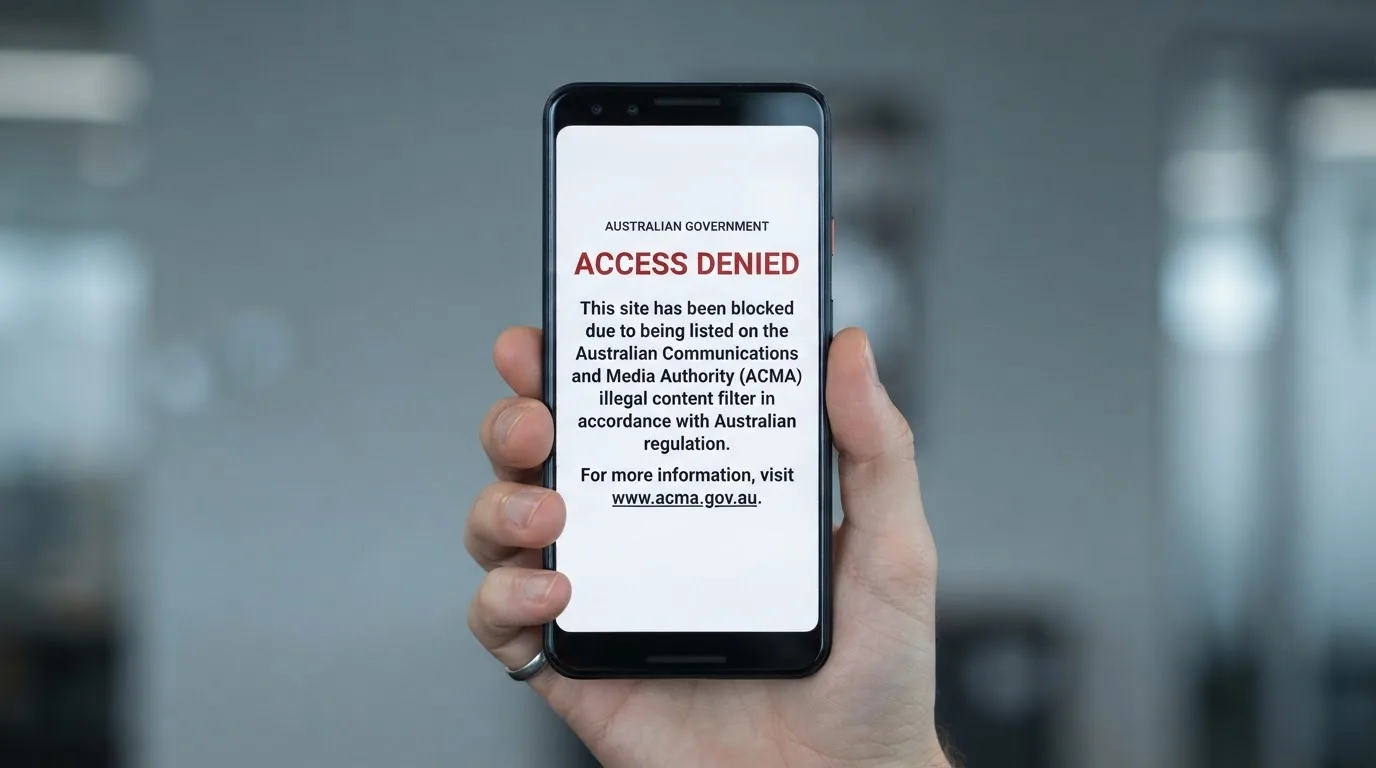
The Australian Communications and Media Authority has been enforcing that prohibition since 2017. By June 2026 the ACMA had asked Australian internet service providers to block 1,751 illegal gambling and affiliate marketing websites since the first blocking request in November 2019, and more than 230 unlicensed gambling services had left the Australian market since the 2017 enforcement strengthening. The June 2026 blocking round alone added 12 more sites: 7Signs, ChromaBet, Donbet, Duospin, Freshbet, Slots Gem, Jacks Club, Lucky Start, Pointsbetz.com, Spinrise, Vinyl Casino and Wildsino.
The warnings on individual brands follow a pattern. The ACMA issues a formal warning naming the operator behind the brand and the date; that warning is published on the ACMA’s website; the operator may then choose to stop accepting Australian players, continue, or change its corporate structure and re-enter under a new name. The next section of this page catalogues the specific brands the ACMA has named, the dates the warnings were issued, and the operators behind each brand as published in the formal warning records.
Hobart’s licensed venue against the ACMA’s warning list
The table below puts Hobart’s one licensed casino side by side with the offshore brands the ACMA has acted against. It is not a ranking and not a recommendation. The Wrest Point line carries the venue’s status under Tasmanian law; the other lines carry the formal warning record as published by the ACMA. The “operator named by the ACMA” column reproduces the name from the formal warning publication, and the “ACMA action and date” column gives the month and year the warning was issued.
The point of the table is not to suggest any of these brands are interchangeable with Wrest Point. They are not — one is a licensed venue, the others are unlicensed services that the ACMA has acted against. The point is that a reader weighing “Hobart casino versus online casino” has a specific list of online options that the regulator has already examined, and that list is worth seeing in one place.
| Brand | ACMA action and date | Operator named by the ACMA | Subject support |
|---|---|---|---|
| Wrest Point Hotel Casino | No ACMA action — venue is licensed in Tasmania under the Casino Control Act | Federal Group (licensee) | Australian-licensed land-based venue |
| RocketPlay | Formal warning, March 2026 | Pulsup Ltd (Rocketplay.com.au) | — |
| Level Up Casino | Formal warning, May 2022 | Dama N.V. | — |
| Woo Casino | Formal warning, March 2025 | Dama N.V. | — |
| Spirit Casino | Formal warning, May 2025 | Dama N.V. | — |
| National Casino | Formal warning, July 2025 | Consolutetish S.R.L. | — |
| Bizzo Casino | Formal warning, July 2025; earlier warning, 2022 | Consolutetish S.R.L.; earlier TechSolutions (CY) Group and TechSolutions Group N.V. | — |
| Ignition Casino | Formal warning, July 2025 | Bamboo Media | — |
| Instant Casino | Formal warning, February 2025 | EOD Code SRL | — |
| Jackbit | Formal warning, April 2026 | Ryker B.V. (also over CasinOK) | — |
| Casino Intense | Formal warning, April 2025 | Sterplay Holding Ltd | — |
| Sky Crown | Formal warning, September 2022 | Hollycorn N.V. (also over Blue Leo) | — |
The pattern behind the table is more informative than any single line in it. Of the eleven offshore brands the ACMA has acted against, four are or were operated by Dama N.V. or its corporate successors — RocketPlay, Level Up Casino, Woo Casino, Spirit Casino — and the ACMA has had to re-issue warnings as Dama has restructured. Two more, National Casino and Bizzo Casino, are operated by Consolutetish S.R.L., with Bizzo having already been the subject of a 2022 warning to TechSolutions. That is a regulator chasing the same operators under new corporate names, which is exactly the pattern the ACMA’s blocking regime is designed to interrupt.
For an Australian reader, the practical reading is straightforward. The brands in this table have all been formally warned by Australia’s communications regulator for offering prohibited services to Australians. Some have continued operating under the same name; others have moved to a new corporate vehicle; in every case the underlying offer — online casino games to a person in Australia — is the same prohibited conduct the IGA was written to stop. A reader choosing one of these brands over Wrest Point is choosing to play on a site the regulator has explicitly named, and is giving up the Australian consumer-protection framework in the process.
The Interactive Gambling Act and how it works in practice
The Interactive Gambling Act 2001, as amended by the Interactive Gambling Amendment Act 2017, makes it an offence to provide online casino games, online pokies or in-play betting to a person in Australia. The “to a person in Australia” wording matters — the IGA targets the supply, not the demand, and an Australian player is not personally liable for playing on an offshore site. What the IGA does mean is that the operator is acting unlawfully, and that the operator has no standing to enforce its own terms against an Australian player through any Australian body.
The ACMA’s enforcement tools are formal warnings, civil penalties, injunctions and blocking requests to internet service providers. A blocking request does not require the site’s cooperation; the ACMA asks Australian ISPs to block the site at the DNS level, and the site becomes unreachable from Australian connections. A site that re-emerges under a new domain or a new operator name gets a fresh blocking request. That is why the ACMA’s running total of blocked sites — 1,751 as of June 2026 — has grown steadily rather than levelled off.
What the ACMA cannot do is refund an Australian player’s balance on a blocked site. If a player has money on an offshore casino when the site is blocked, the operator is not obliged by Australian law to return it, and the ACMA has no power to compel a return. The IGA was written to stop the supply, and the consequence for a player who gets caught on the wrong side of a blocking round is that their balance may be stranded. This is the part of the offshore-casino story that affiliate marketing pages do not tell the reader, and it is the part that matters once a real balance is on the line.
For an Australian reader, the simplest reading of the law is that any online casino accepting Australian players is doing so unlawfully. The fact that an offshore site displays a Curaçao, Malta or Anjouan licence is irrelevant to an Australian player — those licences give the site permission to operate in their own jurisdiction, not to override the IGA. What matters is whether the site accepts Australian players, and if the answer is yes, the site is in breach of Australian law from the moment the deposit clears.
The blocking rate: how quickly the ACMA clears new sites
One way to read the ACMA’s enforcement record is as a measure of how quickly the regulator catches up to new sites. Between the first blocking request in November 2019 and June 2026 — roughly 80 months — the ACMA asked ISPs to block 1,751 illegal gambling and affiliate marketing websites. That works out to a band of roughly 20 to 25 blocked sites per month on average across the period, with significant month-to-month variation around that band.
The arithmetic is not a guarantee that any single new site will be blocked within X days. New sites enter the market continuously, the ACMA’s enforcement is not uniform across categories, and some sites attract blocking requests faster than others depending on the volume of Australian-facing advertising and the operator’s response to prior warnings. What the band tells the reader is that the regulator’s output is steady rather than sporadic — the ACMA is not pausing between rounds, and the brands named in formal warnings are unlikely to remain reachable from Australian ISPs for the long term.
For a reader weighing whether to deposit on an offshore site today, the practical reading is that the site is more likely than not to be added to a future blocking round within a reasonable horizon. A deposit made today may not be withdrawable tomorrow if the site is blocked with a balance still on it, and the ACMA’s enforcement record is the data point that supports that read.
Responsible gambling and the tools Australian players can actually use
For Australians who want to control their gambling, the practical tools split cleanly into two categories: tools that work on Australian-licensed services and tools that do not work on offshore services. BetStop — the National Self-Exclusion Register, live since August 2023 — binds every Australian-licensed online and phone wagering service. A player who registers with BetStop is excluded from every Australian-licensed wagering provider at once, and the exclusion period is for a minimum of three months up to a permanent ban.
BetStop does not bind offshore casinos. An Australian player who has registered with BetStop can still log into an offshore site, deposit, and play — because the offshore site is not connected to the register and has no obligation to honour it. The register is a tool of Australian-licensed operators, and an offshore site is not one. For a player who wants to exclude themselves from all forms of gambling — including the offshore options — the answer is not a register, it is the support services.
The National Gambling Helpline — 1800 858 858 — is free, 24/7, and staffed by counsellors who can help a player arrange venue self-exclusion at Wrest Point and other Australian venues. For Tasmanian players specifically, Gambling Helpline Tasmania runs out of Anglicare Tasmania’s Gamblers Help Service, with in-person counsellors based in Hobart, Launceston, Devonport and Burnie. The phone number is the same statewide, and the counsellors can help a player set up self-exclusion at Wrest Point directly. For a player who needs help, the Helpline is the first call, not the last.
For venue-level self-exclusion at Wrest Point specifically, a player can approach the venue’s responsible-gambling team and arrange an exclusion of their own accord; the venue will refuse entry for the agreed period, and the Tasmanian Gaming Commission can be involved if a dispute arises. None of these tools reach an offshore site.
A note on credit cards, crypto and the way Australians pay
Since 11 June 2024, credit cards, credit-related products and digital currency have been banned as payment for licensed online wagering in Australia. Penalties for taking a credit card deposit reach $247,500 for the operator, and the prohibition applies to every Australian-licensed online and phone wagering service. The legal deposit routes for licensed wagering are debit card, bank transfer, PayID/Osko and BPAY.
This rule is another line the offshore sites cross. An Australian-facing offshore casino commonly offers credit card deposits and crypto deposits — both of which are banned for the Australian-licensed alternatives. The presence of those payment options on a site is itself a marker that the site is operating outside the Australian framework, because an Australian-licensed operator would not offer them. For a reader evaluating an offshore site, the payment screen is one of the clearer signals: a site accepting credit cards or crypto from Australians is offering something an Australian-licensed operator is prohibited from offering.
For players who want to keep their gambling spend visible and bounded, debit card deposits through PayID or BPAY are the routes that play cleanly into Australian banking statements. A crypto deposit, by contrast, sits outside the conventional banking record and makes it harder to track spend at the household level. The framework exists for a reason, and the offshore sites’ payment menus are one of the easier places to see why the framework matters.
The reform bill that took effect in August 2026
The Interactive Gambling Amendment (Gambling Reform) Bill 2026 passed Parliament on 19 August 2026. Its advertising and inducement measures commence on 1 January 2027 — a law with a start date, not yet in force on a page published in 2026. The bill tightens the framework around how wagering services can advertise to Australians, and the practical effect for an Australian player is a future reduction in the volume of inducement offers the licensed operators can run. The offshore sites are not bound by the bill at all, and the reform does not reach them.
For a reader comparing options today, the reform is a marker of where Australian gambling regulation is heading rather than a rule that changes the options available now. The IGA itself is still the operative prohibition on online casino games to Australians; the 2026 reform layers advertising rules on top of that prohibition. The two together paint a picture of a regulator tightening the screws year on year, and the offshore operators’ response to that tightening has been the kind of corporate restructuring visible in the formal warning records above.
Tax, winnings and what to do with a big payout
For a recreational player, gambling winnings are not assessable income under section 6-5 of the ITAA 1997, and gambling losses are not deductible. The model only changes if the player is carrying on a business of gambling — a professional punter whose gambling activity amounts to a commercial enterprise, in which case the income is assessable and the losses are deductible. For the vast majority of Australians who gamble recreationally, the tax treatment is straightforward: winnings are tax-free, losses are personal, and there is no need to declare anything to the ATO.
The “check with the ATO” caveat is a real one for any reader whose gambling activity is large enough to look like a business — regular, systematic, organised with the discipline of a profession. For everyone else, the rule holds: keep records if the reader wants to, but the ATO is not interested in a recreational punter’s win. The offshore sites tell a different story — some of them imply that an Australian player needs to declare offshore winnings, which is a confusion. The tax treatment of a recreational Australian player does not change based on where the winnings were earned. Offshore winnings are still not assessable income, and offshore losses are still not deductible, until and unless the player’s circumstances change.
What the comparison actually looks like
For most readers searching for the best casino in Hobart, the honest comparison ends at Wrest Point. The venue is the only licensed option, the rooftop tower is the closest thing Hobart has to a casino-resort experience, and the surrounding hotels give realistic alternatives for visitors who want to stay nearby without sleeping on-site. The minimum age is 18, the responsible-gambling tools work, the Tasmanian Gaming Commission has jurisdiction over the venue, and the consumer-protection framework applies.
For the smaller group of readers who are weighing an offshore site instead — the comparison the marketing pages invite them to make — the answer is that there is no defensible choice that keeps the reader inside Australian consumer-protection law. The brands in the ACMA’s warning list are not a “best casino” shortlist; they are a record of how the regulator has applied the IGA over time. A reader who picks one of those brands over Wrest Point is choosing to play on a site the regulator has acted against, and the consequence of that choice is that Australian law does not protect them if the site blocks withdrawals, disappears, or gets added to the next blocking round with a balance still on it.
The “best” answer, for the overwhelming majority of readers, is Wrest Point. The page has no second-best option to recommend.
Choosing a night at Wrest Point
For a reader who has decided on Wrest Point and is now choosing how to spend the visit, the practical considerations are different from the legal ones. The rooftop bar and revolving restaurant at the top of the 17-storey tower are the venue’s strongest feature and the one no other Hobart venue can match; for a special-occasion visit, the tower restaurant is the right starting point. The gaming floor is the reason most readers are there, and the layout is straightforward — the 650-odd electronic gaming machines sit on the main floor, with table games and poker in their own dedicated sections. Late-night sessions run past midnight on weekends; early-evening sessions are quieter and give more room to move between machines.
For a reader visiting Hobart specifically to gamble, the practical choice is whether to stay at Wrest Point itself or at a nearby hotel. Staying at Wrest Point puts the room and the gaming floor under the same roof, removes the question of how to get back to a city hotel after a late session, and turns the venue into a destination rather than a stop. Staying at a non-casino hotel in Sandy Bay or the CBD saves money on the room but adds the transportation question, which is real on weeknights when rideshare coverage is patchy.
For a reader visiting Hobart for other reasons who is adding a casino night to a longer trip, the Wrest Point gaming floor is one option among many — the city’s restaurants, MONA and the waterfront are the bigger draws for most visitors, and the casino is a single evening’s entertainment rather than the centrepiece. The venue’s non-gaming features — the bars, the restaurants, the convention centre — make it a viable evening out even for visitors who do not intend to play.
The closing judgement
The best casino in Hobart in 2026 is Wrest Point, and the comparison the search query invites does not survive contact with the IGA. For an Australian player, the licensed option is one venue; the unlicensed options are a long list of offshore brands the regulator has been warning against since 2017, and the formal warning record above is the public record of that enforcement. A reader who chooses Wrest Point gets consumer protection, dispute resolution and responsible-gambling tools that work; a reader who chooses an offshore site gives all of that up.
The page’s recommendation is therefore simple. For the question as most readers ask it — what is the best casino to visit in Hobart — Wrest Point is the answer, and the second-best option is to stay home, visit the rooftop restaurant without playing, and use a Hobart visit for something other than the gaming floor. The third option — playing on an offshore site — is the one the regulator has been acting against for the better part of a decade, and the formal warning record is the evidence for why the choice is what it is.
Frequently asked questions about Hobart’s casino
What is the main casino in Hobart?
Wrest Point Hotel Casino in Sandy Bay. It opened on 10 February 1973 as Australia’s first legal casino and is operated by Federal Group under a Tasmanian licence. The 17-storey dodecagonal tower designed by Sir Roy Grounds is the tallest building in Tasmania and houses a revolving restaurant at the top, plus 269 hotel rooms. The complex has more than 650 electronic gaming machines on its gaming floor alongside the standard table games.
Where is the casino in Hobart located?
Wrest Point Hotel Casino sits on Sandy Bay Road in the suburb of Sandy Bay, about four kilometres south of Hobart’s central business district. The complex is on the Derwent River waterfront, with Mount Wellington rising behind it. The venue runs its own on-site parking and is reachable from the CBD by a short taxi or bus ride.
What is the minimum age to enter the casino in Hobart?
The minimum age is 18, set under the Tasmanian Casino Control Act and enforced at the door. Anyone under 18 is refused entry to the gaming floor, and the venue checks photo identification on entry during busier periods. The non-gaming areas of the Wrest Point complex are open to all ages; only the gaming floor is age-restricted.
Does Hobart’s casino offer table games such as blackjack and baccarat?
Yes. Wrest Point runs blackjack, roulette, baccarat and craps on its main gaming floor, alongside a dedicated poker room that runs cash games. The venue also operates a higher-limit salon for serious table-game play, separate from the public floor. The electronic gaming floor adds pokies, video poker and the multi-terminal setups common to Australian casinos.
Are there hotels within walking distance of the casino in Hobart?
Yes. Wrest Point itself runs 269 hotel rooms in the tower, which puts the gaming floor and the bed under the same roof. For visitors who want to stay elsewhere, mid-range hotels along Sandy Bay Road and the waterfront give realistic walking-distance options, and chain hotels further south along Sandy Bay are a short taxi ride away. The CBD hotels are roughly four kilometres north and require transport after a late session.
Can Australians legally play at an offshore online casino instead?
No. The Interactive Gambling Act 2001 makes it an offence to provide online casino games, online pokies or in-play betting to a person in Australia; no state or territory licenses them. The IGA targets the operator, not the player, but the practical consequence for an Australian player is that an offshore casino gives no Australian consumer protection, no complaints body and no recourse if a withdrawal is refused. The ACMA has issued formal warnings to over a dozen offshore brands since 2017 and has asked Australian ISPs to block 1,751 illegal sites since November 2019. The legal alternative to Wrest Point in Hobart is to stay home from the gaming floor altogether.