
Curaçao casino licence and Australian players: where the seal actually stops
A Curaçao gaming licence is the most common credential on an offshore casino’s footer. For an Australian player sitting in front of that footer, the question is whether the seal changes anything that matters locally. The short answer is no. The long answer is what follows, and it depends less on Curaçao’s licensing reform than on the Interactive Gambling Act 2001 and the Australian Communications and Media Authority’s enforcement record against the very brands carrying that seal.
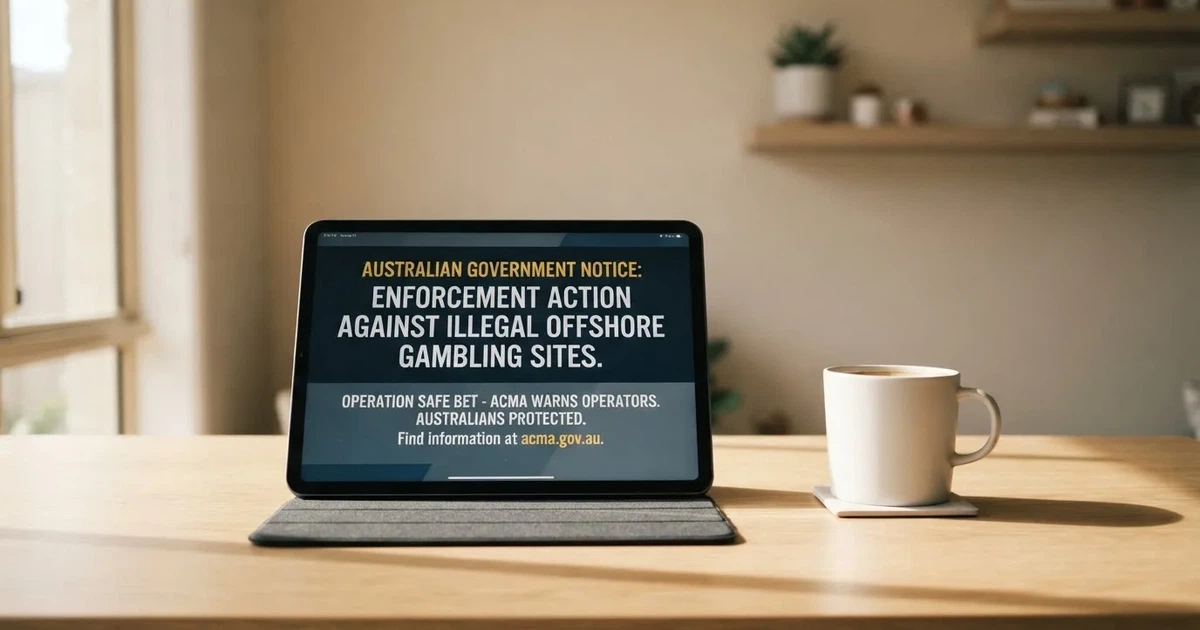
Data current as of 8 November 2026, checked against the ACMA’s published formal warning list and the IGA as amended.
Table of Contents
- The prohibition that runs ahead of the licence
- The ACMA’s blocking record and what it has done to the visible shelf
- Responsible play around a product that Australia does not license
- How the comparison works, and what it sorts
- Each brand, in the order the ACMA has acted
- The rule that decides everything else
- Where the comparison leaves the reader
- Frequently asked questions
The prohibition that runs ahead of the licence
Australia’s federal gambling law draws a line that any offshore seal sits on the wrong side of. The Interactive Gambling Act 2001, tightened by the Interactive Gambling Amendment Act 2017, makes it an offence to provide online casino games, online pokies or in-play betting to a person physically in Australia. No state or territory licenses that product. The category that is licensed is wagering on races and sport placed before the event, plus lotteries and keno. The Northern Territory Racing and Wagering Commission is the practical home of that wagering licensing, covering 52 of the country’s online bookmakers — Sportsbet, Bet365 and Ladbrokes among them — for tax reasons; the commission runs without full-time staff and meets once a month in Darwin. That arrangement is the only Australian-issued permission that touches online play, and it has no application to online casino games.

The Interactive Gambling Amendment (Gambling Reform) Bill 2026 passed Parliament on 19 August 2026, with its advertising and inducement measures commencing on 1 January 2027. For a player reading the rules in the calendar year covered by this page, that reform is law with a start date rather than law in force.
What that prohibition costs the player is not theoretical. The ACMA is the body that investigates breaches, issues formal warnings, and directs Australian internet service providers to block offending sites. A site can be blocked while a real-money balance still sits on it, with no Australian consumer protection behind that balance and no local complaints body to argue with about it.
What a Curaçao licence actually certifies
The licence is a permission to operate from Curaçao, granted under the National Ordinance on Games of Chance (the LOK framework) and supervised by the Curaçao Gaming Authority alongside the Gaming Control Board. The fees that frame a 2025 application are concrete: EUR 4,592 for both B2C and B2B application fees, an annual B2C fee of EUR 47,450 split between a EUR 24,490 National Treasury licence fee and a EUR 22,960 CGA supervisory fee, and an annual B2B fee of ANG 48,000 with no monthly charge. The supervisory side of that regime rests on the National Ordinance on Identification and the National Ordinance on Unusual Transactions, with licensed operators reporting unusual transactions through the goAML portal established under PB 2020 no. 157.
None of which extends the holder’s reach into Australia. A Curaçao licence is a permission to offer a regulated product to the players Curaçao’s law defines as its own. The Australian player’s address is the variable that the IGA turns on, and a foreign licence does not change it.
Where Australian licensing does apply — and where it does not
A reader who hears “Australian-licensed” and assumes it covers the casino games on a Curaçao-licensed site has heard a different claim. Australian licensing covers wagering services — sports and race betting placed before the event — and the lotteries and keno that state and territory bodies run. Every online casino game and every online pokie on a Curaçao-licensed site sits outside that perimeter, regardless of the marketing. The Hollycorn N.V. brands Sky Crown and Blue Leo, the Dama N.V. portfolio that includes Woo Casino and Spirit Casino, the Bamboo Media brands Ignition Casino and National Casino, and Ryker B.V.’s Jackbit and CasinOK are all subjects of formal warnings from the ACMA for offering exactly that prohibited category to people in Australia.
The ACMA’s blocking record and what it has done to the visible shelf
The page’s calculation lives in the cumulative picture, not in any single round. As of the ACMA’s June 2026 update, 1,751 illegal gambling and affiliate marketing websites had been blocked since the first blocking request in November 2019. More than 230 unlicensed gambling services have left the Australian market since the 2017 enforcement strengthening. The June 2026 round alone directed Australian ISPs to block 12 more sites: 7Signs, ChromaBet, Donbet, Duospin, Freshbet, Slots Gem, Jacks Club, Lucky Start, Pointsbetz.com, Spinrise, Vinyl Casino and Wildsino.
The reader can draw a clear picture from those two figures. Over roughly 80 months — November 2019 to the June 2026 update — the ACMA moved from the first blocking request to a running total of 1,751 blocked sites and 230 withdrawn services. The standing rate is somewhere between the early rounds and the most recent ones; a single figure is not honest here. As a band, the pace has run from roughly a handful of blocks per month in the early years to a working tempo of twenty to thirty sites added per active round in the most recent year, with the cumulative count lifting as each round lands.
The point that follows from that band is the one a reader can act on. A Curaçao-licensed casino that is visible in Australia today is not protected by its licence from this list. Two of the brands featured later in this guide — Woo Casino and Spirit Casino — are subjects of formal warnings over 2025. A third pair, Jackbit and CasinOK, was the subject of a formal warning in April 2026. A reader looking at a Curaçao-licensed site this week is looking at a site whose licence has not, in any of those cases, kept the ACMA from acting.
The shape of an ACMA action
A formal warning under the Interactive Gambling Act 2001 is the regulator’s first formal step. It names the operator, the date, and the specific service that the ACMA judges to be providing prohibited interactive gambling services to people in Australia. A formal warning is followed, where the conduct continues, by a request to Australian ISPs to block the service at the network level. A site can move from warning to block within the same calendar year, and the block can land while existing customer balances remain in play.
The register of formal warnings is the ACMA’s published list. Each entry is a name and a date. Across 2022, 2025 and 2026, the entries concentrate around a small set of operator groups: Dama N.V., Hollycorn N.V., TechSolutions Group N.V., Bamboo Media, Consolutetish S.R.L., EOD Code SRL, Sterplay Holding Ltd, Pulsup Ltd and Ryker B.V. The repetition of those names is itself the picture: the same Curaçao-licensed operators appear against different brand names, and the brand-level warning is what the ACMA publishes rather than the group-level sanction.
H2 Gambling Capital’s estimate of what flows through those sites
H2 Gambling Capital’s 2025 report puts Australian losses to illegal gambling sites at roughly A$3.9 billion a year. The same report traces the share of gambling going through legal channels from 74% in 2021 to 64% in 2025 — a ten-point slide over four years that runs in the opposite direction from the regulator’s stated aim. A reader weighing whether a Curaçao-licensed site offers anything that a locally licensed wagering service does not should weigh that figure alongside the loss of consumer protection that the offshore route carries.
Responsible play around a product that Australia does not license
The Australian player-protection perimeter is built for Australian-licensed wagering services. It does not reach an offshore casino, and the page should not pretend otherwise. The shape of what it does cover is what follows.
BetStop and the self-exclusion register
BetStop, the National Self-Exclusion Register, has been live since August 2023. A player who registers excludes themselves from every Australian-licensed online and phone wagering service at once. The minimum exclusion period is three months, with longer periods of up to a lifetime available. The mechanism is a binding instruction to the licensed providers themselves, not a card-level block. An offshore casino is not connected to BetStop, so registering there does nothing for a player who also plays on Curaçao-licensed sites. The Australian-licensed perimeter is the perimeter the register covers, and an offshore casino sits outside it.
Bank-level gambling blocks
Three of Australia’s major banks — Westpac, ANZ and Commonwealth Bank — offer card-level gambling blocks on eligible personal debit and credit cards. Westpac’s block works by refusing authorisation of any transaction registered under the merchant category code for betting and casino gambling. ANZ’s block, set in the ANZ app, also extends to gambling transactions routed through a digital wallet such as Apple Pay on the eligible card. ANZ also requires a 48-hour waiting period before a player can remove the block again. The bank warns that not every gambling transaction will be blocked and that some non-gambling transactions may be blocked in error, so the block is a coarse filter rather than a guarantee. None of these blocks reaches a Curaçao-licensed offshore casino that does not register under the standard merchant category code, but each of them is the cheapest available line of defence for a player whose deposit methods go through an Australian card.
Where to find help
The National Gambling Helpline is 1800 858 858. It is free, available 24/7 and connects to counselling in every state and territory. Gambling Help Online offers web chat and email support. Financial Counselling Australia can put a player in touch with a free financial counsellor, and that service is useful when the problem has already become a debt problem rather than a session-by-session budget question.
The IGA’s ban on credit-funded gambling
Since 11 June 2024, Australian-licensed online wagering services have been prohibited from accepting credit cards and other credit-related products, with penalties for operators of up to A$247,500. Digital currency is also excluded. Legal deposit routes for licensed wagering are debit card, bank transfer, PayID, Osko and BPAY. A site asking an Australian player for a credit card deposit or a crypto deposit is operating outside that Australian rule set, which is one more piece of evidence that it is operating outside the Australian perimeter entirely.
How the comparison works, and what it sorts
This page is not a ranking. Every brand featured in the table below is there because the ACMA itself issued a formal warning over it for offering prohibited services to Australians. The comparison sorts them on the ACMA action, the operator the regulator named and the date, and what consumer-facing directories have on file about the same brand. There is no editorial weighting beyond those entries; the prohibition cuts across all eleven brands.
| Brand | ACMA action and date | Operator named by the ACMA | Subject support |
|---|---|---|---|
| RocketPlay | Formal warning, March 2026 (Pulsup Ltd); earlier warning, May 2022 (Dama N.V.) | Pulsup Ltd | — |
| Level Up Casino | Formal warning, May 2022 | Dama N.V. | — |
| Woo Casino | Formal warning, March 2025 | Dama N.V. | — |
| Spirit Casino | Formal warning, May 2025 | Dama N.V. | — |
| National Casino | Formal warning, July 2025 | Consolutetish S.R.L. | — |
| Bizzo Casino | Formal warning, July 2025 (Consolutetish S.R.L.); earlier warning, 2022 (TechSolutions) | Consolutetish S.R.L. | — |
| Ignition Casino | Formal warning, July 2025 | Bamboo Media | — |
| Instant Casino | Formal warning, February 2025 | EOD Code SRL | — |
| Jackbit | Formal warning, April 2026 | Ryker B.V. | — |
| Casino Intense | Formal warning, April 2025 | Sterplay Holding Ltd | — |
| Sky Crown | Formal warning, September 2022 | Hollycorn N.V. | — |
A note on the Subject support column. A directory that lists a brand is not the same thing as a regulator that licenses it. The listings cited in the research — Australian Payments Plus, Westpac, AUSTRAC, PayID, ecoPayz and the ACMA’s own register — are records of where a brand name appeared in a third-party context, not endorsements of its standing. Where research carried no such listing, the cell stays empty.
Each brand, in the order the ACMA has acted
RocketPlay
The ACMA issued a formal warning to Pulsup Ltd over Rocketplay.com.au in March 2026. The same brand had been the subject of an earlier formal warning to Dama N.V. in May 2022, when six casino brands were warned at once. The operator group has changed between the two actions; the brand has not moved off the regulator’s list. Two warnings across four years, against two different parent companies, is the picture. The verdict for a reader is straightforward: a brand that the regulator has had to warn twice is a brand whose offer has not changed in any way that the regulator accepts. The relevant comparison is not to other Curaçao-licensed sites but to the Australian-licensed wagering services the IGA actually permits.
Level Up Casino
Level Up Casino was named in the May 2022 warning to Dama N.V. alongside Bambet, Dazard, Rocketplay, Wild Tornado and Cobra Casinos. It is part of the same six-brand package that drew the first of Dama N.V.’s warnings. A reader comparing Level Up Casino to any of its sibling brands is comparing entries on the same warning, not entries on a feature checklist. The verdict is that the warning did not produce a change in the offering; the regulator’s standing has not moved.
Woo Casino
Woo Casino drew a fresh formal warning to Dama N.V. in March 2025, more than two years after the 2022 round. That the same operator group drew a second warning over a different brand from the same portfolio is the regulatory picture: the conduct the ACMA objected to in 2022 was continued in another product in 2025. A reader who arrived at Woo Casino because it was described as a separate brand has, in fact, arrived at a brand from the same operator group the ACMA had already warned. The relevant fact is the repeat, not the brand name.
Spirit Casino
Spirit Casino followed Woo Casino into the regulator’s view two months later, in May 2025. The pairing is the same operator group and two consecutive months of formal warnings. A reader weighing one Dama N.V. brand against another is weighing two products the regulator has separately warned; the warning does not turn on the product name.
National Casino
The July 2025 formal warning to Consolutetish S.R.L. named National Casino and Bizzo Casino together. National Casino was not previously on the ACMA’s warning list, which means Consolutetish S.R.L. took over the conduct the ACMA had previously attributed to TechSolutions (CY) Group Limited and TechSolutions Group N.V. over Bizzo Casino in 2022. The operator name on the warning has rotated; the brand portfolio has not been cleared.
Bizzo Casino
Bizzo Casino has been on the ACMA’s warning list twice. The first warning ran to TechSolutions (CY) Group Limited and TechSolutions Group N.V. in 2022. The second ran to Consolutetish S.R.L. in July 2025, paired with National Casino. The same brand under two different parent companies, both of them formally warned. The repetition is the picture.
Ignition Casino
Ignition Casino was named in the July 2025 warning to Bamboo Media. There is no earlier warning in the ACMA’s record for this brand; the warning is a first action rather than a repeat. A first action is still an action, and the conduct the regulator objects to is the same one that ran across the July 2025 round.
Instant Casino
The ACMA’s February 2025 formal warning to EOD Code SRL over Instant Casino is the only action in this comparison that named an Italian-registered operator. The brand surfaced in Australian-facing directories in the months that followed; a directory listing is not a regulator’s endorsement. The relevant fact is the warning, and the fact that no Australian regulator recognises the operator’s standing for any Australian consumer protection purpose.
Jackbit
Jackbit was named alongside CasinOK in the April 2026 formal warning to Ryker B.V. Two brands, one operator, one warning. A reader weighing Jackbit against CasinOK is comparing two entries on the same document rather than two feature checklists. The relevant fact is that the ACMA acted in the same month this page is published, and that the regulator’s standing has not changed.
Casino Intense
Casino Intense drew a formal warning to Sterplay Holding Ltd in April 2025. The warning is the only ACMA action on the public record for this brand. As with Ignition Casino, a first action is still an action; the regulator’s position is on the page.
Sky Crown
Hollycorn N.V. received the ACMA’s formal warning over Sky Crown and Blue Leo together. The published PDF dates to September 2022, which makes it the oldest warning in this comparison’s set. A reader weighing Sky Crown against a brand warned in 2026 is comparing a regulator action from four years ago against one from this year. The relevant fact is that no Australian regulator has since accepted the brand as operating within the IGA’s perimeter.
The rule that decides everything else
Australian-licensed online wagering services cannot accept credit card, credit-related products or digital currency as payment. Legal deposit routes are debit card, bank transfer, PayID and Osko instant transfers, and BPAY. Apple Pay, Google Pay and Samsung Pay collectively accounted for around 45% of all card payments in Australia by number at the end of 2025; the Reserve Bank’s July 2025 review of surcharging proposes removing surcharges only on eftpos, Mastercard and Visa transactions and explicitly leaves American Express outside that scope.
PayID-based instant transfers are available at over 100 Australian financial institutions, with over 25 million PayIDs registered on the New Payments Platform by April 2025. PayID transfers show the name of the account holder before the transfer is sent, which is the practical safeguard against being asked to send money to a PayID on an illegal site. The New Payments Platform itself became public on 13 February 2018 and is owned by New Payments Platform Australia Ltd, a non-profit whose 13 shareholders include the Reserve Bank of Australia and the country’s major banks. Participants are required to keep monthly outages to under two minutes; in 2021 the ACCC authorised the merger that created Australian Payments Plus, the operator of PayID, Osko and BPAY.
Osko by itself arrives in under a minute, 24/7 including weekends, addressed either to a BSB and account number or to a PayID. BPAY has operated since 1997 across more than 140 banks and financial institutions, offered by over 95,000 businesses, and runs through the same Australian Payments Plus operation. The threshold-transaction-report rule for transfers of A$10,000 or more applies only to physical cash, not to ordinary electronic bank transfers, so the per-transaction reporting rule is not the relevant constraint on a digital deposit to a wagering service.
The point is that none of those rails reaches a Curaçao-licensed offshore casino in the same way it reaches an Australian-licensed wagering service. An Australian card’s merchant category code does not always tag an offshore casino’s deposit; a PayID transfer shows the receiving account’s name before it lands; and the absence of an Australian dispute resolution path means a refused withdrawal has no local referee.
Where the comparison leaves the reader
Eleven brands, eleven ACMA formal warnings, and one federal prohibition that covers all of them. The shape of the comparison is not which of the eleven is the best — the IGA’s prohibition is uniform across them — but which the regulator has had to come back to. Bizzo Casino has two warnings under two different parent companies. RocketPlay has two warnings under two different parent companies. Woo Casino and Spirit Casino share a second-round action against Dama N.V. in consecutive months of 2025. Jackbit and CasinOK share a single warning to Ryker B.V. in April 2026. National Casino joins Bizzo Casino under Consolutetish S.R.L. The repeat appearances are not the comparison’s fringe; they are the comparison’s substance.
The reader who treats any of these eleven brands as if it operated under Australian consumer protection is reading past the warning. The reader who treats the warning as a recommendation against the brand is reading too narrowly: the warning names the conduct the regulator objects to, and that conduct is the offer of online casino games to people in Australia. The product, not the brand, is what the regulator acts on.
For a reader who wants a deposit rail that interacts with Australian consumer protection at all, the only category licensed for that purpose is wagering on races and sport placed before the event, plus lotteries and keno. For a reader who needs help with gambling that has already become a problem, the National Gambling Helpline is 1800 858 858, and Gambling Help Online is the web and chat entry point. A bank-level gambling block on an eligible card is the cheapest tool the reader can set up on their own, and a BetStop registration excludes the reader from Australian-licensed wagering services for a chosen period. None of those tools is a substitute for the IGA’s perimeter; they are what sits inside it.
Frequently asked questions
Does a Curaçao gaming licence give an operator any legal standing to serve Australian players?
No. A Curaçao licence is a permission to offer regulated gambling services to players under Curaçao’s own jurisdiction, granted under the National Ordinance on Games of Chance and supervised by the Curaçao Gaming Authority. Australia’s Interactive Gambling Act 2001 prohibits the provision of online casino games, online pokies and in-play betting to people in Australia regardless of where the operator is licensed, so the licence has no bearing on what the operator may lawfully do for an Australian-based customer.
What changed when Curaçao’s National Ordinance on Games of Chance took effect?
The LOK framework set the fees and supervisory structure that the research documents: a EUR 4,592 application fee for both B2C and B2B licences, an annual B2C fee of EUR 47,450 split between a National Treasury component and a CGA supervisory component, and an annual B2B fee of ANG 48,000 with no monthly charge. The supervisory side rests on the National Ordinance on Identification, the National Ordinance on Unusual Transactions and the goAML portal under PB 2020 no. 157. None of those changes extends the licence’s reach into Australia.
Who is the regulator behind a Curaçao gaming licence?
The Curaçao Gaming Authority and the Gaming Control Board, operating under the National Ordinance on Games of Chance. The Authority grants the licence and collects the supervisory fee; the Gaming Control Board runs the AML/CFT supervisory side through the goAML portal. The framework is Curaçao’s own, and it does not coordinate with the ACMA on Australian consumer protection.
Does the ACMA treat a Curaçao-licensed site any differently from an unlicensed one?
No. The ACMA’s test under the Interactive Gambling Act 2001 is whether the service is offering prohibited interactive gambling services to people in Australia. The Curaçao licence does not exempt the site from that test. Hollycorn N.V., Dama N.V., Consolutetish S.R.L., Bamboo Media, EOD Code SRL, Sterplay Holding Ltd, Pulsup Ltd and Ryker B.V. have all received formal warnings over Curaçao-licensed brands; the licence has not changed the regulator’s response in any of those cases.
Can an Australian pursue a dispute against a Curaçao-licensed operator through an Australian regulator?
No. Australian regulators do not have jurisdiction over an offshore operator that has not accepted Australian licensing. BetStop, the National Self-Exclusion Register, binds only Australian-licensed wagering services. There is no Australian complaints body with reach into a Curaçao-licensed operator, and a refused withdrawal from an offshore site has no local referee. The dispute path runs through Curaçao’s own supervisory channels, where they exist.
How does a Curaçao licence differ from the licences held by Australian land-based casinos?
Australian land-based casinos are licensed by state and territory casino control boards under their own state and territory Acts; the Northern Territory Racing and Wagering Commission regulates 52 of the country’s online bookmakers for wagering on races and sport before the event. Neither regulator licenses online casino games. A Curaçao licence is the credential most often seen on an offshore site offering the product no Australian regulator licenses, and the gap between the two regulatory frameworks is the reason an offshore site offers no Australian consumer protection.