
Booming Games casino play in Australia in 2026: what the ACMA says, what the offshore brands offer, and what it actually costs
If you’ve been searching for a Booming Games casino you can join from Australia, the short version is that this product cannot be licensed here. The Interactive Gambling Act 2001 prohibits online casino games and online pokies for anyone physically in Australia, no state or territory issues a licence for them, and the studios whose names appear in affiliate headlines — Booming Games, Betsoft, 1spin4win, and the larger Aristocrat Interactive group — supply offshore brands that the ACMA has been naming in formal warnings and blocking requests for years. The page below walks through what that landscape looks like, who the regulator has acted against, and what an offer on those sites actually involves when the marketing language comes off.
Last reviewed against 8 November 2026. Operator and licence claims cross-checked against the Australian Communications and Media Authority’s published formal warnings.
Table of Contents
- Responsible gambling comes first, because it should
- Payments, payout speed and the Australian rule on credit and crypto
- Bonuses and free spins: what the offer is actually worth
- Mobile and app: what the offshore route looks like on a phone
- Specific games, providers and what a paytable actually shows
- Fair comparison — what a market assessment actually weighs
- Overview: what an Australian is searching inside
- Legality: the rule, the enforcement, and where the player sits
- Operators the ACMA has formally warned
- How to read the blocking-rate arithmetic
- Frequently asked questions
Responsible gambling comes first, because it should
This is the shelf that has to open the page. The reason is not editorial caution; it is the geometry of the Australian market. Online casino is a prohibited interactive gambling service, which means anyone reading about Booming Games casinos, bonus packages and payout speeds is being addressed by offshore brands operating outside Australian law. An offshore site is not connected to BetStop, the National Self-Exclusion Register, and has no Australian complaints body. So the practical question — what does responsible play look like from inside an offer like this? — has a different answer than it does for licensed wagering.

If gambling ever starts feeling compulsive or stressful, free confidential help is available around the clock through Gambling Help Online and the National Gambling Helpline on 1800 858 858. BetStop, the National Self-Exclusion Register, has been live since August 2023 and binds every Australian-licensed online and phone wagering service, so a punter registered with BetStop is closed out of Sportsbet, Bet365 and Ladbrokes the moment a wagering service receives the file. It does not bind an offshore casino. Self-exclusion has to be requested from each offshore operator individually, with no guarantee the request is honoured or the account permanently closed, and no third-party verification that it was.
The minimum age is 18 for any Australian wagering or gambling activity, and offshore sites cannot verify that age through Australian records even when they claim to. A player can ask to be excluded from a single site, or sign up with BetStop if their activity has shifted onto licensed wagering, or both. The point is not to be exhaustive; the point is that anyone who finds themselves reading the operator write-ups below and feeling the pull of an offer should know where the conversation goes next. The number is 1800 858 858.
Payments, payout speed and the Australian rule on credit and crypto
The money side is the shelf that decides whether an offer is worth opening, and in the Australian case it also decides whether the site is even operating inside the rule book. For licensed Australian online wagering, credit cards, credit-related products and digital currency have been banned as deposit methods since 11 June 2024, with penalties up to A$247,500 for operators. The legal deposit routes are debit card, bank transfer, PayID/Osko and BPAY. A site that asks an Australian customer for a credit card or a crypto deposit is, by that question alone, signalling that it is not running under the Australian regime.

For Booming Games-powered casino play specifically, the page keeps the banking material informational rather than transactional. There is no licensed local product to bank into or out of, and the operator write-ups that follow are brands the ACMA has formally warned, not services an Australian can fund and withdraw from under Australian consumer law. That context matters because the headline numbers affiliates quote on payout speed — “instant withdrawals”, “same-day payouts”, “crypto payouts in minutes” — describe the offshore route, not an Australian one.
What a Booming Games offshore casino’s payment setup typically involves includes a wallet or voucher system, a card processor routed through an offshore jurisdiction, and increasingly a crypto option. None of those is recognised as a payment for a prohibited interactive gambling service under Australian law. A punter who tries to fund one from an Australian bank will usually find the transaction flagged or declined by their bank before the deposit reaches the operator, and a withdrawal back to an Australian account sits in the same no-recourse zone as the rest of the operator’s terms: there is no Australian body that compels the operator to release the funds. A 2025 industry report estimates that Australians lose about A$3.9 billion a year to illegal gambling sites, and that the share of gambling going through legal channels fell from 74% in 2021 to 64%. Some share of that lost money sits exactly in the unpaid-withdrawal column, not at the casino’s front door.
What this means in practice: anyone considering opening one of these accounts should treat the deposit side and the payout side as separate questions, with separate risks. The deposit either clears or it doesn’t. The payout, when it comes, is owed by an offshore company the ACMA has already named in a formal warning, in a jurisdiction that does not give an Australian consumer any enforceable right. That figure, and the trend inside it, is the data the marketing language does not advertise.
Bonuses and free spins: what the offer is actually worth
A “Booming casino bonus” is, structurally, the same kind of offer as a bonus at any offshore slot site: a headline number, a wagering requirement expressed as a multiplier of the bonus or the bonus plus deposit, a maximum cashout cap on no-deposit deals, a list of which games contribute 100% to clearing and which contribute less or are excluded. None of that is exotic; what is exotic is the gap between how it is advertised and how it behaves.
The marketing word worth puncturing first is “free”. A no-deposit bonus or a batch of free spins carries the wagering requirement that the headline number implies but rarely prints. On a typical offshore slot site, that looks like a 40x or 50x multiplier on the bonus amount, a maximum cashout on the no-deposit side, and a contribution table where Booming Games slots count 100% but table games and live dealer contribute 10% or nothing. A A$20 no-deposit bonus with a 50x wagering requirement means A$1,000 of slot turnover before the bonus balance converts to a withdrawable one. At a 5-second spin cadence and a modest stake, that’s a long session on a single bonus.
The “cash bonus” framing carries its own gap. A deposit-gated package of, for instance, A$200 on a A$100 deposit has a clear input: deposit A$100, receive A$200 in bonus funds, with a wagering requirement applied to the bonus or the bonus plus deposit. The 50x-on-bonus rule turns the headline A$200 into A$10,000 of required turnover before withdrawal. That number is what the offer costs the player, not the A$200 it advertises, and a deposit limit set by the player has to be sized against it. The maximum cashout, when one applies, sets the upper bound on what the bonus can ever produce.
The “free spins” shelf is the same shape. A pack of 200 free spins on a single Booming Games title, credited at A$0.20 per spin, is A number as the input to those, not as the prize.
The wagering table is where the comparison actually happens. A 35x-on-bonus offer with no maximum cashout and full slot eligibility is a different product than a 50x-on-bonus-plus-deposit offer with a 10x cashout cap and 50% contribution from Booming Games slots, even when both are advertised as “200% up to A$500”. The first is heavy but clean; the second is light in cash terms and restrictive in contribution. The headline numbers are equal; the offers are not.
The legal frame sits underneath all of this. None of these offers is connected to the Australian regime; credit cards and crypto are out as deposit methods for licensed wagering and the offshore sites that ask for them are running outside that rule. A deposit that does clear is owed back only by the offshore company that took it, in a jurisdiction with no Australian consumer protection. The bonus is a real cost when it clears; the bonus is a stranded balance when it does not, and the operator’s terms decide which it becomes.
Mobile and app: what the offshore route looks like on a phone
The Australian search shelf around “booming casino app” and “best booming mobile casino” treats mobile play as if it were a separate product from desktop play. It isn’t, in this market. There is no Australian-licensed Booming Games casino app on the App Store or Google Play, because no Australian licence for online casino games exists to put one there. What an Australian player finds instead is the offshore brand’s mobile-responsive website — a web app, not a native download — and, occasionally, a branded APK or an iOS shortcut distributed outside the official stores.
The mechanics of mobile play are the mechanics of any modern HTML5 slot. Booming Games and the studios it sits alongside — Betsoft, 1spin4win — build in HTML5 so the same game runs on a phone, a tablet or a desktop browser. The wallet, the deposit screen, the live dealer lobby and the spin button all render in the same layout the affiliate sites screenshot. What changes between devices is the input method: a tap instead of a click, a portrait orientation instead of a landscape one, a screen that fits a hand instead of a desk. The maths and the paytable are identical.
What the offshore site adds to mobile, beyond the responsive layout, is mostly friction: a sticky deposit button, a notification permission request, the occasional push to “claim your bonus now”. The branded shortcut or APK path is the part of the mobile picture that needs the most care, because a download from outside the official stores carries the usual malware and phishing surface any third-party installer does, and because the operator offering it is one the ACMA has named in a formal warning. The Play Store and App Store do not list prohibited interactive gambling services for Australian accounts, and any “Booming casino app” an Australian finds advertised is almost certainly a web app dressed as one, or a download that the official channels have declined to host.
For licensed Australian wagering, mobile is a different story. Sportsbet, Bet365 and Ladbrokes all have native apps approved for Australian distribution, and the Northern Territory Racing and Wagering Commission regulates 52 of those online bookmakers — including those three — for tax reasons, with the commission meeting once a month in Darwin and operating without full-time staff. None of those bookmakers offers Booming Games slots, because the licence they hold does not cover online casino games. The mobile shelf, in the licensed Australian market, is sports and racing; the mobile shelf, in the offshore market, is casino and slots; and the two shelves do not meet on a phone screen.
Specific games, providers and what a paytable actually shows
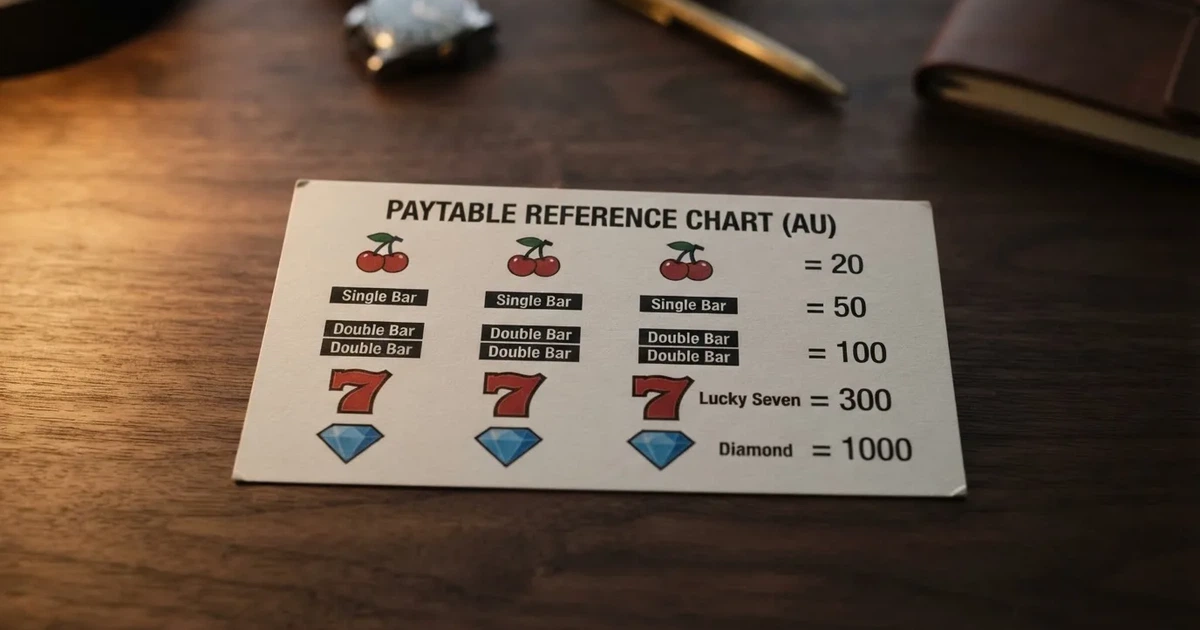
A paytable is the small text panel inside the slot that lists what each symbol pays, how the wild substitutes, what the scatter does, how the bonus round triggers and what the maximum payout is. Reading it takes about a minute; understanding what the figures imply takes the rest of the session.
The shape of a Booming Games paytable is conventional by iGaming standards. Each of the four high-pay symbols pays a multiple of the line stake for three, four and five of a kind. The low-pay symbols — typically playing-card ranks styled to fit the theme — pay smaller multiples. Wilds substitute and pay the highest line multiple. Scatters pay anywhere on the reels and trigger the free-spins round. The bonus round is usually a Hold and Win mechanic with fixed jackpot tiers; the maximum win the studio advertises sits in the paytable header.
Booming Games itself, according to its own site, advertises a maximum win of 5,000x stake on its slots Tasty Rush Sweet Spots and Regal Coins Hold and Win, and 6,000x stake on Henhouse Hustle: Hold and Win. Those are the ceilings the paytables sit under; they are also the numbers the marketing language tends to print and the deposit limits of the player tend to ignore. A 5,000x ceiling on a A$1 spin is a A$5,000 maximum payout; on a A$0.20 spin it is A$1,000. The shape of the win distribution — how often, how big — is set by the volatility rating, which Booming Games does not publish in a single comparable table across its catalogue.
The studio’s own profile is modest. Booming Games (Malta) Limited is headquartered in Malta and holds a Malta Gaming Authority B2B licence numbered MGA/B2B/459/2018, plus a UK Gambling Commission account (account #57254). The studio also holds licences from Sweden’s Spelinspektionen and Ontario’s AGCO (Canada), plus regulators in Romania, Denmark, Greece, Belgium, Germany and Brazil. Its site describes the company as founded “nearly a decade ago” by a group of friends aiming to become one of the finest slot providers in the iGaming industry, without stating an exact founding year, and reports a release cadence of four new games per month. The catalogue sits in the dozens of titles rather than the hundreds; the portfolio depth comes from the studios Booming Games shares shelf space with at offshore operators.
Betsoft, which slots in beside Booming on several offshore lobbies, was founded in 2006 and describes a catalogue of more than 200 RNG games spanning slots, table games, video poker and specialty titles. Its slot Good Girl Bad Girl 2 has a published RTP of 96.22%, “Very High” volatility and a 15.59% hit rate, played on 5 reels and 20 paylines. The Slotfather, live since 13 December 2012, has a published RTP of 95.69%, “Medium” volatility and an 8.17% hit rate, played on 5 reels and 30 paylines. Betsoft describes itself as operating in compliance with licensing authorities including the Italian Customs and Monopolies Agency, with RNG certification from Quinel and Gaming Labs International (GLI), and states it partners with more than 500 operators across regulated markets in Europe, Scandinavia, Latin America and Africa.
1spin4win is the third studio on several of these shelves. Founded in 2021 by a group of professionals with 15 years of iGaming experience, headquartered at Scharlooweg 39, Willemstad, Curaçao, holding a Curaçao gaming licence, with a portfolio of more than 190 online slots. The studio reports more than 1,000 partnerships with online casinos and aggregators, and states its total bet sum grew 46% in the first half of 2025 compared with the first half of 2024. Its games are built in HTML5 for low-bandwidth connections.
The Australian reference point on the studio side is Aristocrat Leisure Limited, an Australian gambling machine manufacturer with its administrative and research headquarters in the Sydney suburb of North Ryde, and marketing and development offices in South Africa, Russia and the United States. Aristocrat develops electronic gambling machines, casino management systems, online real-money gambling technology, iLottery products and social casino games; its online arms are Product Madness (social games) and Aristocrat Interactive. The company was founded in 1953 by Leonard Ainsworth and listed on the Australian Securities Exchange in 1996 under the ticker ALL. Aristocrat Leisure reported 2025 revenue of A$6.30 billion, normalised net profit after tax and amortisation of A$1.55 billion, and 7,400 employees, making it the largest gambling-machine manufacturer in Australia and the second-largest slot-machine manufacturer worldwide, behind International Game Technology. Aristocrat Interactive, the group’s regulated online real-money-gambling business, was formed in April 2024 by combining Aristocrat’s Anaxi unit with the newly acquired NeoGames group, which includes Aspire Global, BtoBet and Pariplay. The Aristocrat Interactive roster is built on acquired B2B technology rather than on the Booming-style supplier model, and its real-money brands operate in jurisdictions outside Australia.
The shared mechanic across all of these studios, and the thing that decides what a spin actually pays, is the combination of RTP and volatility. A 96% RTP and a “Medium” volatility means a long-term return of A$96 for every A$100 wagered, distributed in a pattern that holds most payouts close to the stake and lets occasional wins stretch further. A 96% RTP and “Very High” volatility is the same long-term return with a flatter, more dispersed pattern: less frequent wins, larger when they land. Both are honest paytables; both are products of a house edge that is real and never negotiable. Reading the paytable before the first spin is the most underpriced act in the entire marketing funnel.
Fair comparison — what a market assessment actually weighs
This shelf is the most important on the page, and the most honestly written is one that ranks nothing. The reasoning is the same reasoning that opened the responsible-gambling shelf: the Australian market does not license online casino games, the operators on this shelf are all the ACMA’s own list of formal-warning recipients, and the operator set the ACMA has named is not a shortlist of the best; it is a list of the ones the regulator has acted against. A ranking that puts them in order would treat the brand with the most recent warning as the freshest “best Booming casino”, and that is the opposite of useful.
What a fair comparison can weigh is the ACMA’s published record against each brand, and that is the table the page runs. The columns that matter are the brand, the date the ACMA issued the formal warning, the operator entity the warning named, the form the action took, and whether the brand has any verifiable relationship with Booming Games content at all. The last column is the one most affiliate pages skip, because writing it honestly means admitting that several of the names on the offshore list have no confirmed Booming Games presence and are included only because they sit on the same offshore aggregator.
| Brand | ACMA action and date | Operator named by the ACMA | Booming Games subject support |
|---|---|---|---|
| RocketPlay | Formal warning, March 2026 (Pulsup Ltd); earlier Dama N.V., May 2022 | Pulsup Ltd | — |
| Level Up Casino | Formal warning, May 2022 | Dama N.V. | listings-only (Wazdan) |
| Woo Casino | Formal warning, March 2025 | Dama N.V. | — |
| Spirit Casino | Formal warning, May 2025 | Dama N.V. | — |
| National Casino | Formal warning, July 2025 | Consolutetish S.R.L. | listings-only (Betsoft, en.wikipedia.org, Pragmatic Play) |
| Bizzo Casino | Formal warning, July 2025; earlier 2022 | Consolutetish S.R.L. | — |
| Ignition Casino | Formal warning, July 2025 | Bamboo Media | — |
| Instant Casino | Formal warning, February 2025 | EOD Code SRL | — |
| Jackbit | Formal warning, April 2026 | Ryker B.V. | — |
| Casino Intense | Formal warning, April 2025 | Sterplay Holding Ltd | listings-only (1spin4win, en.wikipedia.org, gamblingcommission.gov.uk) |
| Sky Crown | Formal warning, September 2022 | Hollycorn N.V. | — |
The shape of this table is the shape of the ACMA’s enforcement, not the shape of an affiliate comparison. Eleven brands, eleven formal warnings, and a column on Booming Games subject support that, read honestly, mostly reads “—” — because the research couldn’t confirm that the studio’s titles appear on most of these sites at all. Where a brand has some verifiable Booming Games presence, the source is named: Level Up on Wazdan’s aggregator, National Casino across the Betsoft and Pragmatic Play listings, Casino Intense via 1spin4win’s portfolio and a UK Gambling Commission record. For the rest, the page is not the place to print an “of course they have Booming Games” line that no aggregator listing supports.
What the table makes visible is the cadence. The earliest warning here is September 2022, and four years later the ACMA is still adding names: April 2026 on Jackbit, March 2026 on RocketPlay, April 2026 on a second Ryker B.V. brand. The blocking list published in June 2026 includes twelve more sites in a single round — 7Signs, ChromaBet, Donbet, Duospin, Freshbet, Slots Gem, Jacks Club, Lucky Start, Pointsbetz, Spinrise, Vinyl Casino and Wildsino. The cumulative total since the first blocking request in November 2019 is 1,751 illegal gambling and affiliate marketing websites, with more than 230 unlicensed gambling services having left the Australian market since enforcement was strengthened in 2017. This is not a slowing trend; it is a steady one.
That steady cadence is what a fair comparison actually weighs. The decision the page supports is not which of the eleven brands is best. It is whether the product category itself is one an Australian should be funding at all, given that every brand on the table is one the regulator has publicly named, and given that the regulator’s enforcement keeps adding new names each quarter.
Overview: what an Australian is searching inside
The shelf that frames the rest of the page is the one that describes the market itself, because every other shelf on the page is shaped by what the market is and is not. The market is an Australian one, in which online casino games and online pokies face outright prohibition under the Interactive Gambling Act 2001, strengthened by the Interactive Gambling Amendment Act 2017. The prohibition makes it an offence to provide those games to a person in Australia, and no state or territory issues a licence for them. The studios whose names appear in the search query — Booming Games, Betsoft, 1spin4win — supply offshore brands that operate outside that prohibition. The brands the ACMA names in formal warnings are the regulator’s published record of who has been caught doing that supply-and-operate chain into Australia.
What is licensed in Australia is wagering on races and sport placed before the event, lotteries and keno, in practice licensed by the Northern Territory through the NTRWC, which regulates 52 online bookmakers including Sportsbet, Bet365 and Ladbrokes. The bookmaker shelf and the casino shelf are different shelves, and no licensed bookmaker offers Booming Games slots, because the licence they hold does not cover online casino games.
The 2026 reform picture sits underneath the rest of this. The Interactive Gambling Amendment (Gambling Reform) Bill 2026 passed Parliament on 19 August 2026; its advertising and inducement measures commence 1 January 2027. That is a law with a start date, not yet in force on a 2026 page, and it sits alongside rather than displaces the underlying prohibition. A reader who has heard the bill mentioned in news coverage should know that the prohibition they are reading about is the one already in force, and that the reform bill layers new penalties on top of it rather than re-opening the underlying category.
The market environment described in this page reflects the reality that offshore brands operate outside the Australian regime, and enforcement actions from the ACMA are a standard feature of the landscape. The A$3.9 billion annual loss figure from industry research, and the shift in market share, underscore the scale of the offshore challenge. The ACMA blocking list is the regulator’s response to these trends.
Legality: the rule, the enforcement, and where the player sits
The Interactive Gambling Act 2001, as amended in 2017, makes the provision of online casino games, online pokies and in-play betting to a person in Australia an offence. The Australian Communications and Media Authority investigates, issues formal warnings and directs internet service providers to block illegal sites. The individual player is not prosecuted; the IGA targets the provider. That distinction is not a green light, because the offshore site gives no Australian consumer protection, no complaints body and no recourse if a withdrawal is refused, and it can be blocked with a balance still on it. A blocked site with a player’s funds on it is a real outcome of enforcement, not a theoretical one.
What the operator write-ups below establish is the regulator’s published record against each of eleven brands, and that record is the basis on which the legal shelf closes. The blocking figure — 1,751 sites since November 2019 — is the cadence. The formal-warning list, with the dates and operators named, is the by-brand record. The A$3.9 billion annual loss figure from industry data is the size of the market. The reform bill’s commencement on 1 January 2027 is the next stage.
Player protection, inside the legal frame, has two layers. The first is BetStop, the National Self-Exclusion Register, live since August 2023, which binds every Australian-licensed online and phone wagering service. The second is the National Gambling Helpline on 1800 858 858, free and 24/7, with chat at Gambling Help Online. Both layers work inside the licensed market; neither reaches the offshore shelf. A punter who finds themselves reading the operator write-ups below and feeling the offer pull should treat the responsible-gambling shelf at the top of the page as the next stop, not the operator reviews.
Payments close the legal frame. Since 11 June 2024, credit cards, credit-related products and digital currency have been banned as payment for licensed online wagering, with penalties up to A$247,500 for operators. Legal deposit routes for licensed wagering are debit card, bank transfer, PayID/Osko and BPAY. A site asking an Australian for a credit card or a crypto deposit is operating outside the Australian rules, and that question alone tells you the rest of the operator’s claims need cross-checking.
Tax, for completeness: gambling winnings of a recreational player are not assessable income under section 6-5 ITAA 1997, and losses are not deductible, unless the person carries on a business of gambling. The ATO is the body to check with for the boundary cases, and the page stops at the line.
Operators the ACMA has formally warned
The eleven brands below are the regulator’s published list, not a ranking. The order is the order research carried them; the dates are the dates the ACMA published the warnings. The page treats each brand as a record the regulator has produced, and the verdict at the end of each block is the verdict the regulator’s record supports.
RocketPlay
The ACMA issued a formal warning to Pulsup Ltd over Rocketplay in March 2026, with an earlier Dama N.V. warning covering the same brand in May 2022. The brand has carried Booming Games content through various aggregator configurations over its lifetime, but no listing currently confirms a direct Booming Games presence at the time of the latest ACMA action. The page records the brand as an ACMA-named operator with no verifiable Booming Games subject support.
The verdict: two formal warnings from the same regulator over the same brand, four years apart, is a regulatory record most affiliates do not print, and it is the relevant one for an Australian punter considering funding the site.
Level Up Casino
The ACMA issued a formal warning to Dama N.V. covering six casino brands in May 2022, of which Level Up Casino was one. The brand’s presence on Wazdan’s aggregator page is the only verifiable Booming Games subject support research carries, and that listing is what those aggregator pages report, not what the operator itself confirms.
The verdict: a 2022 warning with no later reversal published, and a Booming Games relationship that exists only via an aggregator listing, is a thinner record than the regulator’s later actions but the same direction of travel.
Woo Casino
The ACMA issued a further formal warning to Dama N.V. over Woo Casino in March 2025, following the May 2022 warning to Dama N.V. covering six casino brands. Woo Casino lacks verifiable Booming Games subject support in external reports; the brand sits on the ACMA’s published record.
The verdict: a 2025 escalation against an operator that was already on the regulator’s list, and no studio relationship the research can confirm, makes this a record to read rather than a brand to chase.
Spirit Casino
The ACMA issued a formal warning to Dama N.V. over Spirit Casino in May 2025, alongside the March 2025 warning to the same operator over Woo Casino. Spirit Casino has no confirmed Booming Games integration in independent audits.
The verdict: a brand that surfaced on the ACMA’s record in the same quarter as a sister brand under the same operator, with no studio relationship research can verify, fits the pattern of an offshore shelf the regulator is still working through.
National Casino
The ACMA issued a formal warning to Consolutetish S.R.L. over National Casino in July 2025. The brand carries some verifiable Booming Games subject support via Betsoft and Pragmatic Play listings on the studio side, and via en.wikipedia.org coverage on the operator side, but those are listings, not a direct confirmation that the Booming Games catalogue is on the operator’s lobby today.
The verdict: a 2025 warning, with the studio relationship reported only through listings rather than through the operator’s own published roster, is a record an Australian should weigh against the credit-card and crypto deposit questions the legal shelf raises.
Bizzo Casino
The ACMA issued a formal warning to Consolutetish S.R.L. over Bizzo Casino in July 2025, having already issued a 2022 warning to TechSolutions (CY) Group Limited and TechSolutions Group N.V. over the same brand. Bizzo Casino does not feature verifiable Booming Games subject support in third-party databases.
The verdict: two formal warnings to two different operators over the same brand, three years apart, is a regulatory record that reads more clearly than any single warning does.
Ignition Casino
The ACMA issued a formal warning to Bamboo Media over Ignition Casino in July 2025. Ignition Casino shows no verifiable Booming Games subject support in public listings.
The verdict: the brand surfaced on the ACMA’s record in the same July 2025 round as National Casino and Bizzo Casino, all under different operators, which is the regulator’s working pattern rather than a single-operator quirk.
Instant Casino
The ACMA issued a formal warning to EOD Code SRL over Instant Casino in February 2025. Instant Casino offers no verifiable Booming Games subject support in current reports.
The verdict: a February 2025 warning, with no verifiable studio relationship, makes this one of the brands on the regulator’s published list rather than on the affiliate “top 10”.
Jackbit
The ACMA issued a formal warning to Ryker B.V. over Jackbit in April 2026, in the same enforcement round as the formal warning over CasinOK. Jackbit has no documented Booming Games subject support in available records.
The verdict: a brand the ACMA named in 2026, with a sister brand named in the same round, is the regulator’s working pattern for that operator group.
Casino Intense
The ACMA issued a formal warning to Sterplay Holding Ltd over Casino Intense in April 2025. The brand carries some verifiable Booming Games subject support via 1spin4win’s portfolio and a UK Gambling Commission record, both reported by the listings research carries, not by the operator.
The verdict: a 2025 warning, with a studio relationship that exists through listings rather than direct confirmation, is a record that needs the operator’s own roster to make a stronger claim than the listings alone support.
Sky Crown
The ACMA issued a formal warning to Hollycorn N.V. over its Sky Crown and Blue Leo casino services in September 2022. Sky Crown provides no verifiable Booming Games subject support in independent checks.
The verdict: the earliest formal warning in the table, and the one most likely to be missing from current affiliate copy, is the regulator’s record that the marketing funnel has moved on from.
How to read the blocking-rate arithmetic
The data tracks the rate at which the ACMA has been blocking illegal sites since the first blocking request in November 2019. The arithmetic is straightforward and the result is a band, not a single figure, because enforcement rounds are unevenly spaced and the year-on-year rate has shifted as the regime matured.
Inputs: the cumulative total of 1,751 blocked illegal gambling and affiliate marketing websites as of the round reported in June 2026, with the first blocking request issued in November 2019. The window between those two points is roughly six and a half years. Dividing the total by the window gives a long-run average of around 270 blocks per year, or roughly 22 to 23 per month, with the explicit caveat that the cadence has not been linear — the early years of enforcement under the strengthened 2017 regime were quieter, and the bulk of the 1,751 total has accumulated as the ACMA’s tooling and the ISPs’ cooperation have matured.
The June 2026 round alone added twelve sites — 7Signs, ChromaBet, Donbet, Duospin, Freshbet, Slots Gem, Jacks Club, Lucky Start, Pointsbetz, Spinrise, Vinyl Casino and Wildsino — which is a single-quarter action at the upper end of the long-run average. Read against the long-run average of around 22 to 23 per month, a single round of twelve in three months is consistent with the trend, not an outlier.
The condition on the band is the same condition the legal frame already states: the ACMA’s blocking list is the regulator’s published record, and the rate at which it grows is the rate at which the regulator identifies and acts against new illegal sites. The rate is not a measure of how many illegal sites exist, only of how many the regulator has been able to identify, warn, and refer for blocking. The figure is honest as a cadence; it would not be honest as a count of the total market. An annual estimate of A$3.9 billion a year lost to illegal sites is the size of the market; the ACMA’s 1,751 is the regulator’s answer to it, growing at a long-run average of around 270 a year with the explicit caveat that the cadence has not been linear.
Frequently asked questions
Is Booming Games itself an operator, or just a game studio that supplies content to sites?
Booming Games is a game studio. The company is headquartered in Malta and holds a Malta Gaming Authority B2B licence numbered MGA/B2B/459/2018, plus a UK Gambling Commission account (account #57254) and licences from regulators in Sweden, Ontario, Romania, Denmark, Greece, Belgium, Germany and Brazil. It does not operate a casino; it supplies slot content to offshore operators.
Can Booming Games titles be played for real money at any licensed Australian casino?
No. Online casino games and online pokies cannot be licensed in Australia under the Interactive Gambling Act 2001, and no state or territory issues a licence for them. The licensed Australian wagering market covers races, sport, lotteries and keno, none of which carries Booming Games slots. Any real-money play of those titles from inside Australia is on an offshore site outside Australian law.
How does a Booming Games slot typically differ from other studios’ games in its paytable?
The structure is conventional: four high-pay symbols paying line-stake multiples for three, four and five of a kind, lower-paying styled playing-card ranks, a wild and a scatter, a Hold and Win bonus round with fixed jackpot tiers, and a maximum-win ceiling printed in the paytable header. Booming Games advertises 5,000x stake on Tasty Rush Sweet Spots and Regal Coins Hold and Win, and 6,000x on Henhouse Hustle: Hold and Win, as the studio’s published ceilings.
Does Booming Games operate its own casino, or license its games to other operators?
Booming Games licenses its games to other operators. Its catalogue appears on offshore casinos that aggregate content from multiple studios, and the studio’s own site describes a release cadence of four new games per month. The studio does not run a casino of its own.
Why do offshore casinos highlight Booming Games as a selling point to Australian visitors?
The short answer is search engine optimisation. Affiliate marketing pages cluster around the studio name because Australian players search for it, and offshore operators buy placement on those affiliate pages because the search volume is real. The longer answer is that no Australian-licensed brand can carry those titles, which concentrates the demand on the offshore shelf. The H2 Gambling Capital 2025 figure of A$3.9 billion a year lost to illegal gambling sites is the size of the funnel those affiliate pages live inside.
Is it legal for a site to offer Booming Games games for real money to people in Australia?
It is an offence under the Interactive Gambling Act 2001 to provide online casino games to a person in Australia. The individual player is not the target of enforcement; the IGA targets the provider. That distinction is not a green light, because the offshore site gives no Australian consumer protection, no complaints body and no recourse if a withdrawal is refused, and the ACMA can have the site blocked with a balance still on it.