
BGaming-powered online casinos in Australia: a 2026 picture of a market that does not legally exist
The phrase “BGaming casino” promises a clean idea: a slot studio whose games sit on a real-money lobby, available somewhere, to anyone with a wallet. In Australia, that idea runs straight into a wall. The Interactive Gambling Act 2001 prohibits online casino games and online pokies for anyone in Australia, no state or territory issues a licence for them, and BGaming-powered online casino play therefore only exists on offshore sites operating outside Australian law. This page sets out what BGaming actually is, why none of those offshore sites is a legal option here, what the Australian regulator has been doing about them, and what that picture means for someone who came looking.
Currency and licensing data are presented as of 8 November 2026, against the Australian Communications and Media Authority’s published register of formal warnings and blocking actions.
Table of Contents
- Help first: what to do if BGaming-style play stops feeling like a choice
- The money side: deposits, payouts and the payment-method ban
- Bonuses, free spins and what those offers actually cost
- The mobile lobby: app, browser and what “BGaming mobile” actually means
- A paytable, in plain English
- The offshore brands the ACMA has acted against
- What “BGaming casino in Australia” actually describes
- The legal frame in one paragraph
- How the ACMA enforces: the blocking rate
- Help and protection, restated
- Where this leaves the search
- Frequently asked questions about BGaming and online casinos in Australia
Help first: what to do if BGaming-style play stops feeling like a choice
If reading this page is part of a session that has started to feel compulsive, late-night or stressful, the practical step is a free, confidential call before any further research. Gambling Help Online runs a 24/7 chat, and the National Gambling Helpline on 1800 858 858 is free from anywhere in Australia. These are not BGaming-specific services; they exist precisely because the offshore product this page is about sits beyond Australian consumer protection.
BetStop, the National Self-Exclusion Register, is the other piece of the safety net. It binds every Australian-licensed online and phone wagering service — sports and racing bookmakers, the licensed lottery products, keno — so a single registration closes the legal side of an account. It does not reach an offshore casino, which is one of the reasons the regulator’s other lever exists: blocking sites at the internet-service-provider level rather than registering them with a self-exclusion database.
That asymmetry is the heart of the responsible-gaming story on this subject. Onshore, the harm-minimisation framework is built into the licence: BetStop, the credit-card ban, the prohibition on inducements, identity checks at the door. Offshore, none of that attaches. The protection a reader can actually use lives on this side of the border, which is why the help lines come first and the rest of the page follows.
The money side: deposits, payouts and the payment-method ban
The economics of a BGaming lobby on an offshore site look ordinary until the payment screen is reached. Deposit and withdrawal methods on those sites typically include Visa, Mastercard, a handful of e-wallets such as Skrill and Neteller, bank transfer, and some combination of Bitcoin, Ethereum, Litecoin and Tether. BGaming’s own marketing leans hard on the crypto angle — TRUEWAYS mechanics, a 250+ game catalogue, “3,000+ operators” — and that positioning is not incidental. It is one of the selling points that catches Australians searching for the brand, and it is the single feature most likely to clash with Australian rules.
Since 11 June 2024, credit cards, credit-related products and digital currency have been banned as a payment method for licensed online wagering in Australia, with penalties of up to A$247,500 for an operator that accepts them. The ban is targeted at licensed wagering, not at the offshore casino product, but the practical effect is that any Australian-facing deposit page asking for a credit card or a crypto wallet is, by definition, sitting outside the licensed framework. That makes the payment screen a useful tell: a site accepting AUD through PayID or Osko is on the licensed side; a site asking for a card or a coin address is on the other one.
Payout speed on the offshore side is whatever the operator publishes, and what it publishes is rarely audited. There is no Australian dispute body to take a complaint to if a withdrawal stalls or a verification check loops, and the site’s own terms govern. “Crypto casino” branding carries an unspoken promise of fast settlement that the underlying game catalogue does nothing to back up. The marketing wraps a payments risk in a studio brand and hopes the reader does not look closely at either.
The relevant comparison is therefore not which offshore cashier clears faster. It is whether the reader has any recourse at all if it does not. Onshore wagering routes through debit card, bank transfer, PayID, Osko or BPAY, with the operator licensed and the player protected; offshore offers a longer list of methods and a shorter list of rights.
Bonuses, free spins and what those offers actually cost
A “BGaming welcome bonus” or “BGaming free spins” pitch is structured the same way every other offshore welcome package is structured: a match percentage on the first deposit, a free-spin allocation on a named title, a wagering requirement somewhere in the small print, a max-cashout cap, and a list of games that count partially or not at all. None of the brands featured later on this page published verified terms in a form research could rely on — the only sources carrying wagering multiples and cap figures were affiliate marketing pages — and so the terms are described here as a category rather than as numbers attached to a brand.
The arithmetic of a bonus is the part the marketing works hardest to keep out of the headline. Required turnover is the bonus amount multiplied by the wagering factor, and on most offshore welcome packages that factor sits in the 35× to 50× range on the bonus alone, before deposit contribution is added. Free-spin winnings usually clear at the same multiplier on a different base. A spin on a BGaming title at A$0.10 with a 40× requirement on winnings can mean several thousand spins of clear-through before a withdrawal is allowed, and the expected loss on that turnover, at a published RTP in the mid-90s, is the real cost of the offer — not the headline match percentage.
There is also the “no deposit bonus” shape, where the site credits a small amount of bonus cash or a handful of free spins purely for signing up. The trade is sharper here: a no-deposit bonus usually caps cashout at a low fixed figure, often in the A$50 to A$100 band, and attaches the same wagering multiplier to a smaller base. The marketing calls it a free trial; the terms call it a coupon. The reading is closer to a coupon: a small, conditional credit with a ceiling on what comes out of it.
Max-bet rules during wagering, game-weighting tables that count table games at 10% or 5%, and time limits on the bonus — typically seven to thirty days — are the other lines that quietly shape the cost. None of those lines is the reason a reader clicked the headline, which is the whole point of where they sit.
A promo code attached to any of these offers, where the marketing prints one, sits on the same footing as the offer itself: a marketing artefact that has no place on a page describing what the offer is worth rather than how it is claimed.
The mobile lobby: app, browser and what “BGaming mobile” actually means
“BGaming mobile casino” implies a downloadable app, the way a sportsbook client does. In practice the BGaming catalogue is built in HTML5 and runs in a mobile browser the same way it runs on a desktop, with no install step and no separate code path. The studio’s design choices — touch-sized spin buttons, a portrait-friendly reel layout for most of its slots — make the browser experience the canonical one, and the operator’s own wrapper around it is what changes between sites.
What changes between operators, and matters more than the wrapper, is the licensing posture of the app store or APK that delivers the wrapper. A real-money gambling app is not on the Australian Google Play or Apple App Store for the prohibited product categories, and an offshore casino’s mobile product is therefore either a browser-only lobby, a side-loaded APK outside the official channel, or a thin web-app shortcut added to a home screen. None of those routes is the same as installing a regulated wagering app from a licensed Australian bookmaker, and the difference is the same one the rest of this page is about: who can be complained to if the app stops paying out.
BGaming’s mechanics — TRUEWAYS, MultiDice X, Merge UP — are designed mobile-first, so the experience on a phone is not a watered-down version of the desktop. The maths, the volatility and the RTP figures carry over. What does not carry over is the consumer protection that sits around the maths, and that is the relevant feature of “best mobile BGaming casino” once the studio’s catalogue is stripped out of the picture.
A paytable, in plain English
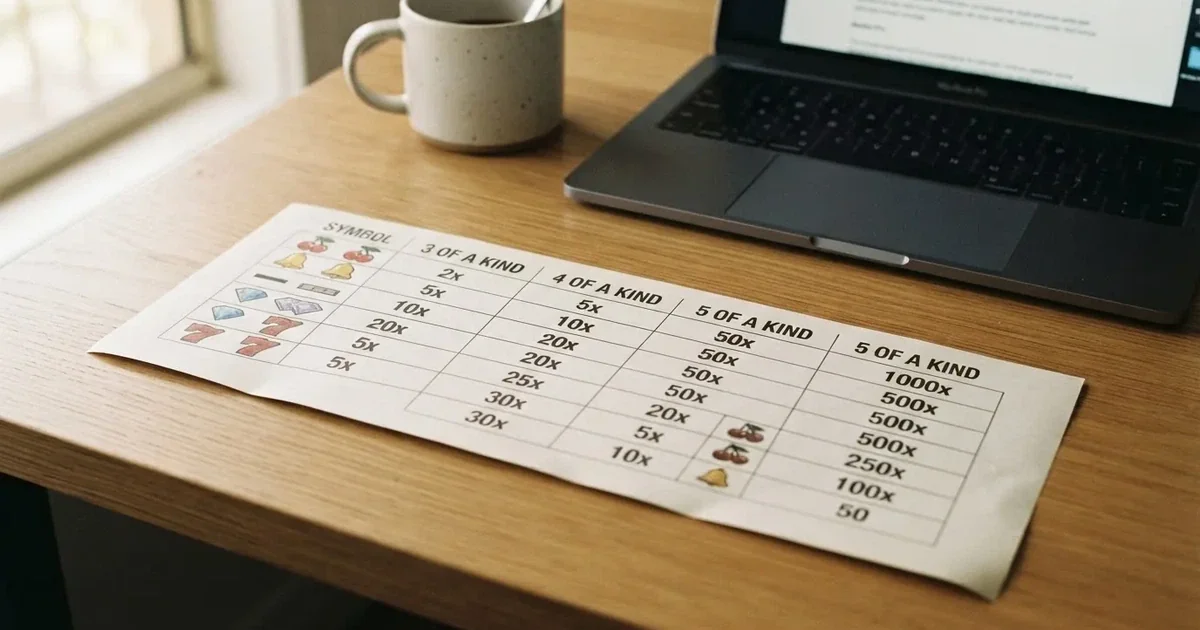
The single concept most worth taking from the BGaming brand, for a reader who has not yet spun a reel, is the paytable. Every slot has one, BGaming’s included, and a paytable does the same three jobs on every studio’s games: it lists the symbols in descending value order, it shows how many of each on a payline produce what payout, and it names any special symbols — wilds, scatters, bonus triggers — that break the standard line-by-line math.
A “5-of-a-kind” payout on a high-value symbol is the headline figure, and the rest of the table is the version. A wild substitutes for paying symbols but not for scatters, except where it does. A scatter pays anywhere on the reels and may also trigger free spins or a bonus round. A bonus symbol lands only on specific reels and only counts toward the feature. The exact rules are different on every title, which is the one reason the paytable exists rather than a generic summary.
“BGaming slots” carries a few sub-brands worth knowing. TRUEWAYS is the studio’s proprietary mechanic, offering up to 262,144 ways to win on the titles that use it — a number that sounds large and is, mechanically, a way of multiplying line combinations rather than a guarantee of payout. MultiDice X is a dice-game format. Merge UP is a casual/crash hybrid. These are labels, not bets: they describe the shape of the game, not the expected return.
The expected return itself is what the published RTP figure measures, and it is the same number on every paytable page that lists one. RTP is the share of wagered money the game is programmed to return over a very large number of spins; it is not a promise for any single session. The volatility label next to it — “Low”, “Medium”, “High”, “Very High” — describes how the return is distributed. A 96% RTP at “Very High” volatility is a different experience from a 96% RTP at “Low” volatility: the high-volatility version pays rarely and in larger chunks; the low-volatility version pays often and in smaller ones. Both return the same number in the long run.
BGaming’s portfolio, by the studio’s own count, runs to more than 250 certified games across video slots, video poker, lottery, card, scratch, crash and casual titles. The variety is real. The legal status of playing them for real money in Australia is unchanged.
The offshore brands the ACMA has acted against
Eleven brands sit in this comparison. None of them is a recommended place to play; each is included because the Australian Communications and Media Authority issued a formal warning over it for offering prohibited online casino services to Australians. The order follows the regulator’s own actions, and the table below sets them out alongside the warnings issued against each.
| Brand | ACMA action and date | Operator named by the ACMA | Subject support |
|---|---|---|---|
| RocketPlay | Formal warning, March 2026 | Pulsup Ltd | No data |
| Level Up Casino | Formal warning, May 2022 | Dama N.V. | Listed as a Wazdan partner on Wazdan’s site |
| Woo Casino | Formal warning, March 2025 | Dama N.V. | No data |
| Spirit Casino | Formal warning, May 2025 | Dama N.V. | No data |
| National Casino | Formal warning, July 2025 | Consolutetish S.R.L. | Listed on Betsoft, Wikipedia, and Pragmatic Play |
| Bizzo Casino | Formal warning, July 2025 (after a 2022 warning to TechSolutions) | Consolutetish S.R.L. | No data |
| Ignition Casino | Formal warning, July 2025 | Bamboo Media | No data |
| Instant Casino | Formal warning, February 2025 | EOD Code SRL | No data |
| Jackbit | Formal warning, April 2026 | Ryker B.V. | No data |
| Casino Intense | Formal warning, April 2025 | Sterplay Holding Ltd | Listed on 1spin4win, en.wikipedia.org, and gamblingcommission.gov.uk |
| Sky Crown | Formal warning, date as published | Hollycorn N.V. | No data |
The “Subject support” column shows how each brand is associated with other studios. Wazdan’s own site lists Level Up Casino as one of its partners; Betsoft and Pragmatic Play list National Casino in their operator galleries; 1spin4win names Casino Intense. The other brands carry no data the page can confirm against the BGaming thread, and a blank cell there means exactly that — no confirmed listing rather than a denial. None of those listings changes the regulatory status: each brand remains an offshore operator against which the ACMA has acted for offering prohibited services to Australians.
RocketPlay: the most recent warning
Pulsup Ltd, which the ACMA names as the operator behind RocketPlay, received a formal warning in March 2026 — the freshest action on this list and the reason the brand sits at the top. The site is the same Dama N.V. property that the regulator warned in May 2022 under its earlier ownership, which means RocketPlay has been on the ACMA’s record twice in four years. A reader weighing this brand has to balance the recency of the action against the fact that an earlier warning did not produce a withdrawal.
Level Up Casino: Dama N.V.’s 2022 cohort
Dama N.V.’s May 2022 warning covered six brands at once — Bambet, Dazard, Level Up, Rocketplay, Wild Tornado and Cobra Casinos — and Level Up is one of the survivors of that round still actively marketed. The Wazdan listing ties the brand to a specific studio, which gives the page a thin thread back to the studio even though BGaming itself does not list Level Up among its named partners. The brand is otherwise a typical Dama N.V. build.
Woo Casino: a 2025 escalation
Woo Casino’s March 2025 warning came out of the same Dama N.V. group that absorbed the 2022 cohort, three years after that earlier round. A repeat warning inside that window is a signal the regulator treats the property as ongoingly non-compliant rather than as a one-off. BGaming support data for the brand is absent on the studio’s own channels.
Spirit Casino: the May 2025 escalation
Spirit Casino’s warning came two months after Woo Casino’s, also from Dama N.V., and the spacing matters. Two formal warnings inside the same quarter to the same corporate group is the regulator using the same lever twice because the first did not produce a withdrawal. The page carries no BGaming thread for this brand.
National Casino: a 2025 warning with three named studio listings
Consolutetish S.R.L.’s July 2025 warning put National Casino on the same line as Bizzo Casino. National is the only brand in this comparison with three independent studio listings — Betsoft, Wikipedia and Pragmatic Play — which is the strongest public footprint of any brand here and the reason it is worth naming. The footprint does not change the ACMA’s action; it just makes the brand more searchable than its neighbours.
Bizzo Casino: warned twice across two regimes
Bizzo is the only brand on the list with two formal warnings under two different operators: Consolutetish S.R.L. in 2025 and TechSolutions (CY) Group Limited and TechSolutions Group N.V. in 2022. A brand warned once can plausibly be the subject of a paperwork error; a brand warned twice across three years and two corporate vehicles is a brand the regulator has had to act against in earnest. BGaming listings for the brand are absent.
Ignition Casino: the July 2025 warning
Bamboo Media received the July 2025 warning over Ignition Casino. The brand shares the action date with National Casino and Bizzo Casino, but the operator name is different, which is why the ACMA’s three July 2025 actions read as a coordinated round rather than a single chase. The page carries no BGaming thread for Ignition.
Instant Casino: the early-2025 warning
EOD Code SRL’s February 2025 warning over Instant Casino is the earliest action on this list and the one that established the pattern of monthly formal warnings that ran through 2025 and into 2026. The brand has no BGaming listing the page can rely on.
Jackbit: the April 2026 warning
Ryker B.V.’s April 2026 warning covered Jackbit and CasinOK in the same action. Jackbit is a crypto-native brand, which puts it closer to the BGaming marketing pitch than most of the rest of the list, but the page carries no confirmed studio listing for the brand, and the ACMA action is what it is regardless of the marketing angle.
Casino Intense: the only brand with a UK Gambling Commission connection
Sterplay Holding Ltd’s April 2025 warning over Casino Intense sits alongside the brand’s appearance in three different studio ecosystems — 1spin4win, en.wikipedia.org and gamblingcommission.gov.uk — which is the broadest public footprint on this list outside National Casino. The UK Gambling Commission listing is the closest thing on this comparison to a regulated anchor, but a UK licence is not an Australian licence, and the ACMA action applies in full.
Sky Crown: Hollycorn N.V.’s brand
Hollycorn N.V. received a formal warning from the ACMA over Sky Crown and Blue Leo together, in a published record that runs back to 2022. Hollycorn is one of the more prolific operators on the ACMA’s list — the same corporate vehicle has attracted multiple warnings for different brands over several years — which is the relevant context for any reader weighing the parentage. BGaming listings for the brand are absent.
What “BGaming casino in Australia” actually describes
In summary, the picture is this. BGaming is a Malta-licensed B2B game studio with a 250+ game catalogue and a stated footprint of 3,000+ operators worldwide. Its own corporate filings tie it to Stable Games Ltd of Valletta, Malta, holding a Malta Gaming Authority Critical Gaming Supply Licence (MGA/B2B/785/2020) for Type 1 B2B services. None of that licensing attaches the studio to an Australian-licensed casino, because no Australian-licensed casino exists for the product categories BGaming makes.
The brands in this comparison are the ones the ACMA has named as offering prohibited services to Australians. Some of them list BGaming-adjacent studios — Betsoft, Wazdan, Pragmatic Play, 1spin4win — on their own partner pages, which is the closest public connection to a brand. None of those listings converts the brand into a legal Australian option, and the warning stays in force regardless of which studio’s games sit in the lobby.
The same point holds for any other offshore brand the search might surface. If it is not licensed by an Australian state or territory authority for the product on offer, the IGA treats it as prohibited, and the ACMA’s enforcement tools — formal warnings, ISP blocking directions, civil penalty proceedings — apply to the operator rather than to the player.
The legal frame in one paragraph
The Interactive Gambling Act 2001, strengthened by the Interactive Gambling Amendment Act 2017, makes it an offence to provide online casino games, online pokies or in-play betting to a person physically in Australia. The licensable product in this space is wagering on races and sport placed before the event, lotteries and keno — in practice licensed by the Northern Territory Racing and Wagering Commission, which regulates 52 of Australia’s online bookmakers despite meeting only once a month in Darwin and carrying no full-time staff. The minimum age is 18.
The Interactive Gambling Amendment (Gambling Reform) Bill 2026 passed Parliament on 19 August 2026, with its advertising and inducement measures scheduled to commence on 1 January 2027. On a 2026 page, that is a law with a future start date — relevant context, not yet binding conduct.
How the ACMA enforces: the blocking rate
The ACMA’s enforcement is the only ongoing measure that actually touches the offshore product. Since the first blocking request in November 2019, the regulator has directed Australian internet service providers to block illegal gambling and affiliate marketing websites, with a running total that reached 1,751 by June 2026 — including the 12 sites ordered blocked in a single June 2026 round (7Signs, ChromaBet, Donbet, Duospin, Freshbet, Slots Gem, Jacks Club, Lucky Start, Pointsbetz, Spinrise, Vinyl Casino and Wildsino). More than 230 unlicensed gambling services have left the Australian market entirely since enforcement was strengthened in 2017.
The arithmetic that matters here is the rate at which the block list has grown since the first request in November 2019. Across roughly 80 months, 1,751 sites have been blocked — a working figure of about 22 sites per month on average, though the spread is uneven: the regulator publishes a round every few weeks rather than a steady drip, and some months carry no round at all. Reading the rate as anything more than a band is a mistake. The point is not that exactly 22 sites per month are blocked; it is that the ACMA is adding to the list continuously, that any brand warned under the IGA is a candidate for a future round, and that a balance on an offshore site at the moment of a block order is exactly the loss the regulator’s other tools cannot return.
H2 Gambling Capital’s 2025 estimate puts Australian losses to illegal gambling sites at about A$3.9 billion a year, with the share of gambling going through legal channels falling from 74% in 2021 to 64%. The trend, on the data the regulator cites, runs against the licensed side.
Help and protection, restated
The protection that attaches to a licensed Australian wagering account is real but narrow. The credit-card and digital-currency ban keeps the licensed cashier on the AUD side. BetStop self-exclusion closes the licensed side of a player’s accounts in a single registration. The National Gambling Helpline on 1800 858 858 is free and runs around the clock, with chat at Gambling Help Online. None of that reaches an offshore casino. The reader who finds this page because they have already opened an offshore account has, in practice, exactly the same protections the law gives them anywhere else — which is to say, the operator’s own terms page, and the regulator’s enforcement list if the operator ends up on it.
Where this leaves the search
A reader who typed “best BGaming online casino Australia 2026” was looking for a ranking that, under Australian law, cannot exist. The pages that publish one anyway are selling access to a product the IGA prohibits and the ACMA actively blocks, and the comparison they offer is the offshore operator’s own comparison of itself. The BGaming catalogue is a real thing; the legal Australian product to play it on is not.
This page sets out the ACMA’s own record of which offshore brands it has warned, the dates those warnings were issued, the operators behind them, and the one piece of arithmetic the regulator’s data carries — the blocking rate since November 2019. The rest is the legal frame the IGA already sets out, and the responsible-gaming services that already exist for someone who needs them.
Frequently asked questions about BGaming and online casinos in Australia
Is BGaming itself a casino, or does it just make games for other operators?
BGaming is a game studio, not an operator. Its corporate vehicle is Stable Games Ltd of Valletta, Malta, which holds a Malta Gaming Authority Critical Gaming Supply Licence (MGA/B2B/785/2020) for Type 1 B2B gaming services, issued 18 March 2021. The 3,000+ operator footprint the studio publishes is a count of third-party sites that license its games; BGaming itself does not run a real-money casino.
Can BGaming titles be played for real money at any licensed Australian casino?
No. Online casino games and online pokies are prohibited under the Interactive Gambling Act 2001, and no Australian state or territory issues a licence for them. A site carrying BGaming titles and accepting Australian players is operating outside Australian law, which is why the ACMA’s enforcement record is the most relevant document about the offshore brands involved.
What does a BGaming paytable actually tell a player?
A paytable lists the symbol values from highest to lowest, the payouts for combinations on a payline, and any special-symbol rules for wilds, scatters and bonus triggers. It is the same document on every studio’s games, and reading it is the only way to know what a specific title actually pays before a session starts. The published RTP figure beside it is the long-run return share, not a guarantee for any single session.
Does BGaming run its own casino, or only license games to others?
BGaming only licenses games to other operators. The Malta B2B licence covers the supply of games, not the operation of a casino, and the studio’s own pages describe an aggregator and studio business model rather than a player-facing brand. Any site calling itself a “BGaming casino” is an operator running BGaming’s games under its own licence and its own terms.
Why do offshore casinos keep using BGaming as a selling point to Australian visitors?
Two reasons. BGaming’s catalogue genuinely is broad — more than 250 certified games, including the TRUEWAYS mechanic and a deep crypto-friendly lineup — and the studio’s brand carries a polish an offshore operator can use to differentiate. The same selling point is also a useful tell: a brand leaning hard on a studio’s reputation is selling the catalogue rather than its own regulatory standing, which on the Australian side is the part that matters.
Is it legal for a site to offer BGaming games for real money to people in Australia?
No. The Interactive Gambling Act 2001 makes it an offence to provide online casino games and online pokies to a person in Australia, and the ACMA has issued formal warnings over offshore brands offering exactly that. The player is not the target of the law; the operator is. The practical consequence is that an offshore site gives no Australian consumer protection and can be blocked at the ISP level with any account balance still on it.