
Plinko casino Australia in 2026: the game, the law, and the offshore sites that carry it
Current data: 8 November 2026 — verified against the Australian Communications and Media Authority register and the federal Interactive Gambling Act 2001 as published.
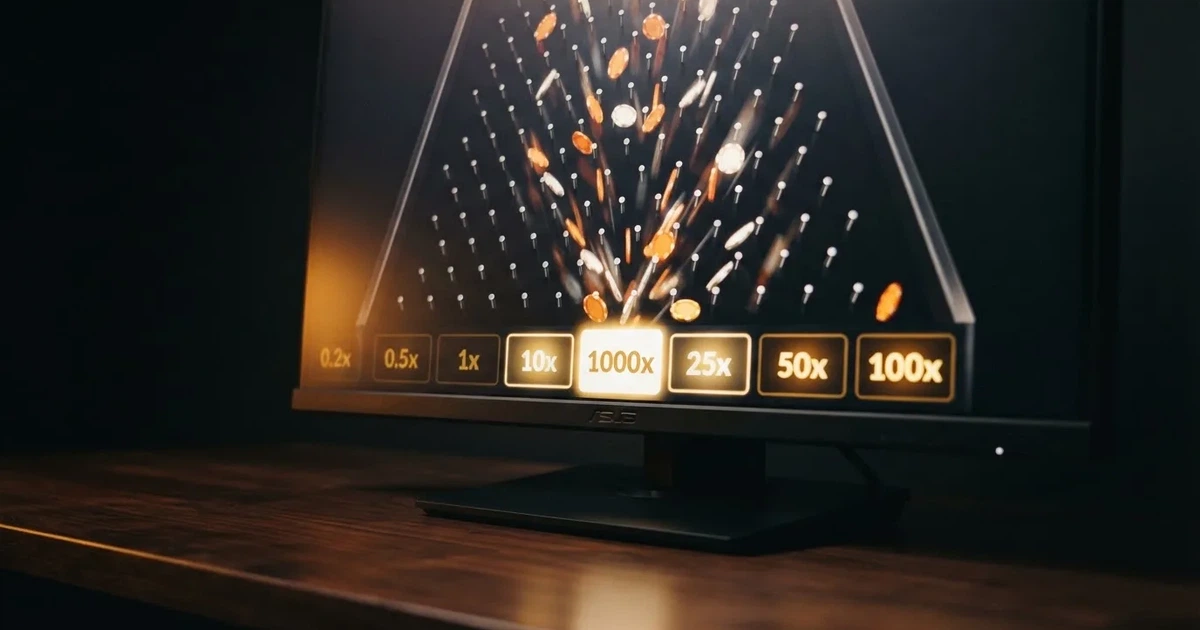
A ball drops through a field of pegs, deflects left and right on contact, and lands in a slot at the bottom. The slot carries a multiplier. That is the entire mechanism of every Plinko-style casino game on the market today, and it is also the only honest place to begin a page about Plinko at Australian-facing casinos, because the rest of what gets written about it is closer to marketing than to gambling. Australians search for Plinko casino Australia 2026 because the game looks uncomplicated, because offshore sites advertise a 99% return-to-player figure alongside it, and because the ball-drop is easy to imagine winning on. The page that follows sets out what the game is, what the paytable actually contains, who is offering it to Australians right now, and where the federal prohibition sits across all of it. The short version: the offer is real, the licence that would authorise it in Australia is not, and the regulator has been naming — and blocking — sites one after another for years.
Table of Contents
- Plinko at offshore crypto casinos: what paying with bitcoin and tether changes
- Payment methods at Australian-facing Plinko sites: the banking on top of the ban
- The Plinko paytable: what the marketing picture does and does not show
- Eleven sites the ACMA has named: what the comparison actually shows
- What the page is actually about: Plinko as a product Australians cannot license
- Legality and regulation: what the Interactive Gambling Act actually says
- Responsible play: what the page is for and where help is
- Operators the ACMA has acted against: the comparison in full
- The blocking rate: how fast the ACMA is removing sites from reach
- Frequently asked questions
Plinko at offshore crypto casinos: what paying with bitcoin and tether changes
The first shelf a reader hits is the one that promises the most and changes the least. Offshore Plinko sites accept crypto for the same reason they accept every other payment method: it settles fast, it crosses borders without a correspondent bank, and it leaves no Australian intermediary to file a report. From the player’s side it feels like a workaround. From the regulator’s side it changes nothing.

A bitcoin or tether deposit at an Australian-facing offshore casino does not give the player an Australian licence. It does not register them with BetStop, the National Self-Exclusion Register that has been live since August 2023. It does not put the operator under Australian consumer law, and it does not give the player a complaint body to ring if a withdrawal is refused. The same Interactive Gambling Act 2001 that makes it an offence to provide online casino games to a person physically in Australia applies whether the deposit is in dollars, in bitcoin, in USDT, or in any token the operator accepts tomorrow. Penalties on conviction reach A$220,000 a day for individuals and A$1.1 million a day for corporations. The crypto route takes the rails around the Australian banking system; it does not take the prohibition out of the IGA.
What crypto does change is practical and narrower. Crypto deposits at offshore sites tend to clear in minutes rather than days. Withdrawals in the same coin can land inside an hour when the operator processes them promptly, which is faster than any bank transfer the licensed Australian wagering market can offer. The trade is that this speed sits on top of a balance the ACMA can direct internet service providers to block at any time, and a balance the operator’s own terms can withhold, suspend, or seize if it judges the play irregular. Crypto does not solve either of those problems — it merely shifts the time in which they can hit.
There is a second, smaller change worth naming. Since 11 June 2024 credit cards, credit-related products and digital currency have been banned as payment for any Australian-licensed online wagering service, with penalties up to A$247,500 for an operator that takes them. The ban applies to the licensed side. An offshore site that advertises Plinko and accepts USDT is not licensed wagering and the credit-crypto ban does not technically bind it. The asymmetry cuts both ways: an Australian who deposits by credit card at a licensed sportsbook is breaking one set of rules; the same Australian who deposits USDT at an offshore Plinko site is dealing with a venue that operates entirely outside Australian rules, with nothing on the Australian side to fall back on when something goes wrong.
The crypto angle on a Plinko casino Australia 2026 page is, then, a narrower version of the offshore angle rather than a separate one. It is faster rails onto the same unlicensed product. Anyone drawn to it for the speed should weigh that speed against the absence of any Australian recourse if the operator disappears, refuses a withdrawal, or gets blocked mid-session with a balance still on the book.
Payment methods at Australian-facing Plinko sites: the banking on top of the ban
The second shelf is more mechanical and shorter. Offshore Plinko sites that take Australian customers tend to list a familiar set of deposit methods: VISA and Mastercard where the merchant code has not yet been blocked, e-wallets such as Skrill, Neteller and MiFinity, prepaid vouchers, bank transfer, and crypto. The list is worth recording because it is what the reader actually sees on the cashier page, not because any of it changes the legal position. Each method carries the same offshore caveats as the others.
E-wallets sit in a middle band. They are faster than a bank transfer and slower than crypto on the deposit side, and they are also the method most likely to be restricted when an operator’s terms change. Skrill and Neteller in particular have a history of being excluded from bonus eligibility at many offshore casinos, which means a player depositing with either wallet often finds the headline bonus does not apply. Mifinity has not been excluded as systematically but has its own bonus restrictions on individual sites. None of this is unique to Plinko; it is the standard offshore cashier layout across every game category the operator carries.
Prepaid vouchers — Paysafecard being the most common — are the deposit route that hides the player’s bank from the operator and from the player’s own bank statement. They are also the deposit route most often capped at a low ceiling, with single-voucher limits of A$100 or less and per-transaction maximums that frustrate anyone trying to play at scale. The trade is the inverse of crypto: it is slow, low-ceiling, and quiet.
Bank transfer is the slowest method on the shelf and the only one that produces an audit trail on the Australian side, which is why some readers default to it despite the wait. A withdrawal by bank transfer from an offshore Plinko site can take three to seven business days once the operator releases it, and the operator usually holds the withdrawal for its own internal review before the transfer is even initiated. The published payout time and the actual arrival at the Australian bank account are not the same number.
The deposit methods at the licensed Australian side — debit card, bank transfer, PayID, Osko, BPAY — do not appear on offshore Plinko sites, because they would amount to the operator taking payment rails that report back to an Australian institution. A site asking for debit card or PayID at an Australian address is, by definition, not the offshore Plinko site this shelf describes.
Net of all of this, the methods matter less than the reader assumes and more than the operator lets on. They settle the same product under the same offshore licence. The decision is rarely about which method wins on speed; it is about which method leaves the player with the most recourse when something goes wrong, and on that count none of them leave any.
The Plinko paytable: what the marketing picture does and does not show
The third shelf is the one the marketing sits on. The standard Plinko paytable gets advertised with three numbers and a pyramid diagram: a return-to-player figure, a top multiplier, and a number of rows or lines. The numbers get quoted as fact. The actual game underneath is more variable than the picture suggests.
BGaming’s Plinko is the version most Australian-facing offshore sites advertise, and it is the version whose paytable is closest to public. BGaming states a 99% RTP and a ×1,000 top multiplier on its own product page. Balls drop through a pyramid of pegs into slots at the bottom; each slot carries a multiplier; the player’s job is to choose how risky the slot distribution is and how many rows the ball will travel through. The risk level is set by the player before each round — low, normal or high — which changes the spread of the multipliers at the bottom. The number of lines is set too, and ranges from 8 to 16. The more lines, the more even the slot distribution at the bottom and the closer every ball’s expected return sits to the headline RTP. The fewer lines, the wider the spread and the more the top multiplier dominates the picture.
What the paytable picture does not show is the standard distribution of outcomes around that RTP. A 99% Plinko game played at high risk over 16 lines still loses 1% of turnover on average, which compounds quickly because the round cadence is fast. Manual play runs at the speed of the player’s finger. Auto-bet runs at the speed the operator allows, often as fast as one ball per second on simple risk settings. The advertised RTP is honest in the statistical sense — over a long enough run, the average will sit near 99% — but the run has to be very long to reach that average, and the variance along the way is wide enough that a short session looks nothing like the long-run figure.
The paytable also does not show the optional bet-size dimension, which is where the actual money gets spent. A round can be played at A$0.10 or at A$100 or anywhere between, depending on the operator’s table limits. The RTP holds across that range. What does not hold is the player’s bankroll, which scales in the opposite direction to the bet. A 1% house edge at A$0.10 a ball is almost invisible. A 1% house edge at A$100 a ball is A$1 a round, A$60 a minute at one ball per second, A$3,600 an hour. The same game, the same RTP, a different speed at which the bankroll drains.
Outside the BGaming version there are a handful of other Plinko variants — Spribe’s, Smartsoft’s, and a few in-house products — and each carries its own paytable structure. Spribe’s version runs at a faster round cadence and a lower advertised top multiplier. Smartsoft’s adds a bonus round. None of them have the same public RTP figure that BGaming publishes, which is one reason the BGaming version gets quoted so widely across affiliate pages. The reader who sees a 99% RTP attached to a Plinko casino page should check whether the figure comes from BGaming’s product page or from the operator’s marketing — the second one is harder to verify.
The paytable, in other words, is a real document attached to a real game. It is also the part of the marketing that is least likely to mislead. The misleading parts sit around it: the round cadence, the bet size, the time it takes to reach the average, the absence of any Australian licence making the headline figure enforceable.
Eleven sites the ACMA has named: what the comparison actually shows
The fourth shelf is the one that turns the page from a description of a game into a description of a market. Eleven operators are listed below in the order the regulator itself has named them in formal warnings, not in any order the page has chosen. Each one has been the subject of an ACMA formal warning under the Interactive Gambling Act 2001 for offering prohibited interactive gambling services to customers in Australia. The comparison table is not a ranking and not a recommendation; it is a record of who has been warned, when, and under which operating company, with one column for whether the site actually carries the Plinko game itself.
| Brand | ACMA action and date | Operator named by the ACMA | Plinko carried |
|---|---|---|---|
| RocketPlay | Formal warning, March 2026 | Pulsup Ltd (Rocketplay.com.au) | — |
| Level Up Casino | Formal warning, May 2022 | Dama N.V. | listings report the title |
| Woo Casino | Formal warning, March 2025 | Dama N.V. | — |
| Spirit Casino | Formal warning, May 2025 | Dama N.V. | — |
| National Casino | Formal warning, July 2025 | Consolutetish S.R.L. | listings report the title |
| Bizzo Casino | Formal warning, July 2025; earlier 2022 | Consolutetish S.R.L.; earlier TechSolutions | — |
| Ignition Casino | Formal warning, July 2025 | Bamboo Media | — |
| Instant Casino | Formal warning, February 2025 | EOD Code SRL | — |
| Jackbit | Formal warning, April 2026 | Ryker B.V. | — |
| Casino Intense | Formal warning, April 2025 | Sterplay Holding Ltd | listings report the title |
| Sky Crown | Formal warning, September 2022 | Hollycorn N.V. | — |
The columns the table carries are the columns research backs. Three of the eleven brands — Level Up, National Casino and Casino Intense — appear in third-party listings as carrying a Plinko title; the other eight carry no public confirmation of the title in the consulted set, which is not the same as saying the brand does not stock the game, only that the listings the consulted sources drew on do not place it there. The dating column shows two patterns worth naming. The first is that the warnings do not cluster around one operator; they cluster around several, with Dama N.V. alone accounting for four of the eleven brands (Level Up, Woo, Spirit, and the original 2022 RocketPlay) under different trading names. The second is that the ACMA continues to issue warnings at a steady pace into 2026, with two new entries — RocketPlay in March 2026 and Jackbit in April 2026 — and one more round of site-blocking referrals in the same window. The regulator’s pace has not slowed.
A reader looking at this table for a recommendation will not find one. The shelf is shaped to make the comparison, not to act on it. Every brand in it is prohibited from offering what it offers to Australians, by the same federal statute, and the ACMA’s own publication record is the only fact pattern on the page that touches all eleven at once.
What the page is actually about: Plinko as a product Australians cannot license
The fifth shelf steps back from the shelves that came before. Plinko is a real game with a real paytable, a fixed house edge, and a documented round mechanic. It is also a product that no Australian state or territory licenses an operator to provide. The federal Interactive Gambling Act 2001 makes the provision of online casino-style games — including multiplier games built around a ball-drop — an offence, with the penalties named in section 7 of the same Act. The 2017 amendments strengthened the prohibition and gave the ACMA the powers it has been using since, which include the formal warning and the blocking request to Australian internet service providers. There is no Australian-licensed casino at which an Australian can play Plinko for real money, because there is no category of licence under which that offer would be lawful.
The game’s appearance on Australian-facing offshore sites is a consequence of those sites operating from outside Australia and accepting Australian customers through the open internet. The IGA targets the provider, not the player, which is why an Australian who opens an account at one of the eleven brands in the previous section is not personally at risk of prosecution. The trade is that the player has no Australian consumer protection either: no Australian complaints body has jurisdiction over an offshore operator, no Australian court has straightforward authority to enforce a withdrawal dispute, and the operator’s own terms govern every interaction. The same offshore licence that lets the operator ignore the IGA also lets it ignore the player’s complaint.
The offshore market is also where the marketing for Plinko lives, because that is where the offer sits. The 99% RTP figure, the ×1,000 top multiplier, the fast crypto withdrawal — none of these are claims that come from an Australian-licensed source. They are claims that come from BGaming’s product page, from affiliate marketing that quotes BGaming’s product page, and from the operator’s own promotional material. A reader who treats them as facts is treating marketing as a product specification, which is the failure mode the rest of the page is built to avoid.
The legitimate alternatives for Australians who want to gamble online are narrower and clearly bounded. Wagering on racing and on sport before the event is licensed, in practice by the Northern Territory Racing and Wagering Commission. Lotteries and keno are licensed at state level. Online casino games, online pokies, and Plinko-style multiplier games are not licensed anywhere in Australia, and the offer to play them at an offshore site sits outside the regime that would make it legal. The page cannot recommend a workaround, because there is no workaround that the statute recognises as one. The page can lay out the prohibition clearly and trust the reader to make the call from there.
Legality and regulation: what the Interactive Gambling Act actually says
The sixth shelf is the legal frame. The Interactive Gambling Act 2001 is a federal statute; it was amended in 2017 to give the ACMA its current enforcement powers and then again in 2026 by the Interactive Gambling Amendment (Gambling Reform) Bill, which passed Parliament on 19 August 2026. The 2026 amendments cover advertising and inducement measures that commence on 1 January 2027 — law with a start date, not yet in force on a page read in 2026, which matters because any 2026 marketing claim has to be assessed against the 2001 Act and its 2017 amendments rather than against provisions that do not yet operate.
The 2001 Act makes it an offence to provide prohibited interactive gambling services to customers physically in Australia. A prohibited interactive gambling service includes any online casino-style game, which the Act describes by reference to games of chance or mixed chance-and-skill games offered over the internet for money. Plinko — a ball-drop multiplier game played for money on an offshore website — falls within that description. The penalties are A$220,000 per day for an individual provider and A$1.1 million per day for a corporation, on conviction. The penalties are not theoretical: they are the maximum the court can impose, and the existence of a maximum at that level is the reason the ACMA’s enforcement strategy leans on tools short of prosecution — formal warnings, blocking referrals, and the reputational cost of being named in a regulator’s publication.
The ACMA is the federal regulator with responsibility for the Act’s enforcement. Its role is operational rather than legislative: it investigates complaints, issues formal warnings to operators it judges to be in breach, refers sites to Australian internet service providers for blocking, and publishes the warnings on its own register. The blocking power is the most visible of the ACMA’s tools. The cumulative count of blocked sites since the first blocking request in November 2019 reached 1,751 by June 2026, and a single round reported on 26 June 2026 added twelve more — 7Signs, ChromaBet, Donbet, Duospin, Freshbet, Slots Gem, Jacks Club, Lucky Start, Pointsbetz.com, Spinrise, Vinyl Casino and Wildsino. The pace has not slowed since 2019.
A second regulator — the Northern Territory Racing and Wagering Commission — sits at the other end of the Australian gambling market. The NTRWC regulates 52 of Australia’s online bookmakers, including Sportsbet, Bet365 and Ladbrokes, all licensed in the Territory for historical tax reasons. The commission has no full-time staff and meets once a month in Darwin. Its jurisdiction is wagering on racing and sport, not online casino. The contrast with the ACMA is sharp: one regulator with a small staff running a mature licensed market, and another regulator with growing enforcement powers running an enforcement-only operation against an unlicensed one.
At state level, the picture is more uniform. New South Wales, Victoria, Western Australia, South Australia, Queensland, Tasmania and the ACT all have their own casino and wagering regulators, none of which licenses online casino games. Victoria’s regulator, the Victorian Gambling and Casino Control Commission, replaced the VCGLR on 1 July 2022 and approves table-game rules at Crown Melbourne. New South Wales’ Casino Control Act 1992 prohibits a casino from offering any game without regulator approval, with the approved rules made available to patrons on request. None of these state regimes extends a licence to an online casino game. The legal position is federal-prohibition-with-state-supervision, and the prohibition is the same in every state.
The enforcement side is reinforced by the payment side. Since 11 June 2024 credit cards, credit-related products and digital currency have been banned as payment for any Australian-licensed online wagering service, with penalties up to A$247,500 for an operator that takes them. The ban does not bind an offshore operator — an offshore site is not a licensed wagering service — but it binds the licensed side, and it is the reason an Australian who tries to deposit by credit card at a licensed sportsbook is declined. The same Australian who deposits USDT at an offshore Plinko site is dealing with a venue that operates outside the ban entirely, which is neither a workaround nor a protection.
The minimum age for any form of licensed Australian gambling is 18. Recreational gambling winnings are not assessable income under section 6-5 of the ITAA 1997 and losses are not deductible. The tax treatment is the only part of the regime that treats offshore gambling the same as licensed gambling; the regulatory treatment is different everywhere else.
Responsible play: what the page is for and where help is
The seventh shelf is the one the page exists to keep honest. Plinko at offshore sites sits outside Australian consumer protection, outside BetStop, and outside every state complaints body. None of the eleven brands in the comparison table is bound by an Australian self-exclusion register. None of them is required to honour a BetStop exclusion. None of them is answerable to an Australian regulator if a player asks to be barred and is barred and then keeps playing through a new account.
BetStop, the National Self-Exclusion Register, has been live since August 2023. It binds Australian-licensed online and phone wagering services. An exclusion registered with BetStop is enforced at the licensed operator. An offshore Plinko site is not connected to BetStop, has no obligation to honour an exclusion that was set elsewhere, and is not required to offer any self-exclusion tool of its own. Some offshore sites do offer their own self-exclusion — the better-run ones offer it through their responsible-gaming pages — and a player who intends to keep playing offshore should look for that feature before depositing rather than after.
The support services for an Australian with a gambling problem sit outside the offshore market. The National Gambling Helpline is 1800 858 858, free, available 24/7, with chat support at Gambling Help Online. State-level services extend the same offer face-to-face and by appointment. Financial counsellors, who are free and independent, can help a player work through debt that has built up through gambling, including debt run up at offshore sites. None of these services requires the player to have played at a licensed Australian operator first; the helpline does not check where the gambling happened before it answers.
The page cannot end with a piece of advice to a reader about whether to play Plinko at an offshore site. The advice the page can end with is sharper: the eleven brands named in the previous section are the only Australian-facing operators whose names appear in this article, and every one of them sits outside the Australian regime. A reader who has read this far has read the comparison. What they do with it is their call.
Operators the ACMA has acted against: the comparison in full
The eleven operators from the comparison table are written up below in the same order the table uses. Each write-up is short: the ACMA action, the operating company, the date, and the Plinko status where the consulted listings confirm one. The closing verdict is the page’s own judgement of the brand, in the shape the spec requires, and each verdict answers a different question about the brand rather than repeating the same frame.
RocketPlay — freshest ACMA action on the list
RocketPlay carries the most recent ACMA warning in this set, issued in March 2026 to Pulsup Ltd over Rocketplay.com.au. The brand had already been named in a May 2022 ACMA warning to Dama N.V., which makes RocketPlay the rare entry on this page with two formal warnings on its file — one against the original operating company and one against the successor. Game listings for RocketPlay do not show the title, so the brand sits on the page for the warning itself rather than for any verified product. Verdict: a brand the regulator has had to warn twice, which is more attention than the average offshore operator draws.
Level Up Casino — Dama N.V. warning, Plinko confirmed by listings
Level Up Casino was named in the May 2022 ACMA warning to Dama N.V. alongside Bambet, Dazard, Rocketplay, Wild Tornado and Cobra Casinos. The consulted listings report a Plinko title at Level Up, which makes it one of three brands on this page where the connection to the game itself is verified rather than assumed. Verdict: the Plinko presence is real, the Dama N.V. lineage is the same lineage the ACMA has had to warn repeatedly, and the two facts are not separable.
Woo Casino — fresh 2025 warning, no Plinko listing
Woo Casino was named in an ACMA formal warning to Dama N.V. in March 2025. The consulted listings do not put a Plinko title at Woo, so the brand appears on this page for the warning and not for a verified product match. Verdict: a Dama N.V. property that the ACMA has now addressed by name, two years after the original cluster of warnings.
Spirit Casino — second 2025 Dama N.V. warning
Spirit Casino was named in an ACMA formal warning to Dama N.V. in May 2025, two months after the Woo warning. A Plinko title is absent from the documented game selection for Spirit Casino. Verdict: a near-simultaneous second warning to the same parent company is itself the regulatory finding — the ACMA named Dama N.V., and Dama N.V. did not stop.
National Casino — Consolutetish S.R.L. and a Plinko listing
National Casino was named in the July 2025 ACMA warning to Consolutetish S.R.L., alongside Bizzo Casino. The consulted listings report a Plinko title at National, which makes it the second of three brands on this page with a verified product match. Verdict: a Plinko presence under a different operating company than the Dama N.V. cluster, which broadens the picture but does not soften it.
Bizzo Casino — two warnings, two operating companies
Bizzo Casino was named in the July 2025 warning to Consolutetish S.R.L. and had already been the subject of a 2022 formal warning to TechSolutions (CY) Group Limited and TechSolutions Group N.V. There is no public confirmation of a Plinko title in the game floor data for Bizzo. Verdict: a brand with the unusual record of being warned under two different operating companies, which is the regulatory record of an operator that has changed hands and continued under fresh names.
Ignition Casino — Bamboo Media warning
Ignition Casino was named in the July 2025 ACMA warning to Bamboo Media. The game is not reported as stocked in the consulted listings for Ignition. Verdict: a brand whose poker-and-casino reputation overseas does not insulate it from the same federal prohibition that applies to every other entry on this list.
Instant Casino — EOD Code SRL warning
Instant Casino was named in the February 2025 ACMA warning to EOD Code SRL. The consulted listings do not confirm a Plinko title on Instant’s floor. Verdict: a brand that sits on this page as the earliest 2025 warning in the sequence, which is the regulator signalling that the pace of enforcement has not eased.
Jackbit — April 2026 warning, recent as recent gets
Jackbit was named in the April 2026 ACMA warning to Ryker B.V. alongside CasinOK. The consulted listings do not confirm a Plinko title at Jackbit. Verdict: a brand whose warning is recent enough that it sits next to the RocketPlay warning in the 2026 cluster — the ACMA is still naming new entrants.
Casino Intense — Sterplay Holding warning, Plinko listed
Casino Intense was named in the April 2025 ACMA warning to Sterplay Holding Ltd. The consulted listings report a Plinko title at Casino Intense, making it the third of three brands on this page with a verified product match. Verdict: the warning and the Plinko presence are both on file, and a player who wants the real Plinko presence at an offshore site has fewer and clearer options than the marketing suggests.
Sky Crown — Hollycorn N.V., the oldest warning on the list
Sky Crown was named in the September 2022 ACMA warning to Hollycorn N.V., alongside Blue Leo. The consulted listings do not confirm a Plinko title at Sky Crown. Verdict: a brand whose warning is older than every other entry here, and the only one on this page whose ACMA action predates the 2025 cluster — the regulatory record stretches back further than the recent pace suggests.
The blocking rate: how fast the ACMA is removing sites from reach
The one calculation this page carries is the rate at which the ACMA has been removing offshore gambling sites from Australian reach. The first blocking request was issued in November 2019. By June 2026 the cumulative count of blocked sites and affiliate marketing pages had reached 1,751. That gives an average pace of roughly 265 sites a year, or about 22 a month, since the first blocking request. The rate is not flat — the 26 June 2026 round alone added twelve sites in a single day, and earlier rounds have added more — so the average sits inside a wide band.
The pace band runs from a slow-floor estimate of around 200 sites a year, drawn from a conservative reading of the cumulative total against elapsed time, to a fast-ceiling estimate of around 350 sites a year, drawn from the recent rounds where the ACMA has been publishing more frequently and clearing larger backlogs. Both ends of the band rest on the same two numbers: 1,751 total sites blocked as of June 2026, and a first blocking request in November 2019. The variation is in how the cumulative line is read, not in the data points themselves. A reader who treats the band as one figure will overstate the regulator’s pace; a reader who treats it as a band will understand that the ACMA is clearing around twenty to thirty sites a month on a typical recent run, with bursts higher when a round lands.
The condition that drives the band is the ACMA’s own publication cadence, which has accelerated since 2024. Earlier rounds were issued less frequently and cleared smaller lists. The 2025 and 2026 rounds have been issued monthly and have cleared longer lists. If the cadence continues at the recent pace, the cumulative count will pass 2,000 before the end of 2026; if it reverts to the earlier pace, the count will pass 2,000 closer to mid-2027. The condition is the regulator’s own workload, not the offshore operators’ behaviour, which has stayed roughly constant throughout.
The blocking rate matters because it is the most concrete measure of how seriously the prohibition is enforced. A law that is on the books but unenforced produces a different offshore market than a law that is enforced at the rate this one is. The rate also matters because it sets a horizon for any reader who is considering an offshore Plinko site: the site on the cashier page today may be on the blocking list within a year, and the balance on the account at that moment is not protected by any Australian mechanism. The blocking rate is, in other words, both a measure of regulatory seriousness and a measure of the shelf life of any given offshore offer.
Frequently asked questions
What is the Plinko casino game, and how does the ball-drop mechanic actually determine a payout?
Plinko is a fixed-odds multiplier game. The player chooses a stake, a risk level and a number of rows, then drops a ball through a pyramid of pegs. Each peg deflects the ball left or right at random. The ball lands in a slot at the bottom, and the slot’s multiplier is applied to the stake. The risk level changes the spread of multipliers at the bottom: low risk compresses the multipliers into a narrow band, high risk spreads them out and lifts the top multiplier. The more rows, the closer the expected return sits to the headline RTP. The headline RTP for BGaming’s version is 99%; the top multiplier is ×1,000.
Does a crypto version of Plinko pay out any differently to a standard real-money version?
No. The crypto version is the same game with a different settlement rail. Bitcoin or USDT deposits clear faster than bank transfers, and crypto withdrawals can land inside an hour when the operator processes them promptly, but the paytable, RTP and round cadence are unchanged. The Interactive Gambling Act 2001 applies to the provision of the game to a person in Australia regardless of the payment method used. Crypto does not give the player an Australian licence, and it does not put the operator under Australian consumer law.
Is playing Plinko for real money at an offshore casino something Australians are legally allowed to do?
The IGA targets the provider, not the player, so an Australian who opens an account at an offshore Plinko site is not personally at risk of prosecution. The offshore operator is the party the Act prohibits from offering the game to a person physically in Australia, and the ACMA has been issuing formal warnings and blocking sites accordingly. The trade for the player is the absence of Australian consumer protection: no BetStop coverage, no Australian complaints body, no Australian court with straightforward jurisdiction over a withdrawal dispute. The offer is technically reachable; it is not legally authorised.
What return-to-player rate do offshore sites typically advertise for their Plinko game?
BGaming’s Plinko, which is the most commonly advertised version, is published with a 99% RTP and a ×1,000 top multiplier on BGaming’s own product page. Other providers carry their own figures, and some operators advertise composite numbers that draw on affiliate marketing rather than on the provider’s own specification. A reader who sees a 99% RTP attached to a Plinko casino page should check whether the figure traces back to BGaming’s product page or to the operator’s marketing, because the two are not always the same claim.
Why do Plinko casino apps get advertised separately from ordinary Plinko casino websites?
Plinko casino apps are typically web apps or progressive web apps that the operator offers for download outside the Google Play and Apple App Store channels, both of which enforce restrictions on real-money gambling apps in Australia. The separate advertising is a workaround for the distribution restrictions the app stores apply, not a sign of a different product. The Plinko game under the app is the same Plinko game on the website, with the same RTP and the same offshore operator behind it.
How does a Plinko game’s payout table differ from a pokies reel in terms of the odds involved?
A Plinko game’s outcome is generated by a ball deflecting through a fixed peg pattern, and the payout is determined by the slot the ball lands in. A pokies reel’s outcome is generated by a random number generator deciding which symbols stop on each of several virtual reels, and the payout is determined by the symbol combination that lands on a payline. Both are fixed-odds games with a published RTP, but Plinko’s outcome is a single random walk through a peg field, while pokies outcomes are several independent random symbol draws resolved against a payline structure. The variance profiles differ: a Plinko round is a single binary outcome with a wide multiplier spread; a pokies spin is several smaller independent outcomes combined into one payout.