
Mines casino game in Australia: the grid, the game’s maths, and the prohibition that runs through it
Anyone who has searched for Mines in Australia has been pulled in two directions at once. The first is the product itself — a clean little grid where each tile you reveal bumps a multiplier and each hidden mine ends the round. The second is the regulatory position: under the Interactive Gambling Act 2001, no Australian-licensed operator can offer online casino games of any kind, and Mines sits inside that prohibition exactly the same way pokies, blackjack and roulette do. This page covers both sides, because a reader comparing offers cannot afford to choose between them — and because the comparison itself, however thoroughly it’s done, does not turn any of the brands on it into a lawful option.
The data below was checked as of 8 November 2026 against the Australian Communications and Media Authority’s published register of formal warnings and blocking actions.
Table of Contents
- What Mines actually is
- Paying and getting paid — what real-money Mines sites in fact do
- Bonuses, promo codes and the Mines no-deposit offer
- The game in practice — what the round-by-round decisions cost
- Choosing between the paths that do exist
- The 11 brands the ACMA has formally warned
- How Australia regulates online gambling — and why Mines is inside the prohibition
- Responsible gambling and the Australian support system
- Where this leaves the search
- Frequently asked questions about Mines in Australia
What Mines actually is
Mines is a staked adaptation of the Minesweeper puzzle. A grid of tiles sits in front of the player; a fixed number of mines are hidden under it; the player picks tiles one at a time, and each safe pick raises a running multiplier while a single mine ends the round and forfeits the stake. The version played for real money traces the same idea back through Microsoft’s Minesweeper — first written by Robert Donner and Curt Johnson in 1990 for the Windows Entertainment Pack and dropped as a built-in Windows title in 2012 — and earlier still to Ian Andrew’s 1983 game Mined-Out and Tom Anderson’s 1987 SunOS game called, simply, Mines.
Spribe, the studio most commonly associated with the casino version, was founded in 2018 and built its name on Aviator, a crash-style game that launched in January 2019. Mines followed the same studio template: a single screen, a fixed probability model, a manual cash-out at any point. The shape is borrowed from a 1990 puzzle, the math is a stake-weighted multiplier, and the staking is what puts it on the wrong side of the Australian law described further down.
How the grid and the multiplier fit together
A Mines round is not a slot spin. On a slot, the outcome is set the moment the reels stop; what the player does between pressing the button and reading the result is purely cosmetic. On Mines, the player controls when the round ends — cash out at one safe tile for a small profit, push through to a longer streak for a larger one, and lose everything if the next pick is a mine.
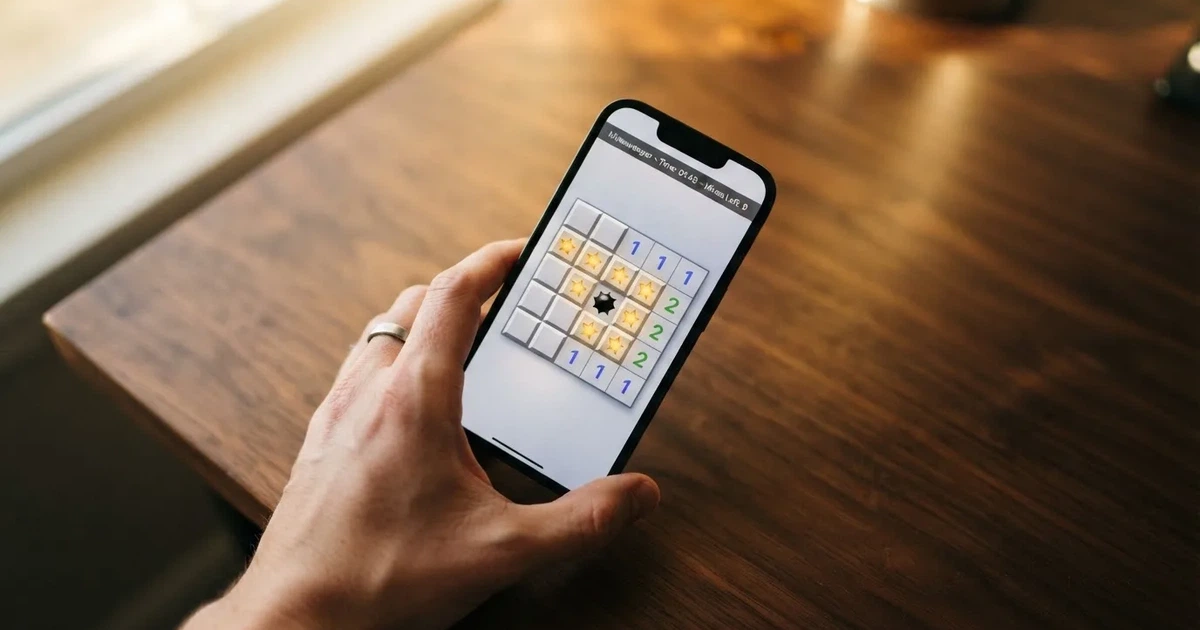
Two numbers determine everything else on the screen. The first is the grid size, which is fixed by the game version (5×5 is the standard Mines layout, smaller grids appear in some variants). The second is the mine count, set by the player before the round starts: fewer mines, lower multiplier per safe tile, longer expected streak before a loss; more mines, higher per-tile multiplier, shorter expected streak. The trade is intuitive but unsentimental — the game’s edge sits in the difference between the multiplier offered and the actual probability of clearing each additional tile.
The paytable is not a fixed schedule the way a slot’s is. It rises with each tile the player chooses to reveal, recomputed from the chosen grid size and mine count at the moment of the click. A player who sets three mines on a 5×5 grid and reveals four tiles in a row has already locked in a multiplier several times the stake; a fifth tile, then a sixth, then a seventh, multiplies that further — and any one of those later tiles can carry the mine that ends the round. The temptation to keep going is built into the structure, and so is the cost of giving in to it.
Why the format rewards a stop point set in advance
Most casino games set their own stopping rule. A slot ends when the reels stop; a blackjack hand ends when the player or the dealer stands. Mines asks the player to choose. That choice, made before the round starts, is the single decision that separates a session that returns some stake from a session that returns nothing.
A run of safe tiles is not information about the next tile. The grid is set when the round opens, and each tile is either a mine or it isn’t; revealing one safe tile does not lower the chance that the next one is. The brain reads a streak as evidence; the maths reads it as coincidence. Setting a stop point — a target number of tiles, a target multiplier, a target loss — in advance, and treating it as binding once the round is live, is the only behavioural lever the game leaves the player.
This is the responsible-gaming observation the Australian regulators do not spell out for Mines specifically because they do not need to: Mines is a prohibited product and the prohibition does the stopping for the player who respects it. For the player who does not, the format itself is the mechanism the warnings further down this page are aimed at.
Paying and getting paid — what real-money Mines sites in fact do
The cluster of search terms that pulls readers to a Mines page — deposit, payout, withdrawal speed — is built around the assumption that a Mines site is a working casino. For an Australian resident, that assumption is wrong: there is no Australian-licensed casino online at all, and no Australian-licensed payment route to one. What exists is offshore brands, and the only Australian body with a public position on those brands is the ACMA.
The payment channels an Australian resident can actually use
Under the rules that took effect on 11 June 2024, licensed Australian wagering services cannot accept credit cards, credit-related products or digital currency as payment. Penalties for operators that do reach A$247,500. The legal routes for an Australian-licensed wagering account are debit card, bank transfer, PayID or Osko, and BPAY. Mines is not on the licensed side of that fence, but the rules still explain what an offshore Mines site asking for a credit card or a crypto deposit is doing: it is operating outside the Australian regime entirely.
A player who funds an offshore Mines site with a Visa or Mastercard is using a payment instrument the licensed Australian market has been closed against for nearly two years. A player who funds it with Bitcoin, Ethereum or USDT is using a payment class the licensed market has banned outright. Neither payment is evidence that the site is licensed, and neither is evidence that any complaint about a refused withdrawal will be heard by an Australian body.
What an offshore payout offer actually means
Offshore sites promoting Mines to Australian residents routinely advertise fast withdrawals, “instant” crypto cash-outs and same-day payouts. None of those offers is enforceable through an Australian consumer-protection route. The ACMA’s blocking actions, the formal warnings listed in the operator section below, and the standing prohibition in the Interactive Gambling Act 2001 are the only Australian regulatory facts on the table; the marketing claims are not.
The H2 Gambling Capital estimate for 2026 puts Australian losses to illegal gambling sites at roughly A$3.9 billion a year, and shows the share of gambling going through legal channels falling from 74% in 2021 to 64% in 2025. The volume is the reason the ACMA’s blocking program exists, and the drop in the legal share is what the program is reacting to.
Bonuses, promo codes and the Mines no-deposit offer
The Mines-specific bonus landscape — promo codes, no-deposit offers, “free” Mines spins — is a search cluster of its own. None of it changes the underlying offer, and none of it changes the law. What changes is what the player has to do before the bonus turns into cash.
What a Mines no-deposit bonus usually carries
A Mines no-deposit bonus is a small credit added to a new account that lets the player run a few rounds without funding the account first. The shape is standard across the offshore casino market: a fixed bonus amount, a list of eligible games (Mines almost always included), a wagering requirement expressed as a multiple of the bonus, and a maximum cash-out cap that limits what can ever be withdrawn from the bonus even after the wagering is complete.
Two specifics are worth naming before anyone claims one. First, the wagering multiple — typically between 30× and 50× the bonus for offshore casino welcome offers of this type — applies to the bonus amount, not the deposit, and it must be cleared before any withdrawal is processed. Second, the maximum cash-out cap is usually a fixed ceiling (often in the A$50 to A$200 range) regardless of how much the multiplier on Mines returns during the clearing playthrough. A round that would normally pay several hundred can pay out only up to the cap.
Why the same wagering terms cover Mines and everything else
Promo codes and bonus codes advertised for Mines almost always carry the wagering terms the casino applies site-wide, not terms negotiated game by game. That is the practical reason a Mines round “feels” like a slow way to clear a bonus: the multiplier grows fast on a successful streak, but each tile revealed counts only as one unit of turnover, and a typical clearing requirement of, say, 40× on a A$10 bonus is 400 units of turnover before the bonus converts to a withdrawable balance.
The site’s own terms page is the only document that decides this. A reader who treats a promo code as a free pass has not read the conditions attached to it. A reader who has read the conditions has, in most cases, decided the bonus is not worth the clearing time.
The game in practice — what the round-by-round decisions cost
Three decisions drive a Mines session: how many mines on the grid, how many tiles to reveal before cashing out, and how much to stake per round. None of them overcomes the house edge, but the gap between an ordinary session and a ruinous one is set almost entirely by the second of these.
Reading the multiplier table
On a 5×5 grid with one mine, the multiplier after each safe tile rises slowly — the odds of clearing any single tile are 24/25, and the cumulative probability of a streak of five is high enough that the offered multiplier after five tiles is only modestly above break-even. With three mines on the same grid, the per-tile multiplier is higher at every step because the odds of clearing each tile are now 22/25, then 21/24, and so on — but the cumulative probability of reaching each step is lower, and the offered multiplier is calibrated to that lower probability.
The math is the same shape as a parimutuel payoff or a derivatives contract: the price of each additional step reflects the risk of taking it, and the player who takes more steps pays for the larger payoff with a lower probability of reaching it. Mines is unusual among casino games in making this trade explicit on screen, and unusual in giving the player the cash-out button at every step.
The arithmetic of a session
A player who stakes A$1 per round on a 5×5 grid with three mines, aiming to cash out after three safe tiles, will on average clear those three tiles roughly 57% of the time. The other 43% of rounds end on a mine, and the stake is lost. Multiplied across enough rounds to be statistically meaningful, the expected return on a Mines round is below the stake by a margin calibrated to the game’s edge — a number Spribe and other studios do not publish per game but which the regulator’s broader rule of thumb places in the low single digits as a share of turnover.
A session that runs 200 rounds at A$1 with the strategy above will, on average, return somewhere in the region of A$180 to A$190 of the A$200 staked. The exact figure depends on the mine count and the cash-out step, and varies title by title. The honest summary is simpler than the math: across any reasonable session length, the player ends with less than they started with.
Choosing between the paths that do exist
The choice a Mines page presents is not “which Mines casino is best”. It is a choice between paths, and the paths have different shapes.
The land-based and licensed options
Mines, in the form described above, is a real-money online casino product. It is not on the menu at a Crown Melbourne table and it is not on a licensed Australian wagering site, because neither carries online casino games of any kind. Crown Melbourne, the country’s largest casino complex, offers table games approved by the Victorian Gambling and Casino Control Commission — baccarat variants and blackjack rule sets among them, with rule changes logged publicly by the VGCCC. What Crown does not offer, and what no Australian venue can offer online, is a real-money Mines grid.
A reader who wants a similar shape — a single decision, a single outcome, a clear end to the round — has several licensed alternatives that look different but behave similarly. Sports betting before the event is licensed in Australia and gives a similar structure: a stake, a fixed price, a single outcome decided by a single event. A pokies session in a licensed venue gives the same structure with a different screen: a stake, a spin, a single outcome decided by the reels. The Australian wagering market is licensed and regulated; the Australian online casino market, of which Mines would be a part, is not.
The offshore path and what it costs
The offshore path is the path the ACMA’s enforcement record addresses. The 11 brands further down this page are not a recommended list. They are a sample of the formal warnings the ACMA has issued under the Interactive Gambling Act 2001, and the sample is chosen because Mines is the search term that brought the reader here in the first place. The point of naming them is to show what the Australian regulator has actually done, in a year when the regulator has been doing more of it than at any previous point.
The ACMA’s enforcement total, as reported in June 2026, reached 1,751 blocked illegal gambling and affiliate marketing websites since the first blocking request in November 2019, and more than 230 unlicensed gambling services had left the Australian market since enforcement was strengthened in 2017. A single June 2026 round added 12 more sites to the block list: 7Signs, ChromaBet, Donbet, Duospin, Freshbet, Slots Gem, Jacks Club, Lucky Start, Pointsbetz, Spinrise, Vinyl Casino and Wildsino. The blocking rate is the calculation set out at the end of this section, and it is the page’s headline data point.
What the reader is actually choosing between
Two paths, and the trade is not between products of equivalent standing. The first is licensed Australian wagering — a market where the consumer protections, complaint routes and self-exclusion tools all work, and where the games available are the games the Interactive Gambling Act 2001 permits. The second is offshore online casino — a market where none of those protections apply, where the ACMA’s record is a sequence of formal warnings and blockings, and where Mines is the entry point that brought the reader here.
A reader who searches for “mines casino game Australia” and clicks through to an offshore brand is not making a comparison between two roughly equivalent offers. They are moving from a market that protects them to a market that does not, on a product the Australian law does not allow to be offered to them in the first place. That is what the choice is, and writing it down plainly is the point of putting both paths on the same page.
The 11 brands the ACMA has formally warned
The table below is not a ranking and not a recommendation. Each row is an offshore casino brand the ACMA itself has named in a formal warning under the Interactive Gambling Act 2001, ordered as research delivers them. Mines is not the only game these brands offer; it is the search term that surfaced them, and the formal warning is what an Australian resident needs to know about them.
| Brand | ACMA action and date | Operator named by the ACMA | Mines availability |
|---|---|---|---|
| RocketPlay | Formal warning, March 2026 (Pulsup Ltd); earlier warning, May 2022 (Dama N.V.) | Pulsup Ltd / Dama N.V. | — |
| Level Up Casino | Formal warning, May 2022 | Dama N.V. | listed on Bgaming.com |
| Woo Casino | Formal warning, March 2025 | Dama N.V. | — |
| Spirit Casino | Formal warning, May 2025 | Dama N.V. | — |
| National Casino | Formal warning, July 2025 | Consolutetish S.R.L. | listed on en.wikipedia.org |
| Bizzo Casino | Formal warning, July 2025 (Consolutetish S.R.L.); earlier warning, 2022 (TechSolutions) | Consolutetish S.R.L. / TechSolutions | — |
| Ignition Casino | Formal warning, July 2025 | Bamboo Media | — |
| Instant Casino | Formal warning, February 2025 | EOD Code SRL | — |
| Jackbit | Formal warning, April 2026 | Ryker B.V. | — |
| Casino Intense | Formal warning, April 2025 | Sterplay Holding Ltd | listed on Abc.net.au / acma.gov.au / Crownmelbourne.com.au |
| Sky Crown | Formal warning, September 2022 | Hollycorn N.V. | — |
The brands themselves cluster around a handful of parent companies. Dama N.V. appears three times in the table — for RocketPlay, Woo Casino and Spirit Casino, on top of the 2022 warning that also covered Level Up Casino and three other brands the ACMA named in the same notice. Consolutetish S.R.L. appears twice, for National Casino and Bizzo Casino, and Bizzo carries an additional 2022 warning tied to TechSolutions. None of the repetition is evidence the ACMA’s enforcement has been ineffective; it is evidence that offshore operators rename and reincorporate after a warning rather than leave the market, and that the regulator’s job is iterative.
What the ACMA record actually shows
Two patterns sit inside the table. The first is that the ACMA’s enforcement is current: the most recent warning in this set is from April 2026, and the ACMA’s own publication of formal warnings updates as new notices are issued. The second is that the warnings are issued to operators, not to Australian players — the Interactive Gambling Act 2001 targets the provider, and no Australian resident has been prosecuted for playing on an offshore site. The cost is borne by the player in the absence of any Australian complaint route, not in any criminal exposure.
A reader who finds one of these brands on a comparison site or a search result has not found an Australian-licensed offer. The licence displayed at the footer of an offshore brand’s page — Curaçao, Anjouan, the equivalent — is not an Australian licence, because no Australian licence for online casino exists. The ACMA’s formal warning record is the Australian position on that brand, and it is the only Australian position that matters.
The blocking-rate calculation
The ACMA’s June 2026 update named 1,751 blocked sites since the first blocking request in November 2019 — a span of roughly six and a half years. The blocking rate that figure implies, set against the full period, is in the region of 250 to 270 sites blocked per year on average, with month-to-month variation driven by the size of each blocking round. The June 2026 round alone added 12. The headline number — 230-plus unlicensed services leaving the market since 2017, 1,751 blocked sites since 2019 — is the cumulative result of a program that runs continuously rather than in bursts, and the rolling annual rate sits comfortably in the high-twenties per month as a working band.
That band is the calculation this page is built around. It is a working estimate from the cumulative totals in the ACMA’s published record, not a guarantee of next year’s figure, and it sits behind every comparison in the table above.
How Australia regulates online gambling — and why Mines is inside the prohibition
The Interactive Gambling Act 2001, tightened by the Interactive Gambling Amendment Act 2017, makes it an offence to provide online casino games, online pokies or in-play betting to a person in Australia. No state or territory issues a licence for any of these. The licensable forms of online gambling in Australia are wagering on races and sport placed before the event, lotteries, and keno.
What the ACMA does, and what it does not
The Australian Communications and Media Authority investigates complaints, issues formal warnings to offshore operators offering prohibited services to Australians, and directs Australian internet service providers to block illegal sites at the domain level. The ACMA does not regulate the games themselves — that role belongs to state and territory bodies such as the Victorian Gambling and Casino Control Commission (which replaced the VCGLR on 1 July 2022) and the New South Wales Casino Control Authority, both of which approve the rules of table games played in their jurisdictions. The ACMA’s role is the Australian front door: it decides which offshore offers reach Australian residents at all.
The Northern Territory Racing and Wagering Commission regulates 52 of Australia’s online bookmakers — Sportsbet, Bet365 and Ladbrokes among them — licensed in the Territory for tax reasons rather than for any consumer-protection advantage. The commission has no full-time staff and meets once a month in Darwin. The structure is unusual and was the subject of an NT reform bill in April 2026 aimed at giving the body the staffing its regulatory load requires.
What the 2026 reform bill actually changes
The Interactive Gambling Amendment (Gambling Reform) Bill 2026 passed Parliament on 19 August 2026. Its advertising and inducement measures commence on 1 January 2027 — law with a start date, not yet in force on a 2026 page. The practical effect on Mines is to extend the existing prohibition to a wider set of promotional practices, including bonus offers and affiliate inducements that target Australian residents. A 2026 reader looking at a Mines promo code on an offshore site is looking at a product whose promotion becomes more tightly restricted from the start of 2027; the product itself is already prohibited.
The payment ban that landed in June 2024
Credit cards, credit-related products and digital currency have been banned as payment for licensed Australian online wagering since 11 June 2024. The legal routes for a licensed account are debit card, bank transfer, PayID or Osko, and BPAY. A Mines site asking for a credit card or a crypto deposit is operating outside those rules by definition, because Mines is not offered by any licensed wagering operator at all. The payment method is a tell, not a feature.
Tax and winnings — the only point where the ATO matters
Gambling winnings of a recreational player are not assessable income under section 6-5 of the ITAA 1997, and losses are not deductible. The rule applies equally to a Crown Melbourne blackjack hand, to a licensed Sportsbet multi, and to a Mines round on an offshore site — the tax treatment does not depend on the legality of the product. A player whose gambling is a business is treated differently under the same Act, but that is a model answer rather than a Mines-specific rule, and the ATO’s own guidance is the place to check it.
Responsible gambling and the Australian support system
The responsible-gambling frame for Mines is the same as the responsible-gambling frame for any prohibited product: the prohibition does the work for the player who respects it, and the support system exists for the player who does not.
BetStop and why it does not cover Mines
BetStop, the National Self-Exclusion Register, has been live since August 2023 and binds Australian-licensed online and phone wagering services. A punter who registers with BetStop is excluded from every Australian-licensed wagering site for the period chosen, and the licensed operators are required to enforce the exclusion. An offshore Mines casino is not connected to BetStop, because it is not licensed in Australia at all. Self-excluding through BetStop will not stop a player who wants to play Mines from finding an offshore brand, opening an account and funding it. The tool exists; the offshore market sits outside it.
The National Gambling Helpline and Gambling Help Online
The National Gambling Helpline — 1800 858 858 — is free, available 24/7 and covers every state and territory. Gambling Help Online, the same service in chat form, runs alongside it. Both services are designed for any gambling harm, licensed or not, and both treat the offshore market as part of the landscape a caller might be playing in. The number is the one a reader should keep, regardless of where the gambling takes place.
The structural feature Mines adds
The tile-by-tile format of Mines rewards setting a stop point before play starts rather than after a run of safe tiles feels lucky. A player who has set a cash-out step and stuck to it has done the one thing the game’s design requires. A player who has not has given the multiplier curve the only thing it asks for — a longer streak to charge against. The advice is not Mines-specific, because the prohibition does not let an Australian resident reach the game through a licensed channel. The advice is for the reader who has already decided the prohibition is not going to stop them, and who is looking for the part of the page that talks to that choice honestly.
Where this leaves the search
Three things are true at the same time. Mines is a real game with a real structure and a real edge. The Australian law prohibits offering it online to Australian residents, and the ACMA’s enforcement record shows what that prohibition looks like in practice. The search that brings a reader to a page like this one ends, more often than not, on an offshore brand with no Australian licence and no Australian consumer protection.
The choice is not between brands in the table above. The table is the ACMA’s record, not a shortlist. The choice is between the licensed Australian market — sports, racing, lotteries, keno, and the table games at Crown Melbourne and other licensed venues — and the offshore market the ACMA’s blocking program is built to reduce. A reader who stays on the licensed side has a complaints body, a self-exclusion register, and payment rules that protect them. A reader who steps off it has none of those, on a product whose promotion becomes more tightly restricted from the start of 2027 and whose offering is already prohibited today.
That is the comparison. The arithmetic on the multipliers and the wagering terms is real, and it is also beside the point, because the comparison the law makes is the one that decides what a Mines search in Australia actually turns up.
Frequently asked questions about Mines in Australia
Is it legal to play the Mines casino game for real money in Australia?
No. Under the Interactive Gambling Act 2001, no online casino game — Mines included — can be offered to a person physically in Australia by a licensed operator. The ACMA enforces the prohibition against offshore operators offering these games to Australian residents, and has blocked more than 1,750 illegal sites since 2019.
How does the payout on Mines increase as more safe tiles are revealed?
Each safe tile raised multiplies the stake by a factor set at the start of the round from the grid size and the chosen mine count. The math is recalculated tile by tile: a longer streak pays a larger multiplier, but each additional tile lowers the probability of reaching the next step and ends the round entirely if the next tile is a mine.
What determines how many hidden mines are placed on a Mines grid?
The mine count is set by the player before the round starts, within the limits the game version allows. Fewer mines raise the chance of clearing each tile and lower the per-tile multiplier; more mines do the opposite. The grid size is fixed by the game version — 5×5 is standard, with smaller layouts on some titles.
What conditions usually apply before a Mines no-deposit bonus can be withdrawn?
The standard offshore casino package: a wagering multiple (commonly 30× to 50× the bonus) that must be cleared before any withdrawal, a maximum cash-out cap that limits how much can ever be withdrawn from the bonus regardless of what the multiplier returns, and a list of eligible games with Mines almost always included but with table-game and live-dealer contributions often weighted differently.
Is the Mines app a separate product from the browser-based version of the game?
No. The Mines app and the browser version are the same game running on the same underlying random-number generator; the app is a wrapper around the web product that adds push notifications and a mobile-friendly layout. The math, the multipliers and the edge are identical on both.
What is a sensible way to decide a stop point before starting a round of Mines?
Set a target — a number of tiles to reveal, a multiplier to reach, or a session loss to cap — before the round starts and treat it as binding once play begins. A run of safe tiles is not evidence about the next tile, and the multiplier curve rewards a player who stops at the planned point more than one who keeps going because the streak “feels” lucky.