
Best casino sign up bonus in Australia in 2026: the shelf the law leaves empty
30 October 2026 — checked against the ACMA’s register of formal warnings and blocking requests, the Interactive Gambling Act 2001, and the Reserve Bank of Australia’s most recent card-payments review.

A reader who lands on this page is, more often than not, looking for a working shortlist: a row of online casinos, the headline bonus on each, the wagering multiple, the deposit method, and a verdict. The honest answer in Australia is that the shortlist the reader came for does not exist as a legal thing. Offering an online casino game, an online pokie, or an in-play bet to anyone physically in Australia is an offence under the Interactive Gambling Act 2001. No state or territory issues a licence for it. The brands a casual search turns up — the ones that welcome an Australian sign-up form, advertise “200% up to A$X + 200 free spins” and pay out in crypto to a wallet the player controls — sit on the wrong side of that line. The Australian Communications and Media Authority has been quietly moving through them, brand by brand, since the November 2019 blocking round.
What follows is a working map of the gap. It walks the law first, then the ACMA’s own enforcement record — the closest thing this market has to a regulator-published comparison — then the payment rails an Australian reader would actually meet on these sites, then the mechanics of the bonus offers that sit behind the marketing, then the eleven brands the ACMA has acted against, and finally the responsible-gambling tools that bind licensed wagering operators but not the offshore ones the reader is more likely to reach.
Table of Contents
Cryptocurrency and the question of anonymity
The shortest route from a Google search to a deposit is, in 2026, a crypto casino sign-up bonus. A Bitcoin casino sign-up bonus, a crypto casino no-deposit sign-up bonus, or a Bitcoin casino no-deposit sign-up bonus all show up the same way on the page: a wallet address, a coin choice (Bitcoin, Ethereum, Litecoin, USDT), a QR code, and a deposit that settles in minutes without a name attached. The marketing word is “anonymous”. The reality is narrower.

What “anonymous” gets a player. A Bitcoin or USDT deposit moves on a public ledger; the on-chain transaction carries the sending and receiving addresses, both of them permanently. What the deposit does not carry is the player’s name, in the same way a cash purchase at a newsagent does not. KYC — the “know your customer” check — runs at withdrawal, not at deposit. Sites that take crypto frequently skip the ID check at the deposit screen and reserve it for the cashout.
Where the law sits. The Interactive Gambling Act 2001, as amended in 2017, prohibits the offer, not the play. An Australian individual who opens an account at an offshore crypto casino is not personally prosecuted; the IGA targets the provider. The provider is the one the ACMA writes to. Crypto does not change what the operator is doing, and the ACMA’s enforcement record treats a Bitcoin deposit method as immaterial to whether the service itself is prohibited.
The bank side. Two of the major Australian banks — Westpac and ANZ — apply gambling blocks at the card level and, in ANZ’s case, extend the block to digital-wallet transactions on the same card. Crypto bypasses the card entirely. The bank cannot see the on-chain transaction and cannot block it. That is the practical appeal, and it is also the practical risk: if a dispute arises over a withdrawal, the player has no Australian consumer-protection route, no AFCA complaint avenue, no BetStop registration to lean on. The only recourse is the site’s own terms page.
What a crypto bonus actually pays. The promotional number attached to a Bitcoin casino sign-up bonus — a percentage match on the deposit, plus free spins on a named slot, plus a wagering multiple — is identical in shape to a fiat bonus. The crypto frame is the deposit rail; the bonus terms are not. A 40x wagering multiple on a 0.5 BTC deposit is the same forty-time turnover as on a A$500 deposit. The coin’s volatility is the player’s, not the casino’s, and it sits on top of the wagering.
The anonymity claim, examined. PayID, by contrast, displays the recipient’s name before the transfer is sent; AP+, the operator of PayID and Osko, warns that being asked to transfer money to a PayID on an illegal gambling site almost certainly means a scam site. The Bitcoin equivalent, by design, displays nothing. That is the feature being sold. Whether it is worth what it costs — no Australian consumer protection, no dispute avenue, no exit — is the reader’s call, and the answer depends on what the player is actually protecting.
Payments and payout speed
The deposit rail decides what the player sees, and for an Australian reader it is, broadly, one of three things: a card, an instant bank transfer, or a crypto wallet. Each behaves differently at the bank, at the merchant, and at the ACMA.
| Payment Method | Status in Australia | Regulatory Note |
|---|---|---|
| Credit Card | Prohibited (licensed wagering) | Restricted by IGA 2023 |
| Debit Card | Allowed | Bank-side blocks apply |
| PayID | Allowed | Instant transfers available |
| BPAY | Allowed | Owned by Australian Payments Plus |
| Crypto | Prohibited (service-based) | High risk, no protection |
Cards. A Visa or Mastercard debit card is the default at most offshore casinos. American Express is rarer; the Reserve Bank of Australia’s July 2025 card-payments review proposes removing surcharges on eftpos, Mastercard and Visa transactions, and explicitly leaves Amex outside the proposed ban. The card itself has no problem being accepted at an offshore site; the bank may have a problem with it going through. Westpac’s gambling block refuses authorisation of transactions registered under the merchant category code “Betting/Casino Gambling” on eligible personal credit and debit cards. Commonwealth Bank offers a gambling lock on eligible cards through the CommBank app. ANZ’s gambling block extends to digital-wallet transactions — Apple Pay, Google Pay, Samsung Pay — on the same card, and once turned on can only be removed after a 48-hour waiting period.
Mobile wallets. Apple Pay, Google Pay and Samsung Pay collectively accounted for around 45% of all card payments in Australia by number by the end of 2025, per the Reserve Bank. Apple does not charge consumers a fee for using Apple Pay; any surcharge comes from the merchant’s processing fee, not from Apple’s. Apple sets no transaction limits itself — those are set by the card issuer or the merchant. The bank-side block is the relevant limit: an ANZ gambling block stops Apple Pay gambling transactions on the card, and so does the Westpac gambling block when the merchant carries the gambling MCC. A wallet does not anonymise the card it sits on top of.
Instant bank transfers. Osko, the instant transfer service that runs on the New Payments Platform, moves a bank transfer between participating Australian banks in under a minute, 24/7, addressed either to a BSB and account number or to a PayID. The New Payments Platform has been live to the public since 13 February 2018, is owned by New Payments Platform Australia Ltd, and merged with BPAY and eftpos into Australian Payments Plus in September 2021. PayID identifiers registered on the platform passed 25 million by April 2025. The practical effect at an offshore casino: a PayID deposit from an Australian bank lands in under a minute, and the recipient name on the PayID is visible to the payer before the transfer is sent. That visibility cuts both ways — the player can confirm who they are paying, and the receiving casino’s name is now sitting in the player’s own banking app.
BPAY. BPAY is the bill-payment service that runs through a customer’s own online banking: the payer enters a Biller Code and a Customer Reference Number. It has been live since 18 November 1997, sits inside the online banking of more than 140 Australian banks and financial institutions, and is offered by over 95,000 businesses. It is owned equally, through Cardlink Services Limited, by the four major banks. As a deposit method at a casino it is unusual — BPAY is built around billers, not payees — and most offshore sites do not list it. Where it does appear it is the slowest of the rails, by design.
Crypto. A Bitcoin or USDT deposit bypasses the card and the bank transfer entirely. It is the only rail that does not leave a card MCC, a PayID name, or a BPAY CRN at the Australian end. The ACMA does not classify the deposit rail; it classifies the service. A Bitcoin casino no-deposit sign-up bonus is, from the regulator’s view, still a sign-up bonus on a prohibited service.
Payout speed. What an offshore site advertises as “instant withdrawal” is usually instant to the wallet, not to the Australian bank account. A Bitcoin payout arrives at the player’s wallet in minutes. An Osko payout back to an Australian bank account arrives in under a minute once the casino has approved it — and approval is where the wait lives, typically 24 to 72 hours, on the operator’s own internal review. A card payout takes longer at the card-network level and may carry its own merchant-side hold.
The card-payments rule. Under the Interactive Gambling Act 2001 as amended in 2023, Australian-licensed online wagering services cannot accept payment by credit card or other credit-related products. The restriction constrains gambling use of linked digital wallets such as Apple Pay, because the wallet sits on top of a card and the card is what the operator is taking. An offshore site is not bound by that restriction. An offshore site that asks for a credit card is doing so outside the Australian regime — not because credit cards are forbidden globally, but because no Australian regime recognises the site.
AUSTRAC’s threshold-transaction-report rule, which requires reporting of transfers of A$10,000 or more, applies only to physical cash. Ordinary electronic bank transfers are not subject to that per-transaction reporting requirement, regardless of the amount sent. The reporting mechanic does not catch a routine A$200 PayID deposit to a casino, but the bank may flag it on its own anti-fraud rules.
Bonus mechanics and what the headline number hides
The promotional word on the page — “200% up to A$1,000 + 200 free spins” — is the start of the offer, not its content. The content lives in the wagering multiple, the maximum bet cap, the eligible games list, the expiry, the maximum cashout, and the deposit method that gates the offer. Each is a knob the operator can turn, and the page’s job is to say which way each one is turned.
Wagering requirement, defined. The turnover, or wagering, requirement is the multiplier the operator attaches to the bonus, and it tells the player how many times the bonus amount must be wagered before any winnings become withdrawable. A 40x wagering multiple on a A$200 bonus means A$8,000 of qualifying bets before withdrawal. On a A$1,000 bonus at the same multiple, A$40,000. The number is mechanical and the cost is mechanical.
Max-bet cap. A bonus is almost always played under a maximum bet cap — typically A$5 to A$10 per spin or hand. The cap is there because, without it, a player could grind the wagering requirement on a single high-variance spin and walk away with a disproportionate win. The cap bites hardest on a player who would otherwise play higher. The page should flag it because the cap is the rule players miss most often, and a breach voids the bonus.
Expiry. Most sign-up bonuses carry an expiry on the wagering requirement — typically seven to thirty days. An unused bonus past the expiry is forfeit, and any winnings attached to it lapse with it. This is the rule the terms page buries in section 6 and the one a casual reader never reaches.
Eligible games. Pokies almost always count 100% toward wagering; table games often count 10% or less, sometimes nothing. A player who likes blackjack will not clear a pokie-aimed bonus by playing blackjack. The contribution table is one paragraph on the terms page and the second-most-missed rule after the max-bet cap.
Maximum cashout. A no-deposit bonus in particular may carry a maximum cashout — say, A$100 on winnings from a “free A$20” sign-up. The bonus is real; the ceiling on what it pays out is the operator’s. A player who wins A$800 from a A$20 no-deposit bonus withdraws A$100, not A$800. This is the rule that turns a big-looking headline into a small-looking payout.
The crypto frame. A crypto casino sign-up bonus or a Bitcoin casino sign-up bonus is structurally the same offer on a different deposit rail. The percentage match is the same. The wagering multiple is the same. The eligible games list is the same. What the crypto frame does is move the deposit rail off the card and the bank transfer. The bonus mechanics do not move with it.
What a no-deposit bonus is. A no-deposit bonus is a small credit — typically A$10 to A$25, occasionally a handful of free spins — given on sign-up before any deposit is made. The trade is the operator’s: a small risk of a small loss in exchange for a registered account. The wagering multiple on a no-deposit bonus is typically higher than on a deposit bonus — 50x to 70x is common — and the maximum cashout is usually capped. The marketing label “no deposit” describes the entry condition, not the cost.
Why terms cap the maximum bet. The cap exists because the bonus is a fixed expected cost to the operator, calculated against an average wagering pattern. A single large bet at high variance blows that average. The cap is the operator’s defence against a player who would otherwise turn the bonus into a lottery ticket. For most players it does not bite. For a player who likes high-stake roulette or high-volatility pokies, it can be the rule that makes the bonus unplayable.
The unused bonus. If the wagering period expires before the turnover is cleared, the bonus balance and any winnings attached to it lapse. The deposit, if one was made, returns to the withdrawable balance — typically, and after the wagering on the bonus portion is resolved. A player who reads only the headline number and not the expiry forfeits whatever the bonus would have paid.
The honest summary. A bonus is a promotional inducement with a cost. The cost is the wagering requirement, the cap on what it pays out, the games it covers, the bet ceiling it imposes, and the time it gives the player to clear it. The headline number is the entry; the terms are the offer.
The brands the ACMA has acted against
The following eleven brands are listed because the ACMA itself issued a formal warning over each, for offering prohibited online casino services to Australians. The ACMA’s register is the closest thing this market has to a regulator-published list, and it is more useful than any affiliate ranking because it is published by the regulator, not by the marketing pages that rank for the search. No bonus terms are reproduced here: the only sources for bonus terms on these brands are affiliate marketing pages, and an affiliate page is not an independent source.
The comparison below lines up each brand against its ACMA action, the operator the warning named, and the payment-method coverage the affiliate listings report. Where a brand has no coverage on a given subject in any independent source, the column is left blank rather than copied across from another row.
| Brand | ACMA action and date | Operator named by the ACMA | Subject support |
|---|---|---|---|
| RocketPlay | Formal warning, March 2026 | Pulsup Ltd | Listings only (Gambling Insider) |
| Level Up Casino | Formal warning, May 2022 | Dama N.V. | Listings only (Westpac) |
| Woo Casino | Formal warning, March 2025 | Dama N.V. | — |
| Spirit Casino | Formal warning, May 2025 | Dama N.V. | — |
| National Casino | Formal warning, July 2025 | Consolutetish S.R.L. | Listings only (acma.gov.au, austrac.gov.au, betstop.gov.au) |
| Bizzo Casino | Formal warning, July 2025; earlier 2022 | Consolutetish S.R.L. / TechSolutions | Listings only (Gambling Insider) |
| Ignition Casino | Formal warning, July 2025 | Bamboo Media | — |
| Instant Casino | Formal warning, February 2025 | EOD Code SRL | Listings only (ecoPayz, PayID) |
| Jackbit | Formal warning, April 2026 | Ryker B.V. | — |
| Casino Intense | Formal warning, April 2025 | Sterplay Holding Ltd | Listings only (austrac.gov.au, betstop.gov.au, Gamblinginsider.com) |
| Sky Crown | Formal warning, September 2022 | Hollycorn N.V. | — |
The pattern in the table. Dama N.V. recurs across four rows — Level Up, Woo Casino, Spirit Casino, and RocketPlay in the May 2022 warning — and the ACMA has kept returning to the same operator under different brand names. That is the shape of enforcement against an offshore group: one warning, multiple brands, repeat warnings as new skins appear. Consolutetish S.R.L. shows up across National Casino and Bizzo Casino, the latter of which had already been warned in 2022 under TechSolutions. The operator behind the brand changes; the warning list accumulates.
The licensing claim. Several of these brands display a Curaçao or Anjouan licence in their footer. The licence is real — those jurisdictions do issue them — but it is not an Australian licence, because no Australian jurisdiction issues one for online casino games. The licence at the footer is a statement about the operator’s home regulator; it is not a statement about whether the service may be offered to an Australian reader. The ACMA’s position is that the offering itself is prohibited, regardless of the licence displayed.
RocketPlay
Pulsup Ltd was the operator named in the ACMA’s March 2026 formal warning over Rocketplay. The brand had already been the subject of a May 2022 warning to Dama N.V. over six brands including Rocketplay. The affiliate listings report RocketPlay as a multi-coin casino; independent verification of its bonus terms, game library or payout time is not available in this set of sources. The brand is a useful example of the ACMA’s repeat pattern: a warning to one operator, a new brand under a new company, a fresh warning. The structural lesson is that the operator changes; the offering does not.
Level Up Casino
The ACMA’s May 2022 formal warning named Dama N.V. for Level Up and five other brands. The affiliate listings report Level Up as carrying the Westpac gambling-block-aware merchant category, which is not a brand feature but a feature of how the card networks classify the merchant. The structural read is the same as RocketPlay: one warning, a group of brands, and the ACMA’s continued attention.
Woo Casino
Dama N.V. received an ACMA formal warning in March 2025 specifically for Woo Casino. Woo also sits under the Dama umbrella that produced the May 2022 warning. The brand carries no independent coverage of bonus terms, deposit methods or payout times in this source set. The pattern is consistent: a brand from an operator that has been warned before.
Spirit Casino
Dama N.V. was the operator named in the ACMA’s May 2025 formal warning over Spirit Casino, two months after the Woo Casino warning to the same operator. The close spacing between warnings — March and May 2025 — is the ACMA working through a queue. Spirit Casino carries no independent coverage in this source set.
National Casino
Consolutetish S.R.L. was the operator named in the ACMA’s July 2025 formal warning over National Casino. National Casino is the brand with the deepest independent coverage of any in this list: it shows up across the ACMA’s own register, AUSTRAC’s enforcement materials and BetStop’s consumer-facing pages. That coverage is incidental — it reflects how often regulators and consumer-protection bodies name the brand, not how good the brand is.
Bizzo Casino
Consolutetish S.R.L. was the operator named in the ACMA’s July 2025 formal warning over Bizzo Casino; Bizzo had already been the subject of a 2022 formal warning to TechSolutions (CY) Group Limited and TechSolutions Group N.V. The two warnings, three years apart, are the cleanest illustration in this set of the ACMA’s repeat pattern: a brand warned, a rebrand or a transfer, a fresh warning. Affiliate listings report Bizzo as a multi-coin casino.
Ignition Casino
Bamboo Media was the operator named in the ACMA’s July 2025 formal warning over Ignition Casino. Ignition carries no independent coverage in this source set. The brand is one of the better-known offshore casino names among Australian-facing marketing pages, which is itself a marker of how much of the search-result real estate is held by brands the regulator has acted against.
Instant Casino
EOD Code SRL was the operator named in the ACMA’s February 2025 formal warning over Instant Casino. The affiliate listings report Instant Casino as carrying ecoPayz and PayID as payment methods. PayID on a prohibited service is the case AP+ itself warns about: a transfer to a PayID on an illegal gambling site almost certainly means a scam site. Whether Instant Casino’s PayID presence is genuine or a marketing line, the warning from AP+ applies regardless.
Jackbit
Ryker B.V. was the operator named in the ACMA’s April 2026 formal warning over Jackbit and CasinOK. Jackbit carries no independent coverage in this source set. The brand is one of the more prominent crypto-first casinos in the affiliate-marketing pages, and the ACMA’s action sits alongside a number of similar crypto-first brands.
Casino Intense
Sterplay Holding Ltd was the operator named in the ACMA’s April 2025 formal warning over Casino Intense. The brand shows up across AUSTRAC’s enforcement materials, BetStop’s consumer-facing pages and Gamblinginsider.com — the broadest cross-regulator coverage of any brand in this list apart from National Casino. That is not an endorsement; it is the brand showing up on the lists a reader might consult.
Sky Crown
Hollycorn N.V. was the operator named in the ACMA’s formal warning over Sky Crown and Blue Leo, published as a PDF in September 2022. The brand carries no independent coverage in this source set. Sky Crown is one of the older entries on the ACMA’s list and a useful reminder that the register has been accumulating since 2022.
The verdict, across the eleven. None of the eleven is an Australian-licensed option, because there is no such option for online casino games. The reader’s choice is not between these brands and an Australian-licensed alternative; it is between these brands and the lawful alternatives — licensed wagering with a bookmaker, a land-based casino, licensed pokies at a club or hotel, or not gambling at all. The page’s role is to make that choice visible.
The Australian legal landscape
The Interactive Gambling Act 2001 — the IGA — is the statute. It was strengthened by the Interactive Gambling Amendment Act 2017, and the amendments make it an offence to provide online casino games, online pokies or in-play betting to a person physically in Australia. No state or territory issues a licence for any of those services. What is licensable is wagering on races and sport placed before the event, lotteries and keno.
Who regulates wagering. The Northern Territory Racing and Wagering Commission regulates 52 of Australia’s online bookmakers — including Sportsbet, Bet365 and Ladbrokes — which are licensed in the Territory for tax reasons. The commission is small: it has no full-time staff and meets once a month in Darwin. The structural fact is that the body regulating most of Australia’s licensed online wagering is a part-time NT commission meeting monthly, and that the licences it issues are for wagering, not for casino games.
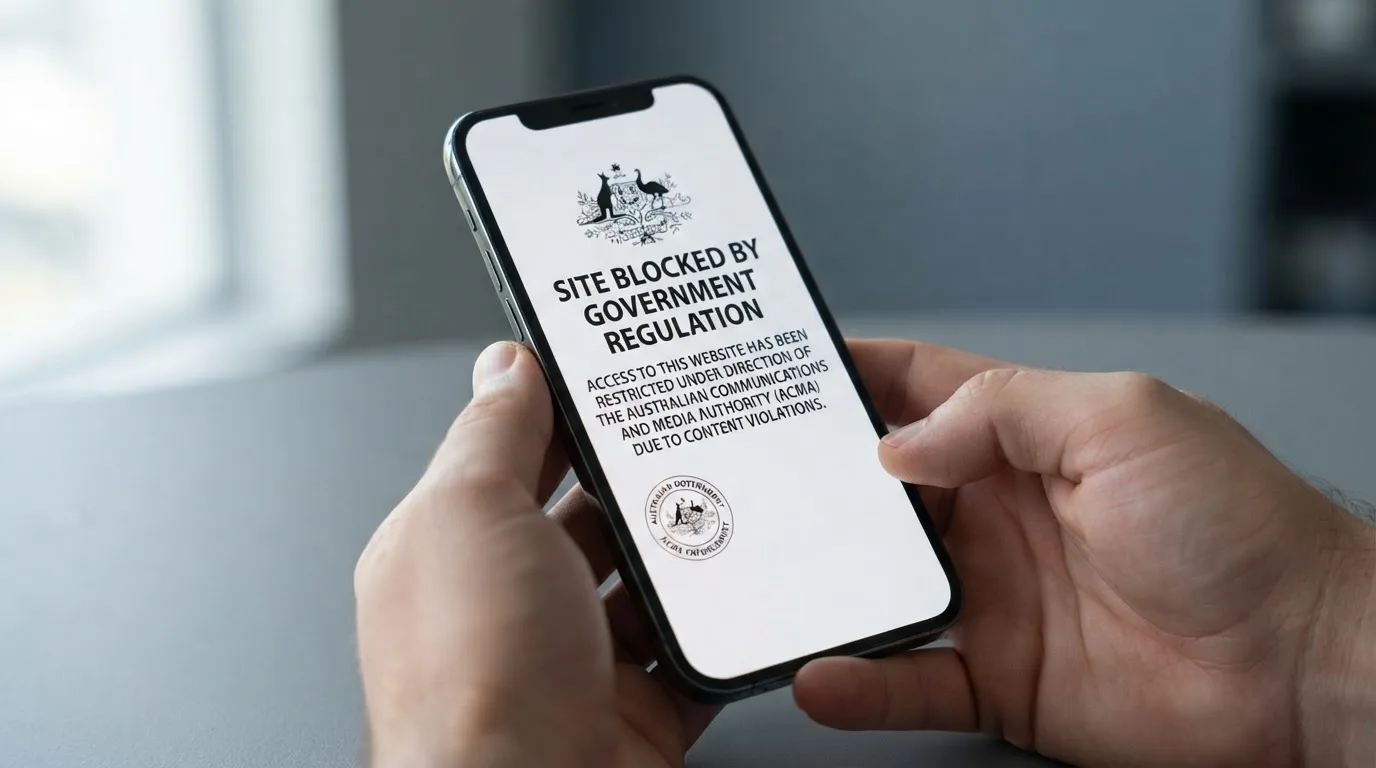
Who enforces the prohibition. The Australian Communications and Media Authority — the ACMA — investigates, issues formal warnings, and directs Australian internet service providers to block illegal sites. The ACMA’s enforcement record is the working answer to “is anyone actually doing anything about this”. By June 2026, the ACMA had reported a running total of 1,751 illegal gambling and affiliate marketing websites blocked since the first blocking request in November 2019, and more than 230 unlicensed gambling services had left the Australian market since enforcement was strengthened in 2017. In the round reported on 26 June 2026, the ACMA asked ISPs to block twelve more: 7Signs, ChromaBet, Donbet, Duospin, Freshbet, Slots Gem, Jacks Club, Lucky Start, Pointsbetz, Spinrise, Vinyl Casino and Wildsino.
The cost. H2 Gambling Capital’s 2025 report estimates that Australians lose about A$3.9 billion a year to illegal gambling sites, and that the share of gambling going through legal channels fell from 74% in 2021 to 64%. The estimate is the regulator-adjacent market view, and the direction of the share is the regulator’s concern: more of Australians’ gambling spend is moving offshore each year the ACMA publishes.
The individual player. The IGA targets the provider, not the player. An Australian individual opening an account at an offshore casino is not personally prosecuted. What they give up is the consumer-protection framework that sits around an Australian-licensed service — the AFCA complaint route, the BetStop binding, the Australian bank-side dispute mechanism. An offshore casino can be blocked with a balance on it; the ACMA’s blocking requests do not come with a payout.
The 2023 credit-card ban. The 2023 amendments to the IGA made it an offence for an Australian-licensed online wagering service to accept payment by credit card or other credit-related products. The rule binds licensed wagering, not offshore casinos. A licensed bookmaker cannot take a credit card deposit; an offshore casino that asks for one is operating outside the Australian regime — the credit-card prohibition is a marker of what an Australian-licensed service looks like, and the absence of that marker is part of how an offshore site presents.
The 2026 reform. The Interactive Gambling Amendment (Gambling Reform) Bill 2026 passed Parliament on 19 August 2026. Its advertising and inducement measures commence on 1 January 2027 — law with a start date, not yet in force on a 2026 page. The page notes the passage and the date; the measures themselves take effect in the next calendar year.
Tax. Gambling winnings of a recreational player are not assessable income under section 6-5 of the ITAA 1997, and losses are not deductible. The position differs for a person who carries on a business of gambling; that is a model answer, and the practical instruction is to check with the ATO for any individual case that crosses the recreational line.
Responsible gambling around prohibited services
The responsible-gambling infrastructure in Australia is built around licensed wagering and licensed venues. An offshore casino sits outside it.
BetStop. The National Self-Exclusion Register — BetStop — has been live since August 2023. A player who registers is excluded from Australian-licensed online and phone wagering services. The exclusion is binding on the licensed operator; it is not binding on an offshore casino. A BetStop registration does not stop an offshore casino from accepting a deposit, and the casino has no obligation to honour the registration. The register is the most useful single tool an Australian player has against licensed wagering, and it is the tool that does not reach the brands on this page.
National Gambling Helpline. 1800 858 858 is free, 24/7, with chat at Gambling Help Online. The helpline is for anyone affected by gambling, regardless of where the gambling happens, and the staff are trained for the offshore case as well as the licensed case. The number is the one to ring first; the website is the one to open first if ringing is not the right first step.
Bank-side blocks. Westpac, ANZ and Commonwealth Bank each offer a gambling transaction block, applied at the card level and (in ANZ’s case) extended to digital-wallet transactions on the same card. ANZ’s block, once turned on, requires a 48-hour waiting period to remove, and the bank warns that not all gambling transactions will be blocked and some non-gambling transactions might be blocked in error. The block is the most direct tool an Australian player has against an unintended deposit; it operates at the bank, not at the casino.
The limit of the bank-side block. A bank-side block does not block a crypto deposit. It does not block a BPAY payment to a biller code the bank does not recognise. It does not block a PayID transfer to a name the player does not recognise until after the transfer is sent. The block is most effective at the card, where the merchant category code is identifiable. For a player whose gambling exposure is moving to non-card rails, the bank-side block is necessary but not sufficient.
The limit of the offshore consumer-protection framework. There is no Australian consumer-protection framework for an offshore casino. The casino’s own dispute process, if it has one, is the only one. The ACMA’s blocking power can deny the player access to the site but does not compel a payout. An AFCA complaint is not available because no Australian financial-services provider is in the loop. The page’s role here is to make the absence visible: an offshore casino is, by design, outside the Australian consumer-protection ringfence.
The lawful alternatives. A reader who would otherwise have been a customer of an offshore casino has three lawful alternatives. A licensed wagering service — a bookmaker licensed in the Northern Territory or another jurisdiction — for sports and racing bets placed before the event. A land-based casino, in the states and territories that license them, for table games and pokies in person. A licensed pokies venue — a club or hotel with a gaming-machine licence — for pokies in person. Each is regulated, each is bound by Australian consumer-protection rules, each accepts the responsible-gambling framework above. None offers an online casino game.
The blocking rate, in plain terms
The ACMA’s blocking record, expressed as a rate, is the simplest way to read the enforcement trajectory. The first blocking request was issued in November 2019; the running total of blocked sites reached 1,751 by the ACMA’s June 2026 report. That is roughly six and a half years of blocking activity, against a queue that is still being added to. The June 2026 round alone asked for twelve more sites to be blocked.
Read as a band rather than a single figure, the rate is somewhere between 200 and 300 sites blocked per year over the period, with the annual count varying as the ACMA’s enforcement priorities shift. The exact count for any single calendar year is not stated in the sources; the running total is. The point of the rate is the shape: the ACMA is not catching up, it is keeping pace. Each round adds a dozen. The queue does not empty.
What the rate does not show. The blocking count does not show how many of the blocked sites re-emerge under a new domain, how many of the warned operators simply open a new brand, or how many of the warned services relocate the offering to a sister company. The qualitative observation — that Dama N.V. has been warned under four different brand names in this set, and Consolutetish S.R.L. across two — is the more telling number, and it is not in the published blocking count.
The economic backdrop. H2 Gambling Capital’s 2025 estimate of A$3.9 billion a year in losses to illegal gambling sites is the scale the blocking rate operates against. The blocking rate moves at hundreds per year; the losses move at billions per year. The two numbers are not on the same axis. The blocking rate is the regulator’s pace; the loss figure is the market’s scale. Both are useful, and neither cancels the other.
Frequently asked questions
What is the difference between a sign-up bonus and a no-deposit bonus?
A sign-up bonus is the umbrella term for any promotional credit offered on opening an account, and it includes both deposit-gated bonuses (a percentage match on the first deposit) and no-deposit bonuses (a small credit given before any deposit). A no-deposit bonus is one specific type of sign-up bonus, distinguished by the absence of a deposit requirement and typically carrying a higher wagering multiple and a maximum cashout cap.
What does turnover, or wagering requirement, mean for a sign-up bonus?
The wagering requirement is the multiple of the bonus that must be wagered before any winnings become withdrawable. A 40x wagering multiple on a A$200 bonus means A$8,000 of qualifying bets before withdrawal. The wagering contribution varies by game — pokies typically count 100%, table games often 10% or less — and the requirement usually carries an expiry window of seven to thirty days.
Is it legal for an online casino to offer a sign-up bonus to players in Australia?
No. The Interactive Gambling Act 2001, as amended in 2017, makes it an offence to provide online casino games, online pokies or in-play betting to a person in Australia, and no state or territory issues a licence for those services. The IGA targets the provider, not the individual player. The ACMA enforces the prohibition through formal warnings and by directing ISPs to block illegal sites, with 1,751 sites blocked since November 2019.
Can a sign-up bonus be claimed using a cryptocurrency deposit?
A Bitcoin casino sign-up bonus and a crypto casino sign-up bonus are structurally the same offer as a fiat sign-up bonus — the same percentage match, the same wagering multiple, the same eligible games list. The crypto frame moves the deposit rail off the card and the bank transfer, which bypasses the bank-side gambling block. The offer is still on a prohibited service from the regulator’s view, regardless of the coin.
Why do sign-up bonus terms usually cap the maximum bet allowed?
The cap exists because the bonus is a fixed expected cost to the operator, calculated against an average wagering pattern. A single large bet at high variance blows that average. The cap — typically A$5 to A$10 per spin or hand — is the operator’s defence against a player who would otherwise turn the bonus into a lottery ticket. A breach of the cap typically voids the bonus and any attached winnings.
What happens to an unused sign-up bonus if the wagering period expires?
The bonus balance and any winnings attached to it lapse at the end of the wagering window, typically seven to thirty days from the bonus credit. The deposit, if one was made, returns to the withdrawable balance — generally after the wagering on the bonus portion is resolved. A player who reads only the headline number and not the expiry forfeits whatever the bonus would have paid, and this is the rule terms pages bury deepest.