$200 No Deposit Bonus Casino Australia in 2026 — Who Actually Issues It, and Why the ACMA Keeps Stepping In
 Available in US
A search for a $200 no deposit bonus casino in Australia runs into a wall almost immediately. The credit sounds generous, the headline number is round, and the marketing is loud. What sits behind it is something else: online casino games and online pokies cannot be licensed anywhere in Australia, so no Australian-licensed operator is in a position to issue that offer. A $200 no-deposit casino bonus exists, when it exists, only on offshore sites operating outside Australian law — and the regulator has been naming those sites one by one for years.

The data current as of 24 September 2026 was checked against the Australian Communications and Media Authority’s register of formal warnings and blocking requests.
This page works through what the offer is, where it actually comes from, what the law does about it, and which offshore operators the ACMA has formally warned for advertising something like a $200 no-deposit casino bonus to Australians. The reader who came looking for a free $200 is the reader this is written for — the same person, with the same question, told the truth.
Table of Contents
- What a “$200 No Deposit Bonus” Actually Means in the Australian Market
- How Offshore Sites Reach Australian Players, and What the ACMA Has Done About It
- Why the Offer Is Built This Way: Wagering, Cashout Caps and the Maths Behind the Marketing
- The Legal Position: What the Interactive Gambling Act 2001 Actually Says
- Responsible Play: What to Do If the Search Starts to Feel Compulsive
- Payments and Settlement in the Australian Banking System
- Operators the ACMA Has Formally Warned: The Eleven Brands Behind the Marketing
- How to Read This Market If You Are Still Considering an Offshore Site
- Frequently Asked Questions
What a “$200 No Deposit Bonus” Actually Means in the Australian Market
A no-deposit casino bonus, anywhere in the world, is a credit the casino extends to a new account without requiring an upfront deposit. The headline figure is what the player sees; the wagering requirements, the maximum cashout cap, the eligible games and the expiry window are what determines whether the credit is worth anything. A $200 no-deposit offer sits at the top end of that range — large enough to matter, large enough that the conditions behind it almost always do.

In Australia the structure of the market changes the picture. Online casino games and online pokies are prohibited interactive gambling services under the Interactive Gambling Act 2001 as strengthened in 2017. No state or territory issues a licence for them. What can be licensed is wagering on races and sport placed before the event, lotteries and keno, and in practice that licensing sits with the Northern Territory Racing and Wagering Commission, which regulates 52 of Australia’s online bookmakers and meets once a month in Darwin with no full-time staff. A casino credit is not on that list.
So the offer a punter types in — the free $200, the $200 welcome bonus, the casino $200 bonus, the $200 sign-up bonus online casino — does not trace back to an Australian-licensed operator. It traces back to an offshore site. The licence that brand displays is invariably from somewhere else — Curaçao, Anjouan, Costa Rica — and is meaningless for an Australian consumer: it gives no Australian consumer protection, no complaints body, no recourse if a withdrawal is refused, and no guarantee the site will still be reachable next week.
Why the Bonus Number Carries Less Weight Than It Looks
Marketing pages will lead with the $200 figure because round numbers convert. The real figure is the wagering requirement. A $200 no-deposit bonus with a 40x wagering multiplier asks the player to run $8,000 of bets through the casino before any winnings become withdrawable. A $200 no-deposit bonus with a $100 maximum cashout caps the actual winnings a player can ever take out, no matter how the bonus performs. A $200 no-deposit bonus restricted to a handful of high-volatility slots with a 5% contribution to wagering turns the $8,000 requirement into $160,000 of effective play.

The credit is the marketing figure. The wagering requirement is the real one. Read whichever of the two the marketing chooses to print first, then the one it tries to bury.
The Three Forms the Offer Takes
Offshore sites marketing to Australians present a $200 no-deposit bonus in three recognisable shapes. None of them is issued by an Australian-licensed operator.
The first is a straight credit: $200 added to a new account on sign-up, with the wagering conditions and the cashout cap attached. The second is a staged offer — $20 free on registration, $50 on email verification, $130 on a first deposit that the marketing sometimes quietly elides into the headline. The third is a free-spins package valued in dollar terms against a per-spin stake, where 200 free spins at $1 each becomes the “$200 no-deposit bonus” the page is selling.
The third form is the most common in current offshore marketing to Australians. None of the three changes the underlying fact: the offer comes from outside Australia, and the ACMA has been telling those sites to stop.
How Offshore Sites Reach Australian Players, and What the ACMA Has Done About It
The Australian Communications and Media Authority — the ACMA — is the regulator with the job of policing prohibited interactive gambling services. The individual player is not the target of enforcement: the Interactive Gambling Act 2001 aims at the provider. The ACMA’s tools are formal warnings to operators, blocking requests to internet service providers, and the slow public grind of naming sites one by one until enough of them stop accepting Australian customers that the marketing tail winds down.
The Blocking Track Record
By June 2026 the ACMA had asked Australian internet service providers to block 1,751 illegal gambling and affiliate marketing websites since the first blocking request in November 2019. More than 230 unlicensed gambling services had left the Australian market since enforcement was strengthened in 2017. The most recent round reported on 26 June 2026 named twelve more sites: 7Signs, ChromaBet, Donbet, Duospin, Freshbet, Slots Gem, Jacks Club, Lucky Start, Pointsbetz, Spinrise, Vinyl Casino and Wildsino.
The arithmetic here is straightforward. From the first blocking request in November 2019 to the round reported in June 2026 is roughly six and a half years. Across that span, 1,751 sites blocked works out to somewhere between 20 and 25 sites blocked each month on average — not a single dramatic event but a steady drip, with the rate in active rounds higher and quieter months at the bottom of the band. That is what “enforcement” looks like for an offshore industry that can stand up a new domain in an afternoon.
H2 Gambling Capital’s 2025 report estimated that Australians lose about A$3.9 billion a year to illegal gambling sites, and that the share of gambling going through legal channels fell from 74% in 2021 to 64%. The blocking programme has not, by those figures, closed the offshore market. It has thinned it, made the rest harder to find, and pushed the marketers toward louder offers — including the $200 no-deposit bonus a punter searches for here.
The Formal Warning Track
A blocking request takes a site off Australian DNS. A formal warning is slower and more visible: the ACMA names the operator behind the site, the date, and the legal basis. The register of formal warnings is a public ledger, and over the last four years it has filled with exactly the kind of operator a $200 no-deposit bonus search returns.
In May 2022 the ACMA warned Dama N.V. covering six casino brands: Bambet, Dazard, Level Up, Rocketplay, Wild Tornado and Cobra Casinos. In September 2022 it warned Hollycorn N.V. over Sky Crown and Blue Leo. In February 2025 it warned EOD Code SRL over Instant Casino. In March 2025 and May 2025 it returned to Dama N.V. over Woo Casino and Spirit Casino. In April 2025 it warned Sterplay Holding Ltd over Casino Intense. In July 2025 it warned Bamboo Media over Ignition Casino and Consolutetish S.R.L. over National Casino and Bizzo Casino, the last of which had already been the subject of a 2022 warning to TechSolutions. In March 2026 the ACMA warned Pulsup Ltd over Rocketplay. In April 2026 it warned Ryker B.V. over Jackbit and CasinOK.
The pattern is the point. The same operator shows up under several brand names. The warning that closes one brand simply moves the marketing to the next. A punter who clicks through a $200 no-deposit bonus advertisement in Australia is more likely than not to land on a site the regulator has already named.
Why the Offer Is Built This Way: Wagering, Cashout Caps and the Maths Behind the Marketing
A $200 no-deposit casino bonus looks like free money until the small print is read. Two clauses in particular decide whether the credit produces a withdrawable dollar or only the appearance of one.
Wagering Requirements
A wagering requirement — also called a playthrough or a rollover — is the multiple of the bonus that has to be bet before any winnings become withdrawable. The market sits between 20x and 60x for no-deposit offers, with the offshore brands that target Australia typically in the 40x to 50x band. A $200 bonus at 40x asks for $8,000 of qualifying bets. A $200 bonus at 50x asks for $10,000. The house edge across those bets — at a typical 4% to 5% on online pokies — produces an expected loss somewhere in the $320 to $500 range, before the player ever gets near a withdrawal screen.
The contribution rates compound this. Not every game counts the full stake toward the wagering requirement. Online pokies almost always count 100%. Table games, when they count at all, contribute 5% to 20%. Live dealer games sometimes do not count at all. A bonus restricted to live casino or to table games at a 10% contribution turns the $8,000 requirement into $80,000 of nominal play — at which point the house edge has eaten any expected value the bonus carried.
Maximum Cashout Caps
A maximum cashout cap is the second clause that decides whether the offer is real. Many no-deposit bonuses cap the amount a player can ever withdraw from bonus-derived winnings at $50, $100 or $200. The bonus is $200, the cap is $100, and any balance above that ceiling is forfeit at withdrawal time. The cap is rarely printed in the headline. It is the second sentence of the bonus terms, and it is the one that decides what the bonus is actually worth.
Game Restrictions, Time Limits and Country Exclusions
Two further conditions shape the offer. Game restrictions limit which titles the bonus can be played on, sometimes to a small list of high-volatility slots chosen because the marketing knows the bankroll will not last. Time limits force the wagering to clear in 24 to 72 hours, which on a $200 bonus at 40x means running through roughly $130 to $400 of qualifying bets an hour — a pace that almost guarantees the balance is gone before the wagering clears.
Country exclusions are the clause most directly relevant to an Australian player. Most offshore no-deposit offers explicitly exclude Australian residents in the terms, and the marketing pages quietly leave that clause out. When the player tries to withdraw, the country exclusion is the reason the request is declined. The bonus has done its work — it has produced a depositing customer — and the small print keeps the credit.
The Legal Position: What the Interactive Gambling Act 2001 Actually Says
The Interactive Gambling Act 2001, as amended by the Interactive Gambling Amendment Act 2017, makes it an offence to provide a prohibited interactive gambling service to a person physically in Australia. The 2017 amendments added online casino games, online pokies and in-play betting to the prohibited list. The minimum age for any licensed gambling product is 18.
What the Act permits is narrower than most players assume. The licensing covers wagering on races and sport placed before the event, lotteries and keno. The Northern Territory Racing and Wettering Commission holds the bulk of the licences that exist — 52 online bookmakers including Sportsbet, Bet365 and Ladbrokes, licensed in the Territory for tax reasons and meeting once a month with no full-time staff. Online casino is not on that list in any state or territory. The grey area that persists is sports betting, which is licensed and is the only Australian-licensed product most readers will ever place online.
What the ACMA Can and Cannot Do
The ACMA investigates complaints, issues formal warnings, and asks internet service providers to block illegal sites at the DNS level. It does not pursue individual players. A punter who places bets on an offshore site does not face prosecution under the IGA. What the punter does not get is Australian consumer protection. There is no complaints body the punter can approach if a withdrawal is refused, no regulator that will force the offshore operator to pay, and no recourse when the site is blocked with a balance still on it.
This is the trade the offshore offer makes. The $200 no-deposit bonus is real in the sense that the credit lands in the account. It is not real in the sense that the regulator will do anything about the operator if the cashout never arrives.
The 2024 Credit Card Ban and the 2026 Reform Bill
Two further pieces of the legal frame bear directly on payment. Under the Interactive Gambling Act 2001 as amended in 2023, Australian-licensed online wagering services cannot accept payment by credit card or other credit-related products, a restriction that took effect on 11 June 2024. The penalty for an Australian-licensed operator that takes a credit payment is up to $247,500. The restriction also constrains gambling use of linked digital wallets like Apple Pay on an eligible card, because the wallet transaction still draws on credit where the underlying card is credit-funded.
The Interactive Gambling Amendment (Gambling Reform) Bill 2026 passed Parliament on 19 August 2026, with its advertising and inducement measures commencing 1 January 2027. That is law with a start date, not law in force on a 2026 page. What the Bill will do, once commenced, is restrict the advertising hooks offshore and Australian operators alike use to attract new accounts — inducements, bonus offers, sign-up credits. A $200 no-deposit bonus advertised to Australians is squarely within the kind of inducement the 2026 reform targets.
Tax Position for the Player
Gambling winnings of a recreational player are not assessable income in Australia — section 6-5 of the Income Tax Assessment Act 1997 treats them as the result of luck rather than of carrying on a business. The corollary is that gambling losses are not deductible. A punter who wins $50,000 from a $200 no-deposit bonus does not pay tax on it; a punter who loses $5,000 over the wagering requirement cannot offset the loss against other income. The only case in which gambling income becomes assessable is when the ATO treats the activity as the carrying on of a business of gambling — model only, “check with the ATO” applies.
Responsible Play: What to Do If the Search Starts to Feel Compulsive
A $200 no-deposit casino bonus search is a marketing funnel. The page that turns up the bonus is designed to move the reader from search to click to account creation to first deposit. The Australian regulator is aware of this, and so are the people who run the help lines.
Gambling Help Online and the National Helpline
Free confidential help is available around the clock through Gambling Help Online, with phone support on the National Gambling Helpline at 1800 858 858. The line is free, operates 24/7, and the chat at Gambling Help Online is staffed by counsellors trained in gambling-related harm. The service is for the person placing the bets, the family member watching the bets being placed, and anyone else whose life has been touched by it.
BetStop and the National Self-Exclusion Register
BetStop, the National Self-Exclusion Register, has been live since August 2023. A person who registers with BetStop is excluded from Australian-licensed online and phone wagering services for a chosen period — from three months up to a permanent exclusion. The exclusion is enforced by the licensed operators themselves.
The qualifier matters. BetStop binds Australian-licensed operators. It does not bind offshore casinos. A punter registered with BetStop who then opens an account with an offshore site advertising a $200 no-deposit bonus is not covered by the exclusion — the offshore site is not connected to the register, has no obligation to check it, and has no incentive to refuse the account. BetStop is the right tool for the licensed half of the market. For the offshore half, the only protection is the player’s own discipline.
Bank-Level Gambling Blocks
Australian banks have introduced their own layer of protection. Westpac’s gambling block refuses authorisation of transactions registered under the merchant category code ‘Betting/Casino Gambling’ on eligible personal credit and debit cards. Commonwealth Bank’s gambling lock works similarly through the CommBank app, with the same caveat — the bank states it cannot guarantee all gambling-related purchases will be stopped. ANZ’s gambling transaction block, activated in the ANZ app, also blocks gambling transactions made through a digital wallet such as Apple Pay on an eligible card, not just the physical card; once turned on, removing it requires a 48-hour waiting period.
The block sits between the player’s card and the merchant. A punter who turns the block on, then tries to deposit at an offshore site, is refused at the card authorisation step. That is one more reason an offshore casino pushes hard for crypto and for prepaid voucher routes the bank cannot see — they are the deposit methods that survive a card-level block.
Payments and Settlement in the Australian Banking System
For licensed wagering, the deposit and withdrawal routes are narrow by design. Debit card, bank transfer, PayID/Osko and BPAY are the legal routes; credit cards, credit-related products and digital currency are banned as payment for licensed online wagering since 11 June 2024. An offshore site asking an Australian for a credit card or a crypto deposit is operating outside the Australian rules, and the deposit route alone is a signal worth taking seriously.
PayID, Osko and the New Payments Platform
The New Payments Platform became accessible to the public on 13 February 2018, owned by New Payments Platform Australia Ltd, a non-profit company whose 13 shareholders include the Reserve Bank of Australia and the major banks. By April 2025 more than 25 million PayID identifiers had been registered on the platform, and participants are required to keep monthly outages to no more than two minutes. In 2021 the ACCC authorised the merger of NPP Australia with BPAY and eftpos into a single company, Australian Payments Plus.
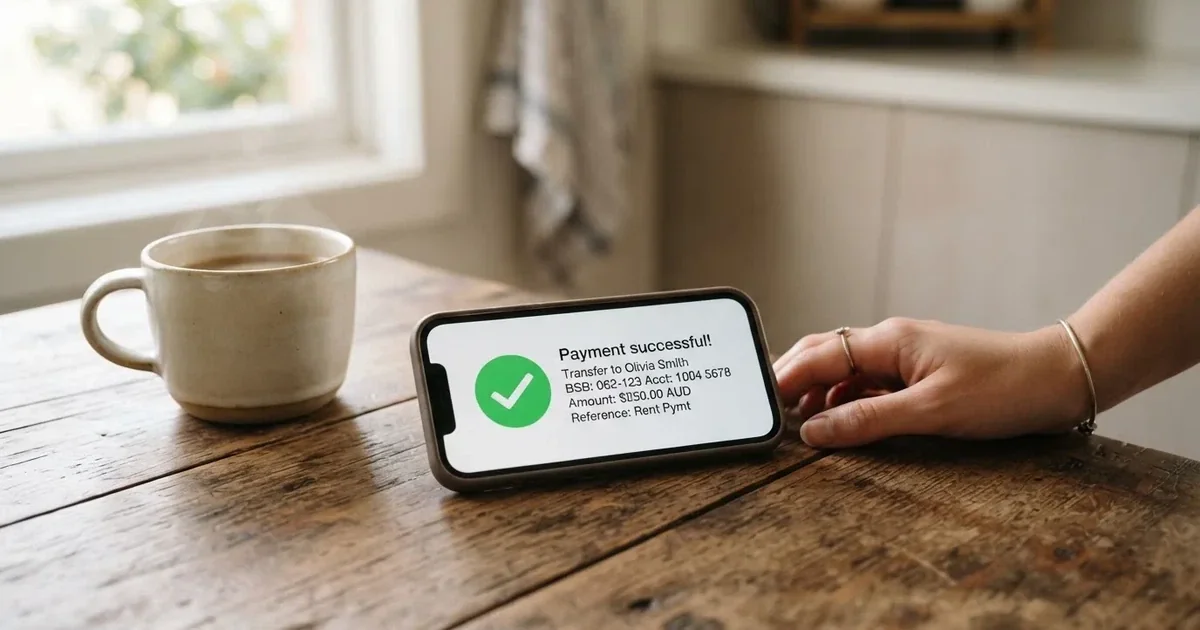
PayID links a bank account to an identifier — a mobile number, an email address, an ABN or an organisation ID. Paying to a PayID shows the name of the account holder before the transfer is sent; AP+ warns that being asked to transfer money to a PayID on an illegal gambling site almost certainly means a scam site. Osko is the settlement layer that makes those transfers arrive in under a minute, 24/7 including weekends, whether the payment is addressed by BSB and account number or by PayID. Over 100 Australian financial institutions offer PayID-based instant transfers.
BPAY
BPAY has operated in Australia since 1997, is available in the online banking of over 140 banks and financial institutions, and is offered by over 95,000 businesses. The payer enters a Biller Code and a Customer Reference Number printed on the bill; BPAY is run by Australian Payments Plus, the operator of PayID and Osko, and was launched on 18 November 1997 under Cardlink Services Limited, owned equally by ANZ, Commonwealth Bank, National Australia Bank and Westpac. In September 2021 the ACCC authorised the merger that brought BPAY, eftpos and NPP Australia together.
AUSTRAC and the Reporting Threshold
AUSTRAC’s threshold-transaction-report rule requires reporting of transfers of A$10,000 or more, but only for physical cash. Ordinary electronic bank transfers are not subject to that per-transaction reporting requirement, regardless of the amount sent. The threshold-transaction report is not a reason an Australian punter cannot transfer $5,000 to an offshore site via PayID or Osko — that is a different question, settled by the IGA and the ACMA, not by AUSTRAC.
Card Networks and the Surcharge Question
The Reserve Bank of Australia’s July 2025 review proposes removing surcharges only on eftpos, Mastercard and Visa card transactions, explicitly leaving American Express outside the scope of the proposed surcharge ban. Amex is a three-party scheme that traditionally issues cards and processes transactions itself, rather than the four-party structure of Visa and Mastercard — it was established in 1850 as a freight-forwarding company and launched its first charge card on 1 October 1958. The point relevant here is narrower: surcharging rules determine what the punter pays the merchant for using a particular card, and on the licensed half of the market the punter is unlikely to pay a surcharge on eftpos, Mastercard or Visa by the time the proposed reforms take effect.
Mobile Wallet Behaviour
By the end of 2025, Apple Pay, Google Pay and Samsung Pay transactions collectively accounted for around 45% of all card payments in Australia by number. Apple does not charge consumer fees for Apple Pay in stores, online or in apps; any surcharge comes from the merchant’s own card-processing fees. Apple also states that transaction limits and PIN requirements for Apple Pay purchases are set by the card issuer or merchant, not by Apple itself.
For an Australian punter using Apple Pay on an eligible card to deposit at a licensed wagering operator, the card-level rules apply: ANZ’s gambling block, for instance, blocks gambling transactions made through Apple Pay on the underlying card, not just the physical card. The wallet is a convenience layer; the block sits underneath.
Operators the ACMA Has Formally Warned: The Eleven Brands Behind the Marketing
The eleven operators below are not a ranking. They are not a recommendation. They are a list of brands the ACMA itself has named in formal warnings for offering prohibited interactive gambling services to Australians — which is the population a $200 no-deposit bonus search returns in practice. Online casino games cannot be licensed anywhere in Australia, whatever licence any of these sites displays.
| Brand | ACMA action and date | Operator named by the ACMA | Subject support |
|---|---|---|---|
| RocketPlay | Formal warning, March 2026; earlier May 2022 | Pulsup Ltd (Rocketplay); earlier Dama N.V. | listings-only |
| Level Up Casino | Formal warning, May 2022 | Dama N.V. | listings-only |
| Woo Casino | Formal warning, March 2025 | Dama N.V. | — |
| Spirit Casino | Formal warning, May 2025 | Dama N.V. | — |
| National Casino | Formal warning, July 2025 | Consolutetish S.R.L. | listings-only |
| Bizzo Casino | Formal warning, July 2025; earlier 2022 | Consolutetish S.R.L.; earlier TechSolutions | listings-only |
| Ignition Casino | Formal warning, July 2025 | Bamboo Media | — |
| Instant Casino | Formal warning, February 2025 | EOD Code SRL | listings-only |
| Jackbit | Formal warning, April 2026 | Ryker B.V. | — |
| Casino Intense | Formal warning, April 2025 | Sterplay Holding Ltd | listings-only |
| Sky Crown | Formal warning, September 2022 | Hollycorn N.V. | — |
The dates in the table are the ACMA’s, not the operators’. The licences these sites display in their footers are not Australian licences; no Australian licence exists for what they offer. Where the table records a brand as listings-only on payment-method coverage, that is what third-party directory listings carry for the brand, not anything the operator itself publishes as a fact about its own service. Brands left without a subject-support marker are not affirmed or denied on those subjects; the page simply does not attach them.
RocketPlay
RocketPlay was the subject of a fresh ACMA formal warning to Pulsup Ltd in March 2026, having already been warned under Dama N.V. in May 2022. The brand is one of six that fell under the Dama N.V. umbrella in 2022. A punter who clicks through a RocketPlay advertisement for a $200 no-deposit bonus is on a site the regulator has now warned twice. The “Subject support” cell on payment methods carries what third-party listings report only.
Level Up Casino
Level Up Casino was one of the six Dama N.V. brands named in the May 2022 formal warning. The brand has continued to market sign-up offers to Australian customers in the years since; the ACMA’s warning is the regulator’s, and the operator’s continued presence in the marketing funnel is the operator’s own. The verdict here is the same as for the rest of the list: the offer is real, the licence is not Australian, and the regulator has named the operator.
Woo Casino
Woo Casino was the subject of a March 2025 ACMA formal warning to Dama N.V. — Dama returning to the warning list for the third time across four years. The wagering conditions, the bonus structure and the eligible games that an affiliate page would normally carry are not on this page, because the only sources for them are affiliate marketing pages.
Spirit Casino
Spirit Casino was the subject of a May 2025 ACMA formal warning to Dama N.V. — the same operator, the same pattern. None of these brands is offering something the others are not; they are co-branded fronts around a small number of holding companies, and the ACMA warnings travel with the holding company rather than the front.
National Casino
National Casino was the subject of a July 2025 ACMA formal warning to Consolutetish S.R.L. The brand has appeared on third-party listings for payment methods including AUSTRAC-covered transfers and BetStop-relevant Australian context.
Bizzo Casino
Bizzo Casino was warned by the ACMA in July 2025 under Consolutetish S.R.L., and warned earlier in 2022 under TechSolutions (CY) Group Limited and TechSolutions Group N.V. Two warnings, two holding companies, one brand. The pattern is the brand’s own statement to the market.
Ignition Casino
Ignition Casino was the subject of a July 2025 ACMA formal warning to Bamboo Media. The brand markets to Australian customers from an offshore base; the licence it displays is not Australian and gives no Australian consumer protection.
Instant Casino
Instant Casino was the subject of a February 2025 ACMA formal warning to EOD Code SRL. The brand has appeared on third-party listings for payment methods including ecoPayz and PayID.
Jackbit
Jackbit was the subject of an April 2026 ACMA formal warning to Ryker B.V., together with CasinOK. Both brands appeared under the same operator in the same warning.
Casino Intense
Casino Intense was the subject of an April 2025 ACMA formal warning to Sterplay Holding Ltd. Third-party listings have covered the brand for payment methods including AUSTRAC-relevant transfers and BetStop-relevant Australian context.
Sky Crown
Sky Crown was the subject of an ACMA formal warning to Hollycorn N.V. as published in September 2022, alongside Blue Leo. The brand has continued to appear in marketing to Australian customers since the warning.
How to Read This Market If You Are Still Considering an Offshore Site
The reader who has read this far and is still weighing an offshore $200 no-deposit bonus is the reader for whom this final section is written. Three checks decide whether to proceed, and none of them involve the bonus number.
The first check is the licence. A Curaçao, Anjouan or Costa Rica licence is not an Australian licence and gives no Australian recourse. A punter who deposits under that licence has no complaints body, no regulator, and no guarantee of payout. If the bonus produces a withdrawable balance and the operator refuses the withdrawal, the punter’s only recourse is the small claims equivalent in the licence jurisdiction — a process that costs more than the typical $200 no-deposit bonus produces.
The second check is the bonus terms. The wagering requirement, the maximum cashout, the contribution rates, the game restrictions, the time limit and the country exclusion are the offer’s real content. A $200 no-deposit bonus with a 50x wagering requirement, a $100 cashout cap, a 24-hour expiry and an Australian-player exclusion produces no withdrawable dollar under any plausible play. The marketing will not print these numbers first.
The third check is the ACMA register. The eleven operators above are not the complete list; they are the ones this page covers. The ACMA publishes the full register on its website, and a punter considering an offshore brand has the regulator’s own page available. The brand the punter is about to sign up with either appears on the register or it does not, and either answer is information.
The honest conclusion is the one this page opened with. A $200 no-deposit bonus in Australia is an offer that only exists outside Australia. The regulator knows it, the operators know it, and the bonus terms are written to make sure the marketing figure is the part the player remembers and the conditions are the part the player reads last.
Frequently Asked Questions
Is a $200 no-deposit bonus ever offered by a licensed Australian operator?
No. Online casino games and online pokies cannot be licensed anywhere in Australia under the Interactive Gambling Act 2001, so no Australian-licensed operator is in a position to issue a $200 no-deposit casino bonus. Any offer carrying that headline comes from an offshore site operating outside Australian law, and the ACMA has been issuing formal warnings to those operators.
What wagering conditions usually hide behind a $200 no-deposit offer?
The market sits between 40x and 50x for offshore no-deposit offers aimed at Australians, asking the player to run $8,000 to $10,000 of qualifying bets before any winnings become withdrawable. Game restrictions frequently limit qualifying play to online pokies or to a small list of high-volatility slots, and time limits often force the wagering to clear in 24 to 72 hours.
Can a $200 no-deposit casino bonus actually be withdrawn as cash?
Only after the wagering requirement is fully cleared and any maximum cashout cap is respected. Many offshore no-deposit offers cap the withdrawable amount at $50, $100 or $200, and the country-exclusion clause — which frequently covers Australian residents — can be applied at withdrawal time to decline the cashout entirely.
Why does the ACMA warn about sites advertising a $200 no-deposit bonus to Australians?
Because offering online casino games or online pokies to a person in Australia is an offence under the Interactive Gambling Act 2001. The ACMA’s formal warnings name the operator and the date, and the ACMA’s blocking programme has removed 1,751 illegal gambling and affiliate marketing websites since November 2019.
Is a $200 no-deposit bonus different from a free-to-play social casino credit?
Yes. A free-to-play social casino is a game that does not involve real-money wagering, is not regulated as gambling in Australia, and pays out only in further play or in prizes that have no cash value. A $200 no-deposit bonus is a real-money offer from an offshore operator with wagering requirements, cashout caps and the risk that the regulator will block the site with a balance still on it.
Does Australian law allow any operator to market a no-deposit bonus to local players?
No. The Interactive Gambling Act 2001 prohibits providing a prohibited interactive gambling service to a person in Australia, and the Interactive Gambling Amendment (Gambling Reform) Bill 2026 — which passed Parliament on 19 August 2026 and commences its advertising and inducement measures on 1 January 2027 — further restricts the advertising hooks that bring players to offshore sites in the first place.
Published by the Casino Payments Hub team.