
Real money pokies apps for Australian players in 2026 — what sits between the marketing and the Interactive Gambling Act
A real money pokies app is, on the surface, a small piece of software: a launcher icon, a lobby of slot-style games, a deposit screen, and a way to pull winnings back out. Australians search for them because the habit of playing pokies is older than most of the people who play them — registered clubs in New South Wales have been running legal poker machines since 1956, and the country carries roughly three per cent of the world’s pub and club poker machines on a population that is about 0.3 per cent of the global total. In 2020–21, almost A$150 billion was wagered through gaming machines and A$12.18 billion was lost on them. The familiarity is genuine and the appetite is large. The legal frame around an app, however, is not the legal frame around a machine in a pub. No state or territory in Australia licenses an online casino to offer real money pokies apps. What the marketing pages call a “real money pokies app Australia” is, by definition, an offshore service. The rest of this page separates what those services say they are from what the Interactive Gambling Act 2001 (IGA) actually allows.
Current as of 31 October 2026 and checked against the ACMA’s published list of formal warnings and blocking actions.
Table of Contents
- How the offshore pokies app landscape is shaped in 2026
- Touchscreens, app stores and what “an app” actually means
- What is and isn’t licensed in Australia
- Where the actual decisions sit — payment, age, tax
- The mobile decision an Australian reader actually faces
- What “a real money casino app” actually delivers on a phone
- Side-by-side: brands the ACMA has acted against
- What the regulator has actually done — the blocking arithmetic
- The eleven brands, one by one
- What the comparison does and does not establish
- The fundamentals under the marketing
- Withdrawal routes and what they cost the player
- The numbers behind the marketing, in plain prose
- Responsible gambling, and where the help sits
- Where the legal change is heading
- Verdict on each path
- Frequently asked questions
How the offshore pokies app landscape is shaped in 2026
The pitch for a real money pokies app usually arrives in three layers: a sign-up bonus or free spins when an account is opened, a deposit method that the app will accept, and a phone-side experience that the marketing describes as smoother than a browser. Behind each layer sits a fixed set of choices about who the operator is, what licence they hold, and whether that licence reaches a person sitting in Australia.
The numbers around the offshore trade are large enough to be worth knowing. The ACMA reported in June 2026 that 1,751 illegal gambling and affiliate websites had been blocked since the first blocking request in November 2019, and that more than 230 unlicensed services had left the Australian market since enforcement was tightened in 2017. H2 Gambling Capital’s 2025 estimate puts Australian losses to illegal sites at roughly A$3.9 billion a year, with the share of gambling going through legal channels falling from 74 per cent in 2021 to 64 per cent. Those figures do not say Australians are queuing up to download a particular app. They say the offshore trade is real, the spending on it is large, and the regulators are pushing back with measurable effect.
The offline counterpart sits in licensed venues. New South Wales had 87,298 gaming machines outside casinos across 2,195 venues in June 2023, with player losses of A$8.18 billion in 2022–23. Queensland reported 21,122 gaming machines in 351 venues in October 2023; Victoria ran 26,380 outside Crown Casino in 488 venues in 2021–22 under a 30,000-machine statewide cap. Each state regulates its own design and operation — Western Australia has banned poker machines in pubs and clubs since 1985, when Crown Perth opened with about 200 machines, and that casino’s machine count has grown to roughly 2,500 under the state’s Gaming and Wagering Commission. Tasmania ran a single-operator monopoly from 1968 until legislation in November 2021 moved oversight to the Tasmanian Liquor and Gaming Commission; the planned mandatory pre-commitment cards were pushed back to late 2025. None of those machines are an app. The contrast matters because the offshore marketing borrows the cultural weight of the pub pokie to make an unlicensed product feel familiar.
Touchscreens, app stores and what “an app” actually means
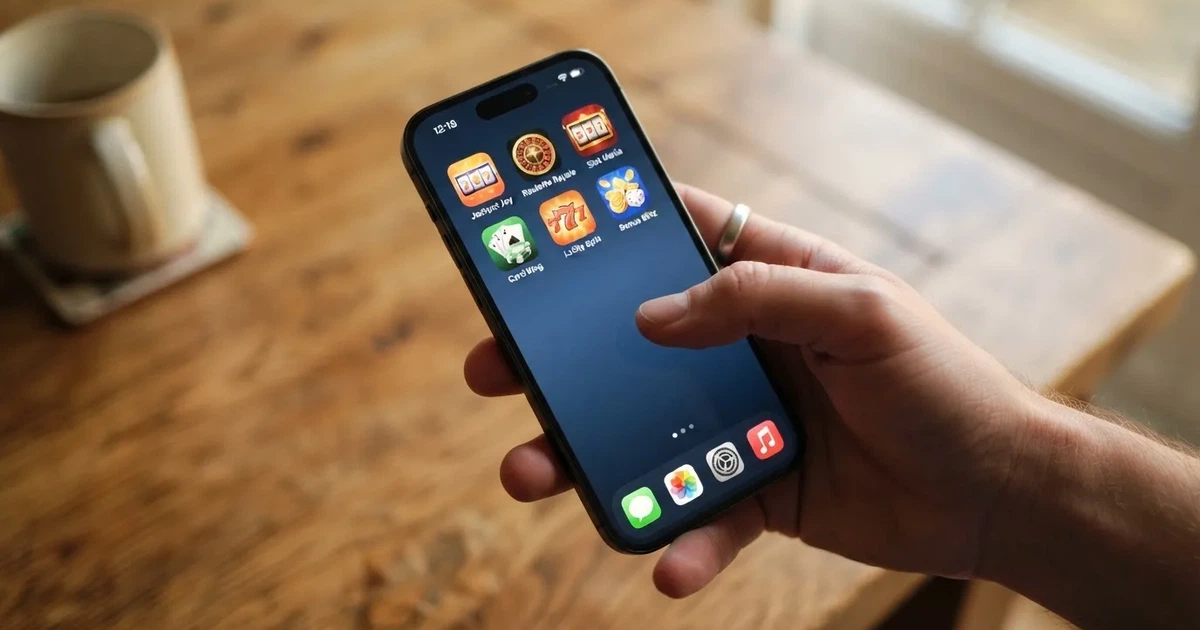
A real money pokies app, in the marketing sense, is a downloadable binary — an APK on Android, an IPA-style distribution on iOS — that talks to a remote service and shows a reel-based game. The Australian reality is narrower. Apple’s App Store and Google Play both prohibit real-money gambling apps that target Australian users in the categories where offshore casino apps sit, so the apps that take Australian deposits tend to be installed from a website rather than from a store, or live as a mobile browser site styled to feel like an app. The marketing often talks about “native apps” for both Android and iPhone; the legal shape of those apps is one of two things: an offshore brand that does not hold an Australian licence, or an offshore brand that does not hold an Australian licence and is also listed by the ACMA.
blocking orders: 7Signs, ChromaBet, Donbet, Duospin, Freshbet, Slots Gem, Jacks Club, Lucky Start, Pointsbetz, Spinrise, Vinyl Casino and Wildsino. A name on that list means the regulator has asked Australian internet service providers to make the site unreachable from a typical Australian connection. A balance held by a player at the moment of blocking is an offshore balance: outside any Australian complaints process.
The mental model is worth holding. A poker machine in a NSW club is a regulated device, with a minimum return-to-player set by state law and a venue that the regulator knows about. A real money pokies app aimed at Australians is a remote service, with a return-to-player the operator chooses to publish, a venue the player cannot visit, and a regulator that has told the service to stop. The two are not the same product because they share a name.
What is and isn’t licensed in Australia
The Interactive Gambling Act 2001, tightened by the Interactive Gambling Amendment Act 2017, makes it an offence to provide online casino games, online pokies or in-play betting to a person physically in Australia. No state or territory licenses an online casino to offer these products. The things that are licensable are wagering on races and sport placed before the event, lotteries and keno — in practice most of the corporate bookmaker licences (Sportsbet, Bet365, Ladbrokes among them) are held in the Northern Territory for tax reasons and regulated by the Northern Territory Racing and Wagering Commission (NTRWC), a body that runs with no full-time staff and meets once a month in Darwin.
The IGA targets the provider, not the individual player. Australians are not prosecuted for downloading or playing on an offshore app. They do, however, give up every consumer protection an Australian licence provides. There is no Australian complaints body for an offshore service, no Australian recourse if a withdrawal is refused, and no guarantee that a balance survives an ACMA blocking action. BetStop, the National Self-Exclusion Register live since August 2023, binds Australian-licensed online and phone wagering services — an offshore casino is not connected to it. The National Gambling Helpline is 1800 858 858, free and 24/7, with chat through Gambling Help Online. Those are the safety nets that apply; the offshore app is not part of them.
The advertising frame tightened in 2026. The Interactive Gambling Amendment (Gambling Reform) Bill 2026 passed Parliament on 19 August 2026; its advertising and inducement measures commence on 1 January 2027. The bill is law with a start date — not yet in force on a page read in 2026, but the direction of travel is unambiguous.
Where the actual decisions sit — payment, age, tax
Age is the first line. The minimum age for any licensed Australian wagering service is 18; an offshore app that lets a minor past its deposit screen has done so without checking an Australian identity. The offshore app’s KYC is whatever the operator chooses, against whatever document the operator’s home regulator accepts. That is not the same as an Australian check.
Payments narrow the gap further. Since 11 June 2024, credit cards, credit-related products and digital currency have been banned as payment for licensed online wagering in Australia, with penalties up to A$247,500 for operators. The legal deposit routes for licensed wagering are debit card, bank transfer, PayID and Osko, and BPAY. A real money pokies app that asks an Australian for a credit card or a crypto deposit is operating outside the Australian rules; the IGA sits underneath the payment ban, and the payment ban sits underneath the licence question.
| Payment Method | Status for Licensed Wagering |
|---|---|
| Debit card | Legal |
| Bank transfer | Legal |
| PayID/Osko | Legal |
| BPAY | Legal |
| Credit cards | Banned (since 11 June 2024) |
| Digital currency | Banned (since 11 June 2024) |
Tax sits one layer further back. Gambling winnings of a recreational player are not assessable income under section 6-5 of the ITAA 1997 and losses are not deductible, unless the person carries on a business of gambling. The ATO’s own pages make the same point in plainer English. The tax treatment does not pull an offshore win into the Australian system — it also does not give an offshore loss a place to go at tax time.
The mobile decision an Australian reader actually faces
The frame on this page is choice — which paths exist and which reader each one suits. Three paths are real in 2026.
The first is a licensed Australian wagering account held by a corporate bookmaker licensed in the Northern Territory. The product set is sports and racing, with in-play betting prohibited. The minimum age is 18, the payment routes are debit card, bank transfer, PayID/Osko and BPAY, and the account sits inside BetStop. This is the only path where the consumer protection is Australian. It is also the only path that does not contain a real money pokies app at all.
The second is the licensed pub or club machine. The legal minimum return-to-player varies by jurisdiction — 85 per cent in NSW, the NT, Queensland and (generally) Victoria, 87 per cent at Crown Melbourne, 87 per cent in the ACT and Tasmania, 87.5 per cent in South Australia and 90 per cent in Western Australia. Each venue is regulated by its state or territory. The product is the same product a generation of Australians have grown up with, and it is licensed.
The third is the offshore real money pokies app. The product is real money slots with a deposit screen, often a sign-up bonus or free spins, and a withdrawal method. The licence is whatever the operator’s home regulator issued, in whatever country that regulator sits. The consumer protection is the operator’s word. The Australian regulator has, in many cases, already published a formal warning over the operator or its parent.
A reader who wants pokies on a phone and is willing to look at a regulated alternative has the licensed wagering account for racing and sport, and the licensed venue for the actual reel product. A reader who wants reel-style games on a phone at home in Australia and has decided the offshore path is the one they want should know what the ACMA has already said about the names on the comparison list. The next sections set that out.
What “a real money casino app” actually delivers on a phone
The mechanics of an offshore app on an Australian phone are not exotic. The launcher icon opens a lobby of reel-style games; each game shows a stake-per-spin selector, a paytable, and an autoplay control. Deposits go through whatever rails the operator has chosen — debit cards and a small set of e-wallets are common, and crypto is common enough that the operator often advertises it as a feature rather than a back-channel. Withdrawals are the slowest part of the cycle, both because the operator runs the request through a manual review and because the payment rail it lands on is not always the same rail that put the money in.
The “free spins” and “no deposit” hooks are the most consistent part of the pitch. A real money casino app free spins offer means a small bundle of spins on a named slot title, credited on sign-up or after a first deposit, with a wagering requirement and a maximum cashout that the operator sets. A real money casino app no deposit offer means the same hook without the deposit, usually smaller and almost always carrying the same kind of conditions. Neither hook changes the IGA. A free-spin credit on an app the ACMA has told ISPs to block is still an illegal service.
The marketing language of “best real money pokies app australia” is doing a lot of work in that sentence. There is no Australian comparison set, because there is no Australian licensed set to compare. Any “best” list of offshore apps is a list of unlicensed services. The list below is not a best list. It is the set of names the ACMA itself has published formal warnings over, with the dates and operators as the regulator recorded them.
Side-by-side: brands the ACMA has acted against
The table below pairs each brand with the ACMA action recorded against it, the operator named in that action, and the status of any independent listing the research turned up. It is not a recommendation and it is not a ranking. It is the regulator’s own record.
| Brand | ACMA action and date | Operator named by the ACMA | Subject support |
|---|---|---|---|
| RocketPlay | Formal warning, March 2026 (also May 2022 under prior owner) | Pulsup Ltd (2026); Dama N.V. (2022) | — |
| Level Up Casino | Formal warning, May 2022 | Dama N.V. | listings reported by Bgaming |
| Woo Casino | Formal warning, March 2025 | Dama N.V. | — |
| Spirit Casino | Formal warning, May 2025 | Dama N.V. | — |
| National Casino | Formal warning, July 2025 | Consolutetish S.R.L. | listings reported by Wikipedia |
| Bizzo Casino | Formal warning, July 2025 (also 2022 under prior owner) | Consolutetish S.R.L. (2025); TechSolutions (CY) Group Limited and TechSolutions Group N.V. (2022) | — |
| Ignition Casino | Formal warning, July 2025 | Bamboo Media | — |
| Instant Casino | Formal warning, February 2025 | EOD Code SRL | — |
| Jackbit | Formal warning, April 2026 | Ryker B.V. | — |
| Casino Intense | Formal warning, April 2025 | Sterplay Holding Ltd | listings reported by ABC, ACMA and Crown Melbourne sources |
| Sky Crown | Formal warning, September 2022 | Hollycorn N.V. | — |
Each row sits on the same legal ground: the ACMA published a formal warning under the Interactive Gambling Act 2001, the operator named is the entity the regulator recorded at the time, and the underlying prohibition on providing real money online casino games to a person in Australia does not depend on which company name sits behind the brand in any given year.
A reader looking at the table should read the operator name as the more stable signal. Dama N.V. appears against four of the eleven entries, on dates spread across 2022 and 2025; the brand above the operator has changed underneath the warning. The fact that the ACMA has named the same operator twice in a row is information about the operator, not about the brand on the front of the site.
What the regulator has actually done — the blocking arithmetic
The arithmetic on this page is the rate at which the ACMA’s blocking actions have built up since the first request in November 2019. With 1,751 illegal gambling and affiliate websites blocked since that date and a first blocking action in November 2019, the running average across the years of the regime lands at several hundred blocking actions a year, accelerating as the rounds have grown longer. That is the picture the regulator itself has reported.
A second-order figure sits beside it. The ACMA’s June 2026 round alone added twelve blocking orders: 7Signs, ChromaBet, Donbet, Duospin, Freshbet, Slots Gem, Jacks Club, Lucky Start, Pointsbetz, Spinrise, Vinyl Casino and Wildsino. A single round of twelve is larger than the early rounds of the regime. Read as a band rather than a single number — the recent pace runs at several hundred blocking actions a year, with single rounds now in double digits — that is the level an Australian reader should expect the regime to operate at in 2026.
| Blocking Round | Twelve Sites Named |
|---|---|
| June 2026 | 7Signs, ChromaBet, Donbet, Duospin, Freshbet, Slots Gem, Jacks Club, Lucky Start, Pointsbetz, Spinrise, Vinyl Casino, Wildsino |
The arithmetic sits next to a number that does not change: an Australian consumer blocked from a site by an ISP order has no Australian complaints body to take a refused withdrawal to, and the offshore operator is under no obligation to return a balance. The blocking pace and the protection gap run in the same direction.
The eleven brands, one by one
RocketPlay
The ACMA issued a formal warning to Pulsup Ltd over Rocketplay in March 2026. The same brand had been the subject of an earlier warning to Dama N.V. in May 2022, when six casino brands under that operator were named together: Bambet, Dazard, Level Up, Rocketplay, Wild Tornado and Cobra Casinos. The brand has changed hands at least once, and the regulator has named both operators. The 2026 action is the one currently published. Independent listings do not place this brand in any Australian-facing directory the research consulted.
A reader who arrives at RocketPlay through a search result is looking at an offshore service that has been warned twice under the IGA, by name, in four years. The recurring warning pattern is itself the answer.
Level Up Casino
Dama N.V. was the named operator in the May 2022 warning that covered Level Up alongside five other brands. The brand has been carried by Bgaming in independent listings; whether Bgaming is itself a listing source an Australian reader should weight is a different question — bgaming is a game provider whose own brand pages reference operators that carry its titles. Level Up sits inside a wider Dama N.V. set the regulator named in a single action.
A reader who recognises the Dama N.V. cluster as one operator has a clearer picture than a reader who reads the brand as an independent casino. The 2022 warning named the operator, not the brand.
Woo Casino
The ACMA issued a further formal warning to Dama N.V. over Woo Casino in March 2025, on top of the May 2022 warning that covered other brands under the same operator. Woo sits in the same operator-level pattern as Level Up, with the additional point that the regulator has returned to the same operator twice within the IGA’s enforcement window. Independent listings do not give this brand an Australian-facing reference the research consulted.
A reader who treats the Dama N.V. warnings as a single story is reading the regulator’s record more accurately than a reader who treats each brand warning as independent.
Spirit Casino
Dama N.V. received a formal warning over Spirit Casino in May 2025. Spirit sits inside the same Dama N.V. cluster, with the regulator naming the operator across multiple brands and across more than one calendar year. Independent listings do not give Spirit an Australian-facing reference the research consulted.
The conclusion a reader should draw from the cluster is the one the regulator drew: one operator, multiple brand fronts, repeated warnings.
National Casino
The ACMA issued a formal warning to Consolutetish S.R.L. over National Casino in July 2025, in the same round that covered Bizzo Casino under the same operator. National carries listings in independent references including Wikipedia. The listing presence does not change the IGA status, and the regulator’s July 2025 warning is published against the operator named in that warning.
A reader who weighs a Wikipedia listing against an ACMA formal warning should know which of the two is binding. The IGA is.
Bizzo Casino
The ACMA issued a formal warning to Consolutetish S.R.L. over Bizzo Casino in July 2025. Bizzo had already been the subject of a 2022 formal warning to TechSolutions (CY) Group Limited and TechSolutions Group N.V. Two operators, two warnings, one brand. Independent listings do not give Bizzo an Australian-facing reference the research consulted.
A reader looking at this row should see two separate regulator actions over the same brand, separated by enough years to make the second action a deliberate choice rather than an oversight.
Ignition Casino
The ACMA issued a formal warning to Bamboo Media over Ignition Casino in July 2025. The warning sits in the same round as the National Casino and Bizzo Casino warnings. Independent listings do not give Ignition an Australian-facing reference the research consulted.
The name of the operator — Bamboo Media — is the more durable signal than the brand on the front of the site.
Instant Casino
The ACMA issued a formal warning to EOD Code SRL over Instant Casino in February 2025. The brand carries a deposit-flow pitch typical of offshore real money casino apps. The 2025 warning sits alone in the record for this brand, which is not the same as saying the brand is otherwise unregulated; the IGA prohibition sits independently of any single warning.
A reader who wants to know whether the ACMA has named the operator can look at the February 2025 warning and see EOD Code SRL on it. The warning is one piece of evidence; the prohibition is the other.
Jackbit
The ACMA issued a formal warning to Ryker B.V. over Jackbit in April 2026, alongside a formal warning to the same operator over CasinOK in the same month. Two brands, one operator, one month. Independent listings do not give Jackbit an Australian-facing reference the research consulted.
The Ryker B.V. pattern is the same as the Dama N.V. pattern at a different operator name: a parent company that the regulator has named across multiple brand fronts in a short window.
Casino Intense
The ACMA issued a formal warning to Sterplay Holding Ltd over Casino Intense in April 2025. Casino Intense carries independent listings in references including the ABC, the ACMA’s own pages and Crown Melbourne’s site. The listing presence does not change the IGA status.
A reader who finds Casino Intense cited in three Australian-facing references should still weigh the ACMA’s April 2025 warning as the regulator’s own record. The references are background; the warning is current.
Sky Crown
The ACMA issued a formal warning to Hollycorn N.V. over Sky Crown and Blue Leo casino services, as published by the regulator in September 2022. The PDF the regulator published names both brands in the same action. Independent listings do not give Sky Crown an Australian-facing reference the research consulted.
The Hollycorn N.V. warning is older than most of the table — September 2022 — and a reader should not infer from the date that the brand is no longer active. The warning is on the regulator’s record until the regulator updates it.
What the comparison does and does not establish
The table and the per-brand entries are not a ranking. The ACMA’s record does not rank brands against each other; it lists formal warnings with dates and operators. A reader who treats the table as a quality comparison is reading more into the regulator’s actions than the regulator published.
What the record does establish is the operator pattern. Dama N.V. appears across four of the eleven entries. Hollycorn N.V., Bamboo Media, Consolutetish S.R.L. and Ryker B.V. each appear more than once across the wider set of ACMA actions the research turned up. A small number of operators are warning a much larger number of brands. The brand on the front of the site is a less reliable signal than the operator name on the regulator’s record.
What the record does not establish is that the eleven brands are the whole offshore trade. The ACMA’s blocking actions are a moving target — the June 2026 round alone added twelve new names — and the brands that have not yet been warned are not, by their absence, safe to use. The set of names on the regulator’s record is a lower bound, not a complete list.
The fundamentals under the marketing
Three figures recur across the marketing of offshore pokies apps, and each one collapses once it is read against the figures the regulator and the wider industry publish.

The first is the sign-up bonus. The free spins hook is the entry point. The wagering requirement, the maximum cashout and the eligible games are not part of the headline, and they are the part that determines whether the bonus has any cash value at all. A reader who treats the headline figure as the offer is reading the marketing, not the terms.
The second is the no-deposit offer. A real money casino app no deposit offer is a real money offer only in the sense that any winning from the spins is paid in cash, not in bonus credit, after the conditions are met. Until the conditions are met, the credit is on the operator’s terms. The same prohibition under the IGA applies regardless of whether the offer carries a deposit gate.
The third is the return-to-player number. The licensed machines in Australia carry a legal minimum that varies by jurisdiction — 85 per cent in NSW, the NT, Queensland and (generally) Victoria, 87 per cent at Crown Melbourne, 87 per cent in the ACT and Tasmania, 87.5 per cent in South Australia and 90 per cent in Western Australia. An offshore app publishes whatever number the operator’s regulator in its home jurisdiction requires, which is rarely the Australian floor. The licensed Australian machine has the higher floor, by design.
Withdrawal routes and what they cost the player
The withdrawal side of an offshore pokies app is the slowest and least predictable part of the cycle. Most operators route withdrawals back through the same rail that took the deposit, with a manual review window in the middle. A player who deposits by debit card and asks for a withdrawal by bank transfer is asking the operator to use a different rail — most operators refuse or hold the request. The speed claims on the marketing pages tend to apply to the operator’s processing window only, not to the time the player’s bank takes to clear the funds.
The Australian payment rules sit underneath any of this. Debit card, bank transfer, PayID and Osko, and BPAY are the legal deposit routes for licensed wagering. Credit cards, credit-related products and digital currency are banned as payment for licensed wagering since 11 June 2024, with penalties up to A$247,500 for operators. An offshore app that offers crypto deposits is operating outside the Australian rules; an offshore app that accepts credit card deposits is operating outside the Australian rules; an offshore app that withdraws to a credit card or a crypto wallet is operating outside the Australian rules. The Australian rules apply to Australian-licensed services. They do not bind the offshore operator directly. They do describe the shape of a payment arrangement that an Australian would have to make on an offshore service to be inside the Australian frame — and that shape excludes credit and crypto.
A reader who wants to deposit by crypto has decided to step outside the Australian frame, by definition. A reader who wants to withdraw by crypto has decided the same. The marketing often presents crypto as a feature rather than as a marker; the frame is the opposite.
The numbers behind the marketing, in plain prose
Three statistics describe the size of the Australian pokies trade, and each one is worth holding alongside the offshore pitch.
Australians bet almost A$150 billion through gaming machines in 2020–21 and lost A$12.18 billion on them. The country carries about 3 per cent of the world’s pub and club poker machines on a population that is 0.3 per cent of the global total. NSW alone ran 87,298 machines outside casinos in 2,195 venues in June 2023, with player losses of A$8.18 billion in 2022–23. Queensland reported 21,122 machines in 351 venues in October 2023; Victoria ran 26,380 outside Crown Casino in 488 venues in 2021–22.
The offshore trade is a smaller number inside a larger one. H2 Gambling Capital’s 2025 estimate is about A$3.9 billion a year in Australian losses to illegal sites, and the share of gambling going through legal channels fell from 74 per cent in 2021 to 64 per cent. The legal channels have lost ground; the illegal channels have picked up roughly ten percentage points of the spend across four years. That is the trend the ACMA’s blocking actions are trying to reverse.
The ACMA has reported 1,751 illegal gambling and affiliate websites blocked since the first blocking request in November 2019, and more than 230 unlicensed services have left the Australian market since enforcement was tightened in 2017. The blocking arithmetic, treated as a band rather than a single figure, runs at several hundred blocking actions a year in the recent pace of the regime, with single rounds now in double digits. The pace has accelerated.
Responsible gambling, and where the help sits
The Australian safety net sits across three numbers and one registry.
The National Gambling Helpline is 1800 858 858, free and 24/7, with chat through Gambling Help Online. The helpline is the front line for a player who has decided the offshore path is costing more than it returns, and the line that an Australian-facing page should carry on it regardless of which other content sits beside it.
BetStop, the National Self-Exclusion Register, has been live since August 2023. It binds Australian-licensed online and phone wagering services. An offshore casino is not connected to it. A self-excluded player who opens an account on an offshore app is not in the BetStop frame; the operator’s own self-exclusion control, if it has one, is the only one that applies.
The minimum age for any Australian licensed wagering service is 18. An offshore app’s age check is whatever the operator chooses. There is no Australian backstop on the offshore check.
The IGA targets the provider, not the player. Australians are not prosecuted for playing on an offshore app. The IGA’s effect on a player is indirect: no Australian consumer protection, no Australian complaints body, no BetStop binding, and no guarantee that a balance survives a blocking action.
Where the legal change is heading
The Interactive Gambling Amendment (Gambling Reform) Bill 2026 passed Parliament on 19 August 2026, and its advertising and inducement measures commence on 1 January 2027. The bill is law with a start date, not law in force. On a page read in 2026, the inducement rules sit as the future shape of the market rather than as the present rule.
The bill does not amend the underlying prohibition on providing online casino games to a person in Australia. That sits in the IGA itself and remains unchanged. The reform sits on the advertising and inducement layer above the prohibition, with a commencement date that gives operators, affiliates and marketing intermediaries a window to adjust.
A reader who is weighing a real money pokies app in 2026 is reading the page under the existing prohibition. The 2027 commencement is information about the advertising environment a player will face, not a change to whether the service itself is licensable in Australia.
Verdict on each path
The licensed Australian wagering account is the only path where the consumer protection is Australian. The product set is sports and racing with in-play betting prohibited; the payment routes are debit card, bank transfer, PayID/Osko and BPAY; the age check is 18; the account sits inside BetStop. This path is the answer for a reader who wants a phone-side experience inside the Australian frame and is willing to look at sports and racing rather than at reel-style games.
The licensed pub or club machine is the answer for a reader who wants the actual reel product under a regulated roof. The minimum return-to-player varies by jurisdiction; each venue is regulated by its state or territory; the age check is 18. This path is the answer for a reader who wants the same product a generation of Australians have played, with the consumer protection that comes with a venue the regulator can inspect.
The offshore real money pokies app is the path the marketing pushes hardest. The product is a real money slots lobby on a phone; the licence is whatever the operator’s home regulator issued; the consumer protection is the operator’s word; the ACMA has, in many cases, published a formal warning over the operator or its parent. This path is the answer for a reader who has decided the offshore trade is the trade they want to make, with the knowledge that the regulator has already told several operators in the same position to stop.
A reader who arrives at this page through a search for a real money pokies app Australia is reading it because the marketing told them the path exists. The marketing is accurate about the path. It is silent on what sits underneath.
Frequently asked questions
What is the difference between a “best real money pokies app” and an ordinary free pokies app?
A “best real money pokies app” list is a comparison of offshore services that take real money deposits and pay real money winnings, none of which is licensed in Australia. A free pokies app is a social or demo product that takes no real money deposit and pays no real money winnings. The first is on the wrong side of the IGA; the second is a phone game. The marketing borrows the word “best” from product reviews to dress a comparison of unlicensed services in the language of consumer guidance.
Does a real money pokies app with no deposit required still count as real money play?
Yes. A no-deposit offer is still a real money offer if the winning is paid in cash rather than in bonus credit. The IGA does not depend on whether the player deposited first. The hook on a no-deposit offer is usually smaller and the conditions tighter, and the offer is still an offshore service under the IGA.
Is downloading a real money pokies app something an Australian resident can lawfully do?
The IGA targets the provider of an illegal interactive gambling service, not the individual player. Australians are not prosecuted for downloading or playing on an offshore app. They give up Australian consumer protection, sit outside BetStop, and have no Australian complaints body if a withdrawal is refused. The download is not the offence; the offshore service is what the regulator moves against.
Why do some real money pokies apps only work on Android and not iPhone, or vice versa?
Apple’s App Store and Google Play both prohibit real-money gambling apps targeting Australian users in the categories where offshore casino apps sit. Apps that take Australian deposits are usually installed from the operator’s website rather than from a store, or live as a mobile browser site styled to feel like an app. The “Android-only” or “iPhone-only” pitch is usually a distribution decision by the operator rather than a technical limit of the device.
What withdrawal method do real money pokies apps typically support once a player wants to cash out?
Most operators route withdrawals back through the same rail that took the deposit, after a manual review window. The Australian payment rules — debit card, bank transfer, PayID and Osko, BPAY for licensed wagering; no credit cards, no credit-related products, no digital currency since 11 June 2024 — apply to Australian-licensed services and do not bind the offshore operator. A withdrawal to a credit card or a crypto wallet is a marker that the service is outside the Australian frame.
How does app-based pokies play differ from playing the same title through a mobile browser?
A downloadable app is a launcher that talks to the same remote service the mobile browser would reach. The game library, the deposit screen, the wagering requirements and the withdrawal route are the same in both cases. The difference is in distribution: an app is installed from the operator’s website rather than from a store, and is styled to feel native on the phone. The legal status under the IGA is the same in both cases. The marketing often presents the app as a separate, smoother product; the regulator’s record treats it as the same service.